Showing posts with label literature. Show all posts

Wednesday, 19 July 2023

Rosshalde, by Hermann Hesse. A second reading.

Carrying on my renewed exploration of the novels of Hermann Hesse, I came to Rosshalde, which I remember made a great impression on me at the first time of asking a few years back.

The story examines the situation of an artist, Johann Veraguth, who lives on quite an opulent estate. His wife also lives on the estate, but they live in separate houses. The marriage has become deeply unhappy, The couple's youngest son, Pierre, is really all that now connects them. The boy lives mostly with his mother, whilst the eldest son is mostly away at school.

It seems that his desire to spend time with Pierre is the only thing which leads Johann to keep up the "pretence", and remain at Rosshalde. A visit from a friend, Otto, a man with an outgoing and inquisitive approach to life, sets in motion a series of fundamental contemplations and decisions on Johann's part, and then tragedy intervenes.

As I hinted at in my opening paragraph, Rosshalde made quite an impact on me when I first read it. The novel exudes a charm, a poignancy and a poetic sensibility which set it apart, even from most of Hesse's work. These qualities may to some extent stem from the fact that the story is, it seems, partly auto-biographical in nature.

The opening chapter sets the scene and the tone effortlessly and beautifully, outlining the ambience of the setting and its natural environs, the dynamics and the intricacies of the human relationships which play out there and which are the centrepieces of the story. We are also introduced to the habits and the demeanour of Johann.

These initial constructions go a long way to ensuring the effect and the atmosphere of the Rosshalde story, in its gently endearing but wistful evocations.

The visit paid to Rosshalde by Otto, and its influence on Johann's thinking, are central to the tale, and provoked much thought on my own part. Associating with vibrant, joyous people often brings us to realise what we are missing out on. It is also arguable that these encounters which wrench us away from an insular, secluded existence have a kind of randomness and transience to them. It is so easy to miss that particular train, in that it does not operate to a set timetable.

Johann's experiences also remind us that many individuals who appear, at first glance, to be living an enviable and stimulating life in fact feel unfulfilled. We are not all content with material comfort and professional "success".

Sometimes our pride makes it difficult for us to admit that something is absent. We pretend, or delude ourselves, that we are contented and happy. The point is made in this novel that contentment is perhaps an indicator of a lack of hope. We see some things merely as a means of blocking out distress, misery or sorrow, rather than as a path to positive self-realisation.

The passages which detail Otto's visit to Rosshalde are highly affecting and exquisitely composed, It is advisable for the reader to devote some time to carefully digesting the vagaries of the exchanges between Johann and his friend.

I find this novel important because it addresses, in a quiet and unspectacular way, so many aspects of the human experience which weigh so heavily. Love, compromise, doing things for the wrong reasons, enduring because the alternative is worse. Not being bitter about the past, but embracing the present and the moment. One door closes, another one opens. Also, sometimes Nature intervenes and engineers the change for us.

A striking note for me was the tragedy of human antipathy, miscommunication and misunderstanding, and the acknowledgement, however frustrating, that this is cold reality. There is little point in feeling angry about these things, for that would mostly be a waste of energy. We must learn how to cope, and also to be kind and reasonable in how we navigate the storms. Some horrors, such as loneliness and disillusionment, can be borne provided that there is hope.

The idea of the artist (in this case Johann) "burying himself in his work" - is this comparable to people burying themselves in their work to block out or forget personal woes? - is another theme touched on.  Does such an approach simply serve as a holding operation, rather than constituting an escape or a solution to the individual's predicament? What is perhaps needed is lasting relief, and not a constant urge to drown the anxieties. Not everyone is fortunate enough to receive the stimulus or the resolution.

The great irony of the story is that the event which finally "liberates" Johann is the demise of that which he had hitherto clung to as a beacon.  I am sure many people can identify with this element of the story, and the temptation to attach "irrational" interpretations to such events.

Rosshalde I found hugely enjoyable and stimulating, but I was also left with some quite stark feelings. On the one hand a certain admiration and satisfaction for a person who has, quite late in the day, achieved clarity and sureness of course. On the other, a certain cold wonder concerning the tragedies and follies of people. Even someone who nowadays is much more resigned to the inevitability and inescapability of those latter phenomena cannot fail to be jolted by their shadows and icy pervasiveness. The certainty that these things are facts of life does little to diminish their impressiveness.


Friday, 14 July 2023

Great Expectations - Charles Dickens

I am not exactly sure where the spur emanated from, but I was recently seized with the intention to return to the works of Charles Dickens, after a break of many years. It may be because some of his books resemble in their format and their "method", the work of Hermann Hesse, perhaps my favourite novelist.

I remember having a copy of Great Expectations during childhood. It became mislaid, or was given away, or else became a casualty of my unaccountable teenaged and early adult drift away from literature, or more specifically the novel. I may have been too busy with "abstract" and theoretical academic studies to be bothered with the humanistic and interpretative demands of classic fiction, much to my detriment. 

Looking back wistfully, I am tempted to speculate that Dickens may have constituted a better education, in a meaningful sense. Having said all this, I doubt that even as a teenager I would have been able to effectively absorb and assimilate all of the material and meaning which proliferate in Dicken's more substantial works.

To summarize, and without giving too much away, the novel tells the story of the development and growth of the 'Pip' character, and is 'narrated' by Pip in the first-person. The latter helps to endow the story with a distinct and curious flavour.

Some of the language and terminology employed may baffle present-day audiences, but to me this is but a small obstacle, and in fact it imbues the novel with a period feel and a strengthened feeling of realism. 

It might appear at first, in a superficial sense, that the story's structure relies too much on a number of coincidences. However, when one subjects affairs to a greater scrutiny it all becomes plausible and more clear; it could be a small world, even in 19th century England. One common factor links much of it together.

This is one of those novels which gathers momentum gradually but surely, as it draws the reader inexorably in. The motives, traits and eccentricities of the various characters help to drive and solidify these processes. Eventually I found myself rooting for the "good guys", once it became clearer who the good guys were.

I would contend that circumspection and leisure are handy things to observe when tackling Great Expectations. They are necessary in order to achieve and maintain a grasp of the plot, to "join the dots" as it were, and keep track of the various participants and their numerous connections.

The social commentary and satire is not quite as overt and as near to the surface as I had expected. but Dickens' concerns and his reformist ideas are still discernible, woven into the narrative and certain of the characterisations - some stand out more than others in the latter respect. Occasionally Pip does make a cutting comment in his account, invariably veiled in sarcasm or humour.

One of the foremost themes which for me stood out was a notion of the goodness, the authenticity and the transparency of ordinary people. This could have emerged in a romantic or "idealized" manner, but it does not, instead being brought out in a subtle way, as something to be picked up and acknowledged by the reader. The first-person narration helps to further this impression, serving to "soften" the impact of any message which the author may or not have been seeking to project, even allowing for the temptation to put words into Pip's mouth.

Let us just say that if the social climate and the economic picture portrayed here were anything like accurate, we can scarcely wonder that Dickens and his contemporaries craved reform and change. The picture of brutalized sections of society is a stark one, and worth more than a moment's contemplation. The dangers of such a scenario, now as then, remain something which we should all bear in mind and seek to guard against.

To me, it seemed that some of the key individual events or incidents in the novel did not have the conventional sense of "drama" or "moment" which I had been conditioned to expect. Some things appeared to just "happen", explained in poetic, even cryptic terms, and the story then moved on, with full explanation sometimes only occurring via the insight of the reader.  When I reflect upon this, it is less a criticism of this particular work, and more a sign of the types of literature which I have habitually frequented. The first-person narration is also a salient point in all this. What the occurrences lost in initial, literal clarity they gained in lyrical and artistic effect.

The mental imagery evoked by the words of Dickens, as spoken through Pip, is very strong, or at least it was strong and affecting in my case. The major locations and settings soon assume a real identity and consistency, and these may prove to be instrumental in attaining an enhanced enjoyment of the tale, and arriving at a deeper appraisal of the characters and the issues explored.

A reason for this novel's significance and enduring appeal is that some of the themes which it examines are universal and not governed by time. One which was highlighted for me was this concept of trying to "compensate" for the effects of our injudicious or errant deeds, even if those deeds might have been committed under duress or through naivete. If we cannot reverse or directly counter-act our mistakes, we can at least learn from our mistakes and experiences, and seek to be a force for good, for humane treatment of others, and for justice. These elements had a distinct resonance for this reader, partly with reference to today's social ills and pressures.

Charles Dickens has sometimes been associated, in my mind at least, with social commentary and the grim industrial and urban landscapes of 19th century London and England. Having returned to Great Expectations, I am happy to revise and retract those outdated and erroneous perspectives. In this novel Dickens shows himself to be a highly capable and resourceful story-teller, with the capability of weaving endearing and captivating narratives. Maybe I will read David Copperfield next - to the best recollection that one eluded me entirely in my younger days....


Saturday, 17 June 2023

Peter Camenzind, by Hermann Hesse - a second reading

 As I continue my second major odyssey through the writings of Hermann Hesse, I turn to his first novel, Peter Camenzind, published in 1904.

It follows the story of the titular character, a young man from the countryside, who goes away to college and subsequently embarks on various travels, friendships and cultural ventures. The novel concludes with Peter returning to his home village to support his ageing father.

What I really like about Peter Camenzind is its streamlined and simple format. Also, Hesse does not settle for stereotypical or "obvious" plot elements or characterizations. The tale is laid out in a pleasingly organic way, exuding a charm and fluency which are outstanding even by Hesse's standards.

The character of Peter Camenzind is quite idiosyncratic but eminently plausible, and he does not necessarily conform to what we expect from protagonists in this type of novel, by Hesse or others. The reader is challenged to accept and recognise that we all have our own quirks and that we all react in different ways to our influences, our upbringing and our environment. We are perhaps mistaken if we cherish the notion that all people develop within a narrow set of parameters.  Young Mr Camenzind is by no means a caricature.

It is telling, I think, that on revisiting the stories of Hermann Hesse, I am a good deal less receptive to the "supernatural" dimension than I was in the past. Instead, I distil things down to a "philosophical" and worldly interpretation, and I would contend that one does not need to be religious or spiritually inclined to be animated and invigorated by Hesse's observations.

As ever, Hesse demonstrates a great facility for evoking imagery through words, imagery which conjures up a vibrant but believable series of locations and situations. This to me suggests a fertile imagination and an observant mind, in addition to solid and wide-ranging personal experience.

The philosophical drive, if one was intended, does not seem as clear and as strong in this novel as is the case with some of Hesse's others. The reader is left with the task of interpreting much of what transpires within the pages. Apart from the standard Hesse themes of self-discovery and a search for personal identity, the "message" is comparatively diffuse here, and the novel is none the worse for that. Only in his later works would Hesse flesh out and engage with his regular fields of inquiry in more concentrated form.

Peter Camenzind's story is an indication that Hesse's work was more varied than some might imagine, and that it evolved and developed over time. It is also fair to say that keen antennae are required to discern the differences and nuances. Even if one accepts that the author's books cover similar ground, I would rather have writing of this quality, continuity and profundity than that of novelists whose subject matter is all over the map but anodyne. Reading Hesse is a journey and an education, not just a form of "entertainment" or relaxation. 

Due to the apparent absence of an all-pervading major theme, the story-line, which is told in the "first person", glides along smoothly, relatively uncluttered by weighty concerns. Hesse is highly adept at basic, enjoyable story-telling, quite apart from his other qualities.

So what did I learn from Peter Camenzind's story?  Well, a conception which crops up here and there is the sense that our experiences, good and bad, even if we do not put them to concrete or tangible use, equip us and embolden us to tackle life's ongoing challenges and trials, although we do not always realise this. In addition, what sustains us is a belief, even a confidence, that something good or rewarding will eventually be ours. This faith may be misplaced and unlikely in reality to ever bear fruit, but a tentative form of progress, consciously and otherwise, towards this vague objective is in the main healthy, provided that we do not visualise the ultimate goal too pedantically or obsessively.

Throughout the novel, Nature, and mankind's relationship to it in the modern age, is a recurring topic. The notion of revering and studying Nature as a means of appreciating and loving our fellow humans more fully is put forward. I must confess that this aspect of Camenzind's wanderings and reflections hit home with me, as someone who has become aware from personal experience of the realities of alienation and detachment.

Recognising that we interact with Nature, as well as being part of it ourselves, may assist in renewing some severed connections, as well as enabling us to steer a more fulfilling and mindful course, by breathing in Nature's gifts. Beauty comes in many forms. These questions are arguably even more pressing and relevant today than when Hesse was composing this story.

The portions of this novel which I relished most were those which chronicled Camenzind's travels, especially those to Italy, and the manner in which he relates the healing and soothing effects of mixing with and befriending ordinary people, with their modesty, humility and earthy goodness. It is perhaps not a coincidence that those people lived more closely attuned to Nature and its munificence.

I sensed that in a way Hesse was setting the authenticity and genuineness of common folk against some others who he encountered in the worlds of academia and art, those who had been affected by ego, vanity and ambition. These points do not really feel to me like an attempt to "romanticize" the distinction, but the writer makes them eloquently enough.

Another argument which caught my attention when studying Peter Camenzind was the idea that observing and associating with individuals is often more instructive and stimulating than an "abstract" examination of humanity as a whole. An example of this is the main character's relationship with the disabled man Boppi, a friendship which is documented most lovingly and touchingly. To be of genuine utility and value, do these relationships need to go beyond the superficial level?

In emphasizing such a "grass roots" method of studying people, Hesse may have been effecting another subtle dig at academia and scholarship, who knows? This introduces us to a field which he would return to, in various forms, later in his career.

Hesse appears to be arguing in his accounts of Camenzind's friendships that we need to value our relationships, learn from them, see them as a two-way process, and harness them to improve and enrich ourselves and the world around us. It is never too late to soak up life's beauty and warmth, and never too late to attain a semblance of realization, and we should not necessarily fear death.

I have always been somewhat sceptical of the oft-asserted suggestion that travel "broadens the mind".  Perhaps what it does accomplish is to help us to get closer to a clue to our true selves, and put other areas of our existence into a clearer perspective. Introduced to different people and backdrops, we may see things which we previously shunned or decried in a new light. This was another of my take-aways from the Camenzind wanderings.

I find it refreshing and interesting that the story does not have a "natural" or definitive ending, as is regularly the case with similar novels, even those of Hermann Hesse. Many of Peter's plans and ambitions remain unclear and unfulfilled, but his experiences and the things which he has learned and achieved together form part of his identity and his personality, and are the resources on which he will draw as his life moves on.

I would say that Peter Camenzind is one of Hermann Hesse's most concise, rewarding and enchanting works. With its broad but important range of questions it might serve as a useful introduction to the thought-world and style of this remarkable writer.


Friday, 9 July 2021

Looking Backward - 2000-1887 - Edward Bellamy

In recent times, my interest has been increasingly focused on how society can be made more just and equitable, whilst still retaining its dynamism and promoting human flourishing and progress. 'Utopian' literature has formed part of my studies in this area. 

The novel 'Looking Backward - 2000-1887', by Edward Bellamy, was first published in 1888. A man in Boston, Massachusetts is placed into a hypnosis-induced trance or sleep, and wakes up in the year 2000, to find that the world has become a socialist utopia, with the means of production nationalised and money effectively abolished. He is given tours of this new utopia by the family which is playing host to him. There is an interesting 'twist' to the plot near the end which adds a touch of romance alongside philosophical heart of the novel. 

In some respects the work bears similarities to 'News From Nowhere' by William Morris, although their respective utopias differ quite markedly. I found 'Looking Backward' to be more substantial, and less of a 'fairytale', than Morris' effort. That said, I would question how a society can be so profoundly transformed in such a relatively short period of time, apparently without much in the way of resistance, and how the 'virtue' of its citizens can be so uniformly purified. In addition, there is the standard lingering question of how things would function with less emphasis placed on 'incentives' and 'competition'.

Of course, some areas of the story can seem dated, because of the time when the book was created, and the attitudes and theories which were fashionable then do not necessarily translate that smoothly or plausibly for twenty-first century consumption. The solutions which are detailed in 'Looking Backward....' do not always correspond to currently 'fashionable' proposals, and might even seem authoritarian or 'dystopian', and what is envisaged might appear excessively regimented.

In the novel, the apologists for the new system are a bit too certain of their own righteousness for my tastes. Having said that, for a utopian novel this is quite a decent read from a literary viewpoint, even if some might contend that the work served to a large degree as little more than a 'platform' or a vehicle for Edward Bellamy's political and philosophical ideas.


Friday, 14 February 2020

Crime And Punishment - Fyodor Dostoyevsky

Recently I finally got around to reading Fyodor Dostoyevsky's classic novel Crime And Punishment, and I was prompted to commit a few thoughts and reflections to blog form.

To summarise, the story centres on an impoverished former student, who carries out a murder, two murders in fact, imagining that the act would serve some "higher purpose". He is then forced to confront the consequences of his deeds, and to seek redemption.

One of the first things which hit me upon reading the novel was its stark, unflinching and often unsettling portrayal of the wretched social conditions which prevailed at that time, and not just in Russia, let us remember, with injustice everywhere. The struggles which many people endured against adverse economic straits and a cruel system are grippingly detailed. 

I loved the style of the language and the writing which the author used, describing almost every move and thought made by the lead character Raskolnikov in particular. One can almost feel like one is there, experiencing the same emotions, being assailed by the same dilemmas and decisions, and sensing the approach of dread and grim reality.

The one feature of Crime And Punishment which surprised me was how cleverly it was put together, and how the supporting and minor characters have considerable depth, inspiring curiosity and enhancing the richness of the tale. The characters overlap and interact in such a way as to make this novel highly cohesive and fluent in its structure. Another thing which struck me was what I perceived to be a relative absence of "philosophizing", especially in the first half of the book.

Further to my identification of the characterisations as a major strength of the novel, I would stress the importance of the attention to detail which the author employs, capturing the fluctuating moods of the participants and the nuanced unfolding of the narrative. A vivid "mind's eye" is engendered, whereby the reader can use the words on the page to paint his or her own pictures. This is how I personally prefer to approach and savour fiction; it is a rewarding means of extracting the most from literature, but it must also be pointed out that the raw material must be there in the first place for the aforementioned process to be genuinely stimulating and invigorating.

As I have intimated above, this work was not quite what I had anticipated, but I make this observation in a positive and complimentary sense. The interest is maintained throughout by the richness of the language, the plausibility of the characters and the moral pull of the subject matter being examined.

Maybe what I am about to say tells as much about me as it does about Dostoyevsky's powers of storytelling, but I found the strength of my social and political perspectives being challenged and roused by the questions which the author managed to pose and evoke through his depiction of the 19th century's inequities. The powerlessness and helplessness of the weak and the poor in the face of the strong, the powerful and the arrogant. At the same time I found myself recognising that things, in many respects, have changed for the better since those days, whilst being conscious of the strains and the flaws which afflict our modern world.

I don't think that the philosophical direction of this work is quite as clear-cut, as straightforward or as unambiguous as many reviews and analyses seem to pronounce. In any event, trying too hard to make clear sense of the story's "messages" and morals may spoil the reader's enjoyment and appreciation of its many other strengths.

I won't give too much away, for the benefit of those who haven't yet read it, but this is a truly affecting, thought-provoking and striking work, which I would recommend to anyone who enjoys challenging and absorbing literature.


Wednesday, 23 October 2019

Lotte In Weimar - Thomas Mann

Continuing my exploration of the works of Thomas Mann, I recently read his novel Lotte In Weimar, originally published in 1939.

This novel tells the story of a visit to Weimar by a woman who was the "muse" and inspiration behind the main female character in Johann Wolfgang von Goethe's novel The Sorrows of Young Werther. Charlotte has come to Weimar ostensibly to see her sister, but she becomes an object of fascination for the locals, and she has a reunion with Goethe himself.


The early chapters are very much consistent with some other Mann novels, with their vibrant and engrossing character, and their richness of detail. The passages which explore the closing stages of the Napoleonic Wars and the parallel political developments in Germany, and their effects on Goethe's family and social circle, are riveting. Conversations between Charlotte and a series of visitors serve as a fascinating examination of Goethe's personality, motivations and world-view.

Subsequent chapters were less appealing for me. Some space is taken up with a conversation which Goethe appears to have with himself, and which is delivered in almost a stream-of-consciousness manner. There are some nuggets of interest in there, though.  The narrative and the focus pick up again when the aforementioned Goethe-Charlotte reunion finally occurs.

Throughout Lotte In Weimar we see evidence of Thomas Mann's social and political concerns, largely told through the person of Goethe and others. The author's misgivings about developments in Germany during Mann's own time find echoes in a critique of  the upsurge of German nationalist sentiment during the early nineteenth century. The fact that this book was first published in 1939/40 must have furnished it with a contemporary resonance.  The political points are eloquently and sharply observed and outlined here.

So this is an intriguing and rewarding read, different in content and atmosphere to what I had anticipated.


Monday, 14 October 2019

Confessions Of Felix Krull - Thomas Mann

Thomas Mann has, in recent years, become one of my favourite novelists, perhaps rivalling only Hermann Hesse in my estimations. The prospect of reading Confessions Of Felix Krull was an enticing one.

Confessions Of Felix Krull is essentially the "memoir" of the eponymous character. Thomas Mann apparently intended to publish several volumes, but his death prevented these plans being realised.

The story is set in the late 19th and early 20th centuries. Felix Krull is a young man from an affluent German family. However, the family falls on hard economic times. Following his father's death, young Felix goes out into the world, to make use of his looks, his wits, his charm and his burgeoning abilities as a con-man.

Much of the early going is taken up with an exploration of Krull's formative years, and how his personality and outlook on life came about.

Some of my favourite passages in the novel concern his time spent in Frankfurt. We gain an idea and an understanding of the social conditions of that time, and we also learn about some of Felix's often lurid adventures and liaisons in the big city.  Felix then moves to Paris to work in a hotel.

I would surmise that the majority of readers will not find the character of Felix Krull very sympathetic, and may conclude that he is downright irritating. Mann may have been writing with tongue-in-cheek, and at the same time making some gentle, and occasionally not so gentle, social commentary. Although the author could have admired some of the character's qualities and talents, I doubt that their respective world-views would have overlapped much.  We are, however, left to interpret or imagine how the writer would have appraised the world in which Krull operated.

The moral ambiguity of the main character is perhaps what makes this book a less rewarding read for me than some other Mann works. The "philosophical" elements seemed more superficial and there was less depth to the characters and the narrative. Maybe the (unwritten/unpublished) subsequent volumes might have redressed the balance in this respect? On the positive side, there are still many examples of Mann's aptitude for detail, imagination and scene-setting.

As this story was "unfinished", the ending to this novel might seem enigmatic or anti-climactic. Mann had set very high standards with some of his previous offerings, but his writing is always formidable, absorbing and invigorating. Very much worth one's time.


Monday, 22 January 2018

Resurrection - Leo Tolstoy

Resurrection is a philosophical novel by Leo Tolstoy. It chronicles the efforts of a Russian nobleman to atone for his previous misdeeds towards a young woman, who has found herself in prison. The protagonist, Nekhlyudov, blames himself for her fall from grace and her later incarceration.

As Nekhlyudov tries to help Maslova, he becomes acutely aware of the injustice, cruelty and corruption around him, and this ensures that his mission extends beyond mere personal redemption.

I had not read any Tolstoy since my teens (War And Peace), and the consensus seems to me that this later effort, Resurrection, is not as "literary" as some of his earlier novels, with less depth in terms of storyline and characterizations. It does act as a platform for the author to expound some of his political beliefs (by this time he was a Christian anarchist).

I was drawn to this work in part because of my own interest in the economic theories of Henry George, to which Tolstoy had become an enthusiastic adherent.  The book, though, does not go into as much detail about the workings of Georgism as I had been led to expect.

Resurrection might not be on a par in artistic terms with Tolstoy's acknowledged masterpieces, but I found the story quite absorbing, and the subject matter should tug at the conscience of most people. Some of the passages concerning the conditions endured by the prisoners are genuinely disturbing and moving.  Also, Nekhlyudov's interactions with Maslova are quite complex, and how one interprets and gauges their attitudes to each other at various stages adds to the interest.

It is possible to argue I think that there is not sufficient space in the novel to fully explore how the Nekhlyudov character arrived at his world-view - it seems that even before his liaison with Maslova he was harbouring grave misgivings about "the system", and at the disparity between the luxury enjoyed by his own class and the plight of the downtrodden. On the other hand, his indignation at what he witnesses, and his energetic moves to intervene, help to propel the story.

I found highly interesting the descriptions of some of the less appetizing representatives of the ruling classes and the bureaucracy, and the way in which their attitudes of arrogance and indifference compounded Nekhlyudov's disaffection with the milieu with which he had hitherto been closely connected.

So, Resurrection is an interesting read.  The world may have changed considerably since this was written in the late 19th century, but the broader issues which it examines can, with some imagination, be transferred to modern times.


Wednesday, 5 October 2016

The Aeneid - Virgil

Having read Homer's epic poems, The Iliad and The Odyssey, it was logical that I should move on to Virgil's own epic poem The Aeneid, which can be construed as some sort of "sequel" to the former. The story follows the fortunes and travels of the Trojan Aeneas, a survivor of the sack of Troy, and his divinely ordained mission to help plant the origins of Rome.


In some respects, such as the style and techniques of the writing, this poem shares characteristics with Homer's celebrated works. Whilst it is accessible and streamlined, the way in which the words are presented sometimes make it a challenging read. It is unfair to say that it is less profound than The Iliad, as it covers different ground, literally and metaphorically.

It would be advisable to read a version of this work with a "glossary" included, as it is a constant struggle to remember the Roman equivalents of Greek deities,places and people. At the same time, it is not necessary to keep slavishly referring to these things in order to appreciate the story.

For me, the poem became more lyrical, gripping and coherent once the Dido/Aeneas relationship commenced. This is where some of the central themes of The Aeneid begin to reveal themselves. Funnily enough, the Dido/Aeneas dynamic did not have quite the impact on me that I had anticipated, possibly because I had unrealistic expectations.

The strength of this poem for me is its evocation of strong and emotive imagery within a digestible and compact format. Lots of things occur, but the "destiny" of Rome gives it backbone and cohesion.

The language appeals to the senses - the ritual sacrifices, the feasts and banquets, the forces of nature. The prolonged similes sometimes augment a scene, but in other places they seem a touch superfluous. No barrier to enjoyment, however.

One of the things which stood out for me in the story was the contrast between grandiose ambitions and more private, innermost emotions and practical needs and aspirations. Some people fell by the wayside during Aeneas' journey and settled for a more secure and easy short-term existence. Individuality and pragmatism still had a place here.

The "underworld" passages are tremendously vivid and powerful, and function as the hinge of the tale, introducing the future. The pace quickens from here on in.

As with Homeric poetry, the interventions of the gods, and the consequences of those interventions, might be interpreted by modern observers as allegorical of the "masters of war" or "puppetmasters" who, we are told, orchestrate and precipitate conflict and animosity. Some factions are unwillingly pressured into aggression.

As with The Odyssey, there is almost a fairytale/fantasy feel, with tales of monsters and mythical creatures. Another noticeable thing is how the story brings together elements of ancient and classical history and mythology, and makes them seem as one.

Rightly or wrongly, I discerned that the depictions of people's attitudes to war are more modern than might be expected, with citizens critical of their leaders for putting their ambitions before reason and the common good and tranquility. The diplomatic discourse on display also had a nuanced side to it, and the concerns and anxieties still ring true many centuries later.

The final chapter is dramatic and deftly executed. The ending is not exactly comforting on a human level, but it has a certain finality and tidiness about it.

Monday, 12 September 2016

(The History Of) The Decline And Fall Of The Roman Empire - Edward Gibbon

I recently finished the marathon effort of reading an abridged version of Edward Gibbon's The History Of The Decline and Fall of the Roman Empire.  It featured 28 of the 71 chapters in full, with summaries of the remainder.


Even in an abridged format, this was a monumental tome. The work was written in the 18th century, so some views expressed seem dated, unsurprisingly.  However, it is hard to dispute that Gibbon could write, and his command, and evident relish, of language are startling, as is the confidence which the writing exudes.

As some have observed, Gibbon's trenchant opinions on certain matters, most notably religious topics, are often couched beneath sarcasm and irony, and it sometimes takes some attentiveness to determine precisely when he is being "literal".  Some of the passages in question only heighten the eloquence, whilst also providing some amusement.

The degree of vehemence, and level of sardonicism, are not uniform throughout, probably a consequence of the work being written over a period of some years. I was quite taken with his depictions of some of the religious fanatics of medieval times, and also with his less than glowing praise for the monastic lifestyle.

Basically, the period covered is from the 1st century CE through to the fall of Constantinople. The middle areas of this version of the book did become rather bogged down, for my tastes, with the theological disputes and conflicts of early Christianity, although once again the richness of the writing is difficult to fault, and helps to maintain the interest.

His views on Byzantium are perhaps what one would have expected of man of the Enlightenment, although they are somewhat at odds with much of the scholarship on that subject which appears these days.

Now that I have read this abridged version, I can definitely see what all the acclaim was about, and I am glad that I made the commitment.


Monday, 5 September 2016

Wilhelm Meister's Apprenticeship - Johann Wolfgang von Goethe

In recent years, I have been most invigorated and energized by my acquaintance with some classic German literature, in the main Hermann Hesse and Thomas Mann and, I will say, finding it more stimulating and engaging than most of the work by English writers that I have encountered in the same period.

This process has also brought me into contact with the world of Johann Wolfgang von Goethe, and I recently read his novel Wilhelm Meister's Apprenticeship, which had been lurking unread on my Kindle for some little time.

I didn't weigh myself down by seeking to determine whether this was a novel of ideas, a philosophical novel, or a bildungsroman. I am in accord with those who have noted that it defies easy categorization.

Basically, the story follows the journey of the eponymous character, as he strives to escape a bourgeois career, and initially seeks to make a career as an actor. The tension between the bourgeois and the bohemian, the worldly and the spiritual, reminded me, superficially at least, of the works of Hermann Hesse.

Particularly to a modern reader, the story does not appear stunningly original, but it is so absorbing that this is largely immaterial. The characters discuss all manner of ideas encompassing art, literature, religion, politics, philosophy and human nature.  Wilhelm's interest in Hamlet and Shakespeare serves as a kind of peg for part of the way.

The discourse is given added authenticity because the novel was composed at the time when societal and cultural ferment was acute.  This is not some idealized, misty-eyed historical novel.  This sense of realism is accentuated by the fact that the ideas do not protrude forcefully from the narrative, but tend to blend quite seamlessly into the flow of the text.  I found this to be the case especially with the gentle commentary concerning the class structures of those times.

An intriguing aspect of this novel which recurs throughout is the scrutiny of the concepts of Fate and Destiny, as they were up against notions of reason and the idea of making one's own "luck". I related sharply to the parts of the story which stressed the value of falling back on something less exalted and fanciful, and of guarding against unrealistic aspirations in life.

Women play a prominent role throughout the story, especially assertive, educated females from affluent or intellectual backgrounds. I'm not sure whether Goethe was trying to make a point in this regard, but it does endow the novel with an added dimension, and was perhaps intended as subtle social commentary.

The opening chapters engender an immersive and stimulating atmosphere, and before long I found myself genuinely caring about many of the characters and their fortunes, and also identifying with their feelings and their dilemmas. Goethe does seem to have that facility to tug at the heart-strings, and it is displayed most pointedly in the passages which deal with Wilhelm's romantic and emotional entanglements and upheavals.  His alternating anguish and ebullience certainly struck a chord.

This is one of those novels which may reveal its true and full depth with repeated readings. The intricacies of the plot and the subtleties of the characterizations may thereby be more vividly illustrated. Importantly, it has some instructive things to say about how we should improve ourselves and enrich our lives, through activity and cultivating a curiosity about the outside world, rather than lingering in introspection.

Quite a long haul, this one, but a rewarding one, and I can readily see how it has been quite influential down the decades.


Saturday, 16 July 2016

The Odyssey - Homer

Having got through Homer's Iliad, I recently set about reading the poet's other celebrated work, The Odyssey.  This was E V Rieu's translation, which was done in a "prose" style.


The poem essentially documents the wanderings, adventures, fortunes and misfortunes of Odysseus (and others) in the aftermath of the Trojan War.  The main thrust of the plot is the quest of Odysseus to return to his home in Ithaca, and his later measures to address the ominous events which had taken place there in his absence.

During the story we are immersed in the world of the palaces  The settings are varied and the story derives much of its richness from the grandiosity or beauty of the locations, and the way in which these are introduced and described. Ironically, this world, as much as it bears some resemblance to historical reality, was shortly to decay and eventually disappear.

In part due to the exotic and evocative settings which form the backdrop for the various portions of the poem, the Odyssey, there is very much a fantasy and/or fairy-tale character to the work, with passages referring to bounteous orchards, streams, forests, springs, exotic fruits and other idyllic features. The mythological element is strong. The constant and elaborate presence of the gods and assorted mythical beings and creatures accentuate this impression.

In other ways I was reminded of some of the stories written by Hermann Hesse, although the precise motivations behind Odysseus' travels were not always the same as those nurtured by Hesse's characters. One can readily appreciate from reading this work how influential Homer has been, subconsciously or otherwise, on many generations of writers, novelists and poets.

For all the tranquil and picturesque landscapes, the Odyssey is not without its violent and disconcerting episodes. The encounter with the Cyclops, and especially his culinary inclinations, certainly raised my eyebrows.  One thing to note is that the story is slightly confusing from a chronological viewpoint, in that much of the plot is related "retrospectively" by Odysseus to the Phaeacians. Once the reader has untangled the order in which the various stages happened, then he or she will be fine, and it should make perfect sense.

The Odysseus is, on the face of it, not submerged by portentousness and gravitas, and some of the dialogue between characters has charm. Moral questions are tackled in a milder and less onerous manner, and this ensures that it is digestible and enjoyable, even if intense concentration is desirable in order to derive the most from it.

It is a gripping and absorbing story, and is well worth reading, and not just for people who have already experienced the Iliad.


Tuesday, 12 July 2016

The Iliad - Homer

Commonly regarded as the beginning of European literature, Homer's epic poem The Iliad is set in the latter stages of the Trojan War, and largely centres on the experiences and emotions of the character Achilles, and to a lesser extent his Trojan counterpart Hector.  I recently undertook the gruelling but truly rewarding task of reading the work in its entirety.

When reading The Iliad, it is tempting to become preoccupied with the "historicity" question, (i.e. to what degree the poem accurately reflects real events), and to let this hinder one's enjoyment of the story-telling and the language.  Perhaps the wisest course of action is to read it twice - once purely to relish its literary beauty and gravity, and then again to cross-reference minutiae with the archaeological and scholarly canon.


One thing which strikes the reader almost immediately about The Iliad is its sheer power and immersive vitality. As some people have observed down the decades, the experience can be almost overwhelming to the reader.  Although the central thrust of the story is the "rage" of Achilles, and his resentment towards Agamemnon, the length of the work permits a diverse array of characters to come under scrutiny, and their presence greatly enriches the depth of the picture.

Of course, much of the narrative is taken up with the deliberations of the gods.  These supernatural and mythical features of the story do endow it with much of its poetic vigour and mystique. I found myself adopting a dual strategy, of both taking those elements literally, and also of divining more rational and worldly interpretations.

It seems an odd thing to say, but it is surprising at how "sophisticated" the narrative is, as if guile, emotion and a grasp of the vagaries of the human condition had not yet been invented three thousand years ago!  Some newcomers may also be surprised at the graphic nature of the descriptions of the combat. There is little effort to cushion the horror, to sentimentalize it or to shroud the actual consequences in cryptic phrases.

In some ways the story can be distilled down to a study of, and comparison between the "heroic" figure of Achilles and Hector.  The latter perhaps embodies the qualities which would be seen as admirable in later, classical times.

A feature of The Iliad which struck me right away was how it brings the senses alive, making the reader feel as if he or she was there on the battlefield, or beside the Achaean ships.  I could almost reach out and touch the action, and taste it.

Parts of the story have something of a medieval fairy-tale quality about them, and I have heard one or two experts proffer this impression too.  Going back briefly to the gods, I could imagine that a modern audience would draw a parallel between their involvement and the "puppet masters" who, we are told, influence and orchestrate wars and upheavals in our own time. Is this me being over-analytical?

As mentioned earlier, the length of the poem allows time and space to dwell on some of the supporting characters, such as Diomedes for instance. Their "back stories", and details of their background and lineage, enhance the piece. The heterogeneous nature of that world is also highlighted, with portrayals of local natural features, and the traits and activities which distinguished the inhabitants of each region.  Colourful pictures are painted, and the reader is drawn even further in.

It probably helps to have a little knowledge of the story beforehand, as well as the historicity and archaeology, in order to render it a more seamless literary experience. A person approaching it "green" may find the breadth of characters and mythology excessive and bewildering.

I can readily appreciate that many 21st century readers will be ambivalent at best about the world which is depicted in The Iliad.  Even if they are awed and captivated by the beauty and intricacy of the poetry, they will be repelled by the values espoused by some of the characters.  I would contend that if we look beyond this, some simpler, timeless and more noble virtues can still be made out.

My perception was that the tension in the poetry escalated towards the end, and this would be more acutely felt if one had an inkling of what is to come, or if one had worked it out along the way. For all the bravado which emanates from the main players, their fear and anxiety are also easily discernible, which reflects well on the quality of the storytelling. I found that my own revulsion at the pitiless and unscrupulous methods of the fighters rose as I got deeper in; the animalistic lust for vengeance and blood, the deafness to pleas for mercy or clemency.  Still, I was transfixed.

It has been asserted that Iliad embodies the tragedy of war, but it also serves as a commentary and a window on the darker, less palatable and edifying aspects of human nature. It is still relevant, even though we like to convince ourselves that we have conquered, or at least tamed, some of our more unpleasant inclinations.

Troy's inevitable doom, and that of some of the central protagonists, hangs over the piece, and contributes heavily to the drama and the pathos. It is also worth remembering that some of the familiar points of the Troy legend are not in this poem, or else are only referred to obliquely.

The ending, which might have been regarded as a redemption for Achilles, would be uplifting in its way, if we did not sense what would follow, having been placed on notice in the text. This ambiguity, and the curious ending, are additional factors in The Iliad's appeal.

The Iliad is a sometimes uncomfortable, daunting but enthralling read, It will also place much other literature in perspective.


Saturday, 23 April 2016

The Moon Is A Harsh Mistress - Robert A. Heinlein

I had been meaning to check out the work of Robert A. Heinlein for a while, but was a little unsure where to begin. Well, I took the plunge by checking out The Moon Is A Harsh Mistress, first published in 1966.

Basically, the novel is set in the latter part of the 21st century.  The Moon has been turned into a penal colony, to where Earth's convicts and "undesirables" are transported. A group of revolutionaries, with the help of a "self-aware" computer, seek to overthrow the authority of "Terra" in the lunar colony.

The story is narrated by one of the main characters, Mannie, and he employs a curious Lunar dialect, which may take the reader a little while to become accustomed to. However, once this minor issue is overcome, the book will absorb and captivate.

Only a short way into The Moon Is A Harsh Mistress, I found myself rooting for the characters and their aspirations, even if their methods were sometimes questionable. I had emotionally invested in their fate and their destiny.  A diverse bunch, and this engendered some friction, and a strange chemistry.


The scientific and technical aspects of the story were for me secondary in importance, although I am not sure that by 2075 computers will have advanced to the degree envisaged here. To be frank, I'm not sure that I would want them to, either.  In truth, I usually reverted to "auto-pilot" mode when elaborate telephone systems and the vagaries of "Mike" the computer were being discussed.

I was impressed by the way in which justification for the Lunar revolt was presented, not just in "abstract" matters of freedom and self-determination, but by bringing ecological issues, economic liberalization and free trade into the equation. This demonstrated a real confidence on the part of the writer,  and added depth and credibility to the story.

Much of the nitty-gritty of how the revolt was organized is not presented in exhaustive detail, and the reader is invited to use his or her imagination, and to read between the lines. From this perspective, the novel does require concentration and open-mindedness, to grasp the rationale and implications of some of the deceptions which are committed by the "revolutionists", for example. A similar approach may be necessary when comprehending the social structures and customs which are shown to have evolved on Luna.

This book has a reputation as a "libertarian" novel,  although I think that conspicuous "preaching" on ideological matters is kept to a minimum.  Rather than being obtrusive, such things are generally woven quite seamlessly into the text, and at appropriate points.

The climax to the novel I found truly gripping, largely because, as mentioned above, I had been drawn in by the characters and the subject matter, and the outcome mattered to me.  The moral questions posed by the story line are not straightforward;they are awkward but timelessly pertinent. My curiosity and my senses had been animated, a good barometer, I find, for how worthy and substantial a work of fiction is.

The Moon Is A Harsh Mistress is well worth a read, and not just for dedicated science-fiction fans.

Saturday, 2 April 2016

The Murder Of Roger Ackroyd - Agatha Christie

I must confess that detective fiction, or crime novels, have not featured that highly on my list of literary priorities over the years. However, the lure of Agatha Christie's work proved too strong, and I therefore recently sought out The Murder Of Roger Ackroyd, first published in 1926, and often cited as one of the most important detective novels of all time.

Almost as soon as I commenced reading the book, the thought struck me that its impact had been dulled by the fact that I had seen the British television adaption, starring David Suchet as Hercule Poirot, even if that adaptation differed from the novel in several respects. On the other hand, the small-screen version did assist me in my "visualizations".


The employment of a central character as "narrator" helps to give this story its distinctive feel. Again, the effect might be different, more pronounced, to those who are unfamiliar with the story in any format.

For me, the character of Hercule Poirot both irritates less and charms less when his idiosyncrasies emanate from the printed page. Even so, one can readily appreciate how Agatha Christie supposedly came to dislike the character, her own creation. I guess that modest, anodyne characters do not inspire strong emotions, or persuade people to read books. Perhaps the reader should develop a method of "tuning out" Poirot's less agreeable traits?

I should stress that my evaluation of The Murder Of Roger Ackroyd may have been coloured by the slant of my fiction-reading in recent times, which has tended to focus on meatier, "philosophical" fare, such as Hermann Hesse and Thomas Mann. So, when a sense of time and place, and historical perspective, seems largely absent, as with this novel, the natural reaction may be "what is all the fuss about?".  An adjustment has to be made, to accept things on their own terms, and to concentrate on the detective elements and the "human nature" angles.

The plot has some compelling elements. Suicide, blackmail, jealousy, resentment, avarice, deceit and of course murder.  The characters themselves are projected quite strongly in the novel, so that one acquires a reasonable understanding of their attributes and vices. The ending can be seen to fulfill more than one function. It surprises, especially to newcomers, but it is also left sufficiently enigmatic to leave some people wondering, and even proffering alternative, if sometimes fanciful, interpretations...

I did enjoy this book, but I wish earnestly that I had experienced it before I saw the television version. Its novelty and "shock" value was much diminished, I think. Repeated readings may alter my attitude, but it does surprise me a little that The Murder Of  Roger Ackroyd is revered to the extent that it is. I guess that opinions depend largely on the personal tastes and literary palate of the reader.

Despite the cleverness of the plot, and its gripping nature, I was not heavily engaged emotionally or spiritually. I was not left feeling inspired or emboldened, or moved by any sense of being uplifted or animated. I had finished the book, and that was pretty much that. It was an interesting and well-constructed novel, but its alleged status as a masterpiece was, I admit, lost on me, during this first encounter.

To my mind, there was little genuine examination of the motives behind the culprit's deeds, or of his underlying grievances, if he had any.  Also, the story is not really placed in any contemporaneous social context, in a way that could penetrate this reader's conscience and imagination. I would have recoiled at the callousness of the murderer, whilst simultaneously pondering any injustices or iniquities which might have been perceived to have fuelled the tragedy.

I think the message to me is either that I prefer pure crime stories to be audio-visual, or that glossy and atmospheric TV shows with lavish production values have tarnished or distorted my approach towards the crime novel genre....


Sunday, 27 March 2016

Hermann Hesse - The Glass Bead Game

The works of Hermann Hesse have the rare capacity to force the reader to reappraise his or her attitudes to life and the world around them.


Of Hesse's novels, The Glass Bead Game, which I recently read for the second time, is one of the longest and most intricate, but the questions which it poses can be very readily distilled. The story basically revolves around the character of Joseph Knecht and his life of study and teaching.

Knecht enters the "pedagogic province" of Castalia, and becomes well-versed in the book's titular pastime, although a detailed knowledge or grasp of the game's niceties is by no means essential to an understanding or enjoyment of the novel.

Essentially, the theme of the novel is the tension between the abstract and the worldly, between the ethos of rarefied,contemplative study and that of the more "sordid" and instinctive life outside Castalia. This conflict, and the conclusions which spring from it, are explored with reference to the author's fascination with Eastern concepts of duality, transitoriness, renewal and rebirth. Certain characters in Knecht's orbit are held to be symptomatic of the existing set-up, or precursors of the future.

The heart of the argument, as I understood it, is to what degree "esoteric" academic and cultural pursuits such as the Glass Bead Game have any value for the real world, but equally how much such undertakings contribute to man's reason and enlightenment, bestow practical applications , and therefore lead to a more peaceful and just world.

Of course, this intellectual "elitism" was in effect subsidized by the man in the street. Such "luxuries" would clearly be jeopardized when emergencies such as war arose. As I deciphered it, part of the message here was that Castalia should try to inculcate Castalian principles and values in society proper.  This presumably on the theory that a more stable society would help to ensure the survival of Castalia in some shape or form, by nurturing a more conducive social and economic climate.

Some of the passages which ruminate about intellectual and cultural developments remind me of Thomas Mann. Some of this was tough going when compared to the purely biographical bits, but they are important in the overall.

The Glass Bead Game works on more than one level. It is easy to dwell on the societal ramifications of the Castalian set-up and its relations with the outside world, but the effects on individuals are equally pertinent. The suffocating impact of the secluded existence, being cut off from "real life", as well as the nagging sense that their talents are not being used for the general good, or indeed for an individual's own spiritual well-being.

An abiding trait of Hesse's writing is that he touches the very essence of life, our make-up and our equilibrium, the soul and what animates it. He makes such things seem so elementary and tangible, but also induces a yearning for self-discovery in those of us who have found the equilibrium elusive and troublesome.

The Hesse works regularly take place in remote settings or situations, but the characters are invariably wrestling with universal turmoils and concerns. Hermann Hesse has been a major influence on my life, and my outlook, in recent years.  Just a few pages are sufficient to rekindle that feeling of serenity and hope, like a reconnection with some semblance of love and truth, if only fleetingly.

In a broader way, the story supports the notion that we benefit from a change of scenery, encountering different people, points of view, and atmospheres, and that we should not prolong phases of our life which have begun to decay and pall, and should move on. Of course, this is easier said than done for most people, and most would not rationalize such impulses in the "exotic" manner favoured by Hesse. We should also try not to entirely estrange ourselves from things which appear alien.

My feeling is that Hesse relied on the sensitivity and perspicacity of his readers to constantly juggle these levels of meaning, and to discern them in the first place. Otherwise, his writing would not possess its unique flavour and vitality. What first drew me to Hesse, when my life had been to a dark place, was the weight placed on self-discovery and enlightenment.  But knowing what we do about the man, it is apparent that he had an eye for wider social commentary, in addition to chronicling the journeys of individuals, the latter often serving as metaphors for the former. Matters of some moment were indirectly addressed in a digestible and "non-threatening" form, but the point was undeniably there.

The Glass Bead Game is grandiose by Hesse standards, and the occasional geopolitical tangent is atypical of the author's usual approach. Its depth renders it more demanding and draining on the reader's faculties. Contained within The Glass Bead Game is a conventional Hesse novel, but it is more "fleshed out".

To some less discerning observers it might seem that the story "tails off" or fizzles out, but one must remember that this is not a conventional novel, Hesse had said what he meant to say, and of course the manner in which the main bulk of the tale concludes encourages the reader to assess the possible interpretations. A whole vista of possibilities should really open up.

Admittedly, this book does not quite leave me with the warm and buoyant sensations engendered with some other Hesse works, but this is counter-balanced by the amount, and variety, of food for thought which it serves up. Thoughts about ourselves, our place in the world, and our responsibilities.

Tuesday, 15 December 2015

Bodyline Autopsy - David Frith - book review

If I had to make a shortlist of my favourite sports-related books, then pretty near to the top would be Bodyline Autopsy by David Frith, a beautifully written and carefully researched account of England's acrimonious 1932-33 cricket tour to Australia.


The book was originally published in 2002, and the game of cricket has changed a bit since then, but the erudition and sweep of this work are timeless. The author's love for the game and its history leaps from every page, as does an appreciation of the world beyond cricket.

Thankfully, this book does not overplay the political and social importance of the Bodyline series, but at the same time it stresses the context in which the controversy unfolded. The world was a different place in 1932, and the relationship between England and Australia was different to what it is in the 21st century.

Much of the early going is taken up with an exploration of the similar controversies and debates which preceded the infamous tour, and how the tactics of Douglas Jardine and his bowlers might have evolved. This all helps to place what happened in some kind of perspective.

Quite apart from examining the Bodyline phenomenon, this book gives us a lovely window on the world, and cricket, as they were back then. The haphazard and piecemeal nature of England's selection process for the tour, and the informal and leisurely nature of the tour schedule and the social scene, evoke great nostalgia. There are also some charming anecdotes from England's ship journey Down Under.

This was also a world which was only just beginning to grapple with the notion of mass communication, and it was also a time before attention spans began to ebb away and finesse in all things was gradually dispensed with.

Frith sets out to analyze the drama from all angles, dispelling some myths and misconceptions along the way, drawing attention to anomalies and contradictions in the cliched popular version. The level of thoroughness is admirable. A wide range of sources and evidence are drawn upon to paint a vivid and balanced picture. The use of photographs is very tasteful. They are integrated nicely into the text, and their character augments the scholarly texture.

The accounts of the Test matches are absorbing and well-paced, making the reader feel that he or she was really "there". Naturally, the pivotal Adelaide match is accorded special attention, and there is an exhaustive "forensic" examination of the leak of details of the dressing room exchange between the Australian captain and the England management. The fact that a "leak" such as that was so emotive in the Thirties again illustrates just how much times have changed.

Reading this book again, the thought "what was the big deal" springs to mind, but we have to place these events in the context of those times. Bodyline stood out because it was seen to breach unwritten rules. At the same time, it was not really a historical watershed either; it didn't signify the imminent breakdown of civilization, and normal service was resumed, for a while anyway.

One of the book's strong points is the depth of its analysis of the aftermath of Adelaide, the sentiment harboured in both countries, and the attitudes in the corridors of power. The relating of the diplomatic toing-and froing is rounded and realistic, not exaggerating the gravity of the episode, but emphasizing the role of statesmen and civil servants. The priority of the politicians appears to have been to limit the damage beyond the portals of cricket.  The precariousness of the economic and trade situation is also highlighted (these were Depression years, of course). In retrospect, one wonders what might have happened had fences not been mended successfully, given what was to transpire globally in the late 1930s.

A sizeable proportion of Bodyline Autopsy addresses the fall-out from the tour, including the efforts to conciliate the two cricketing cultures, and the machinations which affected Harold Larwood and Douglas Jardine in particular. Interestingly, there is also some effort to look at how perspectives changed in some minds over time. There is a look at the later lives of many of the key participants, as well as how Bodyline was perceived in later decades.

This is a beautifully written work, endlessly stimulating, meticulously researched and also thought-provoking. A perceptive and authoritative look at a seismic sporting controversy, as well as a revealing glimpse at how things were back then.


Saturday, 3 October 2015

On The Road - Jack Kerouac - book review

"On The Road", the classic 1957 novel by Jack Kerouac, had been residing on my bookshelves for some time, pleading to be read. To my shame, I have hardly read any "Beat" literature, and was therefore a little unsure what to expect.

In a nutshell, "On The Road" tells the story of Sal Paradise (the narrator, and based on Kerouac himself) and his friends as they embark on various journeys and trips across America. It is semi-autobiographical, and other characters are based on Kerouac's friends and associates. The tale is set primarily in the late 1940s.

To grasp the essence of this novel, it is necessary to understand the mindset of the colourful characters, in particular that of Dean Moriarty, Sal's friend and regular travelling companion. They habitually operate outside what would be considered social norms. The fact that their outlook still seems outlandish is perhaps a sad commentary on twenty-first century life. Are we still, deep down, so conformist?

The "Beat" concept is somewhat nebulous at the best of times, and must appear even more so with our modern modes of communication and discourse, and their tendency to polarize so many things. The lifestyles appear dissolute, but the joie-de-vivre of Dean and the others is enticing. Some of the behaviour detailed in "On The Road" must bemuse even self-proclaimed free spirits. The effect is perhaps more acute because these events are meant to have occurred not long after World War 2, in a period when we are told that most people were craving stability and security.

The fact that this book has a narrator is an aid to keeping track of the characters and their numerous trials, tribulations, revelations and relocations. One of the surprising things to newcomers is that this story is not one of a single journey or trip, but a series occurring over several years, with other events sandwiched in between.

Along the way, we meet a number of engaging and fascinating figures, and learn about their encounters with our "heroes". Many of these episodes are touching and poignant. Some are vignettes, others are more protracted and in-depth. The sadness and harshness of lives, but also the richness and vitality of our world and the human experience. The occasional craziness does not totally obscure the genuine pathos. What also emerges is an affinity for sub-cultures, for the marginalized and the downtrodden.

Whilst reading "On The Road", I was reminded that it would have been easier to pursue these adventures back in those days, when the world was not so weighed down by regulations and bureaucracy. The title "On The Road" does not just denote a journey, but a way of life, a world-view and an ongoing quest. The "unconventional" existence being led by these people was also a strikingly simple one. Straight society struggles to comprehend that it makes its own life complicated and burdensome.

The conduct of the circle becomes more exuberant and far-out once Dean Moriarty fully re-enters the fray. The prose grows more poetic and evocative, and the stream-of-consciousness a more frequent feature.

The outlook of some characters, such as Old Bull Lee, might surprise or confuse a few people. Explicit social commentary is offered only sparingly, and is not always about "obvious" topics. The reluctance to take the easy option is one of the most noticeable things about this novel.

It seemed that in this book, Kerouac acquired the knack of imbuing the mundane with drama and nobility, and of placing the everyday alongside the esoteric and the exotic. The "cameos", involving hitch-hikers and other people met along the routes, add charm and variety, and help to form the tapestry, as well as telling us more about the impulses driving the main players.

In amongst the euphoria and the exhilaration which the participants met on their travels, there were periods of disenchantment and despair, when "home", in its conventional sense, seemed the best place to be after all. In between the trips, acquaintances were renewed and the changes absorbed.

Personally, I could take or leave the lengthy passages extolling the virtues of various jazz musicians, and of the source and impact of their artistry, but I accept that they are important in forming an understanding the world of Dean, Sal and company.

Criminality raises its head more and more as the story progresses. They may have been testing the boundaries, but were they in reality flagrantly breaching them? A theme which gradually predominates is the decision of people to shun and ostracize Dean. Of course, Sal was not one of these. I identified with Sal more than I did with Dean, but Dean's story is admittedly more heart-rending, vibrant and eventful.

The chapters set in Mexico are the most stimulating, and in some respects the centrepiece of the whole story. Mexico as a metaphor for the promised land, what these people have been searching for? Needless to say, the ultimate outcome is rather ambiguous.

One of the lessons which I detected in the pages of "On The Road" is that however dismal and monotonous things may appear, there is always something good just around the corner, and there is plenty to relish and savour in the "here and now". Much of the problem is one of perception, and how we have been conditioned to think and approach our lives and the world around us. Life is a never-ending cycle...

This is a novel which it is possible to read quite quickly, as it has a flow to it, and does not compel the reader to take in every semi-colon and comma. Not quite what I was expecting, in all honesty, but equally I enjoyed "On The Road" more than I had anticipated.


Friday, 25 September 2015

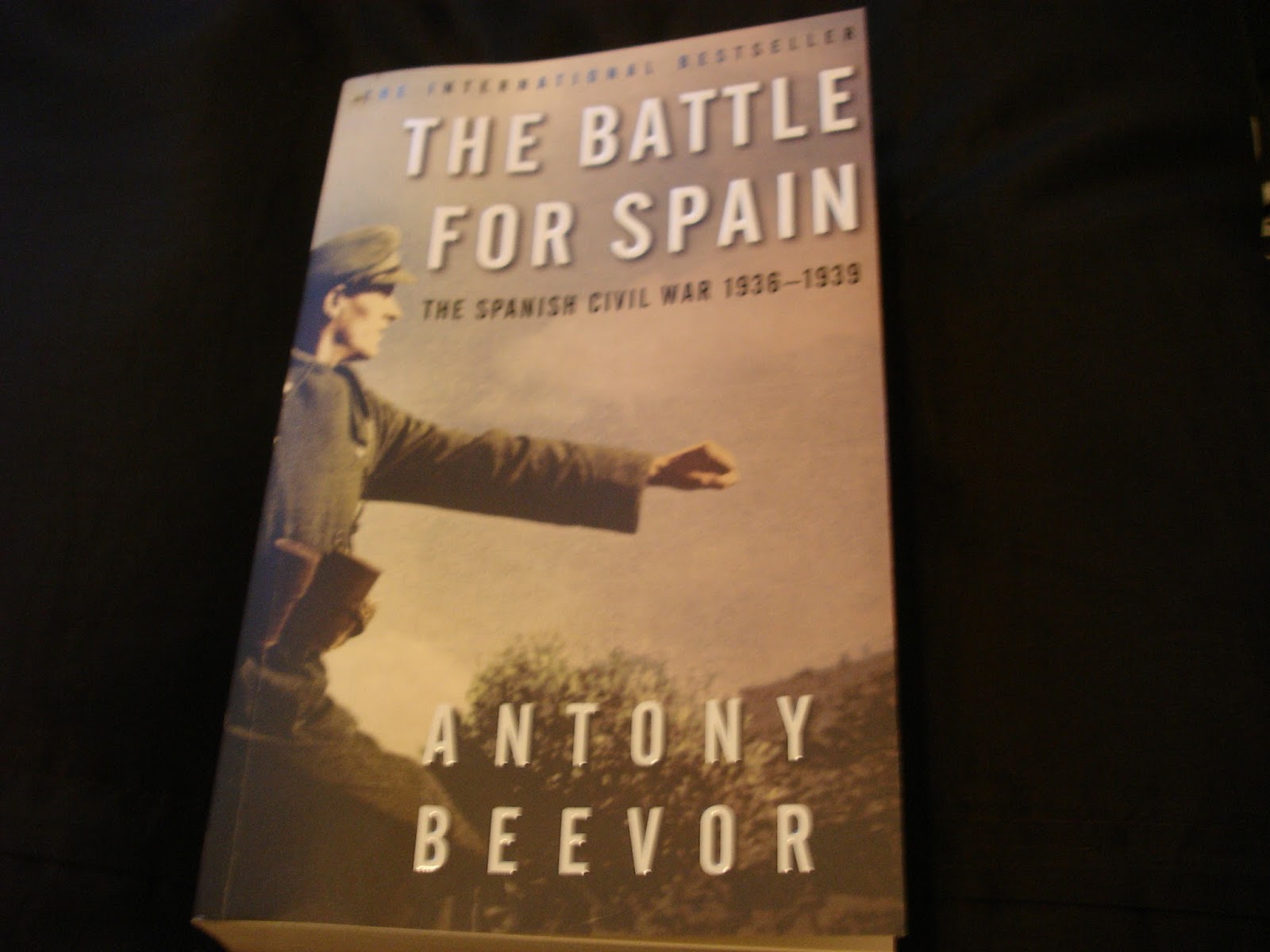
The Battle For Spain - The Spanish Civil War 1936-1939 - Antony Beevor - book review

The Spanish Civil War remains highly emotive. Antony Beevor chronicles and analyses the conflict in his book The Battle For Spain.


In the chapters which constitute a "preamble", Spain's history prior to the 1930s is stressed , with some emphasis on the influence of the Church and the landowners. The country had, it appears, not been affected as much as other parts of Europe by liberalizing impulses.

The plethora of factions on both sides of this conflict can be confusing to say the least, but Beevor does his best to clarify who was who, and why. As he observes, this was not just a struggle between left and right, but also one between libertarianism and authoritarianism and centralization and "federalism"/separatism. These dynamics served to create a very intense and volatile picture.

It is difficult not to be sympathetic to the more libertarian elements of the republican side, however much one feels that they were occasionally naive in their idealism in the face of cold realities. The anarchist scene in Spain around that time, particularly that located in Catalonia, is a fascinating and thought-provoking phenomenon. For all its flaws, a hopeful and positive experiment.

My interpretation was that Beevor felt that the left misjudged the size of its mandate, with its strident rhetoric more than its actions, driving many into the arms of the nationalists. The right exaggerated the "threat".

The infighting between the various groupings, and the fragmented nature of the alliances, is one of the factors which gives the Spanish Civil War an enduring fascination. Loose cannons, hot heads, impractical idealism, brazen opportunism, impulsiveness, impetuosity and cold calculation - all played their part in the drama.

I was impressed by the author's analysis of the early stages of the uprising, the government's hesitant and dilatory initial response, and the motivations behind some of the early atrocities. The republican excesses were more the result of an outburst of rage and chaos. The nationalists, on the other hand, planned a systematic campaign of terror, even "cleansing". The language coined by some nationalist officials is chilling, like something harking back to the Middle Ages...

Beevor goes to great lengths to outline how the unity, or otherwise, of the two sides developed and evolved, Franco maintaining a semblance of cohesion via a mixture of concessions, sops, coercion and eventually demonstrable indispensability to the success of the nationalist cause. Staying largely above the internal strife also clearly helped him. The republicans were not so fortunate, of course, having the heavy hand of Stalin and the Comintern to contend with. Was it the case that the nationalists had a simplicity of purpose, even allowing for lingering agendas, so that they were able to keep their eyes on the prize?  It seems bizarre, but the situation in the anti-fascist camp was not that straightforward.

Another illuminating section of The Battle For Spain deals with the war economy in the republican zone, and the tensions which some methods sparked with the central government. It is difficult not to conclude that the anarchists sometimes clung too rigidly to lofty theories and ideals when a more pragmatic approach may have been more beneficial in the grand scheme of things. Later on, though, they felt with some justification that they were struggling for their very survival and identity.

The rather inglorious attitude of some foreign countries, as well as the manner in which big business connived with the nationalists, is a distasteful facet of the conflict. Yes, we all know now what Stalinism was like, but isn't this a case of being wise after the event? The "rationale" behind certain people's backing for Franco was rather grotesque. The republicans were drastically deprived of genuinely powerful friends, and the consequent reliance on support from the Soviet Union was to bear bitter fruit.

The "romance" surrounding the republican cause is very seductive, even if it is often tricky to pin down exactly. One of the main tasks of the historian therefore is to separate fact from myth, and to weigh what was propaganda, distortion or fabrication. I feel that Beevor remains relatively dispassionate throughout, and does not allow the emotive nature of the subject matter to impinge on lucid judgement. The cruelty and barbarism of the nationalists largely speaks for itself, although the cracks in the republican side take a little more explaining and understanding.

The International Brigades are often the things which most laymen remember about the Spanish Civil War, partly due to the literature and evocative tales which emerged, and also because of the principled stand which they made. Beevor strives to place their role into its proper perspective, and stresses how they slotted into the structure of the Republic's forces.

Diaries and private correspondence are invariably very useful in getting nearer to the truth. Intimate, often candid thoughts committed to paper in the midst of the maelstrom, not alloyed or compromised by propagandistic concerns or embellishment. Such material is made excellent use of in this book.

A probing look at the involvement of intellectuals and artists is also a feature of this work, how many became disillusioned, and how some journalists had their hands tied. It is also pointed how the "demonization" of the communists may have played into their hands, by allowing them to portray themselves as the sole meaningful and dedicated bulwark against fascism.

The portions which address the "civil war within a civil war" evoke a loss of faith among some of the leftist forces and the growth of disenchantment, It is at this point that the paranoia of the Stalin-aligned communists and their acolytes becomes a pervasive trend, seeing the hands of fifth-columnists in almost every military or political reverse. They had leverage, which meant that the other players in the republican fold had to tread carefully in dealing with them. They may admittedly have been on firmer ground in advocating firmer, more cohesive organization and leadership in the face of the nationalist threat.

The vagaries of Stalin's stance are strange. He was doing his best to conceal or downplay the "communistic" side of the republican make-up, for foreign consumption at least, whilst his men on the ground in Spain were throwing their weight around in no uncertain terms. The activities of the secret police, the harsh treatment of the International Brigades volunteers and the draconian punishments for soldiers are all documented here. It is easy to imagine how many people became exasperated and cynical.

A theme which emerges in the second half of this history is the tendency of the republican leadership, under communist sway, to embark on military adventures for reasons of propaganda, playing to both the domestic and international gallery, even when this was not consistent with military or strategic logic. At the same time, of course, the diplomatic picture was clouded and complicated by the gathering storm on the wider European scene. Decisions made regarding Spain were not made in isolation.

Rightly or wrongly, I discerned from some of the author's observations a sense that the republicans were almost naive and "green", both in some of their military decisions, and in their dealings with the outside world, in areas such as finance and arms procurement.

There is a look at what happened after the civil war concluded, including the fate of the exiles,and how Franco went about consolidating his grip on power. The role of both sides in the Second World War is given some attention, and Beevor also looks at the military lessons which the great powers learned, or disregarded, from the fighting in Spain. He also assesses the impact of the interventions made by the Soviet Union, Germany and Italy.

Overall, when reading this book I was left with a feeling of sadness at what befell Spain, at the behaviour of some people on both sides, and how those with honourable and humane motivations and intentions were let down, manipulated and misled.

The Battle For Spain is a sobering but rewarding and worthwhile read. It is well structured and paced, and it brings to life a tragic and contentious episode in modern European history.


Tuesday, 8 September 2015

The Korean War - Max Hastings - book review

"The Korean War", written by Max Hastings, was originally published in 1987.  Having read this book about four years ago, I recently went back to it.

I won't fall into the trap of describing it as "the forgotten war".  That said, if you ask people, even those who consider themselves reasonably well informed, the finer details and the precise chronology might be somewhat hazy.


This is just the sort of history book which I relish.  It feels comprehensive and authoritative, but does not outstay its welcome and, whilst satisfying curiosity, induces a thirst for more knowledge on a range of topics.

There is a good outlining of the background to the conflict. The failings of the South Korean government, the shaky unity in the south, the ill-preparedness of the US and its allies. Throughout the work a picture is created of post-war exhaustion, and of the world adjusting to new circumstances and new alliances. It may surprise some people how stretched the military resources of the US were, early in the war at least. Everybody's inventory was depleted, and forces had to be scraped together and improvised in a short timescale.

The unflattering portrayal of the South Korean regime of that period is a reminder of how many times the West has found it necessary to prop up distasteful administrations in pursuing what it perceives to be noble ends. Hastings does assert that the nature of the North Korean regime justified Western intervention, though.

"The Korean War" is written in a lively  but forthright style. Whether the reader agrees with the author's opinions or not, his arguments are generally well reasoned and supported by evidence. A strength of Max Hastings is his knowledge in both political and military spheres. This gives the book some real depth and authority, and his views and interpretations carry some weight.

As the story unfolds, numerous "case studies" are given, detailing the experiences and recollections of servicemen and civilians. These passages serve as a window on how things were on the ground, as well as hinting at some of the prevailing social and political attitudes in the early Fifties. This "personal" dimension assists in enhancing understanding, as well as instilling some variety, when set against the analysis of grand strategy, Cold War politics and military tactics.

A recurring theme here is the lack of knowledge and reliable intelligence possessed by the West about North Korean intentions, and of attitudes in Moscow and Peking. Also, the differing interpretations between the Americans and the British about the extent of Soviet involvement or control are illuminating, and perhaps reflect the contrast in intensity between the anti-Communist crusades on the two sides of the Atlantic.

This work contains some pretty hard-hitting stuff about the unrest among commanders, and the tensions and military "culture clashes" between the UN countries. The role of Douglas MacArthur is naturally a major topic, especially in the first half of the book. The author spends considerable space explaining why and how the mercurial general made his position untenable.

Whole chapters are devoted to the role of air-power in the war, and to the question of prisoners-of-war. The section which deals with the POW camps on both sides is very powerful and illuminating, and in places disturbing.

I must admit that I found the political and "social" questions more interesting than the discussions of military intricacies. I see this as a tribute to the quality of the book, and a barometer of my own attitudes...

Hastings's summing-up at the end of the book is well-argued, based as it is on an assessment of the geo-political fall-out and the reflections of those who were involved. I was also impressed by the author's capacity to blend a humane approach with a cool appraisal of political realities. It seems that military and political lessons were not learned as fully as they should have been.