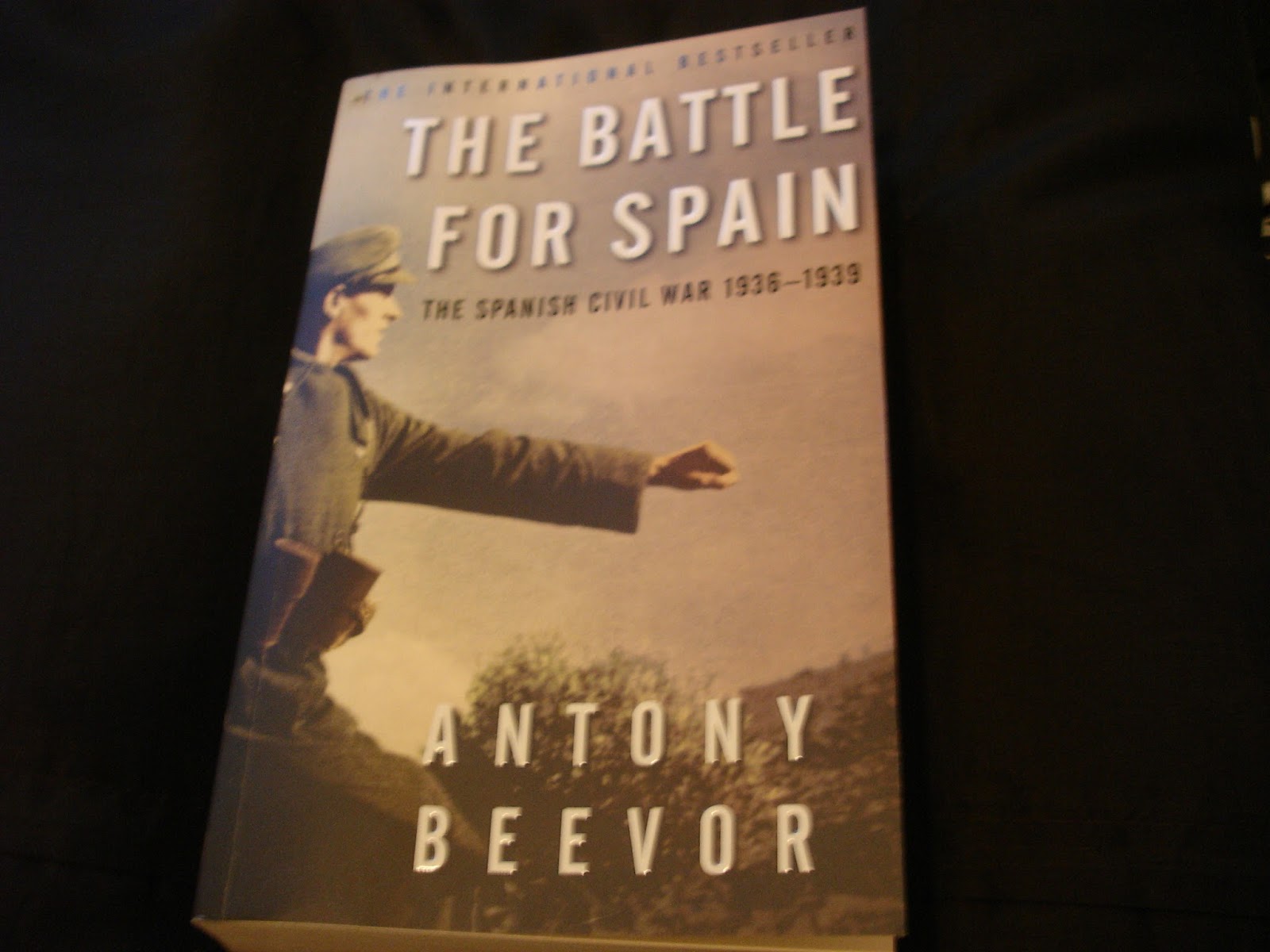
The Spanish Civil War remains highly emotive. Antony Beevor chronicles and analyses the conflict in his book The Battle For Spain.
In the chapters which constitute a "preamble", Spain's history prior to the 1930s is stressed , with some emphasis on the influence of the Church and the landowners. The country had, it appears, not been affected as much as other parts of Europe by liberalizing impulses.
The plethora of factions on both sides of this conflict can be confusing to say the least, but Beevor does his best to clarify who was who, and why. As he observes, this was not just a struggle between left and right, but also one between libertarianism and authoritarianism and centralization and "federalism"/separatism. These dynamics served to create a very intense and volatile picture.
It is difficult not to be sympathetic to the more libertarian elements of the republican side, however much one feels that they were occasionally naive in their idealism in the face of cold realities. The anarchist scene in Spain around that time, particularly that located in Catalonia, is a fascinating and thought-provoking phenomenon. For all its flaws, a hopeful and positive experiment.
My interpretation was that Beevor felt that the left misjudged the size of its mandate, with its strident rhetoric more than its actions, driving many into the arms of the nationalists. The right exaggerated the "threat".
The infighting between the various groupings, and the fragmented nature of the alliances, is one of the factors which gives the Spanish Civil War an enduring fascination. Loose cannons, hot heads, impractical idealism, brazen opportunism, impulsiveness, impetuosity and cold calculation - all played their part in the drama.
I was impressed by the author's analysis of the early stages of the uprising, the government's hesitant and dilatory initial response, and the motivations behind some of the early atrocities. The republican excesses were more the result of an outburst of rage and chaos. The nationalists, on the other hand, planned a systematic campaign of terror, even "cleansing". The language coined by some nationalist officials is chilling, like something harking back to the Middle Ages...
Beevor goes to great lengths to outline how the unity, or otherwise, of the two sides developed and evolved, Franco maintaining a semblance of cohesion via a mixture of concessions, sops, coercion and eventually demonstrable indispensability to the success of the nationalist cause. Staying largely above the internal strife also clearly helped him. The republicans were not so fortunate, of course, having the heavy hand of Stalin and the Comintern to contend with. Was it the case that the nationalists had a simplicity of purpose, even allowing for lingering agendas, so that they were able to keep their eyes on the prize? It seems bizarre, but the situation in the anti-fascist camp was not that straightforward.
Another illuminating section of The Battle For Spain deals with the war economy in the republican zone, and the tensions which some methods sparked with the central government. It is difficult not to conclude that the anarchists sometimes clung too rigidly to lofty theories and ideals when a more pragmatic approach may have been more beneficial in the grand scheme of things. Later on, though, they felt with some justification that they were struggling for their very survival and identity.
The rather inglorious attitude of some foreign countries, as well as the manner in which big business connived with the nationalists, is a distasteful facet of the conflict. Yes, we all know now what Stalinism was like, but isn't this a case of being wise after the event? The "rationale" behind certain people's backing for Franco was rather grotesque. The republicans were drastically deprived of genuinely powerful friends, and the consequent reliance on support from the Soviet Union was to bear bitter fruit.
The "romance" surrounding the republican cause is very seductive, even if it is often tricky to pin down exactly. One of the main tasks of the historian therefore is to separate fact from myth, and to weigh what was propaganda, distortion or fabrication. I feel that Beevor remains relatively dispassionate throughout, and does not allow the emotive nature of the subject matter to impinge on lucid judgement. The cruelty and barbarism of the nationalists largely speaks for itself, although the cracks in the republican side take a little more explaining and understanding.
The International Brigades are often the things which most laymen remember about the Spanish Civil War, partly due to the literature and evocative tales which emerged, and also because of the principled stand which they made. Beevor strives to place their role into its proper perspective, and stresses how they slotted into the structure of the Republic's forces.
Diaries and private correspondence are invariably very useful in getting nearer to the truth. Intimate, often candid thoughts committed to paper in the midst of the maelstrom, not alloyed or compromised by propagandistic concerns or embellishment. Such material is made excellent use of in this book.
A probing look at the involvement of intellectuals and artists is also a feature of this work, how many became disillusioned, and how some journalists had their hands tied. It is also pointed how the "demonization" of the communists may have played into their hands, by allowing them to portray themselves as the sole meaningful and dedicated bulwark against fascism.
The portions which address the "civil war within a civil war" evoke a loss of faith among some of the leftist forces and the growth of disenchantment, It is at this point that the paranoia of the Stalin-aligned communists and their acolytes becomes a pervasive trend, seeing the hands of fifth-columnists in almost every military or political reverse. They had leverage, which meant that the other players in the republican fold had to tread carefully in dealing with them. They may admittedly have been on firmer ground in advocating firmer, more cohesive organization and leadership in the face of the nationalist threat.
The vagaries of Stalin's stance are strange. He was doing his best to conceal or downplay the "communistic" side of the republican make-up, for foreign consumption at least, whilst his men on the ground in Spain were throwing their weight around in no uncertain terms. The activities of the secret police, the harsh treatment of the International Brigades volunteers and the draconian punishments for soldiers are all documented here. It is easy to imagine how many people became exasperated and cynical.
A theme which emerges in the second half of this history is the tendency of the republican leadership, under communist sway, to embark on military adventures for reasons of propaganda, playing to both the domestic and international gallery, even when this was not consistent with military or strategic logic. At the same time, of course, the diplomatic picture was clouded and complicated by the gathering storm on the wider European scene. Decisions made regarding Spain were not made in isolation.
Rightly or wrongly, I discerned from some of the author's observations a sense that the republicans were almost naive and "green", both in some of their military decisions, and in their dealings with the outside world, in areas such as finance and arms procurement.
There is a look at what happened after the civil war concluded, including the fate of the exiles,and how Franco went about consolidating his grip on power. The role of both sides in the Second World War is given some attention, and Beevor also looks at the military lessons which the great powers learned, or disregarded, from the fighting in Spain. He also assesses the impact of the interventions made by the Soviet Union, Germany and Italy.
Overall, when reading this book I was left with a feeling of sadness at what befell Spain, at the behaviour of some people on both sides, and how those with honourable and humane motivations and intentions were let down, manipulated and misled.
The Battle For Spain is a sobering but rewarding and worthwhile read. It is well structured and paced, and it brings to life a tragic and contentious episode in modern European history.
Showing posts with label war. Show all posts
Friday, 25 September 2015
The Battle For Spain - The Spanish Civil War 1936-1939 - Antony Beevor - book review
Labels:
antony beevor,
books,
europe,
germany,
history,
italy,
literature,
military history,
politics,
russia,
second world war,
soviet union,
spain,
spanish civil war,
war,
world war 2,
world war two
Sunday, 30 August 2015
Apocalypse Now - movie review
I recently watched "Apocalypse Now", Francis Ford Coppola's 1979 movie set during the Vietnam War, starring Martin Sheen, Marlon Brando and Robert Duvall, and inspired at least in part by Joseph Conrad's "Heart Of Darkness".
Of all the classic movies of that era, probably my favourite age of cinema, it has in the past been one of the most enigmatic and elusive in terms of its ability to grip my undivided attention.
To sum up the plot, Willard (Martin Sheen) is ordered by his superiors to locate and assassinate the "renegade" Colonel Kurtz (Marlon Brando). We follow Willard as he travels, by helicopter and boat, to Kurtz's hideout over the Cambodian border.
The narration by the Willard character is very evocative, and helps to hold the whole thing together. This aspect of the movie reminds me a little of the similar device used in "Taxi Driver".
Right from the commencement of "Apocalypse Now", one is made aware of an atmosphere of ennui, exhaustion and disorientation, created by the unreality of the experience. I think that the viewer needs to embrace this dimension of "Apocalypse Now" in order to fully appreciate it.
Of course, the Kurtz character does not appear in person until near to the conclusion of the film. Along the way, however, we learn a good deal about him, his character and his history. Willard at times develops a sense of ambivalence towards what Kurtz and his actions represent. Were his actions any more reprehensible just because they were not "officially" sanctioned?
There is something about the combat and action sequences. To me, they almost intentionally look like a movie set. Were they meant to be realistic and authentic, or were they designed to convey a sense of the chaos and confusion, the surrealistic? These scenes, paradoxically, also have a certain symmetry and order, almost as if they were choreographed.
I must confess that I did not understand the hype surrounding the character of Kilgore (Robert Duvall). I am not being contrarian when I say that his role in the story did not really grip me or engage me. I was much more interested in Willard and Kurtz. Perhaps I am missing something?
Incidentally, the most notable line of Kilgore's is, in my view, not the "obvious" one, but the one which he utters after the girl throws a grenade into a helicopter, and he accuses his enemy of being "savages". This was a bit rich from a man who orders that napalm be dropped on defenceless peasants....
For me, the film really gets into its stride when the river journey gets under way in earnest, and the personalities, quirks and fears of the crew members rise to the fore. The river journey is punctuated by some powerful, poignant and even bizarre episodes, the latter category epitomized by the "concert". Each man goes through his own trials, anguish and voyage of personal discovery. In this sense, this picture has some similarities to road movies.
The jungle passages are beautifully shot, with clever use of natural light helping to the capture the claustrophobia and the trepidation, as well as the beauty of the environment. Indeed, the use of light and lighting throughout "Apocalypse Now" is one of the ingredients in making up the film's impact and allure.
There has been intense debate about whether this is an anti-war movie. Anti-war sentiments are not overly pushed, but one cannot fail to be affected by the brutality and callousness occasionally portrayed. The scenes concerned get the message across more effectively and eloquently than any preachy dialogue could ever do. I got the impression, rightly or wrongly, that any disgust expressed by the protagonists was as much directed at the decadent and aimless way in which the war was being conducted on the ground, as at the war per se.
Despite what many people say, I did not think that the climactic scenes, when Marlon Brando and Dennis Hopper enter the fray, were on a separate plane from what preceded them. Again, though, lighting is used to superb effect to evoke a feeling of menace and unreality.
It is noticeable that the Willard character remains relatively phlegmatic and dispassionate throughout most of the film, certainly in comparison to the demons and anxieties plaguing those around him. Perhaps what he had witnessed had made him impervious and hardened.
The scene where Kurtz dies of course alternates with the footage of the sacrifice of the water buffalo. Plenty of scope for seeing the symbolism of the two acts occurring simultaneously. Both acts constituting wishful thinking, and a case of missing the point, shutting out realities?
Some people I suspect view "Apocalypse Now" as nebulous, but that surely is part of the point. It leaves us feeling bewildered, empty and unsettled. Popular perception of it as a meandering behemoth of a film is misguided. Having watched it again, I would say that it is a stunning and affecting creation, if not without its flaws. If nothing else, it is the type of movie which erases any complacency and glibness from the viewer's mind concerning the subject of war. Its quality is all the more remarkable when one remembers the numerous difficulties endured in its production.
It is a memorable film because it is different. It is what it is.
Tuesday, 4 November 2014
The Rising Sun - John Toland
For me, the Pacific theatre of World War Two holds a special fascination. Not only because of certain peculiar strategic issues, but also because of the perceived cultural factors which contributed to the outbreak of hostilities and to how the campaign was conducted.
The period, and the Japanese empire of that time in general, are comprehensively chronicled in John Toland's epic "The Rising Sun". Here the story is told primarily, but not exclusively, from the Japanese perspective. For some unfathomable reason, I had imagined that this book commenced with the Pearl Harbour episode, but in fact the opening chapters are an illuminating and gripping look at the factors which triggered the conflicts in Asia and the Pacific, and the rebellion (s) by Army officers.
People often assume that the Japanese conquests were motivated solely by blind nationalism and rapacious economic greed, but these pages stress that, at least in the beginning, the position was more complex. Japan suffered grievously in the wake of the Great Depression in the early 1930s, and there was also revulsion about political corruption. It is often forgotten that some in the military and elsewhere saw Manchuria as a "new Jerusalem", where socialist ideas could be implemented, and then possibly transplanted to the homeland itself.
The book also amply illustrates how Japan's clock was set ticking once the oil embargo was imposed in the summer of 1941, and how the mixed messages emanating from both sides helped to breed mistrust. Were Japanese officials simply trapped by encroaching economic woes and also by fear of a revolt by sections of the Army, and did the Americans do all that they could have done?
There is an extended description of Pearl Harbour, largely from the point of view of individuals. The unpreparedness of the Allies in the face of the Japanese onslaught is sobering to be reminded of. The horrors of the Philippines campaign are afforded stark attention, with unflinching detail of the hardships inflicted on Allied troops, and the agonizing over the decision to surrender. The author does mention that some Japanese officers repudiated the harsh methods employed by their colleagues.
The sections dealing with the Battle of Midway really bring across what a psychological turning point this event was, because of the dent which was delivered to Japanese confidence, and the knowledge that the material advantage of the US and its allies was now likely to prove decisive. The harsh reality was that perceived spiritual virtues would largely be powerless to sway things.
Throughout "The Rising Sun", Toland looks at the broader question of Asian self-determination, and Japan's efforts to harness these energies. The condescending attitude of many in the West to the Asian peoples is also clear, and one is left wondering whether the Japanese might have had more success if they had adopted a different attitude to the populace in the territories which they occupied. As with the proclaimed socialistic sentiment, it is a moot point whether the rhetoric about fighting colonialism was a ploy to seduce and entice the people of Asia. Perhaps some were more sincere than others in adhering to these views.
In addition to the documenting of the military events, and the first-hand accounts, there is some fascinating coverage of the big wartime conferences attended by the major leaders, and some amusing anecdotes concerning the dialogue between Stalin and Churchill in particular.
The thing which never ceases to amaze, and depress, me when reading military histories is the petty wrangling between commanders, and the egotism on show. It seems absurd and bizarre that professional self-interest and vanity were allowed to interfere with the overriding objectives, but that is human nature, I guess. Perhaps such things are less easy to understand from the vantage point of seven decades later. How many lives were lost because of compromise decisions, effected to smooth over ruffled feathers?
It was interesting to read, towards the end of the story, examples of Japanese soldiers questioning the ethos which guided the nation and its military, and the self-sacrifice which was expected. This belies the conventional "wisdom", and is in keeping with the tendency of this book to pose some awkward questions about both sides who were engaged in the struggle.
Needless to say, the atomic bombs in Hiroshima and Nagasaki are given due prominence. The stories from the cities are harrowing, and should trouble the conscience of anyone who blithely and complacently states unquestioningly that the attacks were necessary or unavoidable.
I must admit that reading this book again has affected me quite deeply, in its portrayal of the futility and cruelty of war, and the intransigence and callousness of some of those who wield power. A thought-provoking and rewarding read.
Labels:
America,
asia,
books,
history,
japan,
japanese,
john toland,
politics,
second world war,
war,
world war two
Saturday, 17 May 2014
Liddell Hart's History Of The Second World War
There are literally thousands of books available which provide an overview of the 1939-45 conflict, catering for many perspectives and tastes. Of those which major primarily on the purely military/strategic aspects, Basil Liddell Hart's "History Of The Second World War", first published in 1970, stands out, both for its level of detail and erudition and its absence of equivocation and bias.
Until recently, I had not read this book in its entirety for several years, and there is a greater quantity of discussion about grand strategy, and the "behind closed doors" elements, than I had recalled. Works of this depth travel comfortably beyond the wishy-washy generalisations seen elsewhere. Liddell Hart quotes extensively from diaries and official records, and from his own post-war interviews with some German commanders.
A lengthy pre-amble sets the scene. It is dispiriting, but worthwhile, to be reminded of the appeasement policies practised by Britain in the 1930s, and of the missed opportunities to stifle and confront Hitler's expansionist sorties, particularly those circa 1938.
In his accounts of the early campaigns of the war, the author emphasizes how comparatively fine the margins were between German success and their being repulsed by the Allies, in France in 1940 for example. He appears to adopt the line that the German victory in the West was not a foregone conclusion, dispelling a few common assumptions about that campaign, and highlighting, as he does elsewhere, how the impetus for the Wehrmacht's tactics emanated chiefly from certain of their field commanders, not from the high command itself.
As one of the early prophets, and advocates, of the new fast-moving armoured warfare, Liddell Hart is therefore ideally placed to judge how these ideas impacted on the course of events in the early stages of the conflict, and how those who failed to take heed of the new realities paid a heavy price for their blinkeredness. In expressing his exasperation at the failings of Allied strategy, he is not simply saying "I told you so", but does back up his assertions with reasoned analysis, whilst also allowing that the deficiencies sometimes resulted from political neglect and misjudgement, or economic factors.
Some of the arguments employed here about strategic and diplomatic matters are ones which appear to be unfashionable today, but I see that as a distinct strength! These viewpoints are arrived at by reasoning and knowledge, whereas I get the feeling that many 21st century commentaries on World War Two are bland, watered down or populist over-simplifications, designed not to tax people's pre-conceptions too much.
The relating of the feverish diplomatic activity both prior to and during the "Operation Torch" landings in North Africa in 1942 is a fine example of how detail and comprehensiveness can give a more representative overview than the "bullet-point" tactics used in many versions. My impression, rightly or wrongly is that the British Mediterranean strategy in the 1942-43 period is given a qualified thumbs-up, even if fault is found with its later implementation. The dreaded word "sideshow" is not to be found that frequently in these chapters!
Liddell Hart's views on the Eastern Front are fascinating, including his view that the "backwardness" of the USSR in those days helped to save it from total collapse and defeat in the first phases of the German invasion. To my mind, he does not adhere as much as some observers to the notion that the Russian front was the only "real front" in the war.
There is a balanced, humane and realistic assessment of the merits, or otherwise, of the various Allied strategic bombing initiatives. The blind alleys are highlighted, but equally the later innovations, breakthroughs and effects are acknowledged. The missed opportunities to end the war more swiftly on the Western Front are subjected to a lengthy dissection and lamentation.
The flaws and pitfalls in the "unconditional surrender" demands put forward by Allied leaders in both Europe and Asia are examined. Did this stipulation unnecessarily prolong the war, by bolstering both civilian and military morale, and defiance, amongst the surviving Axis powers?
On the subject of the atomic bomb, and the possible motivations for employing it, much emphasis is placed on the anxiety in Washington about forestalling increased Soviet influence in the Far East. The author persuasively argues that Japan was probably already finished before the bomb dropped on Hiroshima. Did the bomb merely hasten the inevitable surrender by a very short time?
It may seem to the casual observer that the closing chapters on the chronology of the war itself are a little truncated, but on reflection this is probably just symptomatic of how quickly Germany and Japan collapsed. Also, most of the fighting in the Pacific did not lend itself to the mobile and fluid warfare about which the author specialized.
Those looking for a comprehensive social and political history of the war should probably look elsewhere. The "humanitarian" aspects of the conflict are rarely touched on in detail here, although Liddell Hart refers at times to the moral dimension, and the wider struggle for civilization. If you want to read in-depth about those broader considerations, there are plenty of books which cater for those things handsomely....
Above all, what emerge to me are the author's clarity of thought, his disdain for inertia, and the power of his ideas. This is a lengthy work, but also one which can be devoured quite swiftly, such is its authoritativeness, and resultant capacity to maintain the interest.
Saturday, 10 May 2014
Royal Armouries Museum, Leeds
Following my recent visit to the National Football Museum (described here), I thought it worthwhile to provide my thoughts on another, very different, museum, in the north of England. This is the Royal Armouries in Leeds, which I have visited many times.
Housed in an impressive building in the canal area on the edge of the city centre, the Royal Armouries is described as the UK's national museum of arms and armour. It contains a huge variety of artefacts and exhibits, emanating from all corners of the globe, and almost all periods of human civilization. Multi-media and interactive elements co-exist with passive items. On my most visit, I spent time watching a video about the Battle of Marston Moor!
The emphasis is on arms and armour, but this does not mean that we are dealing with an exclusively "military" museum. There are sections covering hunting, self-defence, heraldry, tournaments and so forth. Perhaps the most striking articles on display are the suits of armour, from many parts of Europe, and the elaborate and ornate uniforms and weapons contained in the "Oriental" area, especially the Japanese ones.
In terms of presentation, I think that the tone is set just about right. There is obviously no attempt to glorify war or weapons, but instead a concerted effort to educate the visitor in the development of these implements, and an undercurrent of hope that mankind has progressed, and will continue to do so. Any "message" is not ostentatiously pressed, and I never get the impression that I am being preached to.
From a personal point of view, I almost feel that the post-World War Two exhibits are a little incongruous or out-of-place, when set against the rare and fascinating things from the earlier epochs. The heart of the museum for me is represented by the period from the early Modern period to the early twentieth century. The items from those times somehow have the capacity to both enthral and also to induce more sober and uneasy sentiments.
During the week, the museum is often visited by school parties, but one never feels that it is overly crowded, or that one's opportunity to appreciate its treasures is impaired. If time is taken, this will be a rewarding and enjoyable day out.
Labels:
britain,
british,
england,
english,
history,
leeds,
military history,
museum,
royal armouries,
war
Monday, 21 April 2014
Kelly's Heroes - movie review
When I was young, and less wise, I developed some strange ideas about what constituted a great film. After seeing "Kelly's Heroes", for instance, I was convinced that I had just experienced the greatest war movie ever made. Little did I know that it was really intended as a "comedy", blending subtle satire, frivolity and action. Whatever my youthful misconceptions, it remains an entertaining, and occasionally thought-provoking picture.
The film centres on the exploits of a group of American soldiers in France in 1944, and their successful efforts to "steal" a haul of gold from a bank located behind enemy lines. The driving force behind the operation is Kelly, played by Clint Eastwood, who summons up his best "mean, moody and magnificent" persona for the role..
"Kelly Heroes" has much in common in many respects with the Vietnam-era war films which appeared later in the 1970s and 1980s. The fact that this picture was made in 1969/70 doubtless helped to shape its aesthetic and some of the undercurrents in the script. The music is vaguely "Age of Aquarius" in nature, and bits of the dialogue are not what one would normally associate with a World War Two film.
This juxtaposition between the Second World War and later counter-cultural values is of course epitomised by the character "Oddball", played by Donald Sutherland. Oddball's tank unit resembles a proto-hippie commune, and the "modifications" to his armoured vehicles are perhaps an insinuation that evil can be tackled without recourse to excessive violence...
I have read it suggested that "Kelly's Heroes" contains an anti-war message. I would concur with this assertion, but at the same time this is an undercurrent, not rammed down the viewer's throat, and it may not be immediately clear to those only watching casually. There is mixture of satire and "black comedy" which helps to soften any abrasiveness or preachiness which might have crept in.
I am not entirely sure whether the producers of this movie were seeking to pose deeper and more complex moral questions. The relative "merits" or stealing gold and waging war spring to mind, although of course in reaching the bank the troops had to engage the German forces anyway. Men died in the process. Which was the more noble "cause"?
Some of the action sequences leave a little to be desired in terms of authenticity, but then again I doubt that "Kelly's Heroes" was aimed at the "purist" audience, militarily or historically speaking. One needs to accept some of the occasional absurdity, and disregard technical minutiae, to appreciate the basic thrust of the movie.
There are, however, one or two memorable scenes. The sequence where the unit becomes trapped in a minefield is especially gripping. More levity is provided by the comical misinterpretations by the American general, who thinks that news of the appearance of Kelly's men behind enemy lines is evidence of some heroic and selfless act of initiative and aggression. Telly Savalas' performance is also worthy of praise, as the irascible sergeant "Big Joe".
It might not be a good idea to watch "Kelly's Heroes" back-to-back with a "serious" war movie, but it is still an intriguing watch.
.
Friday, 18 April 2014
1812 - Napoleon's Fatal March On Moscow - Adam Zamoyski
Zamoyski starts by setting the scene, particularly the respective paths to 1812 followed by Napoleon and Tsar Alexander I, following the peace of Tilsit. Disaffection with Napoleon was growing among his "allies", much goodwill having been forfeited by heavy-handedness and a misunderstanding of the feelings of others. The pretensions of Alexander are illustrated, in so many ways a man of his time, espousing progressive sentiments, but hamstrung by the perilous nature of his own position, and the constant need to take heed of opinions at home.
The author also provides a handy guide to how the Continental System began to unravel, and also makes clear how important the whole Polish question was in the equation, something which is often overlooked. Also included in these preliminary chapters is an analysis of the Grande Armee, its strengths and shortcomings, how it had been diluted by attrition and campaigning, and also afflicted by corruption and decadence.
The logistics of the invasion, when set out in their constituent parts, are staggering to contemplate in their intricacy and scale, when we consider that this was a pre-mechanization, pre-motorisation era. It would also seem that the stories about Napoleon's personal involvement in minute details are not exaggerated. It is also sobering to think that these daunting logistics to a large degree envisaged a short war.....
The great thing about books like this is that they tell the real story, without resorting to the generalisations and clichés prevalent in other media formats. Here, for example, we learn that the much-vaunted Russian strategy was conditioned by a multiplicity of factors, and that it was not as calculating and pre-ordained as is sometimes made out, but evolved due to the pressure of events.
The elements of this book which I found most enlightening were those which addressed the infighting and tensions within Russian society and its "establishment", and how they affected the course of the campaign. Of the generals, Barclay de Tolly appeared to be largely vindicated in his approach, despite the vitriol aimed at him by many. Even after being "sacrificed", he continued to make astute observations.
The portrayal of Kutuzov here is also intriguing. For all his "inspirational" and galvanizing qualities, and his symbolic value, he seems to have been an equivocal influence on matters. The course of the conflict appeared to unfold despite rather than because of his conscious decisions. Indeed, some of the most favourable developments, from a Russian standpoint, occurred because they suppressed the urge to do what their instincts told them to.
Also, we get a look at the truth behind the level of patriotic and peasant engagement in the struggle, and the ambiguity which existed in the relationship of the masses with their leader. Even well into the long French retreat, opinion at all levels of Russian society was very volatile, and could have come down in opposition to Tsar Alexander.
What emerged to me was the fragility of the French enterprise, with a lack of central purpose and clear objectives, betrayed by Napoleon's stress on diplomacy and symbolic shows of power and unity.
It is probably simplistic to say that the Emperor's powers were on the wane, and some of his misfortunes he brought on himself by his flawed behaviour in the aftermath of Tilsit. The fall-out from this was reflected in the agonizing which afflicted him once on Russian soil. Political anxieties assailed him, and ironically the erratic and contradictory signals emanating from St. Petersburg may have harmed France more than they did the Russians, by thoroughly confusing and misleading Napoleon.
It is notable that most of the soldiers in his army still retained implicit faith in Napoleon, even during the most terrible travails. This was most likely due to a combination of blind faith, Bonaparte's remarkable track-record and his hypnotic allure. He was still capable of rising to the heights on occasion, as with the crossing of bridges on the return journey from Moscow, and his political antennae still functioned, if more fitfully than before. Another facet of the tale which stood out for me was how some of Napoleon's generals, Ney for example, retained their professionalism and focus amidst the chaos and misery.
The full horror and relentlessness of the Battle of Borodino is amply conveyed too. Reading those passages, one can fully appreciate why historians regard it as one of the most intensely brutal and horrific days of fighting ever seen. The full desperate ebb and flow of the battle comes across, as does the heart-chilling aftermath.
Needless to say, a sizeable portion of this book concentrates on the horrors and hardships suffered by both soldiers and civilians. Indeed, conditions during the initial invasion in the summer of 1812 sound terrible enough, as is testified by the figures of attrition. The retreat from Moscow is captured in all its shades, with stories of brutality and compassion, desperation and resilience, endurance and resignation. We are also shown how various "subcultures" developed, to cope with the cold, the lack of food and shelter, and the over-riding need to survive.
To conclude the book, the author summarizes the events which followed the French retreat from Russia, as the events and policies of 1807 onwards bore bitter fruit for Napoleon. There is a note of pessimism, with persuasive arguments about the more conservative path which European politics took after 1815, perhaps in reaction to the rise of nationalism and the newly aroused aspirations of the "lower orders".
This is an engrossing, diligently researched and beautifully written account of this momentous episode. One thing which occurred me increasingly as I worked my way through it was how little Europe in particular learned from the cruelties, callousness and sheer futility of what happened, as was made clear just over a century later.
Sunday, 23 February 2014
Europe's Tragedy - Peter H Wilson - book review
In my time in school, history lessons tended to focus narrowly on British concerns, neglecting the momentous events in the wider Europe, which invariably had a greater importance in the grand scheme of things. The Thirty Years' War, for example, was almost entirely overlooked. Even if it was mentioned, it was purely in a "peripheral" context by virtue of its vague connection to British domestic upheavals (the English Civil War, Oliver Cromwell).
This book by Peter H Wilson gives a pretty comprehensive overview of the Europe of the late 16th and early-to-mid 17th century, examining the political, military and religious trends and tensions which were prevalent.
I can imagine that some people will become slightly impatient with the lengthy preamble to the main action of the war itself, but this is necessary in order to equip the reader with a full grasp of the reasons for its outbreak and the varying motives of those who were integral to it. The author assiduously details the numerous political and confessional flashpoints which paved the way, however tortuously, to the eventual conflagration. If the level of detail is confusing and unwieldy at first, I found that the state of play "crystallized" in my mind bit by bit.
Much of the first third of this history concerns itself with the assorted manoeuvres both inside and outside the Holy Roman Empire which preceded the eruption of hostilities in 1618. Portraits of the various key players and protagonists are duly supplied. We see how all manner of considerations - religious, economic, dynastic and power-political - sparked unrest, animosity and confrontation. The various regions (Spain, Baltic, Dutch) are examined, so that we get a flavour of how things on the periphery played their part in determining the course of events.
Another feature which shines like a beacon is the curious and arcane (to modern eyes) way in which central Europe was ruled, organized and generally carved up in those days. It is almost as if someone had started with a blank sheet of paper a thousand years earlier and sought to design a system which would be guaranteed to generate the maximum possible amount of tension, ill-feeling and general unpleasantness. It looked to be riddled with moral hazards, contradictions and fault-lines. The priorities were different back then of course, but from a modern perspective it is fair to say that reason and practicality seemed conspicuously absent.
Gradually, matters become distilled down to the questions of the Habsburg succession, the intriguing of the more militant Protestant territories, and then the Bohemian revolt, where the conflict is commonly deemed to have commenced.
Some of the mysticism and superstition invoked by the radicals on both sides to justify and guide their actions is both comical and absurd, and it is chilling to read of the hatred and intransigence which was so pervasive in those times. It was often the innocent, the weak and the powerless who suffered most. Also, by its nature this was one of those conflicts which entailed troops "living off the land", which gave more scope for atrocities and general brutality.
A large part of the fascination of the Thirty Years' War is the fact that it was not always fought along clearly delineated religious or dynastic lines. Some Protestant states remained loyal to the Empire, seeking a path of constructive engagement or reconciliation. Also, there were machinations and intrigues between rulers who were nominally "allies", but who sought advantage and leverage within these arrangements. Bavaria's approach is a case in point. Much horse-trading took place to secure troops, financing or mediation. The persistent relevance of the Spanish-Dutch confrontation is underscored, both in strategic terms and in the importance of these two factions for the balance of the struggle.
Another recurring facet of the war which I discerned was that the Allied/Protestant cause/rebellion seemed constantly on the brink of collapse, but always managed to revive itself, as new backers, or foreign powers, materialised to step into the breach and breathe new life into the struggle, often with their own agendas and motives for doing so. The creation of martyrs, or the injustice of settlements imposed by the emperor, often spurred resistance and interventions.
As the account of the fighting unfolds, the suffering of the civilians, particularly in Germany, and the ravaging of the landscape and countryside, grows and grows and becomes more and more tragic and stark. Part of the difficulty in conveying the horror and cruelty in such a protracted and fragmented war is that its impact seems less pronounced and concentrated than the more systematic atrocities committed in many shorter conflicts. That said, one senses that the level of violence towards civilians escalated around 1830, with the full intervention of the Swedes in Germany. In saying that civilization has mercifully moved forward since the 17th century, we must not forget the barbarity which humans have inflicted on one another in more recent, supposedly more "civilized" times.
In the context of the suffering and general chaos, some of the peace negotiations, including those which finally concluded matters, appear incongruous in their modernity, vision and moderation.
Wilson also goes to great lengths to convey the social effects and connotations of the development of the war. We are supplied with an insight into how war was managed and prosecuted before the advent of modern nation states, and how the dearth of resources available to rulers and factions necessitated horse-trading and concessions once limited objectives had been attained.
The closing chapters are devoted to an analysis of the legacy of the war and its settlement, its effects on the Empire, and its place in the historical order of things. Wilson also puts into perspective the human, economic and cultural effects of the years of strife, and how they are perceived today.
Reading about the Thirty Years War requires intense concentration, because it is easy to lose track of the shifting and overlapping loyalties and allegiances. However, the protracted and spasmodic nature of the war, with short bursts of fighting interspersed with periods of consolidation and diplomacy, allows one to take stock, and for the mass of data to be assimilated!
If you are seeking a comprehensive and incisive overview of the Thirty Years War, I would highly recommend this book.
Friday, 20 December 2013
The Franco-Prussian War - Geoffrey Wawro
In the course of exploring history, there are some areas which are comparatively poorly served, at least in the English language. On such is the Franco-Prussian war of 1870/71. I suspect that if this topic was put to the average "man in the street" in Britain, you would be confronted with a blank expression, as the conflict did not involve "us", and fell in between other episodes, such as the Crimean and Boer Wars, which had far less significant long-term global repercussions.
The war has always held a certain fascination for me, for a number of reasons. It inhabited a kind of "twilight zone", between the Napoleonic and "revolutionary" period and the First World War, exhibiting characteristics of both. It has a kind of "mystique" for non-German and non-French observers, because it was a localized affair, with the other powers watching from the sidelines with a mixture of foreboding and bemusement. Also, its ultimate legacy and side-effects are remembered more than the war itself.
The import of the Franco-Prussian war has been at the forefront of my mind since reading Geoffrey Wawro's excellent book, which manages to cover the causes of the conflict, the military campaign itself, and the aftermath. In addition to a comprehensive account of the fighting, Wawro comes up with thought-provoking and trenchant views on the central characters in the tragedy, and also on the implications of its outcome.
The book contains an excellent analysis of the background to the approach and outbreak of war, an intriguing feature being comparisons between Napoleon III and his illustrious uncle. This is an obvious line of inquiry to pursue, but Wawro looks at it from a few different angles, pointing out that Louis-Napoleon, whilst striving to complete the previous emperor's unfinished business, was also anxious to avoid the errors of the past. Clearly, Napoleon III also saw emulating the "glories" of the early 19th century as a means of securing his own salvation. Clearly, the worsening domestic political outlook solidified the "case" for war in the estimation of some....
The other pivotal character is Otto von Bismarck, someone who may not inspire affection to modern sensibilities, but whose shrewdness and focus do command grudging respect. There is much illuminating comment here about the Austro-Prussian War of 1866. Can it even be argued that in moral and political terms, that conflict represented a greater hurdle on the path towards German unification than did the collision with France four years later? In order to unite Germany, Bismarck firstly required a united Prussia. The war with Austria helped to placate and bring together disparate elements in the kingdom.
From absorbing Wawro's account, my interpretation was that Bismarck brought Prussia to primacy "on the blind side", achieving these aims bit-by-bit, gradually bolstering power, resources and strategic advantage. Prussia's menace was underplayed by means of diplomatic sleight of hand. By the time that France realized what confronted it, it was too late to redress the balance. Berlin could also count on Napoleon III's desperation, such as territorial ambitions, to assist in binding together any wavering German states.
There is a look at the situation in Germany during the 1860s, with heavy hints that things were by no means as cohesive and united as might sometimes be assumed, with rebellious states and acrimony over integration and harmonization.
The book contains a concentrated and sharp analysis of the final crisis, on the Spanish Question, how gnawing pressures drove France on to seek Prussian humiliation, Bismarck knowing exactly which buttons to press, firstly to provoke France, and subsequently to make them look like the aggressors, unreasonable and excessive.
One theme which came through was the contrast in approach and mentality which the two sides showed. It seems that the initial French enthusiasm and zeal was not matched by practicality, planning and efficiency. Inertia and stagnation soon emerged. Many decisions about personnel may have been based on favouritism and paranoia rather than merit or necessity. Reading about the morale, organization and readiness of France in 1870 reveals distinct similarities with the position commonly supposed to have existed on the eve of Germany's attack in 1940. Apathy, buck-passing, drift....
The differing attitudes within the respective armies are also revealed. Many French soldiers were questioning, insolent, cynical and inquisitive, whilst their Prussian counterparts were subservient, "loyal" and acquiescent. Modern eyes would see the French approach as admirable, courageous even, but was it ever going to suffice to overcome the Prussians? An interesting sub-text is found in comments about the education systems of the combatant countries. Wawro asserts that both the Prussian officers and the "ordinary" soldiers were better educated than their French opposite numbers, citing this as contributing to the outcome. An interesting reflection, when considering the traditional view of the two systems; the hotbed of revolution viewed against a conservative militarist aristocracy....
The author draws attention to the focused professionalism of the Prussian army, in contrast to the French, who were beset by infighting, over-caution and then defeatism. The French appear to have squandered what advantages they had. The Prussians were prepared to gamble, and follow up and capitalize on openings.
One is also made aware of the stark difference between the chaos of the French hierarchy, and the comparatively calm, determined and measured stewardship of Moltke, Bismarck and the Hohenzollerns. In saying this, these pages partially dispel the widespread notion that the Prussians swept all before them in an unending sequence of decisive victories. It was more complicated and difficult than that. Over-zealous Prussian commanders had to be reined in, and there were setbacks, with heavy casualties incurred.
This work features some graphic and chilling descriptions of the carnage on the battlefield, and the damage inflicted on human bodies by artillery shellfire, and the other new and vicious implements which science and technology had placed at the disposal of the armies. Another step in the mechanization and industrialization of warfare. Even so, it was still an age when people displayed some sang-froid about casualties.
Whilst saying that the Franco-Prussian war was influenced by the march of industrial progress, it doesn't always come across that way when reading accounts of the campaign. Yes, strategic railways, modern rifles and machine-guns were involved, but many aspects were little changed from Napoleonic times, including the politics, the morality and the socio-economic landscape. The composition and organization remained a touch archaic and feudal.
Wawro includes some poignant anecdotes about the fate of individual servicemen, placing the spotlight on the cruelty and horror, jarringly set against the grandiose political backdrop, and the grand strategy. Utilization of quotes and diary extracts from the "rank and file" soldiers on both sides helps to convey this. It is easy to lose sight of the impact on the humble soldier or civilian, in an often impersonal and soulless "war of numbers". Some of the quotes from people on both sides are very interesting, not always conforming to stereotypical expectations, or slavishly endorsing their own country's "party line". An example of this is the sympathy occasionally expressed by Prussians for the plight of French troops. The details of the French ordeal at Sedan are quite harrowing.
The closing stages and conclusion of the war are outlined in their full complexity. The plots to establish new dictatorships or monarchies, the great importance of Alsace and Lorraine, and the continuing brutality and chaos. The weariness of French civilians, and their revulsion at the pointless continuation of the fighting, amidst plunder and poverty, shines through.
When appraising the consequences of the war, and the peace settlement, it is interesting to note the impact which was felt in France and Germany. France became more modern and united. The war may have accomplished long-cherished ambitions and aspirations for Germans, but many of its results were baleful and unhealthy. It reinforced the grip of militarism, regressed some and constitutional reform, and engendered wider political tension, mistrust and antagonism.
I would imagine that there are more comprehensive and extensive books about the war than this one, but Wawro's work would be a fine starting point.
Sunday, 1 December 2013
Colditz:The Full Story
Much of the public's "understanding" and image of prisoner-of-war camps doubtless stems from watching movies and television dramas, or from sensationalist or one-sided documentaries.. It is always worthwhile to read a first-hand authoritative account, in order to separate myth from reality, and to obtain a grasp of the dynamics prevailing in the camps. A great example of such scholarship is "Colditz:The Full Story" by Major Pat Reid, a British officer who himself escaped from the infamous fortress.
Reid's account draws on his own experiences and those of his fellow POWs, as well as the diaries of key players in the story, and benefits from research conducted in the decades following the war. Where details or facts are contentious, the author often cites differing versions of events.
One of the first things which I took from this book is how much the truth is at variance with the romantic notions which some people have about Colditz. Down the years, I have heard it intimated that the conditions there were comfortable or benign. However, this account largely discredits such theories, documenting the hardships and travails which the prisoners endured, including food shortages, illness, and endless disruptions and upheavals. Also, the spectre of the Gestapo and the SS, and their brutality, was a constant fear....
Reid provides some enlightening and detailed background information about some of the key protagonists, which not only enriches the reader's appreciation of them as people, but also aids in a grasp of the nature of the times, particularly the troubled Europe of the early 20th century. To his credit, he devotes much attention to the activities and valour of the non-British prisoners, notably the Polish, French and Dutch. The sometimes awkward relations within the national groups are examined frankly.
From reading this history, I gained the impression of a diverse group of men, and while there were some common traits and factors which bonded the prisoners together, many of them were all the while fighting their own private battles of conscience, coping in their individual ways with the privations, the frustrations and the moral dilemmas which arose. Beneath the bravado often lurked some dark forces and thoughts.
An impressive thread which runs through the chronicle of the war years at Colditz is the principled stance taken by so many of the men, presenting a defiance and resolution to the enemy at all times. There was clearly a moral dimension to this, the Allies believing in the justice of their cause, but it no doubt also served as a coping mechanism for many, enabling them to feel as though they were continuing the struggle by another means.
The battle of wills between captors and captives in POW camps is regarded as a microcosm of war itself, although it could be argued that the playing field was more level. It was a contest of intellect, fortitude and moral fibre, and not just brute force, industrial muscle and absence of scruples.
There was also a discernible undercurrent of "give and take" at times in the relationship between the prisoners and the Colditz authorities, both sides tacitly accepting that an agreeable rhythm of life and some semblance of equilibrium had to be maintained. This is often cited as a pervasive phenomenon in penal institutions generally. This is not, though, to imply that a code of chivalry existed between the adversaries...
The dedication and diligence with which the POWs went about their escape activities, and engaged with their enemy, is a reminder of the zeal with which a generation united, put aside minor differences, and fought a virulent threat to freedom and civilization. Would the same happen today, if a malign force comparable to Nazism emerged? I sometimes find myself wondering whether the world has changed too much, but remain optimistic that ultimately the values of humanity and decency remain much the same as they were back then. Hopefully, my theories will never have to be put to the test.....
Reading this work, it is remarkable how much initiative and autonomy the captives exhibited, partly a consequence of so many officers, serial escapees and robust, energetic characters being thrown together in the same place. The amount of planning, intelligence gathering and ingenuity involved in the escapes and general organization was staggering, combining savvy, patience and obduracy. Persistence and perseverance were also essential, given the likelihood that the bulk of escape attempts would not result in a "home run".
The chapters which deal with the closing months of the war are absorbing and sobering. Chaos reigned in Germany, and the POWs became acutely aware of what might befall them in such a scenario. It is often overlooked just how precarious and uncertain their position was shortly before Colditz was liberated by American forces in 1945.
Reid also underlines the role played by the Red Cross, neutral countries and voluntary organizations in supporting and advising the prisoners, these efforts regularly conducted in perilous circumstances. The people, including resistance movements and ordinary civilians, who rendered assistance, deserve enormous admiration and respect.
My chief emotions after reading "Colditz:The Full Story" were those of being humbled by the courage, finesse,tenacity and stoicism shown by the prisoners. Even in the direst of adverse circumstances, they rarely wavered in their resolve and focus. An example to us all.
Tuesday, 26 November 2013
The Crimean War
It is a curious thing that people in Britain know comparatively little about famous, or infamous, episodes in our history. The Crimean War is a case in point. Most of us are familiar with the stories about Florence Nightingale or the Charge of the Light Brigade, but ask the man in the street to give even a basic explanation of the geo-political background, or the strategic "reasoning" behind the conflict, and one is likely to be confronted with a blank expression.
Throughout my own childhood, the war was a constant subject of media references, and even of conversation amongst elderly relatives, seeming to conjure up a certain mystique and mythology. In order to remedy some of the gaps in my own knowledge and understanding, I recently did some reading, part of this process being Alexis Troubetzkoy's book on the subject (part of the "A Brief History Of.." series....)
In the book, the scene is set against the backdrop of the Tsar's visit to England in 1844, which proceeded most amicably, although the seeds of later conflict were buried beneath the surface of the diplomatic exchanges which took place.
Reading about this period provides an important, and disconcerting, reminder of how deferential and reactionary a place Britain still was in the mid 19th century, and how many callous attitudes still prevailed. Different times, yes, but no more edifying for all that.
The time between the end of the Napoleonic Wars and the Crimean War often appears to me like a "twilight zone" in British history. It must have seemed to many like a period of tranquility and peace, but instability remained, and new grievances and designs were being nurtured. The sources of potential were many and diffuse.
Troubetzkoy's book to me underlined the importance of Europe's years of revolution and upheaval (1830, 1848), and equally how incomplete and unevenly distributed the genuine change was. Some of the structures and movements which supplanted and succeeded the "ancien regime" were, looking back, hardly beacons of enlightenment. In some cases it was considered that the only way to consolidate power and prestige was to be strident and belligerent, and to curry favour with regressive elements.
Upon closer inspection, it becomes clear that the reasons for the outbreak of war, and the way in which it was ultimately conducted, are more complex than is popularly considered to be the case. The role of religious privileges in Turkey, for example, although the extent to which this was employed as a smokescreen for the exercising of imperial pride and grandeur, and commercial interests, is open to debate.
The central role of Napoleon III is also clear, possibly determined by his need to assert and consolidate his domestic position. It seems like Britain was forced into a diplomatic corner by France and Russia, forced to choose between alliances and wars. They may have sought to contain the Turkish difficulties, but the alternative would have been a Europe-wide conflagration.
As with so many major events around this time, one appreciates the leverage and power of independent and ambitious diplomats, with their own agendas, awkward to control in the era of rudimentary and primitive communications. Colourful characters they may have been, but their influence was often malign.
Many aspects of this war remain obscure to the general reader, such as the fact that Britain was gradually relegated to a junior role in the "coalition" as the fighting progressed, and the level of distrust between the military commanders, and between the military men and the politicians. The campaign seems to have been largely improvised, and been characterized by compromise, muddle, vacillation and misunderstanding. The Allies "won", but this could have been achieved at much less cost for all concerned. The war did lead to some calls for reform in various areas, but this was to be a long and slow process.
Learning about history is often cited as a means of ensuring that we humans learn from our past mistakes. I would also offer the thought that it can help us to appreciate that, for all our gripes and misgivings, the world has progressed in at least some respects.....
Labels:
alexis troubetzkoy,
books,
britain,
france,
history,
literature,
politics,
russia,
the crimean war,
turkey,
war
Tuesday, 24 September 2013
Nato's Secret Armies - Daniele Ganser
Despite my interest in political and military history, the "Gladio" phenomenon had largely passed me by until I became a regular internet user, and its wider visibility received an additional boost by the whole conspiracy theory "industry" of the past couple of decades, of which it forms an integral part.
There are innumerable books and documentaries out there, of varying credibility, but one of the most widely publicized documents on the subject is "Nato's Secret Armies", by the Swiss academic Daniele Ganser. Not a vast tome, but it gives a digestible and lucidly argued version of what occurred.
To summarise, the "Gladio" project stemmed from a desire by Western governments and intelligence services to install a network of "stay behind" agents and operatives in European countries in the aftermath of World War 2 , to provide information and engage in subversive activities in the event of a Soviet/Eastern Bloc invasion. It has been shown that these networks to varying degrees mutated or were co-opted, and turned their belligerence on political opponents, civilians and the fabric of society. "False flag" terrorist attacks were carried out, often by extreme right-wing groups, and were then falsely attributed to the radical left. It would seem that some of those in positions of power, in intelligence services for example, perpetrated cover-ups in order to protect the existence of the "Gladio" system, and also to shield acolytes.
There is an academic bent to this book, as might be expected given the author's background, and the text drips with some vehemence, indignation and stridency, which is understandable when one objectively appraises the subject matter. The translation into English (if indeed it was translated into English) is not 100 percent perfect, but this is not a major drawback.
Much of the material which has been in the mass media about "Gladio" has concentrated on its highly visible and dramatic manifestations in Italy between the late 1960s and the early 1980s, with also some attention given to events in Belgium and Germany. Ganser's work provides a more broad, all-encompassing view of the saga, looking at the less publicized facets of the scheme. We also gain an idea of the attitudes at national, European and NATO level, and the differing reactions of those kept out of the loop, and those who had been privy to details, and feared exposure and scrutiny.
There is little scope for levity in an expose of Gladio, but there is a certain grim humour to the efforts of the former Italian Prime Minister, Giulio Andreotti, who after being nudged into publicly disclosing the existence of the networks, then decided to stress the involvement or complicity of other Western governments and officials. We are told of the often comically contradictory and obtuse answers given by officials at Nato and elsewhere, when questioned about Gladio.
This book benefits from using a wide and varied range of sources, from officials, researchers, journalists, participants and so forth. One can argue that this approach limits the prospect of a plague of disinformation and sensationalism. I found myself mentally sifting through the welter of claims and allegations, methodically deciding which were more credible than others.
There is a revealing and detailed explanation of the origins of the secret networks, linking them to projects already initiated during the war, primarily those overseen by the British Special Operations Executive (SOE). Some effort is made to place the advent of Gladio in its historical and geopolitical contexts. The book format is more conducive to a comprehensive look at the motivations for setting up the structures, and how they developed and evolved. Audio-visual accounts often look and feel disjointed and nebulous, zeroing in on the eye-opening and blatantly insidious aspects, and not necessarily capturing the essence of the big picture. Ganser manages to join some of the dots, also outlining the Nato co-ordination mechanisms with valuable clarity.
A few insinuations are made about the the British and American attitude to Communism, vis-a-vis the Third Reich, which many will find contentious, but they are difficult to ignore. Nato's Secret Armies is quite uncompromising in that respect.
Cutting through everything for me is a hunch that the original Gladio "stay behind" forces would have been ineffectual and inadequate anyway. They only became truly sinister and potent when the emphasis changed from the "resistance" role to that of domestic subversion and manipulation. It is hard to escape the conclusion that the latter was the main intention all along. The pressure being exerted by the initiative's main sponsors seemed to indicate that this was the case.
Sensibly, the work proceeds to divide itself into chapters addressing the operations and events in each country. It almost doubles as a kind of potted history of Europe in the second half of the twentieth century. The shadowy figures, the abuses and malpractice, and the unsavoury regimes allegedly propped up and tolerated by our so-called democracies. The salutary cases of Chile and Algeria come under the microscope.
As I worked my way through Nato's Secret Armies, it increasingly occurred to me how bankrupt and bereft of moral self-confidence the Western powers must have been, when they felt the need to indulge in such chicanery, even as an adjunct to other propaganda. Clearly the merits of peaceful and honest ideas were not deemed totally sufficient to dissuade people from embracing Communism.
One of the most poignant parts of the account of the early days of Gladio is the extent to which some European statesmen had to compromise their liberal, democratic principles and acquiesce in the project. Their reliance on American economic and military aid presumably ensured this. At that stage, expediency must have overridden almost everything else. Desperate times, and all that?
Can it be argued that the basic "stay behind" concept in itself was sensible and sound from a strategic and military standpoint, and that the flaw in its implementation was the lack of democratic or parliamentary oversight and control? Was it realistic to expect that such supervision could have been undertaken, in the paranoid and insecure post-war period? It is clear that the Americans in particular did not trust everybody to be furnished with details of the covert operations. Consequently the imperatives of secrecy and Cold War expediency won out. The ends justify the means?
It must also be asked whether all the terror, subversion and manipulation actually made any difference to public opinion, and the political climate, in the countries concerned. I suppose that it is almost impossible to quantify this, except to point out that the "status quo" prevailed, but was this in spite of rather than because of these nefarious activities? Some of the motivation must have stemmed from the powerlessness, desperation even, felt by those in the West, and the sense that they needed to "do something", no matter how dubious in moral and strategic terms. Not that this excuses much of what went on....
The contention that these measures were primarily ideological, rather than based on a cogent assessment of the real strategic situation at the time, is hard to rebut. Many of the organisations which were infiltrated, discredited or marginalised were committed to achieving their practical objectives through peaceful and democratic means. The Italian Communist Party is perhaps the most obvious example. It makes one wonder who the real "democrats" were...
It may be unwise and unfair to pronounce uniform motivations and reasons for the "mutation" of some of the secret armies across Europe. Much of the disquiet has revolved around the recruitment of assorted unedifying figures from the defeated Axis powers. The stated rationale was that these individuals could accomplish Allied aims quickly and efficiently, when needs were pressing. Our old friend Expediency again?
In other places, naivete may have been a factor, the misguided view that these people would not do anything seriously untoward. As a counter-argument, a look at the political inclinations of some of the "stakeholders" should surely have raised the alarm? The need for secrecy, and the web of intrigue spun within the overall network, seems to have ensured that nothing was done.
The worrying thing is that even today a fair percentage of the population would unquestioningly endorse the unethical and murderous measures undertaken during the Gladio years. We should rejoice in the knowledge that we have journalists, authors, researchers and academics who tirelessly strive to extract the truth in such matters. Of course, the odd honest and courageous politician always helps....
Although not perhaps a definitive account of its subject, Nato's Secret Armies is an absorbing and disturbing read.
Sunday, 11 August 2013
Napoleon's Wars - Charles Esdaile
Just a few words about a book which I have recently finished reading...
Many books about the Napoleonic Wars cover the familiar ground, with an often narrow, stereotyped view of the geopolitical and ideological aspects, and endless recounting of the famous battles. Napoleon's Wars is slightly different, in that it devotes substantial attention and space to less obvious episodes and sub-plots.
The author dispels myths and challenges well-worn assumptions about some of the events of that epoch, particularly relating to supposed "popular uprisings" and the issue of Britain's financial assistance to some of the other combatant nations.
Also, this book focuses on less publicized areas of conflict in the Napoleonic era, such as parts of the Mediterranean and The Balkans. Not only does this add extra interest and variety, but these episodes were in many ways microcosms of the dynamics and trends which were characteristic of the struggle as a whole.
It is also heartening to note that this book is largely devoid of much of the mythologizing about Napoleon which is all too evident in many histories and biographies. Whilst recognizing Bonaparte's qualities as a military commander, and his charisma and appeal to the French people, it also takes him to task for his intransigence and delusions at various junctures. Repeatedly, we see highlighted opportunities for Napoleon to have consolidated gains, and secured strategic advantage, which were then ignored or squandered due to the emperor's excessive ambition.
Some of the rhetoric and idealism emanating from Napoleon, often harking back to the French Revolution, sounds more and more hollow and fanciful as the story progresses. Whilst he did indeed espouse and uphold some genuinely noble principles, the overall conclusion which I harboured at the end of the book was decidedly ambiguous.
Not that other rulers and statesmen emerge from the tale with much credit. The British establishment of the early 19th century comes across as very reactionary, even allowing for its disquiet about the French military threat. The helplessness and impotence of Austria and Prussia for much of the time is also palpable. Much of the narrative concerns itself with the scheming and agonizing of Tsar Alexander I, a fascinating and complex figure.
This book may not be a conventionally comprehensive and "definitive" chronicle of the Napoleonic Wars, but it is both challenging and evocative. Well worth a read.
Subscribe to:
Posts (Atom)