Showing posts with label world war two. Show all posts

Sunday, 16 January 2022

The Second World War - A Complete History - Martin Gilbert

 I recently finished reading Martin Gilbert's The Second World War - A Complete History. One volume chronicles of such a monumental subject cannot realistically hope to be comprehensive, or cover all the bases, but this particular work offers an absorbing and deeply impressive perspective on the conflict.

The 'format' I found surprisingly effective and workable. The war is documented in a chronological pattern, sometimes meaning that chapters alternately cover developments across the different theatres (Europe, Pacific etc.).  This could have rendered the story confusing and messy, but it turns out to be affecting and relatively efficient. Coverage of grand strategy and the pronouncements of leaders is mixed with quotations and anecdotes from 'on the ground' and from those whose were directly involved and personally impacted; eyewitnesses to horror and heroism.

There is a particular focus on the terror inflicted on Europe's Jews, as well as the activities of partisans and spies, and the effects of strategic bombing.  These emphases serve to convey the cruelty and futility of war, and the way in which it devastates the weak and the defenceless.

I found the text to be quite matter-of-fact, rather letting the facts and the quotations speak for themselves. The author does not dwell unduly on major military episodes or technological developments. I was also glad of the relatively short duration of the chapters, making the enterprise digestible and easy to follow.

Another feature which I found sensible was the tendency to continuously cite quotations from the same people and sources. This ensures consistency, enabling the reader to gauge and assess the changing moods and perspectives of those participants.

I was profoundly intrigued by the passages which dealt with the evolving relationship between the Western Allies and the Soviet Union. It seemed that in the earlier days there was a mixture of solidarity and mutual suspicion, with the Western powers sensitive to how their delays in opening a meaningful 'second front' would be received in Moscow. Of course towards the book's conclusion the thorny subject of the prospective post-war landscape looms larger and larger, especially the question of Poland.

As I moved deeper into this book, I gained the impression that it was not really an attempt to deliver an exhaustive, all-encompassing account of the war, but more a striving to give people a strong flavour of the true nature of that cataclysmic period in global history. In this sense Gilbert succeeded admirably. It does not just highlight the injustice and senselessness of war, but in addition it illustrates the political and social factors which promote armed conflict and what measures may be taken to reduce the likelihood of such catastrophes occurring.

Some people might complain that the book offers an 'establishment' Anglo-centric viewpoint, and even in places underestimates the role of the USSR in the war, but ultimately it is a powerful and gripping read, which will give any reasonable person ample food for thought and reflection.


Friday, 25 September 2015

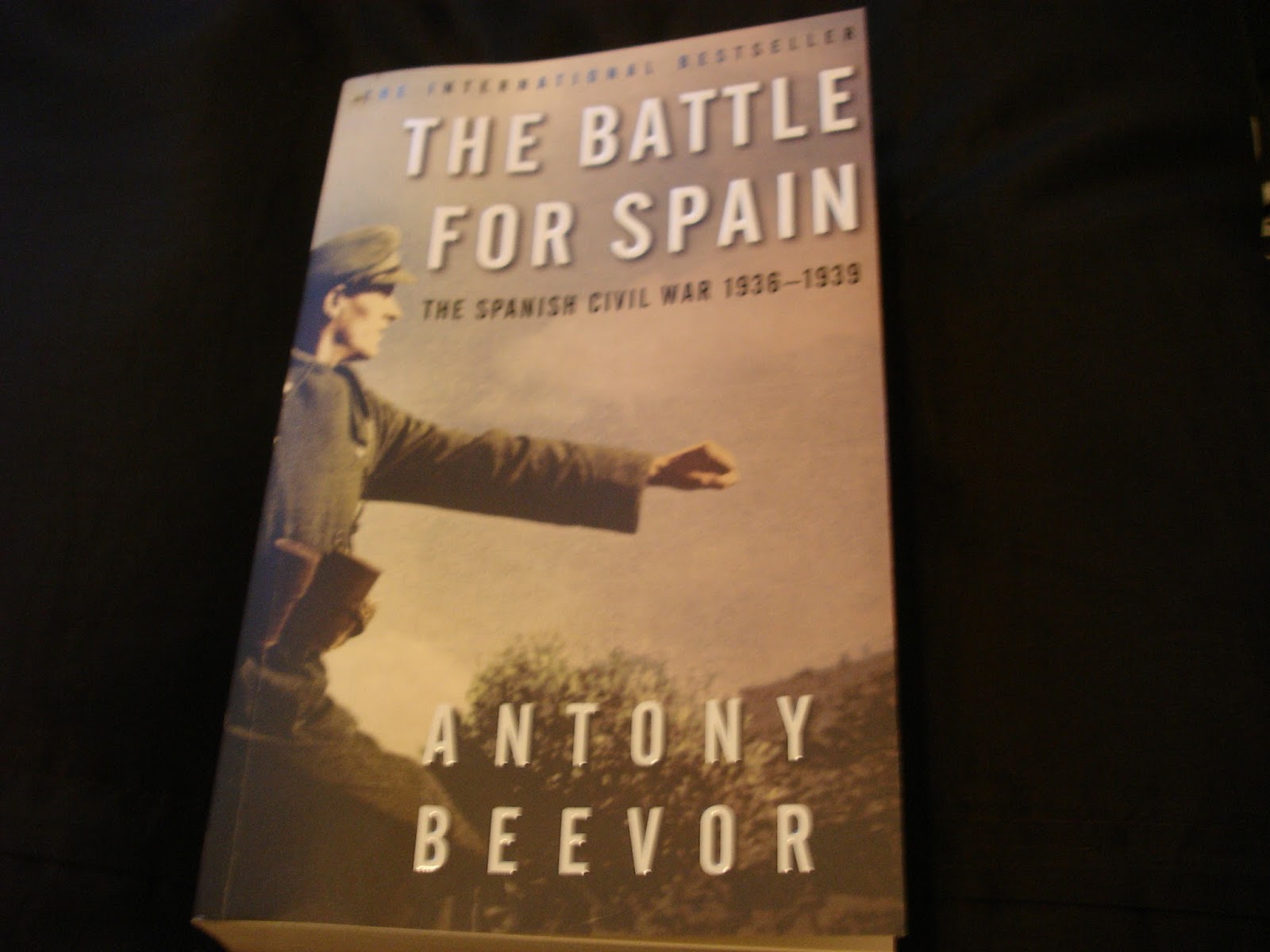
The Battle For Spain - The Spanish Civil War 1936-1939 - Antony Beevor - book review

The Spanish Civil War remains highly emotive. Antony Beevor chronicles and analyses the conflict in his book The Battle For Spain.


In the chapters which constitute a "preamble", Spain's history prior to the 1930s is stressed , with some emphasis on the influence of the Church and the landowners. The country had, it appears, not been affected as much as other parts of Europe by liberalizing impulses.

The plethora of factions on both sides of this conflict can be confusing to say the least, but Beevor does his best to clarify who was who, and why. As he observes, this was not just a struggle between left and right, but also one between libertarianism and authoritarianism and centralization and "federalism"/separatism. These dynamics served to create a very intense and volatile picture.

It is difficult not to be sympathetic to the more libertarian elements of the republican side, however much one feels that they were occasionally naive in their idealism in the face of cold realities. The anarchist scene in Spain around that time, particularly that located in Catalonia, is a fascinating and thought-provoking phenomenon. For all its flaws, a hopeful and positive experiment.

My interpretation was that Beevor felt that the left misjudged the size of its mandate, with its strident rhetoric more than its actions, driving many into the arms of the nationalists. The right exaggerated the "threat".

The infighting between the various groupings, and the fragmented nature of the alliances, is one of the factors which gives the Spanish Civil War an enduring fascination. Loose cannons, hot heads, impractical idealism, brazen opportunism, impulsiveness, impetuosity and cold calculation - all played their part in the drama.

I was impressed by the author's analysis of the early stages of the uprising, the government's hesitant and dilatory initial response, and the motivations behind some of the early atrocities. The republican excesses were more the result of an outburst of rage and chaos. The nationalists, on the other hand, planned a systematic campaign of terror, even "cleansing". The language coined by some nationalist officials is chilling, like something harking back to the Middle Ages...

Beevor goes to great lengths to outline how the unity, or otherwise, of the two sides developed and evolved, Franco maintaining a semblance of cohesion via a mixture of concessions, sops, coercion and eventually demonstrable indispensability to the success of the nationalist cause. Staying largely above the internal strife also clearly helped him. The republicans were not so fortunate, of course, having the heavy hand of Stalin and the Comintern to contend with. Was it the case that the nationalists had a simplicity of purpose, even allowing for lingering agendas, so that they were able to keep their eyes on the prize?  It seems bizarre, but the situation in the anti-fascist camp was not that straightforward.

Another illuminating section of The Battle For Spain deals with the war economy in the republican zone, and the tensions which some methods sparked with the central government. It is difficult not to conclude that the anarchists sometimes clung too rigidly to lofty theories and ideals when a more pragmatic approach may have been more beneficial in the grand scheme of things. Later on, though, they felt with some justification that they were struggling for their very survival and identity.

The rather inglorious attitude of some foreign countries, as well as the manner in which big business connived with the nationalists, is a distasteful facet of the conflict. Yes, we all know now what Stalinism was like, but isn't this a case of being wise after the event? The "rationale" behind certain people's backing for Franco was rather grotesque. The republicans were drastically deprived of genuinely powerful friends, and the consequent reliance on support from the Soviet Union was to bear bitter fruit.

The "romance" surrounding the republican cause is very seductive, even if it is often tricky to pin down exactly. One of the main tasks of the historian therefore is to separate fact from myth, and to weigh what was propaganda, distortion or fabrication. I feel that Beevor remains relatively dispassionate throughout, and does not allow the emotive nature of the subject matter to impinge on lucid judgement. The cruelty and barbarism of the nationalists largely speaks for itself, although the cracks in the republican side take a little more explaining and understanding.

The International Brigades are often the things which most laymen remember about the Spanish Civil War, partly due to the literature and evocative tales which emerged, and also because of the principled stand which they made. Beevor strives to place their role into its proper perspective, and stresses how they slotted into the structure of the Republic's forces.

Diaries and private correspondence are invariably very useful in getting nearer to the truth. Intimate, often candid thoughts committed to paper in the midst of the maelstrom, not alloyed or compromised by propagandistic concerns or embellishment. Such material is made excellent use of in this book.

A probing look at the involvement of intellectuals and artists is also a feature of this work, how many became disillusioned, and how some journalists had their hands tied. It is also pointed how the "demonization" of the communists may have played into their hands, by allowing them to portray themselves as the sole meaningful and dedicated bulwark against fascism.

The portions which address the "civil war within a civil war" evoke a loss of faith among some of the leftist forces and the growth of disenchantment, It is at this point that the paranoia of the Stalin-aligned communists and their acolytes becomes a pervasive trend, seeing the hands of fifth-columnists in almost every military or political reverse. They had leverage, which meant that the other players in the republican fold had to tread carefully in dealing with them. They may admittedly have been on firmer ground in advocating firmer, more cohesive organization and leadership in the face of the nationalist threat.

The vagaries of Stalin's stance are strange. He was doing his best to conceal or downplay the "communistic" side of the republican make-up, for foreign consumption at least, whilst his men on the ground in Spain were throwing their weight around in no uncertain terms. The activities of the secret police, the harsh treatment of the International Brigades volunteers and the draconian punishments for soldiers are all documented here. It is easy to imagine how many people became exasperated and cynical.

A theme which emerges in the second half of this history is the tendency of the republican leadership, under communist sway, to embark on military adventures for reasons of propaganda, playing to both the domestic and international gallery, even when this was not consistent with military or strategic logic. At the same time, of course, the diplomatic picture was clouded and complicated by the gathering storm on the wider European scene. Decisions made regarding Spain were not made in isolation.

Rightly or wrongly, I discerned from some of the author's observations a sense that the republicans were almost naive and "green", both in some of their military decisions, and in their dealings with the outside world, in areas such as finance and arms procurement.

There is a look at what happened after the civil war concluded, including the fate of the exiles,and how Franco went about consolidating his grip on power. The role of both sides in the Second World War is given some attention, and Beevor also looks at the military lessons which the great powers learned, or disregarded, from the fighting in Spain. He also assesses the impact of the interventions made by the Soviet Union, Germany and Italy.

Overall, when reading this book I was left with a feeling of sadness at what befell Spain, at the behaviour of some people on both sides, and how those with honourable and humane motivations and intentions were let down, manipulated and misled.

The Battle For Spain is a sobering but rewarding and worthwhile read. It is well structured and paced, and it brings to life a tragic and contentious episode in modern European history.



Tuesday, 4 November 2014

The Rising Sun - John Toland

For me, the Pacific theatre of World War Two holds a special fascination. Not only because of  certain peculiar strategic issues, but also because of the perceived cultural factors which contributed to the outbreak of hostilities and to how the campaign was conducted.
 
The period, and the Japanese empire of that time in general, are comprehensively chronicled in John Toland's epic "The Rising Sun". Here the story is told primarily, but not exclusively, from the Japanese perspective. For some unfathomable reason, I had imagined that this book commenced with the Pearl Harbour episode, but in fact the opening chapters are an illuminating and gripping look at the factors which triggered the conflicts in Asia and the Pacific, and the rebellion (s) by Army officers. 
 
People often assume that the Japanese conquests were motivated solely by blind nationalism and rapacious economic greed, but these pages stress that, at least in the beginning, the position was more complex. Japan suffered grievously in the wake of the Great Depression in the early 1930s, and there was also revulsion about political corruption. It is often forgotten that some in the military and elsewhere saw Manchuria as a "new Jerusalem", where socialist ideas could be implemented, and then possibly transplanted to the homeland itself.
 
The book also amply illustrates how Japan's clock was set ticking once the oil embargo was imposed in the summer of 1941, and how the mixed messages emanating from both sides helped to breed mistrust. Were Japanese officials simply trapped by encroaching economic woes and also by fear of a revolt by sections of the Army, and did the Americans do all that they could have done?
 
There is an extended description of Pearl Harbour, largely from the point of view of individuals. The unpreparedness of the Allies in the face of the Japanese onslaught is sobering to be reminded of. The horrors of the Philippines campaign are afforded stark attention, with unflinching detail of the hardships inflicted on Allied troops, and the agonizing over the decision to surrender. The author does mention that some Japanese officers repudiated the harsh methods employed by their colleagues.
 
The sections dealing with the Battle of Midway really bring across what a psychological turning point this event was, because of the dent which was delivered to Japanese confidence, and the knowledge that the material advantage of the US and its allies was now likely to prove decisive.  The harsh reality was that perceived spiritual virtues would largely be powerless to sway things.
 
Throughout "The Rising Sun", Toland looks at the broader question of Asian self-determination, and Japan's efforts to harness these energies.  The condescending attitude of many in the West to the Asian peoples is also clear, and one is left wondering whether the Japanese might have had more success if they had adopted a different attitude to the populace in the territories which they occupied. As with the proclaimed socialistic sentiment, it is a moot point whether the rhetoric about fighting colonialism was a ploy to seduce and entice the people of Asia. Perhaps some were more sincere than others in adhering to these views.
 
In addition to the documenting of the military events, and the first-hand accounts, there is some fascinating coverage of the big wartime conferences attended by the major leaders, and some amusing anecdotes concerning the dialogue between Stalin and Churchill in particular.
 
The thing which never ceases to amaze, and depress, me when reading military histories is the petty wrangling between commanders, and the egotism on show. It seems absurd and bizarre that professional self-interest and vanity were allowed to interfere with the overriding objectives, but that is human nature, I guess. Perhaps such things are less easy to understand from the vantage point of seven decades later. How many lives were lost because of compromise decisions, effected to smooth over ruffled feathers?
 
It was interesting to read, towards the end of the story, examples of Japanese soldiers questioning the ethos which guided the nation and its military, and the self-sacrifice which was expected. This belies the conventional "wisdom", and is in keeping with the tendency of this book to pose some awkward questions about both sides who were engaged in the struggle.
 
Needless to say, the atomic bombs in Hiroshima and Nagasaki are given due prominence. The stories from the cities are harrowing, and should trouble the conscience of anyone who blithely and complacently states unquestioningly that the attacks were necessary or unavoidable.
 
I must admit that reading this book again has affected me quite deeply, in its portrayal of the futility and cruelty of war, and the intransigence and callousness of  some of those who wield power.  A thought-provoking and rewarding read.


Tuesday, 13 May 2014

Operation Mincemeat - Ben Macintyre

I have become a touch wary of stories about World War Two espionage and subterfuge, as grandiose and excessive claims are often made for the value or import of certain missions or initiatives. However, "Operation Mincemeat", instigated by British Naval Intelligence in 1943, to support the impending landings in Sicily, possesses elements which make it stand out from the crowd. Ben Macintyre's book on the subject therefore became essential reading.
 
In short, "Operation Mincemeat" was a deception scheme arranged by British intelligence, as a means of keeping the German High Command guessing about Allied intentions in the Mediterranean region, in the wake of the conquest of North Africa. To facilitate this, an ingenious and elaborate, if somewhat macabre, operation was mounted, whereby a human corpse was washed up on the Spanish coast, bearing various "fake" and "planted" letters and documents, in the hope that said items would find their way into German hands, and impact upon the Reich's military decisions in accordance with Allied wishes.


I had previously been aware of this episode, but the book fleshes out the matter considerably, and delivers a penetrating insight into several aspects of the war . The ambiguous and complicated Spanish role, the intricacies of espionage, the various chains of command, overlapping responsibilities and the sometimes petty rivalries and jealousies which constantly threatened to hinder projects of massive importance.
 
Approximately halfway through "Operation Mincemeat", my judgement was still reserved, as I had a feeling of dread about the conclusions which might be reached. There is a natural tendency amongst authors to make outlandish claims for the success or achievement of the enterprise which they are championing or seeking to bring to a wider audience. I am glad to say that in this case my fears proved to be groundless, as Macintyre is realistic, balanced and honest in his assessments of how much "Mincemeat" ultimately accomplished, acknowledging that other factors contributed to Allied success, and that this was just part of a larger overall deception programme.

This is emphatically NOT one of those ".....Who Fooled Hitler" jobs which have begun to populate the bookshelves and broadcast schedules in recent times. Macintyre's approach is much more nuanced and honest. He does not pretend that everything went swimmingly from beginning to end from the Allied viewpoint.
 
The Axis commitment of troops to North Africa in late 1942, and the consequent number of prisoners taken by the Allies in Tunisia, had arguably left Sicily exposed just as much as any decision by the German High Command to divert resources to Greece and Sardinia later on. The author correctly observes that the "Mincemeat" information merely helped to solidify attitudes and prejudices already harboured by Hitler and some of his colleagues. At the absolute minimum, and on balance of evidence, the plan positively benefited the Allies in the Mediterranean, albeit temporarily, as the twin forces of the terrain of mainland Italy, and the astute defensive tactics deployed by their opponents, soon meant much frustration further north.
 
The writing style is not particularly "scholarly", and some may find the tone a little shallow and "populist" in places. I thought that the author tried a little too hard at times to make every character or key player conform to stereotypes or caricatures of loveable eccentricity on the British side or clownish venality elsewhere. Having said that, it is never less than entertaining and absorbing, and several intriguing sub-plots are kept bubbling.
 
It is interesting to note the implication that anti-Nazi elements in German intelligence may have knowingly and deliberately misrepresented the meaning and/or contents of the "Mincemeat" documents, in order to frustrate or deceive their superiors. To be honest, I was expecting to be told that Wilhelm Canaris played a more direct role in the affair, given some of his well-documented activities, but seemingly he did not.
 
If you are interested in espionage or history, or just like a jolly good read, this book is recommended. I breezed through it quickly - always a good sign!
 

Monday, 21 April 2014

Kelly's Heroes - movie review

When I was young, and less wise, I developed some strange ideas about what constituted a great film. After seeing "Kelly's Heroes", for instance, I was convinced that I had just experienced the greatest war movie ever made. Little did I know that it was really intended as a "comedy", blending subtle satire, frivolity and action. Whatever my youthful misconceptions, it remains an entertaining, and occasionally thought-provoking picture.
The film centres on the exploits of a group of American soldiers in France in 1944, and their successful efforts to "steal" a haul of gold from a bank located behind enemy lines. The driving force behind the operation is Kelly, played by Clint Eastwood, who summons up his best "mean, moody and magnificent" persona for the role..
"Kelly Heroes" has much in common in many respects with the Vietnam-era war films which appeared later in the 1970s and 1980s. The fact that this picture was made in 1969/70 doubtless helped to shape its aesthetic and some of the undercurrents in the script. The music is vaguely "Age of Aquarius" in nature, and bits of the dialogue are not what one would normally associate with a World War Two film.
This juxtaposition between the Second World War and later counter-cultural values is of course epitomised by the character "Oddball", played by Donald Sutherland.  Oddball's tank unit resembles a proto-hippie commune, and the "modifications" to his armoured vehicles are perhaps an insinuation that evil can be tackled without recourse to excessive violence...
I have read it suggested that "Kelly's Heroes" contains an anti-war message. I would concur with this assertion, but at the same time this is an undercurrent, not rammed down the viewer's throat, and it may not be immediately clear to those only watching casually. There is mixture of satire and "black comedy" which helps to soften any abrasiveness or preachiness which might have crept in.

I am not entirely sure whether the producers of this movie were seeking to pose deeper and more complex moral questions.  The relative "merits" or stealing gold and waging war spring to mind, although of course in reaching the bank the troops had to engage the German forces anyway.  Men died in the process. Which was the more noble "cause"?
Some of the action sequences leave a little to be desired in terms of authenticity, but then again I doubt that "Kelly's Heroes" was aimed at the "purist" audience, militarily or historically speaking. One needs to accept some of the occasional absurdity, and disregard technical minutiae, to appreciate the basic thrust of the movie.
There are, however, one or two memorable scenes. The sequence where the unit becomes trapped in a minefield is especially gripping. More levity is provided by the comical misinterpretations by the American general, who thinks that news of the appearance of Kelly's men behind enemy lines is evidence of some heroic and selfless act of initiative and aggression. Telly Savalas' performance is also worthy of praise, as the irascible sergeant "Big Joe".
It might not be a good idea to watch "Kelly's Heroes" back-to-back with a "serious" war movie, but it is still an intriguing watch.
.

Sunday, 1 December 2013

Colditz:The Full Story

Much of the public's "understanding" and image of prisoner-of-war camps doubtless stems from watching movies and television dramas, or from sensationalist or one-sided documentaries.. It is always worthwhile to read a first-hand authoritative account, in order to separate myth from reality, and to obtain a grasp of the dynamics prevailing in the camps. A great example of such scholarship is "Colditz:The Full Story" by Major Pat Reid, a British officer who himself escaped from the infamous fortress.


Reid's account draws on his own experiences and those of his fellow POWs, as well as the diaries of key players in the story, and benefits from research conducted in the decades following the war.  Where details or facts are contentious, the author often cites differing versions of events.

One of the first things which I took from this book is how much the truth is at variance with the romantic notions which some people have about Colditz. Down the years, I have heard it intimated that the conditions there were comfortable or benign. However, this account largely discredits such theories, documenting the hardships and travails which the prisoners endured, including food shortages, illness, and endless disruptions and upheavals. Also, the spectre of the Gestapo and the SS, and their brutality, was a constant fear....

Reid provides some enlightening and detailed background information about some of the key protagonists, which not only enriches the reader's appreciation of them as people, but also aids in a grasp of the nature of the times, particularly the troubled Europe of the early 20th century. To his credit, he devotes much attention to the activities and valour of the non-British prisoners, notably the Polish, French and Dutch. The sometimes awkward relations within the national groups are examined frankly.

From reading this history, I gained the impression of a diverse group of men, and while there were some common traits and factors which bonded the prisoners together, many of them were all the while fighting their own private battles of conscience, coping in their individual ways with the privations, the frustrations and the moral dilemmas which arose. Beneath the bravado often lurked some dark forces and thoughts.

An impressive thread which runs through the chronicle of the war years at Colditz is the principled stance taken by so many of the men, presenting a defiance and resolution to the enemy at all times. There was clearly a moral dimension to this, the Allies believing in the justice of their cause, but it no doubt also served as a coping mechanism for many, enabling them to feel as though they were continuing the struggle by another means.

The battle of wills between captors and captives in POW camps is regarded as a microcosm of war itself, although it could be argued that the playing field was more level. It was a contest of intellect, fortitude and moral fibre, and not just brute force, industrial muscle and absence of scruples.

There was also a discernible undercurrent of "give and take" at times in the relationship between the prisoners and the Colditz authorities, both sides tacitly accepting that an agreeable rhythm of life and some semblance of equilibrium had to be maintained. This is often cited as a pervasive phenomenon in penal institutions generally. This is not, though, to imply that a code of chivalry existed between the adversaries...

The dedication and diligence with which the POWs went about their escape activities, and engaged with their enemy, is a reminder of the zeal with which a generation united, put aside minor differences, and fought a virulent threat to freedom and civilization. Would the same happen today, if a malign force comparable to Nazism emerged?  I sometimes find myself wondering whether the world has changed too much, but remain optimistic that ultimately the values of humanity and decency remain much the same as they were back then. Hopefully, my theories will never have to be put to the test.....

Reading this work, it is remarkable how much initiative and autonomy the captives exhibited, partly a consequence of so many officers, serial escapees and robust, energetic characters being thrown together in the same place. The amount of planning, intelligence gathering and ingenuity involved in the escapes and general organization was staggering, combining savvy, patience and obduracy. Persistence and perseverance were also essential, given the likelihood that the bulk of escape attempts would not result in a "home run".

The chapters which deal with the closing months of the war are absorbing and sobering. Chaos reigned in Germany, and the POWs became acutely aware of what might befall them in such a scenario. It is often overlooked just how precarious and uncertain their position was shortly before Colditz was liberated by American forces in 1945.

Reid also underlines the role played by the Red Cross, neutral countries and voluntary organizations in supporting and advising the prisoners, these efforts regularly conducted in perilous circumstances. The people, including resistance movements and ordinary civilians, who rendered assistance, deserve enormous admiration and respect.

My chief emotions after reading "Colditz:The Full Story" were those of being humbled by the courage, finesse,tenacity and stoicism shown by the prisoners. Even in the direst of adverse circumstances, they rarely wavered in their resolve and focus. An example to us all.


Friday, 15 February 2013

The Longest Day

I often find it illuminating to revisit the films, music and books which I admired during my youth, to see whether they still warrant that praise when subjected to the scrutiny of my older, more analytical and critical mind and worldview.  One such example is the 1962 war movie The Longest Day, which I recently watched in its entirety for the first time in years.

As a teenager, I tended to regard The Longest Day as in some ways the definitive war movie, but looking back the reasons for this viewpoint were quite superficial.  The film's big budget and impressive cast seemed to my callow mind to automatically confer greatness on it, and I did not delve beyond these factors to analyse things in greater detail. So, how did my now more discerning, forty-something eye see things?

The Longest Day tells the story of the Normandy D-Day landings of June 1944, from the point of view of Allied and German servicemen, and French civilians and resistance fighters. The whole theater of operations is covered, from paratroops and glider-borne forces, to fighter pilots and those men landing on the invasion beaches.

One of the first things to observe is the impact of the black and white stock used. This lends proceedings a certain gravitas, as well as conveying in places a sense of pathos and foreboding, and the grim and scary truth about war and combat.

Another wise touch was the decision to have the dialogue in German and French as well as English, with subtitles being employed. This imbues the film with a touch more authenticity.


The format of the movie, whereby the story is related from the point of view of various participants, in a multiplicity of roles, helps to bring across the sheer scale and magnitude of events.  I suppose one could argue that this may leave the picture feeling more fragmented, and less intimate, than other ones of this genre.  However, the skill and care employed in characterization and editing means that this is not a massive drawback overall.

This movie by necessity places more emphasis on the preliminary and preparatory phases than most other war films. We gain a hint of the apprehension, excitement and stakes, as well as being introduced to the various characters. These days I tend to find these aspects more interesting than the battle scenes themselves...

Despite the big-budget "Hollywood" status of The Longest Day, I did not get an impression of any major sensationalism, or excessive embellishment or over-inflation of characters. Their trepidation and insecurities seem very "human" and natural.  The general atmosphere is, I would suggest, mildly understated, rather than gung-ho...

It is significant that, on the Allied side especially, the film pays most attention to those at the "sharp end", including both commanders and the rank-and-file "on the ground", as well as civilians.  The scene portraying the conference involving Eisenhower, Montgomery and company is almost an afterthought, with relatively unknown actors playing the relevant parts.

One thing which I pondered on after watching the film was whether it overplayed the extent of German "complacency" and surprise concerning the landings, particularly among the higher echelons of command. On the other hand, there is some attempt to illustrate the nature of the German command structure, the degree to which localised autonomy was constrained from the top, and the recriminations which all this provoked.

The scenes in the hours of darkness, during the early stages of the operation, are perhaps the most evocative and gripping in the entire movie. The monochrome works to powerful effect here. We can begin to get some impression of just how bewildering and frightening it must have been for those people involved.  The sequences featuring  the parachute and glider troops, and special forces and commandos, are very dramatic and compelling.

There is vivid depiction of the improvisation which occurred in the formative stages of the operation, when the best-laid plans had gone awry.  Snap decisions having to be taken by commanders on the ground, and stragglers, or those who were simply lost, joining up with other units. We also see how the Germans reacted to the confusion of those early hours, as the scale of events began to dawn on the high command.

The battle scenes in The Longest Day are not particularly graphic in comparison with more recent war movies. They are though frenetic and intense, admittedly.  There is also some clever and inventive camera-work, with long and wide shots affording a panoramic view of some of the engagements.

Of the acting performances, one which stands out is that of Richard Todd, as Major John Howard. Quietly authoritative and purposeful.

One of the notable features of this film is the number of what might be described as "cameo" or relatively minor parts undertaken by major stars.  The likes of Richard Burton, Henry Fonda and Rod Steiger are among those who perform these roles, and their presence and talent helps to instill real authority and weight.  Another example of this phenomenon which stands out is that of Kenneth More, as an eccentric but fearless beach master.

Of the more substantial roles, a couple really linger in the consciousness.  Robert Mitchum is superb and plausible as an American infantry commander embroiled in the chaos on Omaha beach, showing determination, presence of mind and humanity in his efforts to extricate his men from their predicament.  John Wayne is in his element as the injured parachute commander, being wheeled around on a cart, but displaying a kind of laconic determination and persistence.

I feel that the dialogue in The Longest Day still stands up reasonably well.  There is plenty of dark humour and bathos in there, alongside the standard military discourse, but it rarely descends into the realms of being corny or trite.

A few of the scenes in the picture stand out.  There is a memorable sequence where a group of nuns walks through the middle of a savage battle in order to render medical assistance to Free French soldiers.  Towards the end, there is an encounter between an inexperienced American soldier and Richard Burton's character, a wounded RAF pilot who has killed a German infantryman.  Their conversation, in a relatively tranquil setting towards the end of that momentous day, helps to place the events in some kind of perspective.

The Longest Day has a real scope and sweep about it.  It therefore does not quite have the emotional pull, or pose the distilled and condensed moral or philosophical questions which are characteristic of movies such as The Bridge On The River Kwai.  However, it is a superbly polished and compelling piece of work, with many poignant and fascinating moments.


Monday, 12 November 2012

The Guns of Navarone

There are certain films, particularly war movies, which were staple viewing for people of my generation, who grew up in the 70s and 80s.  It is always intriguing to gauge how much my attitude towards these films has altered with the passage of time, and with the shifting sands of my own outlook and attitudes.  One such movie is The Guns Of Navarone.  I recently watched it, for the first time in quite a while.


Firstly, I had forgotten just how lengthy the film is!  Much scope is allowed for the preliminaries and preparation, the tortuous build-up and the operation itself.  I have not read Alistair MacLean's novel, on which the movie is based, but the running time may reflect a desire on the part of the film-makers to do full justice to the book.  It also permits some concentration on the "human" aspects of the story.

I have always had a penchant for the kind of war movies which look at the more "niche" areas of conflict, and the less publicised theatres of war, and those which concentrate on special or clandestine operations, rather than the grandiose ones featuring mighty clashes of arms.  A healthy dose of political intrigue, and room for plot twists and improvisation, are also very appealing.  The Guns of Navarone combines elements of this, and also those of the "blockbuster", with its all-star cast and the sheer opulence of some of the visuals. This duality works well.

There are cliches aplenty throughout, although in fairness this picture probably invented quite a few of them!  I found a few bits of the story a touch implausible, mainly the intricate ways in which the commando unit continue to evade capture by the Germans, but this is likely just the pedant in me making itself felt. These relatively mild reservations are counter-balanced by the cold reality which occasionally afflicts the raiding party.

Of the acting performances, Gregory Peck brings authority, gravitas and depth to his role.  By contrast, I found David Niven a touch overwrought and unconvincing here.  The real revelation for me is Anthony Quinn, both brooding and humane.

Even when subjected to my more exacting latter-day criteria, The Guns of Navarone still stands up reasonably well.


Saturday, 3 March 2012

Battle of Britain (movie)

One of the drawbacks of some war films from the 1950s and 1960s is that they promote an excessively sugar-coated or jingoistic view of the subject matter.  Genuinely insightful and accurate examination of the historical issues can be obscured by the urge to pander to the prejudices of a mass audience.

Just recently I watched Battle of Britain, a 1969 movie telling the tale of the grim struggle between Germany and Britain in 1940.  I had seen this film several times when I was younger, and now, equipped with greater historical knowledge and a more nuanced political appreciation, I was pleasantly surprised at what a relatively sensible and mature account of events it is.


The cast is impressive to say the least, with prominent roles for Laurence Olivier, Michael Caine, Christopher Plummer, Robert Shaw, Trevor Howard, Kenneth More and others.  The sets and effects are lavish, but employed tastefully and sparingly, and scenes which in other films might have been excessively showy or grandiose are thankfully not much in evidence here.

Rather than simply deal with the air battle itself, the film seeks to apply some context, and so matters begin with the impending fall of France, and the atmosphere of despondency, retreat and chaos. This is swiftly followed by images of Britain bracing itself for possible invasion.  There are some imaginative bits of sequencing which appear to contrast British stoicism with German triumphalism and perhaps over-confidence.

One of the things which I admired about this film is that it celebrated the courage and defiance of Britain in facing up to its plight without being overly sentimental or trite. The "stiff upper lip" is much in evidence, but in an agreeably understated manner.  For me the script flirts with the notion that much of this was a case of "putting on a brave face".  This theme is continued with the often fatalistic or sarcastic humour displayed by the RAF pilots, masking their genuine fear.

This movie was justifiably praised for its action sequences, and it is fair to say that they were impressively done.  The impact of these sequences was magnified for me by the quality of the film stock.  Effective camerawork and judicious use of music also contribute in this regard.

As well as the flying excerpts, the parts where British airfields are attacked are also very powerful, and occasionally graphic, as in the scene where Susannah York's character is faced with a line of the bodies of her subordinates, covered in blankets.  A reminder of the human cost, in a type of war which often seemed relatively impersonal.

One of the scenes which I noticed, but which might not have garnered the credit which it deserved, was one at the height of the battle, where RAF and Home Guard personnel appear in the same location. The producers may have seen this as symbolic, and hinting what was at stake if the battle was lost, and invasion became a certainty.

There were signs that some thorough research had been undertaken, with regard to tactics, the disposition of the respective forces, and so on. I found myself cross-referencing nuggets of information in the film with my own knowledge of the events of 1940.

Laurence Olivier delivers what appears to be a fine portrayal of Air Chief Marshal Dowding. Taciturn, matter-of-fact and a realist, not given to hyperbole.  Solid as a rock and level-headed when such qualities had never been more essential.

My one criticism of this movie is the decision to have a Hitler speech scene, and also some scenes featuring Hermann Goering.  These bits were quite superfluous, and my opinion is that they should have confined the dialogue and characterisations to the men and women at the sharp end, as it were.

Interestingly, there is no real attempt at a stirring climax. There is some symbolism, with empty seats at a dinner for German airmen, and moves in France to suspend invasion plans.  The British looked and sounded more philosophical than elated or euphoric.  At the end, Olivier looks out from his headquarters at the English countryside, and this subtle and gentle, but incisive imagery is in keeping with much of this film's tone.

Overall, I thought this was a credible, well-judged and balanced telling of the tale, possibly a definitive "mainstream" cinematic take.