Showing posts with label sixties. Show all posts

Thursday, 12 May 2016

Neil Young's debut album (1968)

After a hiatus, I am back to listening to the music of Neil Young quite avidly. The authenticity and emotional depth of his work is impossible to ignore for too long. He is one of the most interesting singer/songwriters to study, because of his restless spirit and unpredictability.

Neil Young's debut album, self-titled and released in 1968, tends to be forgotten by the wider music world, in part because it contained comparatively few of his classic or best-known songs. I had even forgotten Ry Cooder's involvement with the record.  Anyway, I recently revisited the Neil Young album in an effort to reappraise it.

The presence of two "superfluous" instrumental numbers, "The Emperor of Wyoming" and "String Quartet from Whiskey Boot Hill", I find a tad mystifying, especially for a singer-songwriter.  While it helps to imbue Neil Young with a certain quirkiness, some might contend that it betrays a shortage of genuinely strong material to put on the record. Perhaps the nature of the track listing was an early indicator of the idiosyncratic and maverick path which the Canadian's solo career would follow?

The overall sound and character of some of the album carries echoes of Buffalo Springfield, which is hardly surprising.  In fact, the tone feels more "Sixties" to me than "70s singer-songwriter".


The one song contained on the album which has endured to a significant degree is "The Loner".  This memorable tune adds real gravitas, and makes the album better than it would otherwise have been. It is one of those dramatic, intriguing Young numbers with an impenetrable aura to it.

Another item in a vaguely similar vein to "The Loner" is "I've Been Waiting For You", which has its own mystique and atmosphere, and even exudes a touch of the psychedelic.

"The Old Laughing Lady" is another song of substance, and is redolent of some of Young's more ambitious and experimental excursions from his tenure with Buffalo Springfield. The influence of Jack Nitzsche is also discernible in the arrangement. Lyrically it would also seem to point the way forward for the songwriter.

One of the other noteworthy compositions to feature here is "Here We Are In The Years", which appears to address issues of "getting back to the country", ecological concerns, the alienating effects of modern life and the pursuit of a simpler, more pastoral existence, themes which were prevalent in much of the rock music being created in 1968. I hear a synthesizer too, which might sound incongruous, but actually works well, and this number has a vaguely "baroque" feel to it.  A certain poignancy and dignity underpin the song, and it quietly qualifies as a minor classic, in my estimation.

The penultimate track, "I've Loved Her So Long", contains some of the hallmarks which would characterize Young's later work, and it is perfumed with zest, things happening. Although an unexceptional song, it is a rather captivating piece of music, with a pleasing presence.

The record closes with "The Last Trip to Tulsa", which anticipates some of the artist's "epic" efforts. The lingering Bob Dylan influence is detectable in the lyrics at least. The earthy nature of the acoustic guitar is a welcome relief - there is not enough of it on the album. Like with some other songs on the LP, though, it is somehow not fully satisfying, as if the artist had not yet found some secret ingredient which would elevate his music to a different plane, emotionally speaking.

The vocals on this record seem to lack authority, and the character and warmth, which we would grow to associate with Young, although this may have been attributable to the mix, or to a lack of confidence by the singer in his own voice.

Neil Young was clearly a formidable talent, and this had been demonstrated by his contributions to Buffalo Springfield. This record contains some glimpses of his potential, but for me it lacks a certain bite and conviction, qualities which were admittedly not slow in emerging on his second solo album. Here, though, things are strangely low-key and even hesitant.  Not a false start, but equally not altogether convincing.

Should we be surprised at how this record turned out, though? 1968 was a transitional year, in the direction of rock music, and in the cultural and political outlook of Western youth. Some of the tension, anxiety and uncertainty of the time is undoubtedly reflected in these songs.

It is easy to forget, too, that this was his first solo effort.  Previously, he had been part of bands. An unevenness is therefore not totally surprising, and it does merit attention as a period piece, and as the start of a wondrous journey. It is folly to try to look for a "pattern" in the man's career. As the world was to discover, Neil Young did not favour simple patterns or easy options, and this is one of the reasons why his body of work remains so important and absorbing.


Friday, 8 January 2016

Revolution In The Head - The Beatles' Records and The Sixties - Ian MacDonald

The Beatles and their music have probably commanded more acres of print than any other pop-culture phenomenon in human history. However, if you are just looking for one book to condense the relevance, spirit and impact of their music, then Ian MacDonald's Revolution In The Head is the one to go for.

As well as exploring how the Beatles shaped, and were shaped by, the Sixties, this work analyses, song-by-song, the group's discography.  As a consequence, an enhanced and broadened understanding of the decade and The Beatles is imparted, even if this does not claim to be a "biography" as such.


The "Introduction" sets the scene, and it is forcefully but subtly argued, offering some observations and theories about the Sixties, the special qualities of The Beatles and, for example, how the differing styles of Lennon and McCartney came about. There is a detailed and perceptive look at 1967 and the counterculture, and how these phenomena were regarded by subsequent generations. Some might find these passages heavy going, but they are essential to the overall message of the book. For me, the most noteworthy thing to emerge was the notion that The Beatles and their peers were among the first to vigorously harness social and cultural shifts which were probably already in progress even before the Sixties dawned.

The "commentary" on the Beatles is hugely entertaining, engrossing and authoritative, packed with anecdotes and astute insight. The author's knowledge and understanding give the articles a real fluency, and in citing influences for songs, he doesn't always give the "obvious" reference points, so the reader's grasp of Sixties pop will be widened. Lesser-known figures and records are brought in from the historical cold.

It is worth pointing out that the author does not pretend that everything the Beatles recorded was beyond reproach. He speaks out when he feels that something is weak and mediocre, or when a lapse in taste has occurred. Some of his opinions on certain tracks may even be uncomfortable reading for long-term fans (for example, "All You Need Is Love", "Nowhere Man", "Across The Universe"). He also highlights examples where The Beatles were following musical fashions instigated by others, and stages where others had stolen a march on them.

Having read quite a bit about The Beatles over the past couple of decades, it seems to me that it is "fashionable" to deride certain songs, or to excessively laud others. MacDonald advances cogent and carefully argued reasons for his views, aided by his trained and perceptive ears, and this challenges us to be intellectually honest, even with hitherto cherished songs, and this has to be a healthy development.

One of the real delights of Revolution In The Head is the resourcefulness with which MacDonald brings out the nuances in the music, coupled with his keen sense of when The Beatles exhibited that intangible magic which often placed them in the vanguard of things.  He goes well beyond the superficial and the elementary in explaining the and interpreting the meanings and motivations behind the music.

Also, the book is admirably compact and concise, and even though the subject matter is very ambitious in places, the words are usually proportionate. It doesn't pretend that everything was wondrous and epoch-making. It gives a summation, and moves on.  In short, this book is immensely readable and vibrant....

Through the studies of the Beatles' records, we are also able to trace the development of the members, in terms of artistic influences and social outlook. This is most clearly discernible to me in the cases of John Lennon and George Harrison. In addition, the evolution of the "pecking order" within the band is a sub-plot, often related to the waxing and waning in the relative creative vigour of Lennon and McCartney.

As the songs are tackled in the chronological order of the commencement of their recording, we are also able to see the maturing in the songwriting, and the increasing willingness to experiment in the studio. One is also struck by how The Beatles maintained their musical standards, despite being faced with what seems to modern sensibilities to have been an absurdly hectic and gruelling schedule, often recording multiple tracks in a single day. The spur of competition in the creative process is also illustrated, both within the group itself and with their peers on both sides of the Atlantic.

Perhaps the most compelling sections of this book are those which deal with the period when Swinging London was at its height. The feverish energy and excitement of those times is palpable, and one can gain a real feel for the bubbling inventiveness, the exchange of ideas and the sunny optimism.

You possibly won't agree with everything which the author says, but the quality of the writing and the scholarship here wins the day, blending erudition with enthusiasm.  This book will enrich your understanding of the Beatles and that era, and it will also enrich your life.


Friday, 18 December 2015

Beatles Thoughts

A couple of days ago I spent an invigorating couple of hours listening to the music of The Beatles, shuffling from album to album. Immersing myself in this music is always a life-affirming and uplifting experience, but a few things occurred to me, mostly concerning the nature of the songs written by Paul McCartney and John Lennon.

The songs were credited to "Lennon-McCartney", but many of them were primarily individual efforts, written in full by one songwriter or the other. Some opinion-formers have tended to pigeon-hole the two men, asserting that John Lennon wrote the edgy and perceptive stuff while categorizing McCartney's songs as more shallow and superficial. I never subscribed to this assessment, and closer inspection of the Beatles canon supports my view.

It was around 1964 that the songs started to become more "mature" and profound, but it was not always the frequently cited "contemporary" influences which had a direct affect on the subject matter in the songs. One interesting thread is what I call Paul McCartney's "kitchen sink" songs, such as "Eleanor Rigby", "She's Leaving Home" and "Lady Madonna". In those tracks everyday concerns are explored, but these are ones which the English in particular find awkward to discuss openly. Middle-aged loneliness, rather than youthful heartache. The generation gap between parents and offspring. The struggles of single mothers.

McCartney was often accused of being excessively sentimental in his post-Beatles career.  In the Fab Four, however, balancing factors were at work, and they helped imbue some of his songs with real authenticity, realism and focus. Of course, these balancing factors worked both ways, and this mechanism and its consequences were part of the magic of the group. One musician's presence or influence placed a check on the perceived "excesses" or flights of fancy of the other. And of course when there was genuine collaboration, the results were often spectacular, as witnessed on "We Can Work It Out" and "A Day In The Life", for instance.

The personal and creative dynamics operating within the Beatles contributed significantly to a highly developed and acute feel for quality control, as if they possessed some kind of sixth sense which helped them to determine what worked, and what didn't work. Considering the volume of material which they released in a relatively short period of time, and how experimental and innovative they were, there were very few lapses in taste. People have offered quasi-mystical explanations for this sensitivity and chemistry, but I prefer to believe that it was just a happy combination of circumstances, personnel and psychology.  These elements help to explain why The Beatles always appeared "relevant", seeming to be in tune with their audience, and with the times, without having to try too hard.

Incidences of this "sixth sense" can be found in the sentiments expressed by McCartney in songs such as "Yesterday", which is more often acclaimed purely for its melodic and musical strengths. "For No One", from Revolver,  is in the same vein. And of course "Hey Jude" exhibited that habit of harnessing and articulating universal feelings practically, simply and memorably without appearing mawkish.

Was John Lennon's approach more intuitive, instinctive and mercurial? A lot, but not all, of his stuff was introspective, existential or abstract, perhaps reflecting his innate personality and his background or upbringing, just as McCartney's temperament may go some way to explaining the character and backdrop of his own songs.

I find myself having these reflective moments whenever I go back to listening to Beatles records intensively. This is another thing which makes them so special and unique, setting them apart from those bands which, while possessing abundant technical and virtuoso proficiency, could never match The Beatles for humanistic depth and that ability to touch the soul.


Wednesday, 21 October 2015

A Hard Day's Night - The Beatles - film review

A Hard Day's Night, released in 1964, was the Beatles' first movie, and by common consent their best.

The reasons why this picture succeeds where other Beatles celluloid efforts didn't are quite simple. They didn't try too hard, the plot was kept simple, and minds were not cluttered by grandiose visions or pretensions. The film is clothed in an "arty" veneer, largely due to the fact that it was made in crisp, evocative black and white. The pace is fast and breezy, brimming with the self-confidence of its time. And of course the music is wonderful!


The movie revolves around a journey made by the Fab Four to appear on a television show, and the associated activities of Paul's "grandfather", played by Wilfrid Brambell. In amongst all this there are musical set-pieces.

The opening title sequences set the tone with their slick editing, preparing us for the impending "journey". The scenes on the train are some of the best remembered, including the encounter with the man in the bowler hat (played by Richard Vernon). Here one of the main themes of the film is seen, namely the lads coming into contact with people and situations outside their normal milieu, and their cheeky irreverence with regard to authority figures and social class. The Beatles' humour helps to smooth the edges.

Of the Fab Four, Ringo Starr arguably displayed the greatest aptitude for acting and the comedic requirements of the film. John Lennon's wit and impishness carried him through. A few people have made disparaging remarks about Paul McCartney's acting here, but I don't think he fares too badly. Describing the band as "the new Marx Brothers" and Ringo as "the new Charlie Chaplin" was hyperbole, but there is no doubt that they exhibited a naturalness on screen, in this movie at least, and this contributed to an air of informality which is most endearing.

There is some attempt to depict the Beatles' routine, including their hectic schedule and the demands of the fans and fame. Occasionally this feels artificial, but generally their charm wins the day. The "non-acting" segments are more convincing, almost having a documentary-like flavour. The implication of some scenes I think is that the Beatles were isolated and suffocated by their fame, whilst others are having enormous fun on their coat-tails.

The various small "sketches" and vignettes help to give A Hard Day's Night a distinctive quality. The "shaving" scene involving George Harrison and John Junkin, with John Lennon clowning around in the bath, springs to mind. Odd surreal touches like these lift the picture out of the ordinary, and hold the interest.

The "Ringo on the run" scenes have been justly acclaimed, both for the acting and the cinematography. Was the moral here that "normal life" is just as lonely and complex as life in the spotlight of millions?  All existence has its disappointments, its downsides and its dark sides.

Some of the social commentary is quite subtle, most notably when the guys meet "media types", who represent a transitional stage between the old school of the fifties and the Swinging Sixties generation. The film gently pokes fun at some of the cliches and absurdities of the showbusiness crowd

Brambell, Junkin and others add a solidity and a substance to the acting. Victor Spinetti delivers a nice comedic stint as the morose director/producer at the television studios. Spinetti's "hairy" sweater is also the sartorial high point of the film!

Although the story drifts a fraction towards the end, this is still a charming document of a period in time, as well as fine entertainment.


Friday, 11 September 2015

The Beatles' Magical Mystery Tour Movie - review

Derided by some, misunderstood by many, the Beatles' "Magical Mystery Tour" film, released in 1967, remains one of the most hotly debated episodes in their career.  I recently watched the movie again to see if the picture would become any clearer in my mind.

In a few places I have seen it described as the prototype for the road movie. I'm not totally convinced by this assertion;surely there were lots of road movies before 1967?  It is certainly a road movie of a kind, with a strong current of English humour running through it, and of course suffused with the psychedelic aesthetic of its time.


The core of the narrative is a charabanc trip, something of a British institution, at least back then. I don't feel that The Beatles were belittling traditions such as this. In view of their own backgrounds, they may even have been seeking to romanticize such things, with a bit of mild satire added.

For me they were poking fun more generally at contemporary straight society and its absurdities, as well as some more pernicious aspects of British life which had become archaic in the context of the Swinging Sixties and its attendant social change. Some of the symbolism is there in the film, although sometimes half-buried in the dialogue or the behaviour of the minor characters. "A Hard Day's Night", the group's first movie, explored similar territory in a more conventional, less cryptic, way. This being The Beatles, it was all done in a gentle, impish manner which the Establishment would not find unduly threatening.

Much of the critical disdain aimed at "Magical Mystery Tour" back in 1967/68 stemmed from its perceived amateurishness, and its alleged pretentiousness. As I think Paul McCartney has pointed out, they didn't set out to produce a glossy mainstream film, but instead it was intended to be quirky and off-the-wall.

The problem was that the media and the public would not "allow" The Beatles to come up with anything deemed to be even slightly self-indulgent. Surely though, by the middle of 1967 they had earned the right to be experimental? As for the charge of amateurishness, I am torn between a feeling that this was intentional, and therefore essential to an understanding of the movie and its ethos, and a nagging sense that they tried and failed to do something more polished. The former theory ultimately holds sway every time...

Allowing for the occasional raggedness, intentional or otherwise, there are some great visuals, such as those in the "Fool On The Hill" sequence, and the footage which accompanies "Flying". Several scenes stand out, such as the one in the restaurant, where John Lennon shovels food on to the woman's plate. Another favourite passage of mine is during "Blue Jay Way", where the four guys are filmed playing cellos in a large garden. For all the "arty" sections, though, I must admit that my favourite part is the drunken sing-song on the coach....

One thing which can be said for "Magical Mystery Tour" is that it is fast-moving. No scenes linger excessively, and the brevity and the diversity of settings are both assets. This of course is conditioned by the patchwork format of the film. The randomness and the chaos succeed in holding the attention.

Even if The Beatles had emphasized beforehand that this was an art-film, and an experimental venture, they would still probably have not escaped the critical barbs. However, one must also say that it is no better or worse than many similar films of that era, and it has the advantage of being less self-conscious than most, with a hint of traditional English self-mockery helping in this regard. It is a harmless period-piece, if not a masterpiece.  And of course, the music is wonderful...


Wednesday, 26 August 2015

Easy Rider - movie review

I recently watched "Easy Rider", the classic 1969 road movie, starring Peter Fonda, Dennis Hopper and Jack Nicholson.

In the past, I had tended to see this film as one of those whose reputation and status was out of proportion to its genuine artistic merit. However, it now strikes me that this in itself has become a stereotyped and spurious attitude.  Consequently, some dispassionate and detached scrutiny was in order...


Essentially, the picture follows the Fonda and Hopper characters as they travel through the American Southwest and South by motorbike. Along the way they encounter various people and different elements of society. In part it is an examination of the Sixties counter-culture, contemporary social tensions, and of popular attitudes towards those things.

One of the things which one first notices is the sumptuous nature of the visuals, a feature of "Easy Rider" which is regularly overlooked. This is complemented by the sparsity and economy of the dialogue. Imagery and symbolism, and the necessity for the viewer to spot and decipher them, form a minor but significant part of the film, if not an overpowering one . An example occurs early on in the piece when Peter Fonda discards his watch on the edge of the desert. Is this some kind of "existential" gesture, or does it signify a more general renunciation of mainstream values?  You decide!  Or alternatively, just sit back, relax and enjoy the movie....

Some modern observers might laugh or snipe at the "arty" editing which occasionally makes an appearance but, making allowances for the fact that this was the late 1960s, it is not too intrusive or egregious. The same could be said for the "freak-out" sequences near to the conclusion of the movie. The occasional diversion into a "homemade", documentary style of film-making offers a counterpoint to the grandeur of the visuals.

Some of the interaction of the two main characters with people they meet on their odyssey is fascinating, although it is easy to read too much into these sections, from a "philosophical" viewpoint. In one of the earlier scenes they stop and speak to some farmers/ranchers, who would perhaps be regarded as "conservative" in their outlook, but if anything the two bikers appear more comfortable in their company than they do when meeting other members of the so-called "counter culture". Non-conformists, outcasts and individualists occur in many forms, and they often find common ground which does not accord with societal categorization, expectations or pigeon-holing.  This is all in keeping with a sense that "Easy Rider" does not necessarily portray its times precisely in the way in which we are conditioned to assume that it does.

The above theme is developed further when Fonda and Hopper visit a "hippie commune". Rightly or wrongly, I got the impression that Wyatt/Captain America (the Fonda character) was too ready and willing to embrace some "romantic" or idealistic notion of communal living, Outwardly Billy (Hopper) seemed the more "alternative" figure, but was much more cynical and wary of the hippies,and the practicality of their way of life, than his travelling companion. Taken like this, it can be seen that the film offers quite a nuanced view of the subject.  The counter-culture was a multi-faceted phenomenon, and its various constituent elements were not always compatible with each other.

Needless to say, the appearance of Jack Nicholson is a highlight of "Easy Rider", although his character does not occupy as much of the running time as people sometimes imagine. Hanson is an intriguing character. It is tempting to see him in part as a semi-caricature of the "trendy" lawyers who, we are told, were commonplace during those times, but even this would be an over-simplification.

Whilst the scene in the cafeteria is disturbing, it also offers some insight;the local girls attracted by the strangers, the males contemptuous and vitriolic. The "discussions" by the campfire are also open to several different interpretation, furthering the ambiguous nature of the general "narrative". Was Hanson furnishing his new friends with a broadened perspective, and were they taking him seriously?

Some might venture the opinion that the movie ends on an excessively downbeat and sobering note, but when one considers that this picture was made in 1969, it was hardly likely to finish with everyone walking happily off into the sunset. Having said that, seeing the violent ending simply as a metaphor for "the end of the 60s dream" is far too trite an option to adopt.

Of course, the wonderful music soundtrack is one of the most compelling and memorable aspects of "Easy Rider", with songs by the likes of The Byrds, Jimi Hendrix, The Band and Steppenwolf featuring, usually in the "road" sequences which link together the stops along the route. A note too about the motorcycles, which are fabulous, especially the one ridden by Peter Fonda....

I think that "Easy Rider" succeeds and endures largely because it is a coherent and plausible document. It does not ostentatiously seek to be clever or portentous, and it doesn't try too hard, unlike other cinematic works of its type and era. It has aged surprisingly well, to these eyes and ears at least.


Wednesday, 5 August 2015

Five Leaves Left - Nick Drake (1969) - album review

The body of work released by Nick Drake during his lifetime, consisting of three studio albums, is intriguing for so many reasons, not least in that each record has its own distinctive character .  In view of these differences, it is a little awkward to single out "favourites" as such, but I will admit that Five Leaves Left, his 1969 debut release, is the one which I return to most frequently.

There is a stripped down tenor to much of the album, with pleasant and tasteful instrumental and melodic flourishes. It possesses a deceptive depth, whilst also retaining an earthy and uncomplicated quality . The opening number, "Time Has Told Me"  has a simplicity of melody, and lyrical sentiments which are profound but universal, a hallmark of the artist's work. Richard Thompson supplies some nice embellishments on electric guitar.

Drake's voice is to me very natural and comforting, if unusual. Expressive if not exactly mournful, sturdily fragile, and well suited to this genre of music, to the nature of the material being performed. The essence of his acoustic guitar technique is very well captured throughout the record. .

"River Man" is a highly evocative and haunting piece, and the singer's voice is used to good effect to accentuate these traits, almost as a separate instrument in itself. This is one of those tracks which employs strings, and they are judiciously used, although they are a feature of the Drake palette which, I find, occasionally divides opinion in some minds.

"Three Hours" is next, and is another instance of different instruments being utilized to add subtle texture;in this case the double bass and the congas.  Drake's guitar style is nicely showcased on this number, too.  This song is quite lengthy, clocking in at over six minutes, but that is no bad thing. More of a genuine mood piece than what surrounds it?

"Way to Blue" adds some variety, the intense strings evoking a "baroque pop" ambience. People who approach Nick Drake's music anew are often surprised to find things like this in his repertoire, having been led to expect more traditional "singer-songwriter" fare.

"Day Is Done" is the shortest item on the listing, in terms of duration, but for me it is the most impactful and emotionally resonant song on the whole record. More delicate guitar is here, and the tune is richly melodic . A day as a metaphor for life as a whole, or an examination of life as a ongoing cycle?

I am not sure whether "Thoughts of Mary Jane" is about what we are led to expect it to be by the title. I guess that one's interpretation of lyrics can be stretched to accommodate anything. In any event, the recorder part (?) is a clever and enticing addition, and the lyrics are suitably enigmatic and poetic, and the overall effect is quite ethereal.

"Man In A Shed" is on the surface an odd song, whimsical even. I find it amusing, although on closer inspection its themes are not altogether different from the other songs featured here. The sprightly and dextrous piano playing adds much to the mixture, and the melody swings rather nicely.

"Fruit Tree" is for many listeners perhaps the quintessential Nick Drake song, both sonically, and lyrically. The poignancy of the melody and the imagery contained in the words complement each other beautifully. "Saturday Sun" is the perfect closer to the set. The vibraphone could have been incongruous, but in practice it is absolutely ideal. An inspired addition, in keeping with the apparent trend on this album for instruments to be selected on a "horses for courses" basis, according to how they could convey or augment a mood or an atmosphere.

In many places this LP is low-key in tone, almost apologetic, but that is a large part of its charm and quality.  It pleads with the listener to pay attention to the lyrics. When taken on these terms, it is a cerebral, exploratory experience. The subsequent Nick Drake albums are more experimental and even more diverse, but they do not quite embody his vision with the clarity which is found on Five Leaves Left.

Sunday, 2 August 2015

Island - Aldous Huxley - book review

I recently read Aldous Huxley's 1962 novel Island, which is often seen as the utopian counterpart to Brave New World. 

This was the first time that I had read any of Huxley's work seriously. I chose Island because the philosophies which seemed to underpin it appealed to me;it is a "novel of ideas", and the ideas propounded here increasingly accord with my own inclinations.

In short, the plot revolves around an English journalist, Will Farnaby, who is shipwrecked on the island of Pala. He is working on behalf of an oil baron. Farnaby is exposed to the way of life on Pala, all of this against the backdrop of negotiations over oil concessions in the region, and with the spectre of invasion by an adjacent, less enlightened, island looming.

Pala is a community which seeks to achieve a fusion of the most enlightened ideas from both Europe and the Orient (the best of both worlds?), standing in contrast to the relentless advance of industrialization, consumerism, tyranny and mass communication in the outside world.

Despite my admiration for the ideals and values which the Palanese espouse, one is left with a feeling of regret and sadness early on in the piece, because of the inevitability of this utopia being trampled on by darker forces, which are intent on bringing the island in line with the misery and injustice being inflicted elsewhere.

To me, there was a real poignancy in reading this story, knowing that noble projects such as that in Pala will find themselves crushed, and dreary and oppressive conformity will be (forcibly) imposed. I say this even allowing for the customary charge that such utopian thinking is naive and "impractical". The feeling of helplessness and resignation is acute . Perhaps the world needs a new "age of enlightenment" - although that would probably be crushed, too....

I had expected Island to contain some criticism of organised Western religion, but was surprised at the vehemence of that criticism. There is much emphasis on Eastern philosophy in the Pala mix. The concepts of "oneness", awareness, mindfulness and so forth are a constant theme here.  

There is I think a case for saying that Huxley was slightly ahead of his time in tackling matters like globalization, ecology and corporatism in such a way. He also makes some prescient observations about the fate of the ex-colonies in the developing world. The Palanese attitude to science and technology is also distinctive - seeking to make it work for the benefit of human freedom and happiness, rather than allowing people to become its prisoners.

A recurring message which I absorbed from this novel was the manner in which fear and insecurity are the main tools by which malign and repressive forces are introduced and embedded in society. Exploiting weaknesses and vices as opposed to harnessing virtues. Cynical, but regrettably highly effective.

Some of the more intriguing aspects of the Palanese vision are the social policies, which differ radically from those seen in the West, especially those concerning population, birth control and the family unit. Considerable space is also allocated to the educational practices and medical procedures designed to minimize and diminish tyrannical and autocratic tendencies in the citizens.

The Will Farnaby character was a little enigmatic to me, although I found his occasionally cynical and sarcastic comments quite endearing. These remarks sometimes made it tricky to discern his true attitudes to what he was absorbing and observing as he spent time in Pala.

As a novel, Island is awkward to appraise, in the conventional sense, but the expounding of ideas is most stimulating. There was less "action" in the narrative than I had anticipated, with the majority of the text taken up by Farnaby's discussions with various Palanese people about how things worked on the island. The geo-political manoeuvrings were more of a backdrop than a centerpiece for the most part. The ending is predictably downbeat and sobering.

As a "novel of ideas", this book is well worth a read.


Saturday, 20 June 2015

Put Me Back On My Bike-In Search Of Tom Simpson - William Fotheringham

A book which has won many plaudits is "Put Me Back On My Bike", William Fotheringham's biography of the British cyclist Tom Simpson, who died during the 1967 Tour de France. I recently read the book myself.


I had enjoyed Fotheringham's biography of Eddy Merckx, and found this one even more compelling. As well as chronicling his life and achievements, it examines the tragic circumstances of his death and his legacy for British and world cycling.

In the past, I had rather shied away from fully exploring the Simpson story, mainly I suppose because of its tragic end and unsettling elements. It is a tale with many old-school elements, but also starkly pertinent for modern eyes and eyes. 

What emerged most of all for me, over and above the well-documented episodes, is Simpson's complex and quirky personality. He appears to have presaged characteristics which we associate with modern sportspeople, but there were endearing traits and contradictions. I found myself warming to the man, even allowing for his flaws.  Aren't we all flawed in some way?  The Tom Simpson who is portayed here is much different from the one who, in my ignorance, I had sometimes imagined. His interest in money, the mild English eccentricity and the mischievous side. The one area which I expected more to be made of was the notion of the "working class boy made good", but it seems that this was only a part the story

It could even be said that he was a visionary in the context of the British scene, having his eyes on the Continental arena from an early stage, and in his renunciation of the insularity and backwardness of the domestic landscape. His approach to training and preparation is also covered in detail here, from his focus on diet to his constant striving for any minute technical or tactical advantage, his hunger for knowledge and information, and how he was prepared to stretch himself and his physical limits.

The testimony and anecdotes, together with the documentary sources, are part of what makes this book work for me, giving it real substance and authority. The recollections of those closely associated with Simpson all go towards composing a vivid picture of the man and his life. The human nitty-gritty is uncovered, not just the dry facts about races won or lost. Some of the stories are funny, others are unsettling or poignant. The author also visits some of the locations central to the tale, augmenting the tapestry.  The book is compact and to-the-point, but the level of detail and insight is impressive.

In relating the Tom Simpson story, Fotheringham also evokes the atmosphere of cycling, and to a lesser degree, European society in the Sixties. Whilst the vibrancy and cosmopolitanism are celebrated,  I sensed his unease about the organisation and financial structures of the professional sport in that era, which often placed the competitors in an invidious position. We also gain a taste of how Simpson was in some respects a man of his time, when sports and the world in general were going through a transitional phase. There are some touching and intriguing passages about the "expatriate" cycling community in Belgium, and how Flanders welcomed and embraced the young Brits who went there to pursue their dreams.

The last third or so of "Put Me Back On My Bike" necessarily assumes a darker tone, as the factors contributing to Tom's death are addressed, as is the issue of drug use in cycling, and how the peloton and the powers-that-be viewed it. Needless to say, these chapters contain much less in the way of levity and lightheartedness than the earlier parts of the work. It seems to me that the standard line that "everybody was doing it" is only accepted by the author up to a point, and he elaborates on the reasons for this.

All in all, I found this book to be an engrossing and informative read. It is well put together, powerful in places, and candid. Highly recommended.


Sunday, 14 June 2015

Merckx : Half Man, Half Bike - William Fotheringham

For some time, I have been fascinated by the great Belgian cyclist Eddy Merckx.  He was one of the world's pre-eminent athletes during the early years of my childhood, and for years afterwards his name was synonymous with the sport of cycling. Fortunately, the world has been quite well served in recent times with books about the great man. I had already read Daniel Friebe's biography, and more recently came across William Fotheringham's book "Merckx;Half Man, Half Bike".


My interest in Merckx was only deepened when I learned more about his approach to his sport, and how he was perceived by his contemporaries. It is probably true to say that he remains something of an enigma.

The thing which stands above all in this relating of the Merckx story is the sheer workload which he took on year after year, There was little picking or choosing of events, by him or his peers, and no concentration on a few select races, as would become the norm in the 1990s.

Fotheringham gives due prominence to the cyclist's upbringing, and how the influence of both of his parents impacted on his temperament and his outlook on life and racing. It is also interesting to note that Merckx came from a slightly different social and cultural background to many of his rivals. This painted him as an outsider, but also has been cited as enabling him to have more universal, less parochial appeal. Of course, how "The Cannibal" sat within the linguistic and cultural make-up of Belgium, and Belgian cycling, is a theme which recurs throughout this work.

One of the things which interests me most about Merckx is how he shunned and broke down many of the cosy conventions and assumptions which prevailed in cycling when he arrived on the scene. This antagonized some, but drew acclaim from others for the way in which it shook up the status quo. It is noted here that his riding style drew ire from some purists, but he won over some sections of the press and public because of the intensity and courage of his modus operandi.

I think that Fotheringham scores highly because he continuously delves into the mind of Merckx, to see what made him tick, how insecurity and a fear of failure, as well a colossal work ethic, drove him on. He was constantly challenging himself, finding out what he was capable of, rather than just doing the minimum necessary to win. These imperatives, coupled with immense natural physical gifts, make a select few sportspeople very special. The author documents how Merckx's methods evolved and were refined throughout his career, from junior days, to the amateur ranks, through to his peak years as a professional, and to the period of decline. The author also draws on his knowledge of the finer technical, as well as tactical, points of cycling.

This book seeks to address some of the mythology which has built up around elements of Eddy's career, including the assertion that he lacked genuine opposition. These themes are explored in a nuanced and balanced way, and I was left with a much enhanced understanding of the Merckx phenomenon.


Monday, 27 April 2015

Let It Bleed - The Rolling Stones - album review

Of the four "classic" studio albums released by the Rolling Stones between 1968 and 1972, Let It Bleed, their 1969 effort, has traditionally inspired the most mixed feelings in me.  Made during a time of turmoil in the band, with the decline and subsequent death of Brian Jones, it has commonly been described as one of the cultural artefacts which most cogently captures the close of a decade and its attendant idealism.

Much has been made of how vividly the record evokes the disillusioning tail end of the Sixties, but I often thought in the past that this has hampered an objective appraisal of the album's musical merits. Just lately, however, I have come to realize that my own views about its perceived sociopolitical weight has clouded my own judgement on the artistic offerings contained within. Some concentration and analysis is required to fully appreciate it.


The album is not as uniformly "rustic" as Beggars Banquet, and this can make it seem disjointed. I would go so far as to conclude that Let It Bleed actually contains less filler than its 1968 predecessor, although strangely there are also fewer memorable or "classic" songs here. Only "Gimme Shelter" truly resonates these days.

Whereas the underlying mood before was part anger, part confusion, part defiance, here there is more a sense of fear, ennui and resignation. Many of the songs almost drift by unnoticed rather than grabbing the listener by the throat and demanding attention.

"Gimme Shelter" looms ever larger as one of the group's towering achievements, both for its relevance and for its musical power. The multiple parts performed by Keith Richards, including the oft-overlooked thundering rhythm guitar, Charlie Watts' drumming, the dramatic vocal intervention of Merry Clayton and Mick Jagger's harsh harmonica interludes.

It is easy to disregard the fact that the stylistic thrust of Let It Bleed is not fundamentally different from that which characterized the previous record made by the band. A country-blues ambience is clearly evident on such tracks as "Love In Vain", "Country Honk" and "You Got The Silver". However, the sound is somewhat "cleaner" than before, and this can mislead one into thinking that there had been a profound departure between 1968 and 1969.

A couple of tracks situated in the middle of the album help to lighten the mood, for different reasons. "Live With Me" can seem like a lightweight item, but its danceability and aggressive rigour are welcome in a contextual way. On the other hand, "Let It Bleed", the title track, instills levity with its risque lyrics and ebullient, almost tongue-in-cheek register.

For a long time I had a blind spot about the studio version of "Midnight Rambler", as it appeared clearly inferior to the version later included on Get Yer Ya-Ya's Out, and the production felt cloudy and muddy. However, I now consider that this is one of those tracks which requires real listening, and the clinical and cold feel here is actually highly appropriate. "Monkey Man" serves a similar purpose to "Live With Me", in its injection of energy, although it has an added drama and menace which makes it one of the more underrated cuts on this LP.

"You Can't Always Get What You Want" is the other popularly "iconic" song on the album, forming a potent pair of bookends along with "Gimme Shelter".  I must admit that I prefer the "single" versions, though, as they are shorn of the "choral" introduction...

Of course, Let It Bleed marked the debut of Mick Taylor on a Rolling Stones album, and although his role is limited, his slide guitar touches, even though low in the mix, indicate the way in which his talents would enhance the sonic tapestry of the band in the four or five years ahead.

So, Let It Bleed is prone to be misunderstood. It can seem a forbidding prospect, but if one gets past the mildly unwelcoming exterior it is revealed as a substantial, intriguing and entertaining collection, and it should not be regarded as in any major way inferior to the other works in the Stones' golden 68-72 run.


Thursday, 29 January 2015

The Italian Job (1969 movie)

I have always had a mild aversion to the misty-eyed nostalgia which surrounds this movie, the original 1969 version starring Michael Caine. English people are "expected" to embrace it as a luminous symbol of everything that was "great" about the Swinging Sixties. I have never quite bought into the hype, in a similar way that I harbour a blind spot about the music of certain pop/rock groups who are meant to embody the same spirit. I have tended to regard such artefacts as nebulous and lacking in genuine incisiveness. Anyway, I recently dug out the DVD and watched the picture again, to determine whether my reservations had been misplaced.

To summarize, the story revolves around a gold robbery in Turin planned by a gang from England. The first thing which one notices in viewing "The Italian Job" is the opulence of the visuals, the scenery and the clothing, hairstyles, cars, settings and so forth. At the same time, there is an abundance of Sixties clichés, musically, visually and otherwise.
 
Another thing which is worth remembering is that this movie was released in 1969, and it is tempting to ask whether the stylings and approach were out of date by then, especially when set against the deeper and less frivolous work which other people were producing at that time.
 
Michael Caine is likeable and confidence-inspiring as always, and the supporting cast is also admirable, including fine British comedy actors such as John Le Mesurier and Irene Handl in "cameos".
 
In its earlier stages, the film is very fast-moving, with numerous short and snappy scenes documenting the preparatory stages. The plot has more substance and depth to it than I had remembered, even if the dialogue is occasionally implausible. Did the Noel Coward character inspire the creation of "Genial Harry Grout", from the later BBC sitcom Porridge, or is this a long-established plot device in any crime-orientated film or book?
 
I made reference before to the Sixties clichés, and to the notion that the film might have been somehow "dated" by the time of its release. However, upon closer inspection, it becomes evident that darker, more insidious imagery also plays a role here, that more typical of films from the late Sixties and early Seventies. The funeral/graveyard scene is one example. This all helps to make the film more "1969" than some popular myth might suggest. It is not all Swinging London euphoria -  there are unmistakable hints of the more cynical and uncertain times ahead.
 
Of course, "The Italian Job" is best remembered for the sequences in the city of Turin, and for the later scenes involving the Mini Coopers and the coach. These scenes, and the stunts therein, are brilliantly executed, although they occasionally look very "choreographed". These, and the scenes surrounding the heist itself, must have been a very intricate logistical undertaking, and it must be emphasized that, in "technical" areas such as these, the movie is excellent.
 
This film is often described as a "caper", which I take to mean that it is not intended as pure comedy, but not intended as deep drama either. There are definitely humorous and even semi-satirical elements to it, but also more cerebral and serious touches, and these all conspire to give it an endearingly enigmatic and ambiguous character.
 
This correspondent has eaten some humble pie since this most recent viewing of "The Italian Job", but I still find myself unable to become truly immersed in the picture. For reasons which are difficult to explain, it just doesn't engage me emotionally or intellectually, even allowing for the fact that it is not meant to be taken too seriously. It is still great entertainment, though, and the "cliffhanger" ending was a real masterstroke....


Friday, 16 January 2015

Led Zeppelin - the debut album - review

My music habits tend to go in "cycles", and I will get away from listening to certain bands or artists for a period of time before organically, naturally almost, returning to their work. In recent days it has been the turn of Led Zeppelin to receive my renewed attention.  Their debut album, released in 1969, still shines like a beacon due to its primal energy and its powerful immediacy. It is probably my favourite Led Zeppelin record, along with the 1975 double-album Physical Graffiti.


This release has probably endured better than most of the group's other efforts, and I think this is because of its exuberantly "live" feel.  There is a freshness, almost a naivete, about it, possibly a consequence of this being their first disc. The music exudes a rawness born of the newness of the combination, as if they hadn't yet had the time or the opportunity to over-complicate matters or burden themselves with various pressures. The sound itself possesses a clarity and a vitality which they never again quite replicated.

Of the individual musicians, all shine, but Robert Plant excels, and producer Jimmy Page admirably captures the vocalist's qualities. Some of the songs do suit his singing style - "How Many More Times" and "Dazed And Confused" spring to mind. Indeed his voice rarely sounded so dynamic and strong again with Zeppelin.  John Bonham's prodigious ability is also a prominent feature, and the fact that these two newcomers to "the big time" perform with such assurance and confidence is a major factor in making Led Zeppelin such a convincing work. The studio and musical know-how of Jimmy Page and John Paul Jones is also crucial, of course.

The predominant styles which dominate the album are blues, folk and folk-rock. The blues-rock element is a continuation of the direction in which The Yardbirds had been heading.  The folk/acoustic side would be a feature of the Zeppelin sound until the mid-1970s, a fact often overlooked by the band's detractors. Page and Plant's interest in folk music, and the American West Coast sound, combined with the general musical eclecticism of the band as a whole, would ensure the diversity of the track listings.

There is a pleasing and effective mixture of epic longer songs and shorter snappier numbers ("Good Times Bad Times", "Communication Breakdown", "Your Time Is Gonna Come"). The latter's vibrant organ-based introduction is one of the highlights of the entire set. The group's musical heritage is illustrated by as much by the inclusion of "Black Mountain Side" as it is by the presence of the two blues covers, "You Shook Me" and "I Can't Quit You Baby".

Led Zeppelin's musical output would grow more "sophisticated" and "polished", but rarely would it match the spontaneity and elan which is to be found in abundance on this, their first album.


Thursday, 18 September 2014

Sgt. Pepper's Lonely Hearts Club Band - The Beatles - album review

When the recorded output of the Beatles is discussed, the 1967 album "Sgt. Pepper's Lonely Hearts Club Band" is a touchy subject. Some rather lazily proclaim it as "the greatest album of all time", while others seek to distract attention from its (minor) shortcomings by emphasizing the record's cultural and social impact and importance.

I first heard "Sgt. Pepper" in its entirety about 25-30 years ago, when a member of my family purchased the vinyl version. I was somewhat underwhelmed, although admittedly my musical palate was woefully under-developed at that stage, and I had yet to appreciate the greatness of the Beatles in general. To my ears, it all seemed a little lacking in drama and "punch". In those days, anything which did not feature blazing guitar riffs and power chords I treated with a touch of disdain.

I re-appraised the album again in the mid-1990s, when the whole "Anthology" project re-ignited my interest in the Fab Four, and I explored their entire back catalogue. My assessment was more nuanced, and my by then more discerning ears were more receptive, but it still did not live up to the "the hype". In fairness, by that stage "the hype" was being counter-balanced by the surfeit of Beatles scholarship available, much of which placed "Sgt. Pepper" in its proper place, and tended to champion "Revolver" and "Rubber Soul" instead. One is tempted to wonder whether that line of thinking itself has now become tired and dated.  Personally, these days I prefer "The White Album" and "Abbey Road", but that's another story!

One thing I would say is that "Sgt. Pepper" cleverly "tricks" people into thinking that it is better and more substantial than it really is. This is partially due to the lavish packaging, the "aura" of a concept and the astute sequencing of the tracks.

John Lennon was later dismissive of the notion that this was a concept album, pointing out that his own contributions were "autonomous" songs, not intended to nourish or realize any greater goal. Ringo Starr I think was nearer the mark in one of the "Anthology" videos when he implied that the group started out with the loose intention of making such a record, but then decided just to record songs. He did correctly observe, however, that the finished article retained some of the flavour of embracing some vague central theme. Lennon was accurate in his suggestion that people became convinced that there was some "concept" because the Beatles said so! The mesmeric power of the Beatles having its effect on public and press alike?  Was major criticism of the Beatles still something of a taboo in 1967?
The album exudes a polish and a charm which mask the deficiencies. A very "clean" sound is evident, partially resulting from the lesser role allotted to electric guitars. Paul McCartney I think has remarked that around that time he was striving for such a sound, perhaps inspired by the achievement of Brian Wilson on the Beach Boys' "Pet Sounds". The music-hall flavour of much of the music here helped to nurture the Sgt. Pepper "myth". Other artists had already been experimenting with such styles, but their adoption by the Beatles gave them mainstream acceptance and credibility.
The opening sequence of songs ("Sgt. Pepper", "With A Little Help From My Friends", "Lucy In The Sky With Diamonds") generates momentum, even if on closer inspection the material is unexceptional and relatively shallow. The momentum is not maintained, as the album then goes off on various tangents.
Of course, with "Friends" and "Lucy" we come to one of the main talking points which surrounds the work. What are these songs really about?  The Beatles were thought to take delight in teasing people by making songs open to certain interpretations, and may have enjoyed poking fun at those in the media and elsewhere who had a tendency to over-intellectualize rock music. One of the strengths of the Lennon-McCartney stable was its capacity to make the compositions work on more than one level.
Some of these numbers have acquired a reputation and popularity somewhat out of proportion to their artistic merit. They might not have merited much attention if they had been performed by Fred Bloggs. In the event, because they were "Beatle songs", minute scrutiny, and a plethora of cover versions, were sure to follow.
Many of the songs on this LP lack the incisiveness of other parts of the Beatles' discography, and I would also dispute the assertion that "Sgt. Pepper" represented the apotheosis of the Swinging Sixties. That accolade belongs, in Beatles terms anyway, to "Revolver".  Did the 1967 record, together with the double A-side single "Strawberry Fields Forever/Penny Lane", instead signify a watershed of sorts, before the Sixties went in another direction entirely?
The relative roles and contributions of the individual Beatles bear close examination. It is commonly regarded as a "McCartney album", and it's tempting to regard this as the point at which Paul, in tandem with George Martin, began to assume something of an ascendancy. Yes, he did come up with the "concept", and by some measurements contributes more than the others, but to say that he dominates the record is erroneous. The album's piece-de-resistance was largely the brainchild of his partner/rival. Lennon was mildly dismissive about "Sgt. Pepper" in later years, ironic indeed when one considers "A Day In The Life". Maybe he was resentful at how the project came to be perceived as a Paul vehicle, or perhaps his attitude reflected tensions which were just beginning to emerge within the group.
George Harrison is mostly a peripheral figure on this particular record, a blip in the steadily burgeoning influence which he had been enjoying within the Beatles. Even his song "Within You, Without You" is eclipsed by "Love You To" from the previous year. It has been hinted that George's blossoming interests outside the band contributed to this temporary plateau in his contribution.
"A Day In The Life" can be difficult to get one's teeth into unless the listener concentrates on what John Lennon is trying to say, and absorbs the symbolism of the arrangements. Once these things are accomplished, its glories become clear. Paul's middle section adds to the effect, and prevents the piece from becoming over-earnest, but as an example of Lennon/McCartney "syncretism" its importance has arguably been a touch exaggerated. One thing I would contend is that "A Day In The Life" is another example of how the Beatles (and their producer) possessed some intangible musical "sixth sense", which enabled them to determine what worked and what didn't.
"Sgt. Pepper" is pleasing and distinctive in its utilization of unconventional sounds, these primarily extracted from conventional instruments. Keyboards (and occasionally guitars) are made to emit sounds which do not outwardly resemble those traditionally associated with them. This quality the album shares with "Pet Sounds", and is also symptomatic of the time and care which the boys were able to lavish on their creation.
The songs forming the heart of the album ("Getting Better", "When I'm Sixty Four", "Lovely Rita" and "Good Morning Good Morning") are all beautifully crafted, and because of the band's humour and joie de vivre, immensely likeable. However, they fall short of genius in their own right as individual pieces. The album's supporters will point to the part these tracks play in making up the "Sgt. Pepper" mosaic, the big picture which makes it an "album" in the truest sense of that term.
"She's Leaving Home" appears to polarize opinion, amongst the critics at least. There is a fine line between capturing a mood perfectly and descending into over-sentimentality, and a few people have tentatively insinuated that the line was crossed by this number. I adopt a middle view, and tend to regard it as a cousin of "Eleanor Rigby". As a take on inter-generational tension and strife it is less overtly strident and subversive, but more affecting and poignant, than most of what was being written on the subject by others at the time.
So how do we judge "Sgt. Pepper", leaving aside personal tastes?  It signalled a further intensification of rock's elevation to that of an art-form worthy of cerebral discussion, and cemented the Beatles' place in the vanguard of that process. The musical merits of the record will continue to be debated so long as there is air to breathe, but in pop-cultural terms it might be the single achievement for which they will be best remembered.


Tuesday, 24 June 2014

In Defence of Progressive Rock

I make no apologies in saying that a large proportion of the music which I listen to these days could be termed "progressive rock".

Progressive rock music is popularly associated with self-indulgence, "uncool" excess and showmanship, and a kind of elitism, a world away from the primal energy and spontaneity of rock and roll. This analysis of course assumes that self-indulgence, excess and elitism are always harmful and bad, and that all the purveyors of progressive music necessarily wanted to be thought of as "rock and roll". Music is tribal in nature, and as with other forms of tribalism, intellectual honesty and open-mindedness are among the first casualties, on all sides.

It is worth recalling whence prog came. It is often asserted that it was a natural and organic continuation and expansion of the psychedelic revolution and experimentation of the second half of the 1960s. However, this would be to over-simplify matters. There was no single source or catalyst, just as what became identified as progressive rock was not single, coherent, homogeneous entity. It takes many forms, and many shades.

Perhaps a better explanation would be that the "genre" emerged from a desire of many musicians, from varied backgrounds, to push the artistic, spiritual and intellectual boundaries of rock. New frontiers and fields were there to be explored, and there is little doubt that some of the, ahem, lifestyle choices of the period hastened and intensified this process.

The term prog became almost a pejorative one in the mid-1970s, and this tended to obscure the fact that it was a broad church, embracing classical, folk,jazz, blues and avant-garde elements, all loosely connected with the desire to produce more complex and intricate music, and to some extent to address more outlandish and challenging themes.

Prog has had a bad press partly because its practitioners were mainly, but not exclusively, from educated middle class backgrounds. Many had received formal or classical musical training. It may also be ventured that many of those who listened to and appreciated prog were from similar social strata. This has prompted charges of "elitism", but I fail to see how this prevents the music from being "relevant" or subversive. It may not have had the visceral energy of punk, but many prog acts examined contentious moral and social questions.  The stances adopted by some prog acts, when looked at closely and objectively, can be seen to correspond to the world-view of many of the journalists and musicians who so fiercely criticized the movement. Often the lyrics, if cryptically or enigmatically, questioned or deplored the social status quo.  They just did it with less outright vehemence or venom than other musical genres, and they often employed sarcasm and humour to get their points across. It was sometimes a case of the prog musicians rebelling against the stagnation and conservatism of the milieu into which they themselves had been born. In their own way, they were also alternative and militant, but the perceived pomposity of their sound tended to conceal this, and many deliberately ignored this dimension of prog.
 
In defending prog, I am not implying that it is beyond criticism, and some of the music of the mid 1970s in particular has not aged too well. It was Yes who were on the receiving end of the much of the vitriol circa 1976/77. Now, however, I would say that their music, particularly that from their peak period of 1971/72, has aged better than the output of most of their prog contemporaries. The melodicism, and the often hippie/New Age lyrics now seem quite benign. Perhaps things have come full circle in that respect.
 
It is often proclaimed that the punk explosion sounded the death-knell for progressive rock, but this thesis ignores salient considerations. By 1974, prog had already passed its peak in terms of artistic vigour, invention and originality,  and to some degree in commercial appeal as well. The "genre" thereafter treaded water, becoming a touch hollow, and was therefore in decline for a good couple of years even before punk fully emerged.  
 
In saying that prog became bloated and self-indulgent, we must bear in mind that by its very nature it was experimental, and when people push boundaries, they occasionally cross that thin, invisible line which divides "ingenious and erudite" from "bombastic and pretentious". Many of the good ideas had been used up, and the survivors remained on the "wrong" side of the line, could not find a way back, and offered up an empty and pale shadow of what had once been, also perpetrating increasingly frequent lapses of taste.
 
Some of the detractors made perfectly valid points, but I still contend that at its best, progressive rock was genuinely innovative, exciting and cerebral. What we all need to remember, whichever side of the fence we inhabit, is that it's only music!


Friday, 20 June 2014

The Unforgiven - The Story of Don Revie's Leeds United - Rob Bagchi & Paul Rogerson

There is frustratingly little in the way of books, that I have seen anyway, which comprehensively cover and analyse Don Revie's glorious but turbulent tenure at the helm of Leeds United. This one, originally published in 2002/03, does not completely plug the gap (if such a gap indeed exists) or satisfy the need, but it is nonetheless an entertaining and lively effort.


"Concise", "lean" and "digestible" would be some of the words appropriately employed to describe "The Unforgiven". Fans and students may feel that it barely scratches the surface on  key issues such as tactics, Revie the man and the mystique surrounding the whole era.  One is left wanting more, but I see this more as a virtue than a criticism of the product.

Where the book does score highly for me is in capturing the essence and the atmosphere of the times, both in football and in a wider social context. The "outsider" status and distinct character of the Revie team, and the hostility which it attracted from the outside, are well conveyed. One is also constantly reminded of the different parameters within which Leeds, and other clubs, were operating in the 1960s and the 1970s.

It is amusing but poignant to note the paltry (by today's standards) financial sums involved, and the crucial importance of week-to-week gate receipts in determining strategy, even in the "glory days".  This leads us on to another thread which runs through the book, namely the complex relationship which the club "enjoyed" with the Leeds public, and the sense that this team was often under-appreciated and misunderstood, even on its own doorstep.

The text is colourfully written in places, and will not be to everyone's taste, but it does help to encapsulate the mud-spattered, rugged world which Revie's men inhabited, with limited squad sizes, horrendous fixture congestion (a familiar bugbear for Leeds in those days) and a very different media landscape. Quotes from the press of the time help to bring over an immediacy and a "real time" feel.

Creditably, Bagchi and Rogerson concentrate much of their effort on the pre-1969/70 period, when the groundwork was being undertaken. We therefore get a glimpse of how the legendary team of later years took shape and evolved, with the introduction of the young players and the occasional judicious signing. The passages dealing with activities in the transfer market are quite illuminating, and once again underline how times have changed. Some episodes not particularly familiar to the casual observer are given prominence, such as the club's early adventures in the European competitions.

By no means do the authors give the impression that all was sweetness and light, examining the less savoury aspects of the epoch, including the beginnings of hooliganism and the excesses of some teams on the pitch. The supposed professional insecurity of Don Revie is also a major theme. The flaws, contradictions and disappointments are part of what made the team so compelling, although some might yearn for a more profound search for the reasons behind Leeds' repeated role as "bridesmaids".

This book was originally written at a time when Leeds United were still threatening to build something vaguely comparable to those heady days of yore. The subsequent precipitate decline of "the dream" only adds to the allure of the era which ended in the summer of 1974. The club, and the city itself, have undergone additional change in the past decade, and some of the comparisons and perspective, in the edition which I have at least, may not be as pertinent as they were. However, this does not negate the overall charm of this piece of work, which is both breezy and highly readable.


Thursday, 23 January 2014

Pet Sounds - The Beach Boys - album review

Such an aura surrounds this album that on initial listenings the primary reaction can be one of disappointment or anti-climax. However, this is an album which demands repeated attention before the melodies and messages seep into the psyche. The process took a little while for me. I, like countless millions of others, was raised on the Beach Boys' naive but infectious hits of the earlier years. Undeveloped or immature musical antennae were ill-equipped to discern the musical signposts which pointed the way towards the glories of "Pet Sounds".


As time passes, the thing which occurs more and more to me about "Pet Sounds" is its overall cohesiveness, in musical and spiritual terms. This sets it apart from the Beach Boys' previous output, and that of many other people for that matter. The backing does not sound like it was created using conventional musical instruments, but by some otherworldly implements. This factor, and the conceptual unity of the subject matter, permit the songs to blend together seamlessly and naturally. The only blemish in this happy scenario is "Sloop John B", which comes perilously close to marring the whole effect....

Was this a Brian Wilson solo project in all but name? Well, he had been exerting greater artistic pre-eminence and control for a couple of years prior to these sessions, and it is fair to say that most of the other Beach Boys were almost reduced to cameo roles, Carl Wilson's glorious vocal on "God Only Knows" being one of these. Brian appears to have handled much of the singing on the album himself, and block harmonies are not as abundant as elsewhere in the Beach Boys canon. As had been the trend, top session musicians provided the bulk of the instrumental prowess.  In this respect, the approach was quite uncompromising, although the end result would seem to justify the thoroughness and care lavished on the production.

"Pet Sounds" shines like a beacon because of its distinctive character and sound when set against the other trend-setting and groundbreaking rock and pop releases of that period, including those by the Beatles and Bob Dylan. "Pet Sounds" almost existed in isolation, on the surface not influenced by its immediate contemporaries and "rivals". Conversely, it served as a shock or wake-up call to others, notably Paul McCartney.

It is possible to contend that "Pet Sounds" was an alternative way of viewing what was "going on" in the mid-Sixties, or maybe a slightly different way of interpreting or channeling the spirit of the era. Others had hinted at similar preoccupations, but this was presented as a fully-formed creation.

"Pet Sounds" has the same kind of immersiveness and all-encompassing engagement more normally associated with classical music. It appeals to the senses in a manner more subtle and surreptitious than most "rock" music. For all that, it is still replete with hooks and pop sensibility. In a sense, the voices and instruments are indivisible and indistinguishable from each other, all equally important in setting and expressing the emotions . One greater "mood piece", and a concept album before such a notion was fashionable.

The journey commences with something adhering to the concept, but which is also accessible - "Wouldn't It Be Nice".  The work is anchored and signposted with such gems as "God Only Knows" and "Caroline, No". For me though the tracks which most acutely exemplify the spirit of the album are the eerie instrumental "Let's Go Away for Awhile" and "Dont Talk (Put Your Head On My Shoulder).

Lest anyone form the idea that this is all sentimental candyfloss , there is also much angst and soul-searching in there ("I Just Wasn't Made For These Times", "I Know There's An Answer").  Brian Wilson famously dubbed "Pet Sounds" a "teenage symphony to God", and the record does depict and explore a range of emotions encountered by young people, but not exclusively by young people;the themes are universal.

Even allowing for its mystique and reputation, I imagine that "Pet Sounds" still confuses people when they first hear it, because it is so distinctive. If it wasn't as socially significant as other records of its time, then as an artistic achievement it still stands up today.  In a strange way, it both operates as a monument to its time, and exists outside the strait-jacket of being categorized as "sixties", because of its dreamy and ethereal flavour and its sonic composition. Even the sleeve photograph, which has come in for much ridicule, somehow adds to the effect. By 1966, artists were expected to come up with outlandish or esoteric cover art. On "Pet Sounds", the words and music say all that needs to be said....


Sunday, 8 December 2013

Funeral In Berlin - Len Deighton

The Cold War is such an inherently captivating and dramatic setting that is tempting to say that even a writer of mediocre talents should be capable of turning out a moderately praiseworthy spy novel set in the period. In reality, a high degree of suppleness.finesse and knowledge is required to write a convincing and exciting one, and but few are endowed with these capabilities. One of the people possessing these talents is Len Deighton, author of Funeral In Berlin.

The initial plot of Funeral In Berlin centres on a plan to arrange the defection of an eminent Soviet scientist to the West, via certain "intermediaries".  However, the waters become muddied, as the murky and equivocal backgrounds of some characters are gradually unfurled. The shadow of the death-camps, collaboration and war-crimes soon descends. On several levels, I detected echoes of this book in Frederick Forsyth's later novel The Odessa File.

The beginning of the story is suitably enigmatic, helping to convey the shifty, subterranean world of espionage.  The eccentricities, the double lives, the solitude, the boredom and the loneliness. There is shrewdly sparse exposition, dropping miniscule morsels, for instance leading the reader to be inquisitive about the importance, or otherwise, of various characters.

Many of the spy thrillers of the era portray London as a grim, monochrome and austere place.  Funeral In Berlin partially follows this trend, but there are a few definite splashes of Swinging Sixties optimism and style. In this novel, Deighton also creates a vivid sensation of a Berlin full of contrasts, vibrancy and character, more freewheeling and "technicolour" than is often depicted.

Another intriguing aspect of the story is the series of references to the development of the post-war German psyche, at what some might describe as a transitional point between the aftermath of the war and the blossoming of the new, modern, prosperous Germany.  A time of tension, opportunity and confusion, where the ambition and self-confidence of certain people helps to mask their deep-seated fears or guilt.

I would say that the plot of Funeral In Berlin is less intellectually arduous than some other espionage thrillers, but the storyline is no less clever for all that. Rather than being rigidly taxing and impenetrable , it consists of a series of fluid jigsaw pieces, each carrying strong hints, with a few different permutations available. It is simply a case of the segments becoming joined, although some elements of the overall picture are still a little ambiguous, and left to the imagination of the reader, at the end.

This was the first Len Deighton work which I have read, and I was greatly impressed by his whimsical style in painting pictures with words, and scene-setting. Real care is exercised in fleshing out the characters to make them seem plausible and human, and a clever ploy is to emphasize traits or eccentricities of players, which eventually turn out to be red herrings, but enhance the overall tapestry and atmosphere.

A nice touch was the series of chess analogies, both by way of the quotations introducing each chapter, and the references to the game in the "dialogue".  One of those things which contributes towards lifting something above the ordinary.

I didn't find Funeral In Berlin to be quite as suspenseful or pulsating as some thrillers which I could mention, but then again it probably wasn't intended as a thriller, but a spy novel.  Judged on those terms, it is a very enjoyable, well conceived and astutely structured novel....


Wednesday, 7 November 2012

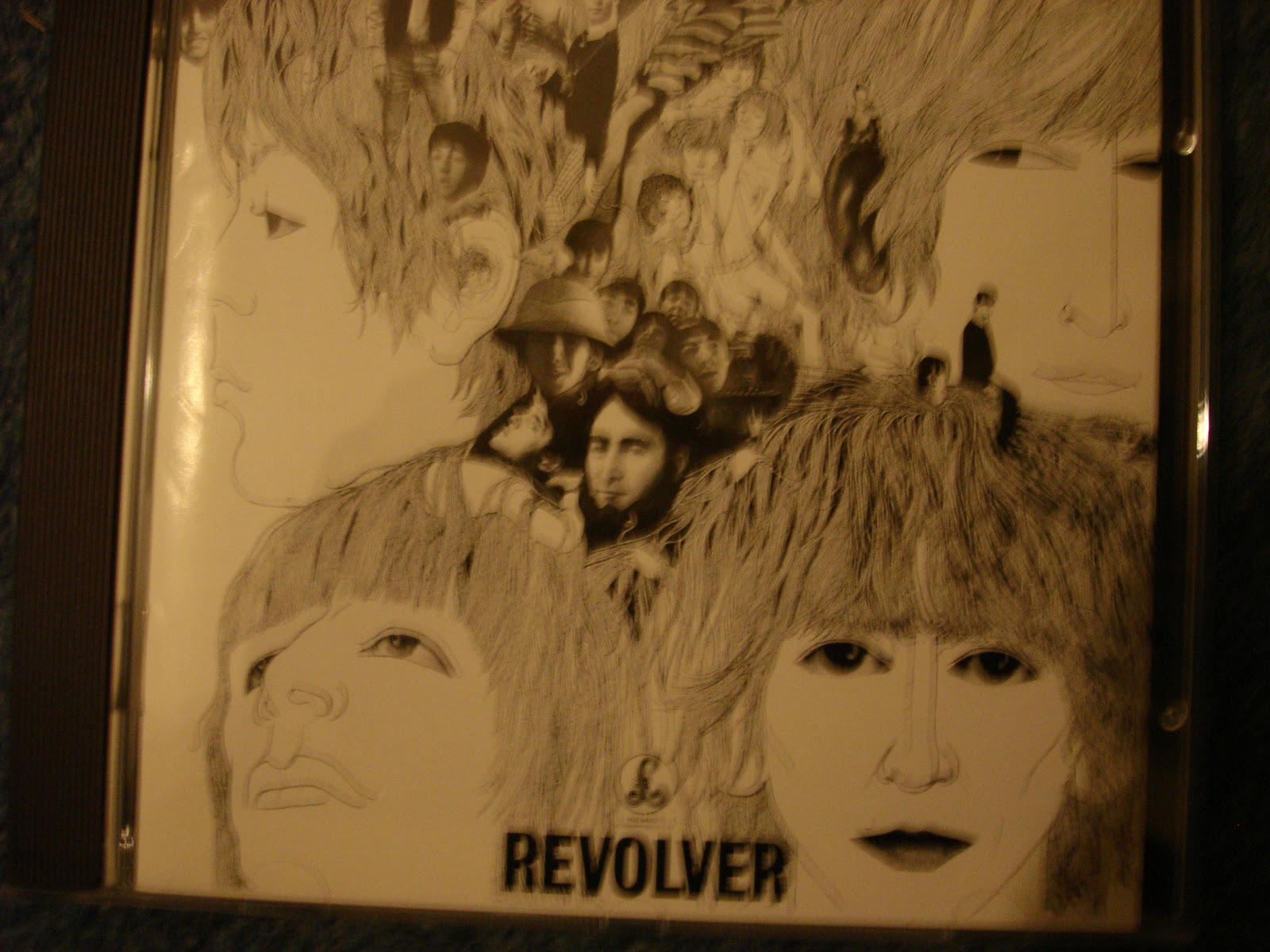
Revolver - The Beatles - album review

Of all the albums recorded by The Beatles, perhaps none more epitomised the Swinging Sixties than Revolver, released in 1966.  Embodying some of the sunny optimism of the time, but also exuding a sophistication and a keener affinity with counter-cultural concerns.

This record was made when The Beatles were still a touring band, before their retreat into a more reclusive and studio-bound existence. Although some of the tracks on Revolver are very much studio creations, others very much inhabit guitar-band territory, with added "attitude" and occasionally tinged with a nascent psychedelia.  One can discern the influence of 1966-era Beatles guitar-orientated material in the New Wave groups of the late 1970s and early 1980s, and even in later indie bands.

Having said that Revolver exudes the vibrancy of its era, it is also worth noting that the scope of its lyrical concerns was very broad, encompassing more social commentary than before, and containing many references to emergent underground culture. The Beatles were by no means unique in exploring virgin subject matter, but the sheer variety of the topics on Revolver is remarkable. Death, taxes, loneliness, consciousness, war and mind-altering substances - they are all there.


It is often said that the complementary strengths and approaches of Lennon and McCartney were some of the ingredients which made the Beatles special.  However on Revolver such simplistic pigeon-holing is not really applicable, as both men are in creative and restless form.  It cannot be smugly declared that one songwriter's contributions are edgy and subversive, whilst the other's are more conservative.  The fact that both rise to the occasion, and push themselves, helps give the album additional depth and sweep.

The record's closing track, "Tomorrow Never Knows" doesn't so much close the book on one era, as open a door and peer into an exciting but unpredictable future.  I would argue that the song has been excessively acclaimed in purely musical terms, but symbolically, and as a statement of intent, its effect was startling, probably more so on their peers and the "in crowd" than on Joe Public.

The continued blossoming of George Harrison added another dimension.  His often contradictory concerns were being projected with greater clarity, as exemplified by "Taxman" and "Love You To", and this greatly augmented the group's eclecticism and mystique.  This was the stage at which George truly advanced from being a mere guitar player to something much more integral.


Many of the songs on Revolver are pervaded by a peculiar, almost sleepy and indolent, ambience, which sets it apart from the warm crispness of Rubber Soul and the flawless perfectionism of "Sgt Pepper". Production techniques may have played a part, but there could have been other contributory factors.

There were sign-posts for the future, with unconventional instrumentation and studio experimentation, but The Beatles never lost sight of the fundamental importance of good songwriting and craftsmanship, and these sensibilities are on full display on tracks such as "Got To Get You Into My Life", "For No One" and "Here, There and Everywhere".

Listening to the record, I am also reminded of the apparent effortlessness with which this album was turned out. On other Beatles albums, for all their undoubted quality and charm, one can sense how hard they were trying.  On Revolver, very little feels "forced" or calculating.  It was as if creativity and ideas were flowing naturally from the musicians, with no need for gimmicks or pretension.

Revolver represents a peak of sorts.  Other artists would have sensed that they had nothing further to say, but time would amply demonstrate that The Beatles were in many respects only just beginning....