Tuesday, 28 February 2012

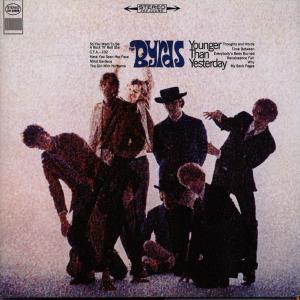
Younger Than Yesterday - The Byrds - album review

It is a trait of the music world that often bands only attain genuine critical acclaim when their records become less commercially successful.  Sometimes this is genuinely down to the greater profundity of the music, but one is often left wondering what was "wrong" with the earlier work. Perhaps shifting millions of units makes something inherently suspect in the eyes of some.....

The Byrds are an example of this phenomenon.  After their initial burst of success in 1965/66, their music became experimental, and therefore less appealing to the masses.  These days, when serious critical study of their catalogue is conducted, the period of 1967/68 is lent most credibility.


Younger Than Yesterday was very much a transitional album.  Gene Clark was no longer involved with the group, and his departure had the effect of liberating and motivating the other songwriters in the Byrds.

Certainly on this album David Crosby made some of the most concise and expressive musical statements of his whole career, the spine-tingling "Everybody's Been Burned" being the highlight.

The most surprising side-effect of the re-alignment within the Byrds was the emergence of Chris Hillman as a songwriter of real stamp, and his vocal and instrumental contributions also became more prominent. "Have You Seen Her Face" is one of the hidden gems in the Byrds entire canon, with its engrossing melody and dense guitar sound.

Younger than Yesterday is less compact and cohesive than its successor, The Notorious Byrd Brothers, or even its predecessor, Fifth Dimension, and this can leave it sounding quite dissonant in comparison.  However, song-for-song it is stronger than either of those albums, and has some moments of sheer beauty and genius (in addition to the songs already mentioned, "Renaissance Fair" comes to mind).

Unlike their earlier records, this one feels like a modern rock album, with the involvement of guests and session musicians providing variety and texture.  This all represented a shift away from the staid "beat group" format.  Foremost among these guests was Clarence White, whose distinctive "twangy" guitar parts would become a feature of later Byrds efforts.

I know that there has been come criticism of the decision to include a cover of Bob Dylan's "My Back Pages" on this LP.  Amongst the innovative and adventurous material, it sounds like a backward step.  I would not disagree, but the Byrds make a fine fist of the song, and it acquires an even more wistful tone in this setting.

In keeping with the Zeitgeist, and their own musical detours, there is continuing evidence of the influence of Indian music and jazz.  On the psychedelia front, only "Mind Gardens" misses the bullseye, appearing somewhat self-indulgent and pretentious.  Admittedly, this was not uncommon in the music world circa 1967!

The closer on the original album, "Why", sounds more futuristic even than some of the other numbers, and tracks like this help to explain why the Byrds became so seminal a touchstone for many acts of future decades.

If you are searching for the ultimate psychedelic rock album, albeit one which retains a core of catchy and memorable songs, then Younger Than Yesterday may just be it.


Saturday, 25 February 2012

F1 Testing in Barcelona

I predicted in an earlier blog post that the formbook would began to "crystallize" during the testing this week in Barcelona, in the wake of events in Jerez.

Looking purely at the headline time-sheets from Barcelona, it is tempting to suggest that the situation is even more confused than following the earlier session. Even if some of the lap-times seem even more unrepresentative of the true picture, there are also signs that the cream is slowly but surely beginning to rise to the top.

Sebastian Vettel have been consistently quick, in their matter-of-fact, undramatic fashion.  The times recorded during longish runs look distinctly ominous for their rivals. McLaren maintained a lower profile in Barcelona, working methodically, and seemingly reasonably content. Positive noises were emanating from Lewis Hamilton about the performance and potential of the car, and this augurs well, even if Red Bull possess a slight but significant edge at present. After the negativity surrounding them a couple of weeks ago, there are indications that things are looking brighter for Ferrari.

Perhaps the most genuinely interesting development of the week was the first serious appearance of the new Mercedes, and the fact that it was quick straight out of the box.  Michael Schumacher seemed pleased with progress, although drivers tend to make these kinds of utterances pre-season, even when the true state of play has not yet made itself plain.  I would suggest that Michael's voice and opinion carry more weight than some other people!

Although there were reasons for Force India and Sauber being particularly swift at some junctures, both of these teams appear to be moving in the right direction.

Will the top teams show their hand, or more of their hand, at the test in early March?  Possibly, but don't bet on it....

Friday, 24 February 2012

On The Beach - Neil Young - album review

Just recently, I blogged about Neil Young's classic 1975 album, Tonight's The Night:

Tonight's The Night - Neil Young


Habitually, another album is tied together with Tonight's The Night as representing a particular stage in the singer-songwriter's career. That album is On The Beach:


It is indeed tempting to lump these two albums together, but I think that this a simplistic way of looking at things. They are markedly dissimilar in musical terms, and the mood is subtly but importantly different.

For me, On The Beach has a certain automony within the Neil Young body of work, operating outside the frameworks of most of his other albums of that era. It is illustrative of his urge to continue his restless musical and philosophical journey, rather than rely on old formulae.

Whereas Tonight's The Night, which was recorded first, had a semblance of a common thread musically, On The Beach is quite diverse, and the palette is expanded to include relatively unusual instruments, such as electric piano, banjo and fiddle.  There is none of the redeeming jauntiness of whimsical bluesiness.  These songs are more brutal, and unsettling.  The fact that the songs are all "self-contained" adds to their potency.

On The Beach has an undercurrent of resignation and quiet despair, and there are lyrical references, oblique and otherwise, to Watergate and counter-cultural neuroses of the time. This is combined with examinations of the paths and lifestyles of the artist and his contemporaries.  A very apt document of its times, in many ways.

The stand out-tracks are "Revolution Blues", with its sinister and disturbing lyrics, the deceptive and under-estimated title track, and the closer "Ambulance Blues".  The latter is one of Young's real gems, harking back almost to his folk-troubadour days.

On The Beach was unavailable on CD for many years, and this helped to generate an air of mystique around it.  Whilst the reality could not really hope to match the mystique, it is a unique album, and one of Neil Young's most important releases.


Thursday, 23 February 2012

The Hundred Years War - Desmond Seward

Over the past two years, I have read quite voraciously, and have managed to fill in some of the gaps in my knowledge of European history.  One area which had somehow eluded my grasp had been the Hundred Years' War.  I possessed a rudimentary awareness of Agincourt, Henry V, Joan of Arc, and so on, but had not gone into the finer points.  Desmond Seward's excellent book, A Brief History of The Hundred Years War, has enabled me to rectify this.


This is of course an enormously broad subject, but Seward succeeds in condensing things into digestible form, while still giving the appearance of thoroughness.  The tale is presented in chronological order, with the chapters sensibly corresponding roughly to the prime of the reign of certain English and French monarchs.

The richness of the story is augmented by the use of quotations from the contemporary reports and chronicles, delivered in the language and prhaseology of the day.

I approached this book with an open mind, but was quite shocked and disturbed at how brutally and mercilessly the combatants behaved in pursuing their objectives, including with regard to their treatment of civilians.  Both sides were culpable, but the English especially seem to have displayed few scruples.  The avarice and amorality of the participants is also strongly depicted.  Henry V in particular does not emerge as a very likeable figure. Different times, I accept, but the descriptions of some of the atrocities committed are enough to chill the blood.

The author, from my standpoint, slightly downplays the military and strategic importance of Agincourt, and also has a more nuanced interpretation of Joan of Arc's role than what I suspect is usually offered.

The final chapters deal with the swing in the pendulum away from the English and towards France, and the slow but sure decline in the fortunes of the former. The financial woes of the English are detailed, as are the advances in military technology which gave France some of its ascendancy as matters approached their conclusion.

Also covered towards the end of the book are the recriminations, and assorted rebellions and insurrections, which followed the English loss of territory and prestige.

I found this to be a very enjoyable and informative book. Presented in a jaunty, readable, non-confrontational style, it is well pitched, appealing to casual readers, but also I would suggest containing sufficient detail and analysis to attract keen students of its subject.


Wednesday, 22 February 2012

Tonight's The Night - Neil Young - album review

Every so often, artists or groups opt to take what is perceived as a diversion in their career path, but sometimes this is quite calculating, and intended merely to enhance their degree of "hipness" and mainstream success.

In the case of Neil Young, following the colossal success of 1972's Harvest, he deliberately took a detour, not for any other reason but to explore new territory and escape the treadmill.  Perhaps the most authentic and compelling product of that decision was Tonight's The Night, recorded mostly in 1973, but not released until 1975.


In addition to a conscious desire to defy stagnation and convention, the music which Neil Young wrote and recorded around this time also clearly addresses the fall-out from the era just past, and its impact on rock culture. The deaths of Crazy Horse guitarist Danny Whitten and roadie Bruce Berry cast a shadow over this album in particular.

Throughout Tonight's The Night, the arrangements and performances are ragged and almost disjointed, contrasting sharply with much of the singer-songwriter's previous work.  As well as signifying an intentional stylistic departure, the basic bluesy approach perfectly complements the lyrical subject matter.

The instrumental hallmarks of the album are also fundamental to its artistic success.  Nils Lofgren's brittle but superbly evocative guitar work is often to the fore, as is the weeping pedal steel guitar of Ben Keith.  The latter, and Young's harmonica are, essential to the subdued mood of several tracks.  These element are supported by the redoubtable Crazy Horse rhythm section.

Neil Young's vocals are as ragged as the backing tracks, sloppy and haphazard, or more accurately perhaps a natural consequence of the turmoil contained in the words of the songs themselves. The croakier, harsher Young voice proves perfectly expressive here, and in keeping with the uncompromising central thrust of the work.  It is safe to assume that very few overdubs were performed during the sessions.  What would normally be seen as mistakes and blemishes were left in....

Despite the melancholy and often rancorous vibes, there is kind of nobility and defiance about Tonight's The Night, which for me is central to its appeal - a "ragged glory", to borrow from one of Neil's later album titles.  Some of the dark humour contained in the lyrics helps to encourage this feeling.

Three of the tracks, "Mellow My Mind", "Albuquerque" and "Tired Eyes", are quite similar in style and melody and, astutely separated, constitute the emotional backbone of the album, together with the bookends of the title track and its reprise.

For the unwary I would expect that Tonight's The Night is an awkward listen at first, and in this and other respects there are parallels with the Stones' Exile On Main Street.  However, as a snapshot of an artist's state of mind, and as a slice of raw emotional candour, this album has few equals in rock music.


Sunday, 19 February 2012

A Bridge Too Far

Very recently, at a loose end one afternoon, I opted to revisit the 1977 war film A Bridge Too Far, directed by Richard Attenborough.  It recounts the tale of the ill-fated Operation Market Garden of World War Two.

The movie begins with an effective and evocative black and white newsreel passage, which sets the scene, and places the operation to come in its proper context.

The term "star studded" does not even begin to describe A Bridge Too Far, although none of the performances stand out in particular, generally tending to cancel one another out.  None of the luminaries is given sufficient screen time to make a special impression. Among those featured are Dirk Bogarde, Ryan O'Neal, Sean Connery, Gene Hackman, Robert Redford, Edward Fox, Michael Caine, Anthony Hopkins, James Caan and Laurence Olivier.

The early scenes of the movie naturally concentrate on the preparations and planning of both sides. Cleverly, the viewpoint of Dutch civilians and resistance activists is also shown. The misgivings of some Allied commanders are also displayed, as well as to what degree the combatants read (or mis-read) the intentions of their opponents.

The rushed and improvised nature of the Allied plan is also emphasised, with subordinate commanders more often than not unwilling or unable to register the doubts about the operation, for fear of being ridiculed or demoted.  One courageous reconnaissance officer spoke up, but was ignored. Whether this is absolutely historically accurate or not is hard to say, but it enhanced this reading of the story.

Some effort is made to contrast the egotism of some commanders, dazzled by prizes and glory, with the reservations and fears of the rank-and-file.

In amongst the glittering cast, I must mention one performance; that of Edward Fox as Lt. Gen. Horrocks. This seemed like a passably accurate, if exaggerated, portrayal of the man, capturing some of his character.

Credit also to the film-makers for having Dutch and German dialogue (and subtitles).  This for me increased the authenticity.

One thing which I noticed about this film is the quality of the cinematography, and the camera-work, which looked to be quite advanced for its time.  There is almost an intimate/documentary feel about some of the battle sequences, bringing the viewer close to the action, typified by the parachute jumps. Sharp editing and well-judged sound also help to strengthen the sense of believability.

As the campaign goes on, we are shown the sense of desperation which starts to intrude on the operation, with some gallows humour and sarcasm, and dissension in the ranks. From the bravado and optimism of the beginning, this movie takes on a bleaker, and more thoughtful, tone. The vast scale of industrialised war is inter-cut with more considered, personal sub-plots.  The sense of weariness,fatigue and hopelessness gradually takes over.

The latter stages of the film dwell on the destruction,misery and futility of war, and how civilians are disproportionately affected. The finale is sombre indeed.

I do not think that A Bridge Too Far is a masterpiece, but it is a decidedly above-average war movie.

Saturday, 18 February 2012

Rites of Peace - Adam Zamoyski

During the past two years, I have read and watched quite a bit about the Napoleonic Wars, but comparatively little of this research had centred on diplomatic and geo-political matters, particularly those which became pressing in the years 1813-1815.  This has been remedied by my reading Adam Zamoyski's admirable book, Rites Of Peace.


The early stages focus on the completion of Napoleon's retreat from Russia, and the efforts of the other powers to position themselves to capitalise on the fall-out from his imminent downfall.  The scene is set, and developments placed in their overall context.

Attention is paid to the differing agendas at work, from Tsar Alexander's sense of destiny and mission, to the tension between Austria and Prussia, and the suspicion aimed at Britain, which was viewed as ignorant of the niceties of European diplomacy.

Zamoyski also introduces us to some of the principal diplomatic players, with colourful anecdotes about their characters and backgrounds.  He also begins to unravel and explain the bewildering intricacies of the age, and how interwoven the various countries were by treaty, alliance, marriage, religion and history.

The bargaining and horse-trading could be confusing for even dedicated historians, but Zamoyski does a commendable job of condensing and streamlining the developments,  whilst still seeming to be thorough.

Also in the early chapters, we find out about the desperate attempts by Napoleon to shore up his alliances, and the equally devious and creative methods employed by the "allies" to persuade rulers or armies to defect or declare neutrality.  As these matters progress, there is a palpable withering of morale and enthusiasm in the French camp, belief ebbing away....

We also see how the divisions and discord in the Allied camp intensified as the armies approached the borders of France itself, Russia and Prussia advocating pressing forward, Austria more circumspect.  Britain seemed handicapped by the fragmentation of its diplomatic team "on the spot", but also concerned at being marginalised and deprived of some of the spoils.  France still entertained hopes of profiting from any discord amongst his foes, to secure more honourable terms.

Throughout the book, we are constantly given quotes from the diaries, letters and papers of some of the protagonists. These help to supply an insight into the state of mind and motivations of these people. This is particularly true in the case of  Metternich, the Austrian Foreign Minister.

Some gaps in my knowledge were certainly filled, mainly on the Allied approach to Paris, and the negotiations which followed.  The covert discussions conducted by Alexander are covered in depth, in particular the feeling that he was too magnanimous in his approach. The reasoning behind the return of the French monarchy would certainly strike modern eyes as quaint and curious.

One thing which struck me about Rites of Peace is how some major events themselves were given scant coverage.  This is no bad thing, as the pivotal battles and ceremonies are covered painstakingly in numerous other books.  Zamoyski prefers to concentrate on the work of the diplomats and sovereigns themselves, and their personalities and quirks.

Moving on to the Congress of Vienna itself, the scene is well set, the difficulties and challenges highlighted.  A constant theme is the precarious nature of the Coalition, its cracks and fissures, and its perpetual state of near-collapse. The ongoing attempts of the diplomats to keep the show on the road are beautifully detailed by Zamoyski.

The social scene in Vienna is colourfully depicted, and the romantic dalliances and lavish occasions do help to break up the paragraphs on political discourse.  However, I must admit that I found myself scanning through these passages after a while.  Once you've read about one extravagant occasion, you've read about them all!

Much of the emphasis in the chapters covering Vienna is on the erosion of trust and solidarity between the allies. Napoleon had been defeated and ousted, and having achieved this, the powers permitted old animosities and tensions to resurface.  The vexed questions of Saxony and Poland almost led to war, and Zamoyski leads us adroitly through the discussions which led to some kind of settlement. He also details the lingering resentment harboured by many smaller countries and territories, who felt left out and patronised by the big powers.

Of course, as matters were being tied up in Vienna, Napoleon was re-entering the drama, and reading the paragraphs on this, there is a sense of initial panic and dismay, followed by grim resolve to confront the situation.

In keeping with the approach of the book, Zamoyski does not dwell overly on the military technicalities of Waterloo, but devotes his attention to its repercussions, the unpredictability of the Tsar becoming an ever greater concern. 

After documenting the resolution, or not as the case may have been, of the outstanding territorial issues, the author examines the legacy of the Congress of Vienna, and the period generally.  Many of the purported ideals and objectives of the Powers were either forgotten or simply not implemented. Much of Europe reverted to the clammy grip of absolutism and repression.  Reactionary forces sought re-entrenchment.

Looking at what occurred in Europe after Waterloo, one could be forgiven for wondering whether some had put on a facade of enlightenment in order to secure some moral high ground during protracted discussions. The gains achieved were not always used to advance freedom or justice, but rather to buttress the power of those who wished ultimately to curtail and limit those things.

The last chapter is somewhat downbeat, almost seeming to question which causes were actually advanced or served by the battles won and the treaties signed. Many of the people and ideas defeated by the Coalition soon seemed more wholesome and edifying than those of the victors, and the flaws in the settlements, and the arrogance displayed by the major Powers, may have simply served to fan the flames of agitation and nationalism in parts of Europe.

I would have perhaps liked to have seen more dissection of the struggle between liberal and conservative ideas at the time, but appreciate that this falls largely outside the remit of the book.

Overall, though, Rites of Peace is a very worthy, readable and informative piece of work.  It certainly gave this reader ample food for thought....