Saturday, 23 November 2013

Blonde On Blonde - Bob Dylan - album review

It is often said that the series of albums recorded and released by Bob Dylan in the period 1965-66 represents one of the most fertile bursts of creativity of any artist, ushering in the "rock" era by making mainstream popular music socially relevant and worthy of critical and erudite analysis. I too subscribe to these theories, but in recent times the worthiness of Blonde On Blonde to belong in the same company as its two predecessors has become questionable to me. I sense a propensity to bracket the record with those which went immediately before it, simply because it was Bob Dylan, and that it must be similarly wonderful because to say otherwise would spoil the narrative...

The two albums which came before, Bringing It All Back Home and Highway 61 Revisited, were effervescent efforts, brimming with creativity, bearing all the hallmarks of a man with lots to say, and who was eager to express himself. There was a breathlessness, spontaneity and urgency about the songs, which must have seemed at the time to form an inexhaustible reserve.


It is curious that Dylan himself has been quoted as saying that Blonde On Blonde constituted the "sound" which he had been aiming for all along.  There is certainly a "progression" of sorts in the character and ambience of the three albums, from the vitality, energy and bite of Bringing It All Back Home to the jaded cloudiness and ennui of Blonde On Blonde. The fact that the great man's career took a dramatic detour immediately afterwards may or may not be instructive....

There is a deceptive listlessness to many of the songs, particularly the longer "epics" such as "Visions of Johanna" and "Sad Eyed Lady of the Lowlands". On the other side of the coin, I have come to regard many of the tracks as bordering on "comedy songs" ("Rainy Day Women #12 & 35, "Just Like A Woman", "Leopard Skin Pill-Box Hat"). This may indicate that my hipster antennae are insufficiently developed. Their exuberance does at least balance out and alleviate some of the gloominess which otherwise pervades the work.

When saying that on close inspection the songs are not as instantly and spectacularly memorable as those on the two earlier records, it is also true to say that Blonde On Blonde hangs together very well as a mood piece, the kind of album to immerse oneself in on a rainy Sunday afternoon. The lack of immediate accessibility demands a patience which not everyone possesses!

The lyrics are less cryptic and oblique than on earlier records, but in their own way just as enigmatic and impenetrable, if less conventionally evocative.  Equally, the soundscapes are more murky and nebulous. These factors do contribute to the album's relative absence of overt sparkle and immediacy, but they also imbue it with its distinctive quality.

Although it is commonly asserted that the "turning point" in Dylan's career occurred shortly after this album was released, it might be more accurate to state that Blonde On Blonde itself signals a new beginning. Despite all all my caveats, provisos and reservations, it is still a rewarding and ultimately enjoyable listen, and essential to an understanding of the Dylan mystique....

My blog posts about other Bob Dylan albums:

Blood On The Tracks

Highway 61 Revisited

Bringing It All Back Home


Thursday, 21 November 2013

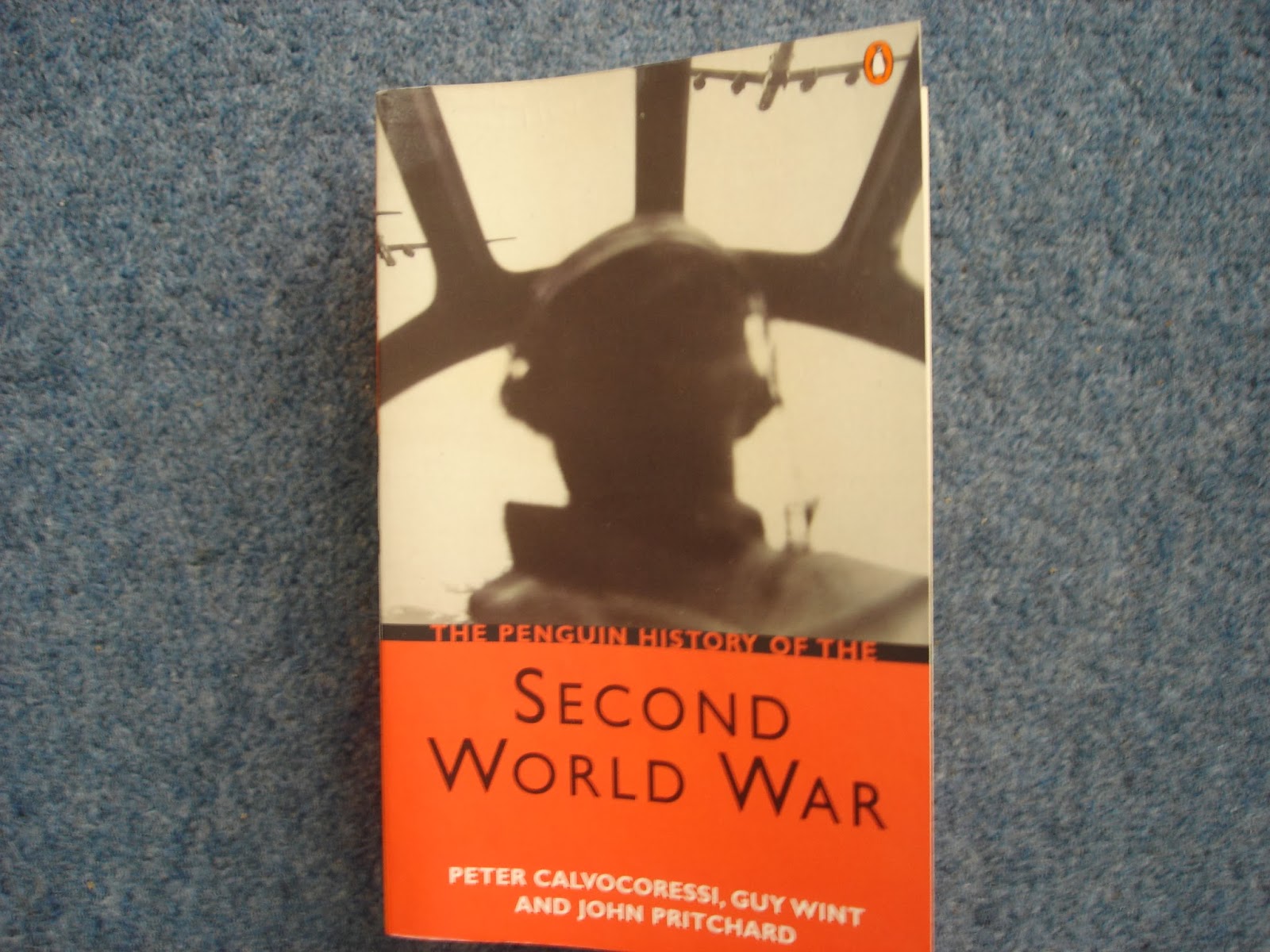
The Penguin History of the Second World War

The Second World War is such a vast and complex subject that it is very difficult to find books about it which achieve the twin aims of being comprehensive and authoritative, whilst at the same time having something different and thought-provoking to say.  Those which give emphasis to matters of broad strategy and diplomacy, rather than the minutiae of military tactics, are particularly valuable. Falling into this latter category is "The Penguin History of The Second World War", by Peter Calvocoressi, Guy Wint and John Pritchard, originally published in 1972. This was a revised edition from some years later.


There is a forthright description of the events in Europe in the 1930s, including some fairly trenchant observations on what might have happened if Britain had been more obdurate and hawkish during the crisis over Czechoslovakia.

I really enjoyed the passages which commented on the major leaders, and their assorted virtues and frailties. I was (pleasantly) surprised by much of the appraisal of the respective parts played by Roosevelt and Churchill, in that it went against the grain of much of the hackneyed "wisdom" to be found in modern-day accounts. Throughout the relevant parts of the book, the interaction between the "Big Three" is assessed conscientiously. I was interested in the observations about "the race to Berlin" in 1945, and the prominence of Allied military leaders in the decision-making process.

There are superb and sobering chapters focusing on how the Nazis treated and administered occupied Europe, and how these policies affected people and the course and conduct of the overall war. Loyalties often converged and diverged due to the vicissitudes of the war. Grievances and suspicions, which were often fuelled by emotion and propaganda in the heat of conflict, are weighed in some detail.

The complex and fluid dynamics of France, from the perspective of Vichy, de Gaulle and the Resistance, is explored in a clear, compassionate and enlightening fashion. The equally elaborate and byzantine scenario in Italy is accorded similar treatment.

Where this formidable tome differs from other similar efforts is in the weight of emphasis placed on the war in Asia and the Pacific, and its origins in China and Japan. Indeed, the revised edition is effectively divided into two parts, the first dealing with European and related theatres, the second the Far East. Great care is taken to document the process by which Japan arrived at the state of affairs which triggered its conquests in the 1930s and early 1940s, with dissections of its alliances with Great Britain, and the ramifications of the war against Russia in 1904/05.

We see how Japan's embarkation on a certain course tied in with, and was affected by, developments in Europe and elsewhere, and how the imperial ambitions of the other Powers in the Far East contributed in determining Japan's approach and mentality.

The importance of China is stressed to a degree uncommon in many latter-day accounts. This is all explained with coherence and confidence, especially how the respective Japanese and Western attitudes to China helped to bring about the eventual catastrophe.

The reasons for Japan's gradual estrangement from the West in the years following the First World War are outlined, as is the manner in which the military influence became stronger and more embedded.  Some insight is provided into the ethos of the armed forces, and the peculiar way in which they at times related to the population at large. Of interest to me was the sense that although Japanese society developed on the surface along Western lines, imitating institutions and policies followed by Europe and America, the outlook and practices which developed were distinctive and unusual.

The chronicles of military campaigns and other episodes are unpretentious and uncluttered, occasionally balanced out by raw statistics to illustrate points, especially dealing with the war economies and grand strategic matters. There are also some pointed and perceptive commentaries on the societal impacts of the conflict and its aftermath.

To summarise, for a slightly different perspective on this vast, complicated and emotive subject, this book comes highly recommended.


Monday, 18 November 2013

The Sleepwalkers - Christopher Clark - book review

After being hugely impressed by his imperious book "Iron Kindgom", a study of Prussia, I was excited to discover that Christopher Clark had written an analysis of the events which led up to the outbreak of the First World War. This book is entitled, quite aptly, "The Sleepwalkers".

Many television documentaries about military history receive deserved plaudits, but the more I read the more I realize that even the most substantial of these programmes are at best superficial, at worst downright misleading. Such documentaries are superbly produced and entertaining, but in order to acquire any authoritative understanding, it is essential to read meticulously researched investigatory works. The Sleepwalkers is the type of study which reinforces this view. It is a truly masterly piece of scholarship, impressive both in its scope and its flavour.


Even in the early pages, I was struck by Clark's characteristic capacity to blend intricate language with an accessibility and infectiousness which compels people to read on. This was one of the great joys of "Iron Kingdom".

Refreshingly, the "how" tends to supersede the "why". No preconceptions and smug premises. He takes a detailed and open-minded look at what unfolded in the run-up to the conflict. Beginning with receptive minds helps to minimize prejudices and inflexible conceits.

Early on, there is a clear and lucid account of how Serbia's position, and that in the Balkans generally, evolved. The minutiae are probably little known to most people. We are reminded how economic and social conditions in a country can impinge on its fate.

As regards Austria-Hungary, a somewhat different picture is painted than is ordinarily the case. The empire is portrayed as more benign, and less recalcitrant, than is customary. The Habsburgs were not entirely blameless, but equally they were battered by extraneous factors. The author also stresses the impact of the peculiar "dual monarchy" and the attendant machinery of government.

Throughout the book, there is superb examination of the motives and insecurities behind the alliances which emerged in the decades leading up to 1914. An example of this is the suggestion of how suspicions about Britain's intentions and reliability contributed towards the Franco-Russian understanding. Clark allows himself time and space to elaborate on these processes, but does so cogently.

Much of this work is given over to an analysis of the fall-out from conflicts, imperial ambitions and trouble-spots in the preceding decades, and their effects on international relations, allegiances and diplomacy. Particular attention is paid to the Moroccan crisis and the Balkan Wars, and also to the ambitions of Russia in central Asia and the Far East.  These chapters underline the extent to which the cementing of alliances was partially dictated by calculations arising from matters on the periphery.

The book slowly begins to focus on the salient factors, and the extent to which the blossoming of the Entente alliance isolated Germany, whose assumptions and calculations could no longer sustain the desired balancing act. Clark cleverly and convincingly argues how hostility was focused and channeled, with the Balkans assuming greater gravity as tensions elsewhere were subdued or diminished.  The mechanisms by which the orientation of Turkey and Bulgaria occurred are revealingly related.

I was particularly impressed with the passages devoted to an explanation of the foreign policy machinery which existed in the European states, and how this affected developments. The account of the role, approach and outlook of Kaiser Wilhelm II is possibly a little at variance with the widely accepted view.  Attention is drawn to the indistinct and multi-faceted structures in some of the nations, and how these influenced the course of the crisis. The detailing of cliques, factions and upheavals is expertly and tidily undertaken.

Some stress is given to the role of the Entente Powers in tacitly sanctioning sorties, for example Italian operations in Libya, which had repercussions, including in the Balkans, and the attempts of the Central Powers to discourage such moves. Again, stripping away the veneer of popular conceptions about what elevated tension, and who was culpable. The author also points out instances where "nationalism" was used as a cloak for avarice, self-interest and megalomania.

There is a probing exploration of apparent French belligerence and assertiveness, and its assessment of the strategic implications of Germany's "two-front" dilemma. The analysis of the rough and tumble of French political life is valuable, as is the depiction of the fluctuations in sentiment seen in both Russia and Britain.

An extensive look at the fallout from the Sarajevo assassination is naturally an important part of this book. During the July crisis itself, whatever its strident behaviour of preceding years, was Germany guilty of misjudgment rather than malevolence, particularly concerning Russian intentions in the Balkans?  Clark highlights ambiguities in the sequence of events which are seldom included in modern accounts. It also becomes clear how many of the Powers formulated multi-layered approaches to the situation, downplaying the chances of others intervening whilst clinging to allies in the event of war.

Austria seemed blinkered in its obliviousness to the prospect of external interest in the Balkan theatre. The Austrian ultimatum to Serbia also comes into sharp focus, including the degree to which the Serbian response was conditioned by the likelihood of Russian support.

This work also looks at less publicized aspects of the crisis, such as the attitude of the Hungarians and the minorities within the Habsburg lands, and France's campaign to embolden and bolster Russian resolve to intervene on the side of Serbia.

It is interesting to note how fixated the Entente Powers seemed on preserving their alliance by whatever means, rather than in objectively appraising Austrian (and German) intentions on the Serbia issue. The importance of Russian mobilization is also thrown into sharp relief. In this reading, there appeared to be a distinct absence of war-mongering on the part of Germany.  In fact, imperial Germany comes across less as almighty and overbearing than clumsy and inept.

We also get a brilliantly articulated critique of how Britain arrived at its decision to get involved, the strategic balancing act which it attempted, and the domestic considerations which weighed heavily.

In recent times, it seems to have become the norm to observe that all of the combatants were claiming defensive motives, and seeking to portray others as the aggressors.  I would contend that this book adheres to that view to some degree, but crucially it fleshes out the subtleties and discrepancies.

In conclusion, this is an insightful, fast-paced and enlightening read.


Thursday, 14 November 2013

Emil and The Detectives - Erich Kastner

I must have read dozens of books during my childhood, and the appeal of many of them was quite ephemeral. However, a few stood out as having a lasting impact, still evoking fond memories today, but also carrying greater moral weight, as opposed to simple pleasure, escapism and wonder. One of these was the wonderful "Emil and the Detectives", by the German author Erich Kastner, published circa 1929. Reading this story seemed to be an obligatory aspect of the education of children of my generation, and we turned out alright, didn't we?

On a whim, or possibly due to some other sub-conscious yearnings, I recently purchased the book, and it is interesting to note the messages and morals which are more clearly discernible in my adulthood.


The book follows the adventures of the young Emil, who has some money stolen by a mysterious stranger whilst travelling from his home to Berlin to visit relatives. Upon arriving in the big city, he follows the culprit, and is then joined by other boys in efforts to apprehend the thief.

Some themes emerge quite quickly in the early chapters. The sense that the world was still a very big place, as exemplified by the awe employed in descriptions of Berlin, and the regular references to "provincial" concerns. The depiction of families in smaller towns and cities as more close-knit than in the bustling metropolis, with their retention of simpler, less materialistic values.

A sub-text which also suffuses "Emil and the Detectives" is the relationship between the establishment, or ruling classes, and the "little people".  Emil and his associates are wary of contact with authority figures, both out of fear, and also a suspicion that such elements are more interested in protecting the position of the rich and powerful than serving the rights of the populace at large.

I feel that the book also captures some of the alienation of many people in the inter-war years, feeling daunted and "left out" by social and economic changes and upheavals, society becoming ever more fragmented and impersonal because of industrialization and technological advancements. In the end, timeless human qualities and virtues are seen to over-ride and conquer these challenges.  Essential decency and integrity are appreciated, valued and rewarded.

There is also some gentle examination of "generational issues", not surprisingly when most of the characters in the story are children or teenagers! It is insinuated that those from humbler backgrounds have more amicable relations with their parents and wider family, who are more inter-dependent than those hailing from the more "exalted" strata of society...

The undercurrent which I detected was of the author's sympathy for, and solidarity with, the downtrodden and the disenfranchised, with an inference that such people, despite their travails, maintain a dignity and an honesty in their endeavours which is often absent from other echelons. This point is implied with much finesse and subtlety by Kastner.

When dissected in socio-political terms, "Emil and the Detectives" poses questions, albeit in a benign and often cryptic fashion.  However, to me its main conclusions and outcomes are hopeful and optimistic, to the effect that justice and love will usually prevail in the end....


Monday, 11 November 2013

Italian Journey - Johann Wolfgang von Goethe

A little while ago, I purchased a compilation of some of the works of Johann Wolfgang von Goethe. In working my way through it, I read the fascinating Italian Journey, which is based on diaries and letters written by the author during his travels in Italy in the years 1786-88. It seems that it was subsequently fine-tuned and added to, and was not published until many years after the event(s).


Much of Italian Journey is taken up with Goethe’s observations about nature, climate, architecture, art ,and social mores. His scientific theorizing also gets a substantial airing, as does his keen interest in mineral deposits and volcanoes!

In addition to being an entertaining document of a learned man’s travels, Italian Journey may also be seen as a snapshot of a time in history. The regions being explored by Goethe may not all have been undergoing quite the pace of change being seen elsewhere, but he offers a window on how people lived and sustained themselves, and how, if at all,they were being affected by new ideas.

Goethe’s experiences are described in colourful and often humorous detail.  Although he strives to be tactful and constructive, he is occasionally quite blunt in his appraisal of places, people and cultural artefacts.  

I felt that the writings became livelier and more robust when he reached Naples and then Sicily.  Less equivocal, and perhaps a sense of perspective is enabled by memories of his other stop-off points.  An accumulation of sights, sounds, exchanges, encounters and experiences makes his opinions seem more coherent and pungent.  As the journey unfolds, he is not afraid of flouting cosy consensus or dispelling myth.  The passages on culture, landscape and topography are broken up with some amusing tangential tales concerning local characters and traditions.

Goethe does not shrink from hinting at his ambivalence about some religious practices and political and social institutions. Such verdicts are expressed cryptically, but equally leave the reader in little doubt where his sympathies lie.  He seems to judge people on what resides in their hearts and minds, and not on their nominal rank or title.  This is refreshing.

As I became more engrossed in this work, I increasingly wondered what a 21st century equivalent would look and feel like.  Yes, people do travel widely today, and they do write perceptively and enticingly about their thoughts and experiences, but the particular tenor of those times, and Goethe’s unusually wide range of interests and concerns, give his writings here genuine character, depth and novelty.  Extra interest stems from the imagery of “forward thinkers” being hemmed in by, and coping with, the restrictions imposed by those times.  Creative people, reconciling the past and present with a changing world and fresh attitudes.

A modern day variant of Italian Journey would probably involve one of the polymaths of our times embarking on some kind of train journey through those regions.  It would still be a good read, but is the world now simply too homogenized, clinical, automated and above all, small, to afford much in the way of romance, spontaneity or unpredictability? Or is it the case that deep down people have not really changed that much, just their surroundings, and the specific means by which they strive to achieve the same goals, deal with the same fears, and fall prey to the same weaknesses?  Have “advances” and “progress” made people’s lives “better” but less “interesting”?  (quotes added advisedly).

Even then, was it the habit of “intellectuals” to look patronizingly on the “little people”, and romanticize about their lifestyles and customs?  To my mind,  this  phenomenon still exists today, if not necessarily in Europe. Asserting that they were a happy, simple people, is a convenient way of avoiding asking some awkward questions.  Those people might actually have welcomed a little Northern European “sophistication” in their lives. The charm and diversity which outside observers gushed effusively about may have been small comfort to some of those on the ground.


Quite aside from any such ruminations, Italian Journey is an entertaining, engaging and thought-provoking read, and is well worth seeking out.

Sunday, 3 November 2013

1975 European Cup Final

Even now, the 1975 European Cup Final in Paris, contested by Leeds United and Bayern Munich, has quite a surreal, nebulous aura about it. I was only five years old at the time, and it was shortly after this that my boyhood interest in the beautiful game began to blossom. Re-watching the game, one senses a kind of pallor over the whole event, as if it was presaging the dark days ahead for Leeds United, and in a sense for the game in general.

Leeds were already in decline, and looking towards a rebuilding process, only finishing ninth in the domestic league table in that Spring of '75. The team had moved on, but there was still unfinished business for the players schooled by Don Revie. Retrospectively, it almost resembles a ceremonial obligation which had to be staged before the club could truly move on.

It has been suggested that Jimmy Armfield felt obliged to give the Revie players the chance to play in this match, with the result that the talented young Duncan McKenzie was restricted to a place on the bench. Who knows whether this was pure sentiment, or a case of going for experience?  It is undeniable that several of the key players of the Revie era were showing the signs of ageing and wear and tear, and that the dynamism of yore was lacking, especially in the midfield area.

The notion that the choice of the starting eleven was based on tactical considerations is strengthened by the presence of Terry Yorath in midfield, to the exclusion of Eddie Gray. Justified in the context of this particular match and the opposition, but somehow out of kilter with the tenor of the evening from a Leeds supporter's viewpoint.

In appraising the evening's events, it is also worth referring to the mundane and unthreatening line-up which Bayern fielded. With star players in decline, Paul Breitner gone to Madrid, and some prosaic performers elsewhere in the team, the reality was much less formidable than the reputation. In fact, there may be a case for arguing that in the mid-1970s European football had slipped somewhat from the lofty glories of Total Football and the superb fare served up during the 1974 World Cup.

Leeds appeared to control possession for much of the game, particularly the first forty-five minutes, although the build-up was laboured and ponderous at times.  Joe Jordan and Allan Clarke posed real problems for the Bayern defence with their movement and athleticism.  In the midfield area Leeds were solid if unspectacular, providing a robust platform rather than a launchpad for audacious runs.

The Leeds strategy was circumspect, but it seemed to be succeeding up to a point. The forwards and the midfield screen were working tirelessly, and Bayern were extracting little change from the Leeds back line. The Leeds passing was measured but usually accurate, and the Yorkshire side seemed to be edging the physical dimension of the contest too. It is true that Leeds were playing deep, maybe a consequence of the team selection, and of the respect which they felt for their opponents.

The more often I watch it, the more blatant the Beckenbauer trip on Clarke becomes. Though this must have caused frustration, Leeds continued to probe and generally dictate proceedings. Even after the disallowed "goal" in the second half, Leeds initially seemed outwardly unaffected. Whether the first Bayern goal was the consequence of Leeds being rattled or distracted, who can say.  It looked like a simple defensive lapse, but did subconscious disaffection play a role? By the time Gerd Muller scored the second, the match had become bitty and fragmented, and it is possible that Leeds had had time to dwell on the injustice of it all.

I was too young at the time to absorb fully the match and its aftermath and implications, but I can imagine the emptiness which all those connected with Leeds must have felt. The party was well and truly over, in more ways than one....


Hitler 1889-1936 - Hubris - Ian Kershaw

Many biographies provide the reader with a detailed and colourful factual account of the life and times of the subject, but comparatively few manage to identify the person's traits and innermost motivations with great acuity. These things are achieved in great measure by Ian Kershaw in the first part of his two-volume work on Adolf Hitler. (A condensed one-volume version is also available).

I have read several books about the dictator and the Third Reich, but this first volume combines a chronological, if not exhaustive, account of this period of Hitler's life with coherent analysis of what made him tick, and how his character and beliefs developed, and perhaps most crucially how such a calamity came to befall a country such as Germany, with dire repercussions for the world as a whole.


One of the most impressive things about Kershaw's work is that it goes out of its way to separate fact from reality, and to challenge many lazy assumptions and cliches which have gained currency over the decades. This applies especially to analysis of Hitler's childhood, family background and early adulthood. It would be very tempting to cite aspects of his formative years, and ascribe to them a significance which is flimsy at best. In reality, Hitler had a relatively mundane childhood, no more or less eventful than the average person, then as now, and any objective and honest view would find it hard to discern any signs which pointed the way to the dramas ahead.

Surprisingly little is given over to the period up until the end of the First World War, but I did not feel short-changed by this. The author fits in what were the salient experiences and turning points. There is a cogent and plausible reading of the possible roots, sources and origins of Hitler's antisemitism and other prejudices, and of Hitler's own portrayal of these processes.

As with his childhood, the early years of Hitler's adult life were thoroughly unremarkable. His life did not differ greatly from others of his background.  The author observes that Hitler was changed and "made" by his experiences at the end of the Great War, and by the atmosphere of ferment in Germany which accompanied those experiences.

Hitler is not portrayed here as an all-masterful figure, always in control of his destiny, and of people and events, but as someone for whom the cards often fell, and whose fate was often decided by accident, in spite of rather than because of his own actions. The way in which Kershaw explains and documents this phenomenon is one of the great strengths of his scholarship.

This book also challenges the frequently espoused view that Hitler was dominant in his own sphere and milieu at all times. Kershaw rightly stresses the complexity of the "volkisch" and nationalist scene in the 1920s, and the fact that the Nazi leader was often obliged to defer to other influential figures.

The account of the period during which Hitler was incarcerated in Landsberg is superbly detailed and enlightening, revealing a helpless and uncertain figure, unable to have much impact on the interminable factional manoeuvrings within his movement. It's a bit too easy to view of all of this as pre-determined strategic shrewdness on the NSDAP leader's part. The fragmentation and discord played into Hitler's hands in the 1923-24 period.  The weakness of the party at that stage, rather than its strength, favoured Hitler.

There is also some excellent analysis of the effect on the party of the relatively tranquil and stable mid-to-late-twenties, and how it reorganized itself, eventually being well positioned to capitalize on the seismic upheavals which curtailed that tranquility and stability. Kershaw goes down some avenues not usually explored in Hitler biographies, such as the divisions caused by cultural differences between activists in different parts of Germany (north and south).

We are also presented with a realistic assessment of the chaotic and fluid allegiances which were prevalent in German politics, and society as a whole, in the early 1930s. Kershaw is quick to pick apart generalizations about who did or didn't support the Nazis, paying particular attention to the attitudes of the business community.

One of the fascinations for the me about this period is the tension within the NSDAP about economic matters, with Hitler anxious to project a moderate image, to the chagrin of the more revolutionary and socialistic elements in the party. It is interesting to note how many tycoons and industrialists were initially deterred from lending their support because of the perceived "red" tinge. One would have thought the the "corporatist" aspects of the Nazi programme might have attracted some of the big corporations and concerns, but for a long time it was the smaller operators who were more amenable. Interesting when we think about how "fascism" has traditionally been defined.

The import of the 1932 Presidential election is also emphasized. Though technically a defeat for Hitler, it also gave him a wider platform and stage, and enhanced credibility and legitimacy in the eyes of the populace, making him less of a marginal or "cult" personality.

The passages which deal with Hitler's accession to power are, it goes without saying, among the most disturbing and perplexing. Widespread fear of Communism, and the fixation with erasing the structures of the Weimar Republic in favour of an old-style authoritarian regime, undoubtedly aided Hitler.  These factors, fused with a complacent assumption that he was innocuous or malleable, ensured that what resistance there was to a Hitler chancellorship slowly but surely melted away.

Although giving prominence to the naivete and irresponsibility displayed by the German "bourgeois" political establishment in its dealings with Hitler, the author also shows how Hitler managed to downplay the more unsavoury elements of his movement at strategic points.  But even allowing for this, it seems reasonable to state that any percipient observer should have been able to discern the true agenda and world-view of the National Socialists; there was ample evidence of illegality and barbarism. The suspicion that many of the key players were aware of these things, and proceeded anyway, makes the episode all the more unsettling. Hitler and his colleagues had committed many errors, but were saved by the all-pervasive atmosphere and misery and desperation in 1932/33, and by the inclinations of the power-hungry, the jealous, the deluded and the misinformed.

There is some attempt to cite constitutional alternatives to what transpired on 30 January 1933.  Hitler had reached something of a plateau in popularity, and the movement may even have begun to disintegrate in a short while. The competing groups and parties backed themselves into a corner, however.

To be honest, I found the parts of the book dealing with the period after January 1933 more fresh, interesting and revealing. They outline deftly how once he was installed in the "hot seat", Hitler's appeals to the vanity and self-interest of various sectors - the Army, big business and so on - helped to consolidate his position. Not unqualified support, but sufficient to placate them, and to persuade them that there was no more desirable option available.  Many were therefore onside and cocooned when the real onslaught commenced. By then, it was too late. They had been co-opted, and were more or less subservient to the regime.

We also see that many of the initiatives and programmes for which the Nazis received credit were already in the pipeline, or in draft or prototype form before Hitler assumed power. The author does acknowledge that Hitler's presence in many cases acted as a catalyst and facilitator, galvanizing the bureaucracy.

In this portion of the book, Kershaw also expertly describes how Hitler had to strike a balance in those early months, when he was still vulnerable;again, belying the assumption that he always held unchallenged and impregnable power and control. Hitler had to adopt a pragmatic and circumspect course on occasion, whilst always being aware of the propaganda value of actions, and quick to seize "low-risk" opportunities.  The author does not shirk from pointing out times when Hitler exhibited some savvy, good timing or canny judgement, for example on foreign affairs and disarmament issues.

There is a lean and stark account of the Summer of 1934, when Hitler's position was rendered secure, if not unassailable. It is clearly and unfussily explained how the SA had turned from an asset in opposition into a major liability in power. In appeasing the concerns of the Army, Hitler also succeeded in blinding them to how they would be manipulated and appropriated by the regime. It is hard to over-estimate how crucial those weeks and months in '34 were.

In the final chapter of this first volume, entitled "Working towards the Fuhrer", brilliantly illuminates how the machinery of government operated in the early years of the Third Reich. Kershaw manages to disentangle and simplify some of the confusing overlaps in responsibility;for example the evolution of the Gestapo and the SS.

The period of 1935/36 seems a pertinent dividing point between the two volumes of the story because, as the author points out, prior to the Rhineland operation, storm clouds were gathering, particularly on the economic front. Rhineland not only negated and obscured these difficulties, but it also made Hitler increasingly headstrong, and ushered in a time when foreign affairs assumed some primacy in the Fuhrer's list of priorities

This first volume is disturbing, chilling but magnificent, sufficient to prompt any rational person to focus all his or her attention on how we can do our utmost to prevent such a nightmare occurring again. The sort of book which can prompt people to become much less apathetic and blase about the world, and adopt a new perspective about ominous trends in our own times.

Thoughts on the second volume to follow in due course....