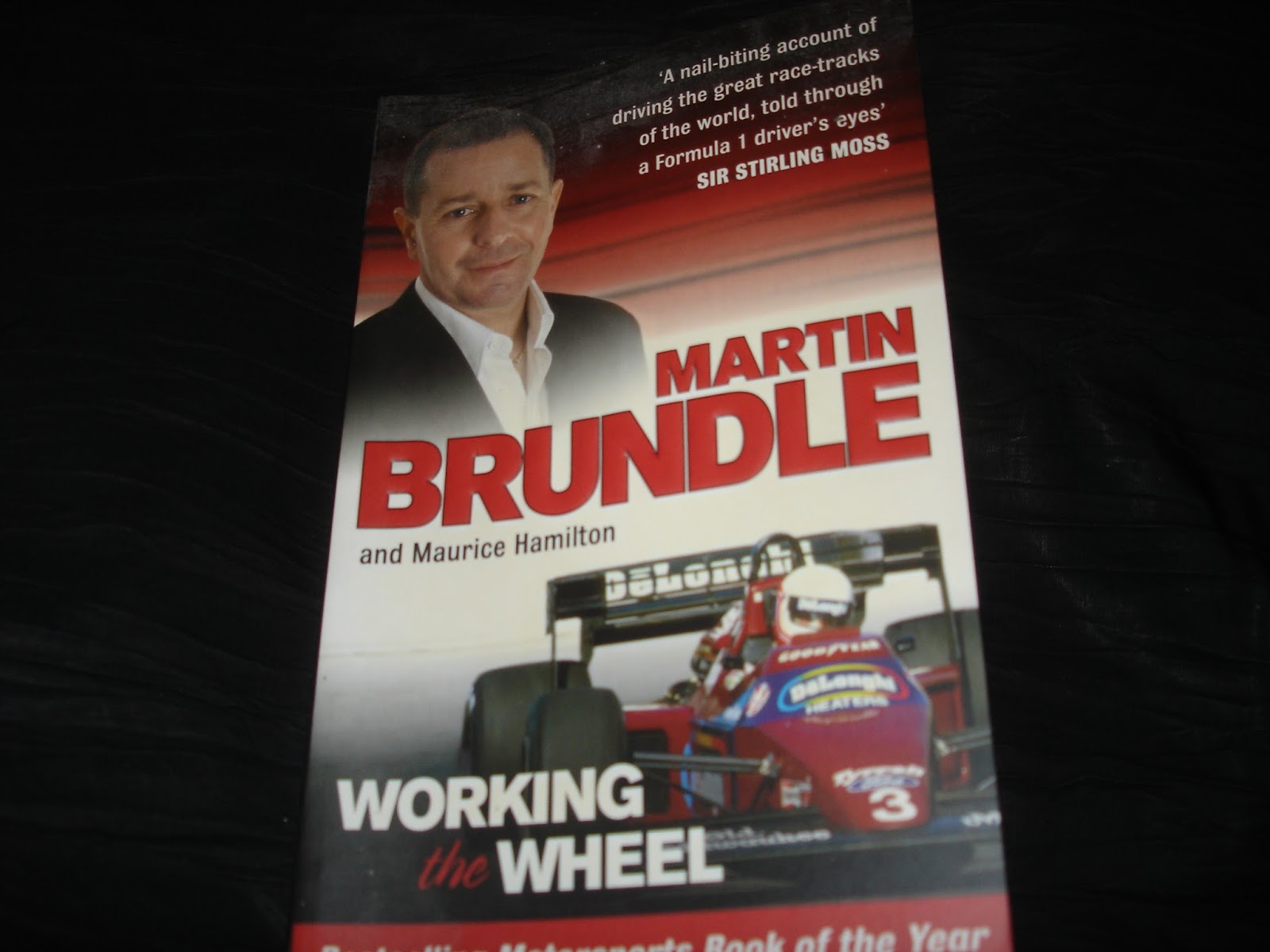
Another item in my library of motorsport books is "Working The Wheel", by Martin Brundle and Maurice Hamilton, first published in 2004. This is a series of recollections and analyses of Formula 1 circuits and venues, based on the words of the former Grand Prix driver and Sportscar World Champion.
The text I think reflects Brundle's feisty but honest, no-nonsense racing persona. His views on some circuits are intriguing and hardly stereotypical, but his reasoning usually appears sound. He welcomes changes made to some tracks, which in other quarters have been decried. He prefers a tricky or convoluted section of track to replace a flat-out section which represents little in the way of challenge to the driver, and with dangers ever-present.
A very practical and pragmatic philosophy emerges, although at the same time Martin underlines his respect for the traditions of motor racing and also his sense of history. He, for example, clearly relishes the atmosphere at places such as Monza.
"Working The Wheel" is liberally peppered with anecdotes from Brundle's time as a racing driver, many of these stories related to contentious or murky episodes, and doubtless made easier to recount by the passage of time. It is fascinating to hear his own personal perspective on some epochal incidents and iconic personalities, and his own, sometimes peripheral role in how things unfolded.
There is lots of "local colour", and vivid memories of the individual flavour and atmosphere of the circuits and their environs. Some might think that a disproportionate amount of space is given over to amusing (and occasionally hair-raising) stories about Brundle's travels to and from circuits, but these add to the entertainment value, and also help to provide an insight into the pressures and the existence.
Some of Martin's observations remind us of his own narrow escapes from disaster, and his hard-luck stories, and also of incidents which have either been forgotten, or did not receive much coverage at the time when they happened. Minor triumphs and tragedies which combine to form a rich tapestry, and a window on the personal battles and "little victories" which constitute such a part of the racer's experience. I was also delighted that he included chapters about Le Mans, as well as a few "defunct" F1 venues, such as Detroit and Adelaide.
In general, the Formula 1 circus comes across as an intoxicating place, and the enthusiasm of the author(s) shines from every page. That said, this tome does shine a light on the hardships which go along with the glory and the riches. I'm still envious of the lifestyle, though.
"Working The Wheel" is a rattling good read. Some readers might prefer to scan over the more technical passages detailing braking points, racing lines, gear changes and so forth, but the contents are by and large candid, highly entertaining and in places enlightening.
Showing posts with label martin brundle. Show all posts
Wednesday, 18 January 2017
Tuesday, 13 December 2011
BBC 2012 F1 coverage
There has been much speculation about the composition of the BBC's commentary and punditry team for its F1 coverage in 2012, following the defection of several high-profile figures to Sky.
Today, however, there were media reports which should give some reassurance to real F1 enthusiasts. It seems that Ben Edwards is being lined up to be the main commentator alongside David Coulthard for next season.
My main memory of Ben is of his partnership with John Watson on Eurosport's commentary team in the mid-1990s, and I gained a favourable impression. As a racing driver himself, he knew what he was talking about, but also had the ability to communicate his knowledge in a friendly, natural style. It remains to be seen, of course, whether he can establish the same chemistry with DC as he had with Wattie.
Although the loss of Martin Brundle and Ted Kravitz is a blow, it is encouraging that Jake Humphrey will stay as main presenter. I must admit that I was sceptical when Jake was first appointed, but I have been forced to eat humble pie and admit that he has done a first-rate job. From a purely personal point of view I hope also that the delightful Lee McKenzie plays an enhanced role in the coverage!
I am often critical of some aspects of the BBC, and in particular the licence fee system, but I wish them well in their efforts to maintain the high standards of their Formula 1 coverage. The portents thus far are good.
Today, however, there were media reports which should give some reassurance to real F1 enthusiasts. It seems that Ben Edwards is being lined up to be the main commentator alongside David Coulthard for next season.
My main memory of Ben is of his partnership with John Watson on Eurosport's commentary team in the mid-1990s, and I gained a favourable impression. As a racing driver himself, he knew what he was talking about, but also had the ability to communicate his knowledge in a friendly, natural style. It remains to be seen, of course, whether he can establish the same chemistry with DC as he had with Wattie.
Although the loss of Martin Brundle and Ted Kravitz is a blow, it is encouraging that Jake Humphrey will stay as main presenter. I must admit that I was sceptical when Jake was first appointed, but I have been forced to eat humble pie and admit that he has done a first-rate job. From a purely personal point of view I hope also that the delightful Lee McKenzie plays an enhanced role in the coverage!
I am often critical of some aspects of the BBC, and in particular the licence fee system, but I wish them well in their efforts to maintain the high standards of their Formula 1 coverage. The portents thus far are good.
Wednesday, 12 October 2011
Senna - DVD review
For various reasons, and much to my chagrin, I did not get around to seeing Senna at the time of its release in the cinemas. However this documentary film has now been released on DVD, and these are my thoughts.
I approached the viewing with mild trepidation, having heard and read the praise lavished on the movie since it came out, and worried whether the reality would live up to the hype. Also, I had seen several other Senna-related documentaries over the years, and wondered if this one would just re-hash and repackage the material from previous efforts.
My concerns, I am happy to report, were largely misplaced. I found Senna to be a beautifully produced film, meticulously researched and well-balanced.
I would not describe it as a definitive documentary about Senna's racing career. Little effort is made to examine the technical aspects of racing, and some portions of Ayrton's exploits are afforded scant coverage. Rather, it is primarily a human story, possibly aimed at the layman or casual fan rather than the racing "anorak". Having said that, there is plenty here for any Formula 1 enthusiast to relish.
Particularly impressive is the amount of rare archive material which has been uncovered for this film. It was not just a case of showing the same old familiar footage. Some of the material from the Brazilian media was particularly revealing.
Thankfully, the producers resisted the temptation to employ "talking heads", in the form of journalists and racing people, to tell much of the story. Any such analysis, supplied by a select few observers, was in audio form only, accompanied by pictures, and was used largely to add context to the narrative. These contributions, together with the striking footage, and the words of Senna himself, served to drive things forward admirably.
Instead of being a dry, chronological account of Senna's achievements in the sport, the film concentrates on several of the pivotal periods and races in his time in F1. From Monaco in 1988, which many regard as a watershed, because of his otherworldly qualifying performance and unforced error whilst leading the race, to the Japanese Grand Prix of the same year, when he clinched his first title, and other episodes.
Naturally, a sizeable proportion of the movie is taken up by the tumultuous years of the Senna/Prost rivalry, from the relatively cordial, but still tense, days of 1988, to the outright animosity of 1989/90. Although Senna's side of the story is told, the film is quite even-handed and non-partisan.
Perhaps the passing of time has enabled some observers to be more dispassionate and candid about the events of that era, and this seems to emerge in the film. The sourcing of commentaries from various countries (UK, Brazil, USA etc) also helps to instill a sense of balance.
Some of the most illuminating passages of the film are the clips from drivers' briefings, and Senna's interactions with his fellow drivers and officialdom. The tension evident in those meetings is palpable, particularly in Japan in 1990. Senna's increasing concern about safety matters is also clear, from 1990 onwards.
I would not go so far as to say that this is a "warts and all" documentary, but neither is it a deferential whitewash. For example, the infamous interview with Jackie Stewart is given an airing, as are the criticisms by the likes of Alain Prost.
The sections dealing with racing are interspersed with home and family footage, and some effort is made to assess Senna's social impact in his home country. I think the film-makers pitched this side of things just about right.
In addressing the traumatic events of Imola in 1994, the film does not try to be wise after the event, and allows the pictures and words to tell the sad story. The aftermath of Imola is dealt with beautifully;moving but not maudlin.
As mentioned before, the film does not attempt to be an exhaustive chronicle, but I was surprised that scant mention was made of Senna's relationship with Gerhard Berger, and that Ayrton's exploits in the junior formulae, and especially his Formula 3 rivalry with Martin Brundle, were largely ignored. Admittedly, these are minor complaints, in view of the time constraints.
One very nice touch was seen at the end of the film, when the story came full circle, and we returned to Senna's karting days, before politics, money and pressure held sway.
For me, Senna was definitely worth the wait. An endearing and compelling portrait of a complex man and his remarkable, if tragically short, life.
I approached the viewing with mild trepidation, having heard and read the praise lavished on the movie since it came out, and worried whether the reality would live up to the hype. Also, I had seen several other Senna-related documentaries over the years, and wondered if this one would just re-hash and repackage the material from previous efforts.
My concerns, I am happy to report, were largely misplaced. I found Senna to be a beautifully produced film, meticulously researched and well-balanced.
I would not describe it as a definitive documentary about Senna's racing career. Little effort is made to examine the technical aspects of racing, and some portions of Ayrton's exploits are afforded scant coverage. Rather, it is primarily a human story, possibly aimed at the layman or casual fan rather than the racing "anorak". Having said that, there is plenty here for any Formula 1 enthusiast to relish.
Particularly impressive is the amount of rare archive material which has been uncovered for this film. It was not just a case of showing the same old familiar footage. Some of the material from the Brazilian media was particularly revealing.
Thankfully, the producers resisted the temptation to employ "talking heads", in the form of journalists and racing people, to tell much of the story. Any such analysis, supplied by a select few observers, was in audio form only, accompanied by pictures, and was used largely to add context to the narrative. These contributions, together with the striking footage, and the words of Senna himself, served to drive things forward admirably.
Instead of being a dry, chronological account of Senna's achievements in the sport, the film concentrates on several of the pivotal periods and races in his time in F1. From Monaco in 1988, which many regard as a watershed, because of his otherworldly qualifying performance and unforced error whilst leading the race, to the Japanese Grand Prix of the same year, when he clinched his first title, and other episodes.
Naturally, a sizeable proportion of the movie is taken up by the tumultuous years of the Senna/Prost rivalry, from the relatively cordial, but still tense, days of 1988, to the outright animosity of 1989/90. Although Senna's side of the story is told, the film is quite even-handed and non-partisan.
Perhaps the passing of time has enabled some observers to be more dispassionate and candid about the events of that era, and this seems to emerge in the film. The sourcing of commentaries from various countries (UK, Brazil, USA etc) also helps to instill a sense of balance.
Some of the most illuminating passages of the film are the clips from drivers' briefings, and Senna's interactions with his fellow drivers and officialdom. The tension evident in those meetings is palpable, particularly in Japan in 1990. Senna's increasing concern about safety matters is also clear, from 1990 onwards.
I would not go so far as to say that this is a "warts and all" documentary, but neither is it a deferential whitewash. For example, the infamous interview with Jackie Stewart is given an airing, as are the criticisms by the likes of Alain Prost.
The sections dealing with racing are interspersed with home and family footage, and some effort is made to assess Senna's social impact in his home country. I think the film-makers pitched this side of things just about right.
In addressing the traumatic events of Imola in 1994, the film does not try to be wise after the event, and allows the pictures and words to tell the sad story. The aftermath of Imola is dealt with beautifully;moving but not maudlin.
As mentioned before, the film does not attempt to be an exhaustive chronicle, but I was surprised that scant mention was made of Senna's relationship with Gerhard Berger, and that Ayrton's exploits in the junior formulae, and especially his Formula 3 rivalry with Martin Brundle, were largely ignored. Admittedly, these are minor complaints, in view of the time constraints.
One very nice touch was seen at the end of the film, when the story came full circle, and we returned to Senna's karting days, before politics, money and pressure held sway.
For me, Senna was definitely worth the wait. An endearing and compelling portrait of a complex man and his remarkable, if tragically short, life.
Subscribe to:
Posts (Atom)