Showing posts with label F1. Show all posts

Monday, 30 May 2022

Inside The Mind of The Grand Prix Driver - Christopher Hilton

Following my reading of the book Deadly Obsessions, I threw myself into another motor-racing-related work, Inside The Mind of The Grand Prix Driver, written by the late Christopher Hilton (the edition I read dates from 2003). The latter book covered similar ground to Deadly Obsessions, but felt more substantial and absorbing in some respects.

I am not really sure to what extent the book truly gets "inside the mind" of the driver, but I found this to be quite an engaging and illuminating look at the world inhabited by racing pilots, tending to belie some of the assessments which I have seen elsewhere. The interviews with drivers are very revealing, and often entertaining.

There are some valuable nuggets of information about the career paths of certain drivers, and we see how precarious and stressful the driver's existence is, with constant anxiety about job security and one's status within team and sport.  It is true to say that the pressures and the intensity rise with each passing year, but it sounds as though the situation was pretty fraught and demanding even in the early 1980s!

The recollections of various Grand Prix competitors really do bring home the notion of the "survival of the fittest" being one of the main guiding principles of the F1 firmament. To many this might seem like an indictment of the sport, a recognition that one must be ruthless and grasping in order to not just succeed, but merely survive. On the other hand, I was quite inspired by being immersed in this rarefied atmosphere, where the mental and psychological faculties and capabilities are stretched to the limits.

Some of the drivers do come across as deluded in their assessments of their abilities, achievements and relative worth, but these traits have to be placed in the context of the necessity to survive, the nature of the beast. Outsiders, real outsiders, would have difficulty comprehending and appreciating all these things. Anything that helps them cope....

In one or two cases I was left wondering whether the drivers' pronouncements constituted posturing and bravado, a front which enabled them to navigate choppy and hostile waters. I suspect that many "lesser lights" have to put on an act, whereas the true greats can more or less take certain attributes for granted, without having to constantly broadcast their prevalence or importance.

It is pointed out in the book that after they retire from racing some drivers mellow, realise that they no longer require "extreme" attitudes or motivations. Others may have been "contaminated" more profoundly by their experiences and remain in "F1 mode" long after they hang up their helmets.

One of the tests of a book for me is the degree to which it instilled in me an enhanced knowledge and understanding of a subject at hand. This work, on balance, does pass that test. The contributions of Jonathan Palmer, Julian Bailey, Perry McCarthy, Martin Donnelly and Allan McNish I found especially instructive, for differing reasons.

To return to the theme which I sought to develop in my article about Deadly Obsessions, did I learn anything from the Hilton book about how the world has changed in the past two decades? Not really, as this is a drier and less emotive exploration of the F1 community.


Tuesday, 31 January 2017

Stirling Moss - The Authorised Biography - Robert Edwards

In my experience, most biographies of racing drivers do not offer much in the way of searching insight into personalities, motivations and foibles. They tend to barely scratch the surface in this respect. A notable exception to these rules is Robert Edwards' authorised biography of Stirling Moss.


This book devotes unusual space and attention to examining Moss's family background, his time at school, the role of his parents and his upbringing. At various stages an effort is made to put Stirling's experiences and achievements in some kind of sociological context; again, not something one usually finds in a racing biography.  In some ways I suppose that he was a transitional figure, combining many "pre-war" values with the ethos of the more commercial age which was just beginning.

So often in books, the prowess and drive of high achievers almost appears to come out of nowhere, but Edwards lays plenty of pipework here, allowing us to gain an idea of how the subject's character took shape, and how his psyche and outlook evolved over time.

I would contend that many of the author's observations and conclusions about Moss would surprise the general observer, in that they tend to be less straightforwardly in line with the public perception. The popular image of racing drivers, especially from the era covered here, does not always tally with reality.  Behind the "heroic" facade, they all had their weaknesses, quirks and needs.

Another aspect of this biography which impressed me was that Edwards was not afraid to leave chronological "gaps" in the narrative, instead preferring to concentrate on context and an evocative and representative portrayal of the subject.  The author goes into great detail about the areas which he thinks are instructive and important, but he doesn't feel pressured to document every race of every season. In this way, one gets a more rounded and humanistic sense of Stirling's progress, as well as a richer perspective on events.

It is pleasing to see that as much attention is given to Stirling's exploits in sports cars and certain "niche" spheres as is allocated to his Grand Prix endeavours. The sport was not so "F1-centric" in the 1950s, and all of this also serves to convey the mastery and sheer versatility of Moss. 

Technical matters are also gone into, mostly as a way of illustrating which way the racing wind was blowing, and to place some of Stirling's career moves into greater historical context.  The passages concerning Maserati, Mercedes and Vanwall in particular are thoughtful and penetrating, again dispelling one or two "myths" along the way, and painting a more nuanced picture than is often painted.

A prominent feature of the latter stages of this biography is the concentration on the aftermath of the accident at Goodwood in 1962, and its physical and psychological effects on the driver. Like many areas of the book, it benefits from being "authorised", and is therefore based on good, sometimes rare source material. Again, this all goes well beyond the simplistic, cliched version which was moulded by the popular press.

I also enjoyed the chapters which looked at Stirling's life following his decision to retire from racing, and how he adapted to his new circumstances. The book is written in a pleasingly erudite but economical and accessible style.  If the test of a good biography is whether the reader emerges with an enhanced understanding of the subject, and actually learns a few things in the process, then I would suggest that this fine effort comes through with flying colours. 

Friday, 27 January 2017

Beyond The Limit - Professor Sid Watkins

Following my blog post about Professor Sid Watkins' book Life At The Limit, I re-read the follow-up, Beyond The Limit.

This "sequel" basically takes up the story from when the first book was published in 1996.  It documents the continuing search for enhanced safety in Formula 1 following on from the dreadful events of 1994, and offers special emphasis on the millennium season of the year 2000.

As with Life At The Limit, there is no shortage of amusing anecdotes and insight, but I must admit that it slightly lacks the focus, impact and cohesion of that first book. This is primarily because the charming and absorbing tales from "the old days" and the formative times of Professor Watkins' role in F1 are not there.  Also, the more regimented and corporate tenor of more modern racing arguably makes for less good raw material when writing a book.

So, this is not quite as good or as entertaining as Life At The Limit, but it is still worth checking out.

Thursday, 26 January 2017

Life at The Limit - Professor Sid Watkins

Life At The Limit is a book written in 1996 by the late Professor Sid Watkins, then Formula 1 doctor/medical supremo. It is not a biography as such, but more a chronicle of his involvement in the sport. This is one of those books which the reader will breeze through quickly, and emerge with a happy, satisfied and illuminated feeling.


Although there are compelling accounts of some famous individual incidents, I was if anything more intrigued by the passages which addressed the struggles which Professor Watkins and his colleagues encountered in raising standards of medical back-up and safety, starting in the 1970s. In those early days it seems that arrangements were distinctly haphazard, and it is sobering to discover the gaps which existed before Sid and company, began to get to grips with the deficiencies.  Standardization and uniform excellence were still some way off in the old days.

In documenting his work and his experiences, Professor Watkins also shines a torch on the way of life travelling with the Formula 1 circus, and also what a small world he moved in. There are lots of amusing anecdotes and stories, and the author's dry sense of humour is a delight. In among the seriousness, the pressures and the grave matters at issue, it was still possible to have fun and be irreverent.

Some insight is given into various motor racing personalities, both drivers and non-drivers. Professor Watkins' friendship with Ayrton Senna is of course covered, and it is hard not to be moved by the chapters which deal with the events at Imola in 1994, as well as the accounts of Zolder 1982, Monza 1978 and so forth.

Life At The Limit is in places, and up to a point, a journey through the corridors of motor racing power, although the Professor is necessarily guarded, cryptic or reticent on some points. The remit of this book was really to tell the story of his own involvement.

Above all,  the reader will be lost in admiration and respect for Sid and his colleagues, for what they accomplished in helping people and in raising standards around the world. This is an entertaining and enlightening account of those times.


Wednesday, 25 January 2017

1982 - The Inside Story of the Sensational Grand Prix season - Christopher Hilton

I remember that during the 2012 Formula 1 season, relative neophytes were speculating that we were experiencing perhaps the most dramatic and unpredictable Grand Prix year ever.  Those people had evidently not been around in 1982. Christopher Hilton's book, published in 2007, captures the turbulence and tragedy of that extraordinary season.


For me, the 1982 campaign was in large part coloured, and tarnished, by the death of Gilles Villeneuve, who was one of my first heroes in life. I distinctly remember crying on the day of his accident, staring into space at the end of our driveway, on a warm spring evening.  However, as time has passed I have grown to recognize how that season did have some redeeming features.

The material about the drivers' strike in South Africa is fascinating, in that it suggests that the views of many of the drivers were ambivalent. They were caught between concerns of principle and solidarity and the imperatives of ambition and avarice.  There are some interesting theories about Niki Lauda's motives, too. The strike is also placed within the context of the wider, momentous power struggle which was ongoing within the sport at that time.  A healthy selection of quotes from drivers and other personnel helps to paint the picture.

The chapter dealing with the Belgian Grand Prix in May contains much harrowing but gripping testimony about the events of that tragic qualifying session at Zolder.  Similarly, the passages documenting the Canadian Grand Prix, the scene of Ricardo Paletti's fatal accident, are moving and affecting. It is good that the author went to the trouble of researching Paletti's background and racing career.

Reading the quotes and recollections in this book, it occurs to me that in the 1980s, Grand Prix drivers were more worldly men than they are today. Maybe I think in these terms because the drivers in those days were much older than me, whereas nowadays I am many years their senior. People such as Derek Warwick and John Watson impress with their honesty and roundedness. Making allowances, one would have to say that, thirty-odd years ago, the goldfish bowl was less overpowering, and the world was a different place.

"1982" also offers a persuasive reminder that technological progress has made things too "perfect" and "infallible" to be interesting and uncertain on an "organic" level. Variables and imponderables are banished, and much of the soul and raw excitement extracted.

The heterogeneous nature of the venues, the media coverage and so forth is another part of the backdrop to this work, No identikit tracks, podium ceremonies, pit and paddock complexes, and the like.

Hilton relates some great tales, such as the Toleman "half-tanks" ploys and the Derek Daly "short cut" at Dijon. More innocent times, but in keeping with many aspects of this book, I get the impression that the people involved have been made less guarded and equivocal, and more candid, in their recollections by the passage of time.

It seems to me that, in a Formula 1 sense at least, the 1980s had not truly arrived in 1982.  I tend to see this as happening in 1984, with the full flowering of the Ron Dennis/TAG/Lauda/Prost era at McLaren.  Things became more clinical and orderly, and rough edges were smoothed over. The years 1982 and 1983, by contrast,  still exuded elements of the Seventies. A transitional, confusing, but vibrant time.

Christopher Hilton's book, lavishly illustrated and well-researched, evokes those times vividly.


Wednesday, 18 January 2017

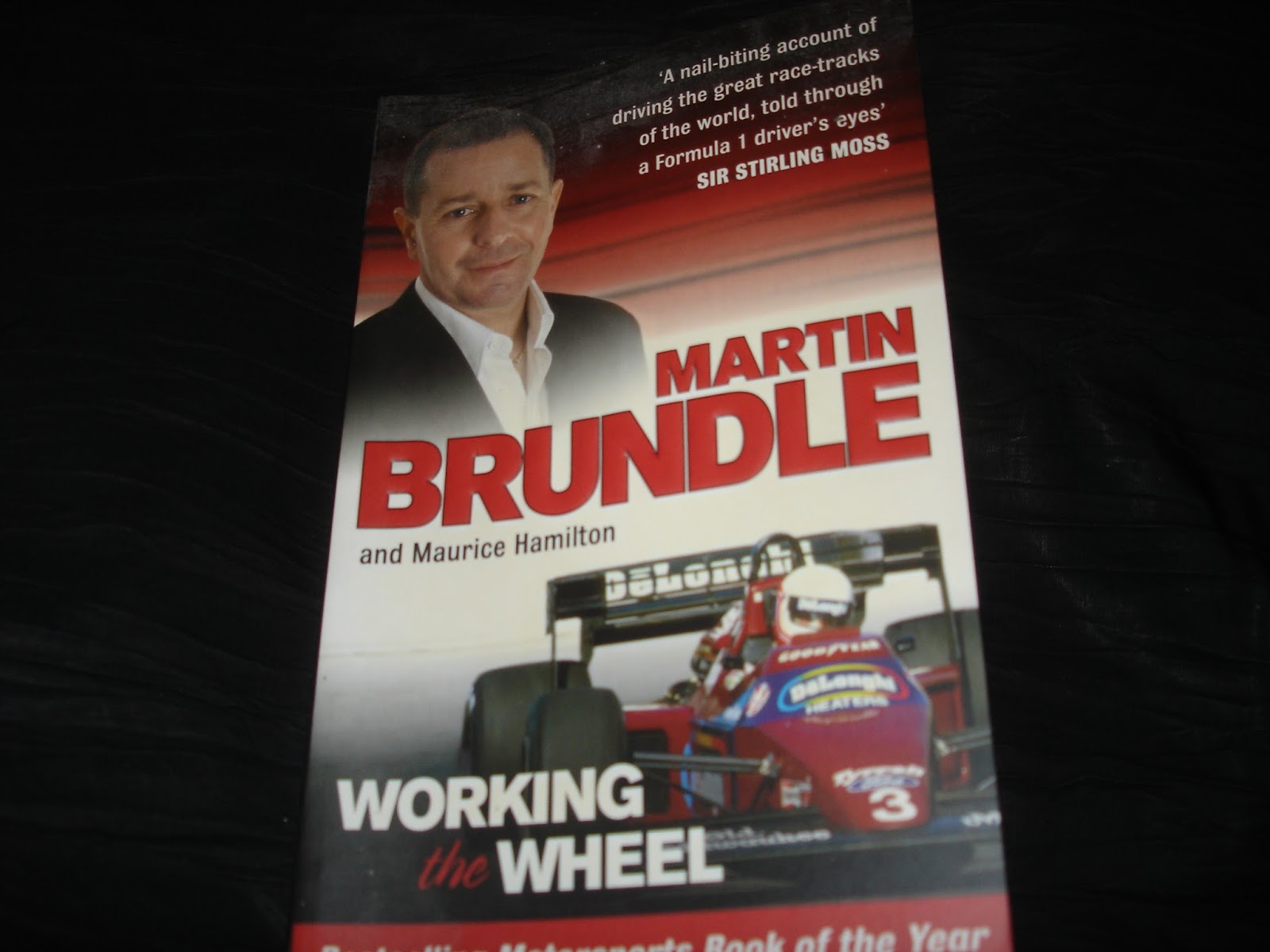
Working The Wheel - Martin Brundle and Maurice Hamilton - book review

Another item in my library of motorsport books is "Working The Wheel", by Martin Brundle and Maurice Hamilton, first published in 2004. This is a series of recollections and analyses of Formula 1 circuits and venues, based on the words of the former Grand Prix driver and Sportscar World Champion.


The text I think reflects Brundle's feisty but honest, no-nonsense racing persona. His views on some circuits are intriguing and hardly stereotypical, but his reasoning usually appears sound. He welcomes changes made to some tracks, which in other quarters have been decried.  He prefers a tricky or convoluted section of track to replace a flat-out section which represents little in the way of challenge to the driver, and with dangers ever-present.

A very practical and pragmatic philosophy emerges, although at the same time Martin underlines his respect for the traditions of motor racing and also his sense of history. He, for example, clearly relishes the atmosphere at places such as Monza.

"Working The Wheel" is liberally peppered with anecdotes from Brundle's time as a racing driver, many of these stories related to contentious or murky episodes, and doubtless made easier to recount by the passage of time.  It is fascinating to hear his own personal perspective on some epochal incidents and iconic personalities, and his own, sometimes peripheral role in how things unfolded.

There is lots of "local colour", and vivid memories of the individual flavour and atmosphere of the circuits and their environs. Some might think that a disproportionate amount of space is given over to amusing (and occasionally hair-raising) stories about Brundle's travels to and from circuits, but these add to the entertainment value, and also help to provide an insight into the pressures and the existence.

Some of Martin's observations remind us of his own narrow escapes from disaster, and his hard-luck stories, and also of incidents which have either been forgotten, or did not receive much coverage at the time when they happened. Minor triumphs and tragedies which combine to form a rich tapestry, and a window on the personal battles and "little victories" which constitute such a part of the racer's experience.  I was also delighted that he included chapters about Le Mans, as well as a few "defunct" F1 venues, such as Detroit and Adelaide.

In general, the Formula 1 circus comes across as an intoxicating place, and the enthusiasm of the author(s) shines from every page. That said, this tome does shine a light on the hardships which go along with the glory and the riches. I'm still envious of the lifestyle, though.

"Working The Wheel" is a rattling good read.  Some readers might prefer to scan over the more technical passages detailing braking points, racing lines, gear changes and so forth, but the contents are by and large candid, highly entertaining and in places enlightening.


Saturday, 14 January 2017

Jim Clark - Tribute to A Champion - Eric Dymock

Jim Clark is possibly the most gifted racing driver ever to emerge from British shores, yet his public profile was never as high as several of his contemporaries or near-contemporaries. Graham Hill was a charismatic extrovert who enjoyed the limelight and public affection, whilst Stirling Moss and Jackie Stewart survived their racing careers to achieve a high media profile in the ensuing decades.


Clark's comparatively low level of recognition with the general public may be put down to his reserve and reticence, and these and other elements of his make-up are examined in Eric Dymock's book, first published in 1997. The common perceptions about him may have clouded a more complicated and nebulous picture. The book devotes much space to assessing Clark's character traits and psyche, in addition to his feats on the racetrack.

Much emphasis is placed on his upbringing in the Scottish Borders farming community, as well as his education, and all this provides a more rounded portrait of the man than is often projected by superficial and condensed television documentaries and internet "screenbites".  This once again reinforces my conviction that if you want to acquire a nuanced understanding of a subject, don't rely purely on "audio-visual" media;read books, too.

Dymock's book has a quirky flavour and structure to it which I found quite appealing, eschewing a dry chronological story, and occasionally going off on tangents to explore sub-texts. Don't expect an exhaustive documentation of race results and chassis numbers. There is some input from people who knew Clark well, and their observations merely serve to strengthen the enigma. 

What emerged for me was a sometimes melancholy tale, not a smooth and seamless fairytale. The contradictions inherent in motor racing come through;people were entranced by aspects of the sport, but also had to reconcile themselves to its more unsavoury realities, especially the dangers and risks. Also, the true nature of the sport in the Sixties was perhaps not as idyllic and wholesome as is sometimes made out.  Some of that era's most revered exponents were not as perfect and heroic as some might like to hope, and Dymock does not flinch from highlighting some of the flaws. 

An illuminating and intriguing read...


Wednesday, 4 January 2017

McLaren Memories - A Biography of Bruce McLaren - Eoin Young

This book had been nestling on my shelves, but had been awaiting my full attention. I am glad that I gave it a read. Biographies are always more satisfying, and linger longer in the memory, if the reader comes away with a significantly greater appreciation for the subject than beforehand. This was the case for me with this book about the life of the New Zealand racing driver Bruce McLaren.


The book is based on the recollections of the author, a long-time friend and associate of Bruce, but equally importantly it draws heavily on the driver's own words and writings. There is no in-depth analysis of his character, although indications of his innermost feelings and concerns emerge in the various quotes and reminiscences.

There is some valuable material about his childhood, and struggles against adversity, and those first steps to immersion in the spheres of engineering and racing. Insight is also gained concerning the burgeoning of his ambitions, once he arrived in Europe.

To me, the middle sections of the book were the most illuminating and enthralling, evoking as they did the atmosphere and flavour of racing in the late Fifties and Sixties. McLaren's laconic and dry humour is a delight. The schedule which the drivers and teams of those days coped with is, looking back, extraordinary, and one gains a sense of the improvisation which was vital, in organisation and logistics. The haphazard, frenetic and breathless state of things seemed also part of the fun and the stimulation.

Overall, McLaren Memories greatly augmented my knowledge and understanding of the man's achievements and abilities.  It is not a massively penetrating examination or appraisal of its subject's psyche and motivations, but it is an entertaining and endearing portrait of a popular and successful figure, who had a short but eventful life.

Thursday, 22 December 2016

Racers Apart - David Tremayne

Continuing my journey through some half-forgotten items in my motorsport-related library, I recently re-read Racers Apart, by David Tremayne, a little gem of a book which was first published back in 1991.

Essentially, Racers Apart is a series of portraits of, or articles about, selected motorsport figures. The author includes some figures from the world of land and water speed records, an area of special interest for him. As well as Tremayne's own thoughts, there are observations by colleagues and friends of the subjects.


The choice of people portrayed might seem almost random, but in fact it is just diverse, and the competitors examined are chosen mostly for their human qualities or their influence on the direction of the sport. Some of those featured are personal favourites of the author, such as Pedro Rodriguez, Tom Pryce,Roger Williamson and Gilles Villeneuve. This latter factor I feel induces a greater conviction, passion and authority in the writing.

It is by and large quite balanced and honest stuff, not ignoring the negatives and the frailties.  The interviews with subjects are quite penetrating, managing to extract some candid recollections and analysis. These are not bland portraits.

One thing which also stood out for me during this recent reading was the author's vehemence in lamenting some aspects of modern motor sport. It is sobering to think how, even twenty five years ago, contemporary journalists perceived the sport to be so shallow and soulless at the top level. The book's general tenor is to celebrate those who, in their approach and temperament, bucked those ever-encroaching trends.

Overall, this book seems to come more from the enthusiast than the scholar, and in places seems genuinely heartfelt. Like with much of the best motor sport writing, the human dimension transcends the nuts and bolts and the technology. Those who left a scant impression in the record books are placed alongside the legends and superstars - David Purley sits very comfortably in company with Ayrton Senna and Jackie Stewart.


Tuesday, 13 December 2016

James Hunt - The Biography - Gerald Donaldson

Many biographies of sportspeople are entertaining, informative or provocative, but few manage to stir the emotions.  One work which evokes the latter feelings is Gerald Donaldson's biography of the former Formula 1 world champion James Hunt, first published in 1994.


This is a comprehensive, vibrant but measured account of a remarkable life, and it is amusing, evocative and in places highly poignant.

I think where Donaldson's work scores especially highly is in its efforts to analyse what made this complex man tick, and how this was conditioned by his upbringing.  The factors which influenced James' singular approach to life are frankly impossible to pin down definitively, but here there is much fascinating and insightful speculation, much of it based on the opinions of the subject's friends and associates. He was often portrayed as a caricature, but such assessments grossly over-simplified the true picture.

The biography also delves into what motivated James during his racing career, and how those who worked with him sought to extract the best performance from him. These passages, putting the racing driver's psysche under the microscope, are part of what lifts this tome out of the ordinary, and one gains some idea of how extraneous "personal" matters affected results on the track, and vice-versa.

It has been asserted by many people that this is above all an honest, "warts and all" biography, and I am fully in accord with that judgement. For example, there is a look at how his personality was perceived to have changed after he became World Champion, and also how he tackled the demons which often plagued him following his retirement.

In a broader sense, the story of James Hunt is also evocative of an era in racing, and an epoch in social and cultural history.  A central theme is also how he was one of the first British sportspeople to be covered in a "sensationalist" way by the popular press. It is a salutary glimpse at the effects, and pitfalls, of fame, fortune and media attention.

The chapters which address his post-retirement endeavours and tribulations are, if anything, even more absorbing than those detailing his racing exploits. The chronicles of his later years are intensely moving in places.  The fully rounded picture is presented, in keeping with the compact, economical but authoritative tone of the book as a whole.

A picture emerges of a remarkable character. Flawed, like all of us, but possessing intelligence, drive and charm. I think that the popular fascination with James Hunt grows with time, because whilst seeming on the face of it a throwback, there were some contradictions which rendered him thoroughly modern. As I think the author implies, it is facile to speak in terms of a "split personality". The real essence of James Hunt remains elusive and impenetrable, but attempts to capture that essence are hugely enjoyable and stimulating.

Thursday, 24 November 2016

Books About Sports

Most of my non-fiction reading in recent times has focused on history and philosophy, but it is notable how good and absorbing the best sports-related writing can be. Here are some of the sports-orientated books which have made the greatest impact on me in recent times, or which I just found enjoyable, informative and enlightening.....

Bodyline Autopsy, by David Frith.  An absorbing, erudite and meticulously researched chronicling of England's contentious cricket tour of Australia in 1932-33...


Several works on cycling have left quite an indelible impression.....

Merckx: Half Man, Half Bike, by William Fotheringham...


Eddy Merckx : The Cannibal, by Daniel Friebe.  Another excellent portrait of the great Belgian cyclist....


Put Me Back on My Bike : In Search of Tom Simpson, by William Fotheringham.  A fascinating and candid biography of the tragic English cyclist...


The Lost Generation, by David Tremayne.  An intensely compelling, highly moving and beautifully illustrated telling of the story of three British racing drivers who died young during the 1970s....


Gilles Villeneueve: The Life Of The Legendary Racing Driver, by Gerald Donaldson.


Inverting The Pyramid : The History of Football Tactics, by Jonathan Wilson.


Back Home - England and the 1970 World Cup, by Jeff Dawson.  A highly entertaining and nostalgic look at the national football team's campaign in that fabled tournament in Mexico....


All of these books I would recommend.

Sunday, 26 June 2016

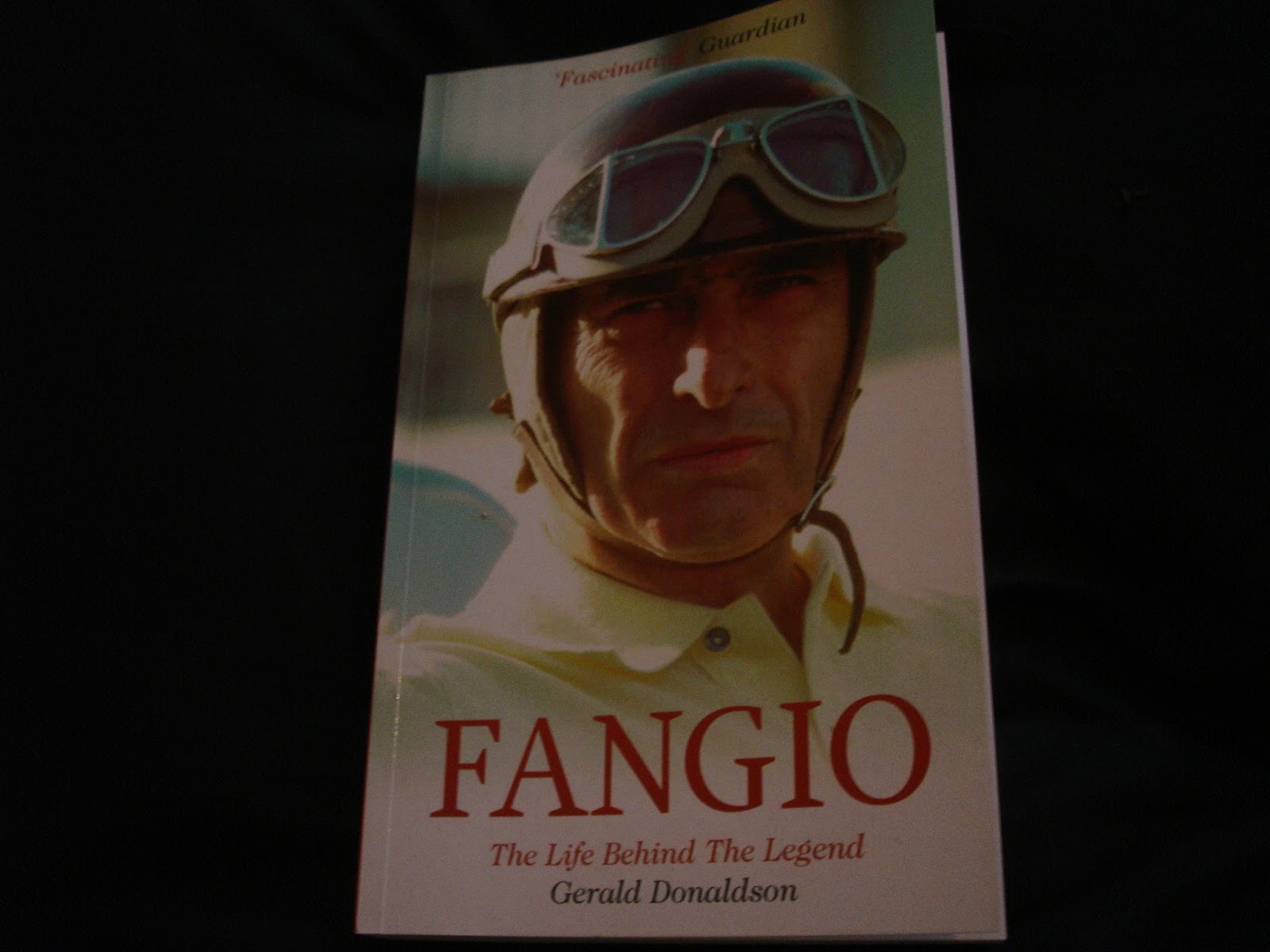
Fangio: The Life Behind The Legend - Gerald Donaldson

Furthering my campaign to revisit some of the motorsport-related titles residing on my dusty bookshelves, I recently re-read Gerald Donaldson's 2003 biography of the great Argentinian driver, Juan Manuel Fangio.

Fangio still holds a special fascination and a particular aura, matched perhaps only by those of Ayrton Senna, although they were quite different people. Fangio was revered by his peers, and still represents something of a benchmark, as much for his human qualities as his consummate skills behind the wheel of a car.

His upbringing was in stark contrast to that of today's stars, and indeed to most of his contemporaries. In addition, his racing apprenticeship was unusual, and may have helped to equip him with the qualities which separated him from his competitors when he embarked on his international career.


The early chapters are an intriguing window on the world of the early twentieth century, when motor vehicles were still a relative novelty, and in the infancy of their technical development. The picture which emerges is of an early life characterized by the inculcation of certain imperatives, such as the importance of hard work.  Even the early years suggest Fangio's hallmarks of mechanical sympathy, adaptability and resourcefulness.

A crucial part of the story is Fangio's participation in the epic South American road-race marathons. The author unfurls evocative  accounts of the sheer scale of these undertakings, the hardships which were undergone, and the perils and hazards which confronted the competitors. The range of emotions and environments which he encountered must have been character-building. Describing the dramas, the surroundings and the sensory experiences is a strength which is noticeable in some of Donaldson's other books, and those skills are well employed here.

This biography paints a picture of the tenor of an epoch, where improvised machinery and improvised racing schedules were the norm. Also, the comradeship and friendly spirit which prevailed among the drivers throughout comes across strongly.

Fangio seems to have been a self-made man, also self-taught to some extent. From humble origins, a strong work ethic had helped to instill a resilience of character which was crucial to his success. The author does not portray the man as some kind of saint, but his flaws and weaknesses were evidently less pronounced than those of most people, and a practical, pragmatic approach served him well. It also appears to me that Fangio combined old-fashioned virtues with the more entrepreneurial spirit of modern times. A more complex individual than is sometimes made out, perhaps.

The book contains some interesting material on that "lost" period between the end of the Second World War and the 1950 inception of the World Drivers' Championship. It is sobering to be reminded of the frequency of fatalities and serious injuries back then, both to competitors and spectators.  The stories of the Grand Prix races are related entertainingly but sparingly, and they capture some of the essence of what was still a "heroic" age. Indeed, some might contend that the "heroic age" came to a close when Fangio retired from racing.

There is a little insight into Fangio's character, and his philosophy of life, via quotes and anecdotes. These focus on his means of coping with danger and challenges, and with the nature of competition. An element which permeates these pages is just how much physical discomfort the drivers of that period had to withstand, whether through primitive, ill-handling machines or via the elements. Comfort was still some way in the future.

This biography is compact and balanced, although I don't think it is quite as fluent and impressive as the author's books about Gilles Villeneuve and James Hunt. It will, however, enthuse the reader about the man and the era in which he competed so ably and nobly.

Sunday, 19 June 2016

The Last Road Race - Richard Williams

Whilst sifting through numerous old books on my shelves, I came across "The Last Road Race", by Richard Williams, originally published in 2004, which tells the story of the 1957 Pescara Grand Prix.

The premise of the book is that the race represented the closing of an era, in that it was the last World Championship Grand Prix to be staged on a particular type of circuit, and in a certain set of conditions. It is a compact work, packed with details and anecdotes, and it contains several evocative passages.

Only a relatively small proportion of the book is actually taken up with the Pescara race itself.  Much of the space is given over to scene-setting, with portraits of some of the key participants in the event, and analysis of the key trends which determined its outcome, such as the emergence of the British constructors.  In some ways, "The Last Road Race" also functions as a brief history of motor racing in the period up until 1957, a chronicle of how that point had been reached.


The tenor of the era comes through, such as the more relaxed, informal feel of less regimented times and even through the improvised arrangements for travel, accommodation and so forth. There are some amusing stories about these aspects.

Much of the story revolves around Stirling Moss, either directly or indirectly.  Whenever I read anything about Moss, my admiration for the man rises. His professionalism, his talent and his energy combined to make him a compelling study.  There is some illuminating material how about how he organized himself, and how his approach differed from some of his peers. Moss comes across as a transitional figure on more than one level.

In addition to Moss, another person who impresses is Tony Brooks. An intriguing character, whose opinions and frank observations about racing and life are always worth reading.

I discerned quickly that the drivers had varying views about racing, their motives and their anxieties. Some were at home on the classic, perilous natural road courses, and bemoaned the sterility which later infiltrated the sport. Others were candid in expressing their unease about some of the conditions which they raced under.  Less romantic than some of their contemporaries, they were more pragmatic and business-like. Not everyone later complained unfailingly that things were better in their day.

From today's vantage point, the 1950s feel like a fabulous period for racing. Post-war optimism and renewal, the rise of the British drivers and teams, and the beginnings of technological upheaval, overlapped with the remnants of the pre-war age. This book manages to capture much of that atmosphere and excitement.

The actual competitiveness of the racing was often lacking, but the spectacle was enticing, and that seemed to be enough. It was real theatre, this dimension being heightened by the greater contribution of the driver, and the manner in which that contribution was more immediately visible.  Yes, some things in today's world are better, but those far-off days had an innocence and a raw drama about them.

Also, the media and the public did not constantly agonize about "the show", and subject it to minute scrutiny. In some respects the audience, and expert observers, had a more nuanced and sophisticated view. Attention spans were longer, and there was less pressure to pander to some perceived requirement to "entertain".

In 1957, the world was already beginning to change, but old-world courtesies lingered, and some timeless values were scrupulously observed. The drivers from that era were a diverse but likeable and noble group. They were not perfect, and had their flaws like all of us.

"The Last Road Race" is an enjoyable and stimulating document on a place and a time, written with enthusiasm and some style.


Wednesday, 8 June 2016

The Amazing Summer of '55 - Eoin Young

Just recently, I surveyed some of the unread books piled up in a corner of my humble abode.  One which caught my attention was The Amazing Summer of '55, written by the late Eoin Young. This tells the story of the dramatic, tragic and turbulent motor racing season of that year.


The book takes the form of a series of articles, arranged in chronological order, covering the pivotal racing events of 1955. Extensive use is made of quotes from participants and excerpts from diaries, giving many of the episodes a genuine rawness and immediacy. The individual articles are concise and breezy, and they cover not just the "obvious" topics and incidents, but also some more obscure and less-publicized things which occurred during the year in question.

Human interest stories are combined with technical details.  The informality and relative lack of regimentation of the mid-Fifties shines through, although doubtless the "old hands" of that period bemoaned how things were different from previous times.

This was an intriguing epoch, not just in motor racing but in the wider world. The remnants of the "pre-war" world were increasingly in collision with elements of modernity such as technological progress, scientific advances and social change. The stories concerning Ruth Ellis and James Dean help to illustrate and emphasize the latter.

The epic and momentous nature of the Mille Miglia never ceases to impress and captivate, and it is accorded due prominence here. There are some evocative quotes and passages, and amusing anecdotes.

A strong quality of this book is how it covers the broad canvas of motorsport, not just the Grands Prix, but also sportscar racing in all its facets, and also the Indianapolis 500. One can get a real flavour of the culture of racing back then, and the attitudes and motivations of the people involved.

Of course, the disaster at Le Mans in 1955 figures strongly in this work, and the horror is powerfully evoked. Some interesting material is featured relating to the aftermath, the ramifications and the investigations, especially on the response of Mercedes to the tragedy.  These sections, and also the chapter examining the Tourist Trophy race at Dundrod, highlight perhaps most acutely the differences between now and then.

I worked my way through this book through it very quickly, which is generally a good sign. It is the kind of book which prompts the reader to seek out additional information about some of the topics covered.  A lively and enjoyable read.

Friday, 1 January 2016

The Lost Generation - David Tremayne


As part of my current campaign of re-reading books, I went back to David Tremayne's "The Lost Generation", his 2006 study of the lives of three British racing drivers (Roger Williamson, Tony Brise and Tom Pryce) who died tragically young during the 1970s.

This book has rightly been the subject of considerable acclaim, and it is even one which can be recommended to the non-motorsport fan, such is the poignancy of its stories and the richness of the author's writing, knowledge and understanding.  The beauty of the photographic content also makes it visually appealing. Both the text and the pictures help to evoke the era, as well as the human qualities of the subjects.

It is tempting to say that those were "simpler times", but it is perhaps more accurate to say that they were more heterogeneous, and less regimented. Corporate conformity was but a cloud on a largely unseen horizon.

This book relates a story of hopes dashed, potential unfulfilled and hearts broken. At the same time it beautifully articulates the attributes and characters of the three young men, as well as many of their associates and contemporaries. As much as it is a portrait of Roger, Tony and Tom, it is also a compelling snapshot of an epoch.

For me, one of the strengths of "The Lost Generation" is the care taken by Tremayne to obtain input and contributions from a wide variety of sources, ensuring many perspectives and angles. The structure of the book, which could have been a tricky task to accomplish, helps to make the story flow quite seamlessly.

The chapters dealing with the drivers' rise through the racing ranks remind us of the highly competitive, but informal, environment which prevailed in those days. The depth of the research also means that misconceptions can be corrected. In this reading, for example, Tony Brise's progress through the junior formulae is less meteoric and easy than can sometimes seem the case. There is some interesting speculation as to how his occasional struggles may have shaped his outlook.

Don't expect a dry, exhaustive chronological or statistical account of the races. The focus is really on how they progressed, and on an examination of their personality traits and abilities.  Negatives are not glossed over, and things are balanced but respectful. Heavy use of contemporary press reports and interviews augments the authenticity and scope appreciably.  All of this contributes to a sense that things are being chronicled in a rounded and representative manner.

An impressive dimension of the book is the care taken to analyse the evolution of driving styles, this being especially pointed in the case of Tom Pryce, who was sometimes forced to temper his exuberant approach when faced with cold motor racing logic.  Also, we are given an insight into what changes, if any, were discernible in the three men as they climbed the ladder.

The chapters which address the deaths of the three drivers are moving, powerful but sensitively done. Equally, the author does not shy away from highlighting thorny issues.

Some of the passages, particularly those which look at the personal and family lives of the subjects, are heartbreaking.  There is some persuasive analysis about "what might have been", and how the three compared with others who survived and prospered in the sport.

"The Lost Generation" is an absorbing, honest and superbly realized work.


Sunday, 27 December 2015

Rush (2013 movie) - more thoughts

When it was first released on DVD, I composed a blog post reviewing the 2013 movie "Rush".  This is the Ron Howard film which tells the story of the Seventies Formula 1 drivers Niki Lauda and James Hunt.  I recently watched the movie again, and wondered whether my views and impressions might have shifted in the intervening period. I propose to leave aside for the most part any historical inaccuracies which I noticed.


From my late 2015 standpoint, I might describe the feel of "Rush" as being slightly "forced", a little airless and compressed. It is visually impressive, but lacking a touch of elegance, guile and finesse, notwithstanding the inclusion of a few powerful and insightful scenes.

It has been suggested that the movie's comparatively modest budget, and associated time constraints, might have contributed to its flavour and to some of its flaws. My thoughts on this are ambivalent - in places the film has a very "professional" look, but elsewhere one can see where corners might have been cut. For my own tastes "Rush" is a touch too "digital" and post-modern, lacking the charm and fluency of some earlier racing films.

Part of my assertion that the film is "forced" is based on something which I observed when I first saw it almost two years ago. The makers appear to have had a "checklist" of anecdotes and stories (some apocryphal) which they felt they had to pack in during the early portions of the picture. My sensitivity to this phenomenon may be traceable to my status as a 70s-F1-anorak. I appreciate that this would not occur as much to more casusl viewers.

The performances of the main actors attracted much comment. Daniel Bruhl rightly received much praise for his portrayal of Niki Lauda. Quite apart from the physical resemblance, he also managed to capture many of the Austrian driver's traits and mannerisms.

Chris Hemsworth as James Hunt was less universally acclaimed, and it is true that he does not quite evoke the nuances of James' inimitable persona, or the voice. The comparison between the two actors is invidious, though. It may well be more difficult to convincingly play Hunt than it is with Lauda.

I think that "Rush" really gets on track during the scenes relating to the close season of 1975/76, when we are shown Hunt's struggles to get a drive for the forthcoming season, as well as his personal problems. Cliches aplenty, of course, but some very fine moments too. In these sequences Hemsworth is very good.  The movie improves at this point because it becomes less about "back-story", composites of events and time-compression and more about a straight account. The dramatic raw-material is also better....

The Nurburgring sequences I think were well produced, without being excessively long or sensationalist, and the hospital scenes were handled more delicately than one has come to expect in films of this sub-genre or in "biopics".

The dialogue between Niki and James at Monza is convincing and credible, and the press conference where Lauda speaks is actually better than similar scenes in most movies. However, the bit where the journalist is beaten up has rightly been deplored as over-the-top and misrepresentative. A real fly in the ointment, that one. On the plus side, the imagery used at the start of the Monza race is highly effective in conveying the tension and the apprehension.

As for the racing action scenes in "Rush", well on reflection they are a mixed bag. Some are good, and CGI is used to fine effect, but others are less dazzling. One wonders why this was.  The "arty" close ups of crash helmets, suspension parts and so forth are entertaining, and a feast for the senses, but hardly original.

The build-up to the final 1976 race at Fuji is also well done, with a "less is more" ethos concerning dialogue. Visuals, sound and music all help to create the mood and the tension before and during the event.

The final scene at the airport is noteworthy both for its quality and its plausibility. It also comes as quite a surprise to have something this reflective and pensive after what had preceded it. Philosophizing, yes, but in a believable and poignant vein.

Looking at it honestly, "Rush" is a good and entertaining, if unexceptional, piece of cinema, its main strengths being Bruhl's performance, the inherent attractiveness of the subject matter and the occasional amusing or poignant scene.


Monday, 21 December 2015

Formula 1 on Channel 4

Earlier today it was announced that UK terrestrial television coverage of Formula 1 racing will be taken over by Channel 4 in 2016, as they assume the role previously performed by the BBC. Under the three-year deal, 10 races per season will be broadcast live.

The reaction to this news among British F1 followers appears to have been mixed, but I am more sanguine than most about the announcement. It has been confirmed that under the new agreement there will be no advertisement breaks during the actual races to be shown live on Channel 4.  The ad breaks were a bugbear of some fans when the sport was previously shown on commercial terrestrial TV (ITV) in the UK.

I have generally quite enjoyed Channel 4's coverage of sports, a good example being their presentation of Test Match cricket a few years back. They have a reputation for doing things slightly differently in comparison to other British broadcasters, so with luck this ethos will help to ensure that their Formula 1 coverage introduces some innovations and a fresh approach.

Much will depend on the personnel recruited to act as presenters, commentators and pundits on Channel 4's show. My ideal scenario would be for some of those on the previous BBC team to be involved, with a few fresh faces to spice things up.

It is good that F1 will remain on terrestrial TV in Britain. Interesting times ahead....

Friday, 20 March 2015

Enzo Ferrari, A Life - Richard Williams - book review

With the dawn of the new Formula 1 season, I have been prompted to revisit some of the racing books gathering dust on my shelves. One of those was Richard Williams' biography of Enzo Ferrari, first published in 2001.


This is a biography of Ferrari the man, so those searching for exhaustive lists of chassis numbers, or intricate technical analysis, should perhaps look elsewhere. There is some good scene-setting stuff, exploring Ferrari's early life and his background.  Indeed, these stimulating passages left me yearning for more information concerning those formative years. The chapters dealing with Enzo's own racing exploits are equally evocative, for example the 1919 Targa Florio.

With limited space, it is understandable that this book does not go into great detail about how Ferrari reacted to, and fitted into, the febrile social and political climate which prevailed in Italy when he was launching his career in motor sport and business. The author does not ignore the issue, though, and one is left with an impression of the realities and choices faced by many prominent Italians at that time.

It is striking how convoluted, constantly shifting, and sometimes strained, Enzo Ferrari's relationship with Alfa Romeo was, much more so than is popularly imagined. I was gratified to find that this stage of his life is covered in some depth, as are the "heroic" and "golden" ages of motor racing, between the world wars. These sections are gripping, and one is left with a vivid impression of a perilous but momentous era. From the emergence of the likes of Nuvolari, Varzi and Moll, and Ferrari's relationship with these figures, to the sea-change brought about by the advent of the Auto Union and Mercedes teams. The legendary races such as the Mille Miglia and the Targa Florio are also afforded due attention.

At various junctures in this biography we are informed how some of the mythology and legend which surrounds (or surrounded?) Ferrari accumulated. It is worth stressing, however, that Williams does not go overboard on this dimension of the tale. Indeed, some myths and/or tall stories are dispelled or debunked. It is tempting to view every episode surrounding Ferrari in "conspiratorial" terms. Thankfully, a more measured and dispassionate approach is adopted here.

The parts of the book which address the tumultuous 1950s are also quite absorbing. The tragedies, the controversies, the playing off of drivers against each other, the brief Ferrari tenure of Juan Manuel Fangio and the turbulent 1958 season all feature heavily. Throughout there are also fascinating and often revealing anecdotes about Ferrari's dealings with drivers, celebrities, notables and the families of drivers. I feel that the portrayal of the man is balanced, showing his flaws but also highlighting his human qualities, which are often overlooked or obscured by the aforementioned mythology.

The outbursts of political trouble in the racing team are naturally detailed, including the problems with Italian drivers, the strains which led to the departure of John Surtees, and the Niki Lauda epoch. A recurring theme in the later chapters is the incidence of infighting, and the extent to which this was compounded by Ferrari's remoteness and consequent tendency to delegate. The complex nature of his relations with several drivers, including Surtees and Lauda, is examined realistically and sensibly. Matters were not always black and white, despite what some would like us to believe.  The accounts of the negotiations with Stirling Moss and Jackie Stewart leave me with a sensation of "what might have been".

Of course, Ferrari's personal and family life are documented here, as is the growth of the road car side of the company. We also learn about the abortive negotiations with Ford in the 1960s, and the subsequent agreement with Fiat.

Overall, this is a lively and well written book.


Thursday, 1 May 2014

Ayrton Senna

In the summer of 1983, I was slowly becoming obsessed with Formula 1 racing, having had my imagination well and truly captured by the exploits of Gilles Villeneuve a couple of years before. I vividly recall reading the various motor sport magazines around that time, and learning about a remarkable young Brazilian, who in those days raced under the name Ayrton Senna da Silva. Soon enough this precocious talent found his way to Grand Prix racing, and we now found ourselves commemorating the twentieth anniversary of his tragic accident at Imola.

Only yesterday I was speaking with a female friend, who told me that she had no great interest in Formula 1 as such, but had been utterly captivated by Senna's charisma, and remains so to this day. Untold millions around the globe were affected in a similar way. Senna possessed that intangible magic which transcended his own field of endeavour, an accolade which goes to the very few. It can be persuasively argued that he played a massive role in transforming F1 into the slick multinational media spectacle that we see today.  He broadened the appeal of the sport.

Not unnaturally, Senna's tenure with the McLaren team tends to be highlighted, but I find his period with Lotus, from 1985 to 1987, equally compelling. The legendary outfit was in a slow decline, but Senna's mixture of raw ability, work ethic and competitive spirit kept them in the hunt. His tally of pole positions from those seasons, even when up against McLaren, Williams, Ferrari et al, speaks for itself. Senna was competitive almost everywhere, at least in '85 and '86, and his fearsome commitment and dedication were already clearly evident. Both in and out of the car, he took the "science" and "art" of Grand Prix racing to a new level, even above that practised by such modern greats as Stewart, Lauda and Prost, who had been cited as innovators and modernisers.

In common with most of the truly great drivers, Senna had what almost amounted to a "sixth sense", by way of his mechanical sensitivity. The most startling example of this which I have personally seen was captured in a British television documentary covering the 1993 season. At one race, Senna returned to the pits, unhappy with the performance of his car, and insisted that there was a minor problem with the engine, this seemingly having not been highlighted by telemetry and so forth. After much debate, the engine was dismantled, and sure enough a small but significant fault was discovered....


Sunday, 16 March 2014

2014 Australian Grand Prix

After much fanfare and uncertainty, the opening Grand Prix of the season is behind us, with many talking points.

The spectacle seemed ever so slightly subdued, and it may take some time to become accustomed to the dull drone of the turbos again, after twenty-five years of screaming normally-aspirated engines of various descriptions. Similarly, people will have to re-calibrate their minds to accommodate the modus operandi and vagaries of the new cars. On the plus side, there were encouraging signs of competitiveness, despite the impression that Mercedes enjoy a significant advantage out of the blocks. Also, the cars look much less ugly in motion than they do when stationary!

Mercedes do look impressive, and their whole package looks compact and efficient. Nico Rosberg seemed to have plenty in hand, and the onboard footage from his car suggested a user-friendly and sympathetic vehicle, whereas some of the other teams have yet to fully tame and harness their new creations.

The race in Melbourne also represented a renaissance of sorts for McLaren, and it was great to see Ron Dennis much in evidence in the pits, and even on the pitwall. It must have been very satisfying for the team to witness Kevin Magnussen achieve a podium finish on his debut. The young Dane has taken to Formula 1 like a duck to water, impressing in testing as well as during his first taste of "the real thing". His pass of Lewis Hamilton early on exhibited real confidence and flair, and had the mark of real class about it.

After enduring a miserable series of tests, and having an ultimately disappointing race weekend, Red Bull cannot be discounted. Daniel Ricciardo's race display, although ending in disqualification, is a persuasive sign that the reigning champions will be a force to be reckoned with before very long.

Williams might have been hoping for slightly better than what they got from Australia, but it is great to see them back as a major player. Although Felipe Massa was taken out at the start, Valtteri Bottas' comeback drive had real swagger and vigour, and confirmed the promise of both car and driver. As an added bonus, Williams have reintroduced to F1 one of the coolest liveries in racing!

I probably sound like a broken record in my effusive praise of Nico Hulkenberg, but the German once again showed his class at Albert Park, driving consistently and unobtrusively to a solid finish in the points. Any lingering disappointment at not landing a "top" seat will hopefully be assuaged by the knowledge that Force India have adapted to the new era better than most.

It is hard to know what to make of Ferrari at the moment. Their testing form was a touch inconclusive, but they hardly inspired in Melbourne. Fernando Alonso did his formidable best in the race, maybe even flattering the machinery, but there are signs that Kimi Raikkonen is struggling to get to grips with the new technology. The "superteam" may take a while to unleash its full potential.

In a way, the better than expected reliability which was seen in Australia was a disappointment, because it meant that the shake-up in the running order was less pronounced than might have been hoped for. Mercedes might have the edge, but as demonstrated by the gremlins which afflicted Lewis Hamilton, they are as yet far from infallible. I think that we can expect further surprises in the races to come, with interlopers popping up in unexpected positions.