I have read several biographies of Napoleon Bonaparte, but this offering by Adam Zamoyski was one I simply had to check out, having enjoyed one or two of the author's other books.
Napoleon: The Man Behind The Myth takes an emotionally detached view of the great man, and is outwardly quite "dry" when compared to such biographies as Andrew Roberts' Napoleon The Great. There is little of the hero worship or hyperbole which sometimes pervade chronicles of Napoleon's life.
The point which Zamoyski appears to be making is that Napoleon was very much a man of his time, who did have some outstanding qualities, but was not a superhuman. I detected a certain scepticism about some features of the French Revolution and its aftermath, particularly concerning how certain principles of the Enlightenment were implemented practically. Having said all this, I would emphasise that this is a balanced and convincing account, and the author points out many instances where Napoleon was in the right or vindicated by the course of events.
One of the central themes in this book is the notion of Bonaparte "saving" the Revolution, and the tension between revolutionary ideals and the measures which Napoleon deemed necessary to stabilise France after he assumed power.
As hinted at before, the book is written in quite a sober, measured style. However, what it possibly lacks in "fireworks", it more than makes up for in depth, and genuine insight into political realities and the merits of events and initiatives. The book can seem to start slowly, but if the reader persists he or she will be richly rewarded.
The biography is strong on strategic matters, but it does not dwell on military intricacies. One will find that certain major campaigns or episodes are not covered in the minute detail which might be expected. Even in "condensed" form, however, the chronicling of events in Russia in 1812 is still harrowing.
A feature which recurs is the "obsession", especially after 1804, with harnessing monarchical trappings. As someone who has grown very inimical to such things, I found myself very receptive to the author's observations. A lot of care is taken to illustrate Napoleon's exercising of power and how he interacted with those around him, including his often wayward relatives. Another key aspect of the interpretation is how the subjects of "honour" and "saving face" loomed so large, and how Napoleon became trapped by some notion of being guided by destiny and his "star".
So to conclude this is a highly authoritative and balanced assessment of Napoleon's life and career, which is underpinned by the author's sure grasp of the big picture.
Showing posts with label europe. Show all posts
Thursday, 19 December 2019
Tuesday, 8 October 2019
Les Rendez-vous d'Anna (The Meetings of Anna) - 1978 film
This is an intriguing and sometimes unsettling film, directed and written by Chantal Akerman, and starring Aurore Clement.
The story follows a film-maker (Anna) as she journeys across Europe on business. Along the way she has encounters with friends, strangers, relatives, acquaintances and lovers. She listens to the other people as they tell their stories and their gossip, but she seems curiously distant and disengaged. This is a film about isolation, the personal price of success, and about the human condition in general, set against the backdrop of an economically and socially stagnant continent, rendered so by the energy crisis and its effects.
I would say that the world portrayed in this movie is dreary and impersonal, characterised by uniformity, routine and ennui. There is almost a surreal flavour at points, conveying the unnaturalness and loneliness. The relative sparsity of the dialogue heightens the unreality and the discomfort, as does the relative absence of bystanders when characters are interacting with each other.
Aurore Clement is perfect for the role of Anna. Effortlessly elegant and compelling, but possessing the ability to maintain an impassive visage, which at the same time is curiously evocative.
The impression which emerges is of people fighting against the coldness and superficiality of their lives, seeking humanity and emotional contact amongst the torpor, their discussions fluctuating between the trivial, the profound and the incongruous. This leads to awkwardness, people struggling to be natural, relaxed or expressive. Communication, or genuine communication, is difficult.
Throughout, the writer/director appears to be essaying a commentary on post-war Europe. The adults of that time are still affected by their experiences, and the legacy of, World War Two. Some of the routines and regimentation of the war, and the post-war epoch, are still evident.
Some of the unreality experienced by creative people is perhaps explored here. Anna struggles to express herself in everyday discourse, so maybe she leaves things to her films;easier that way.
The cinematography and backdrops are in accord with the general tone. Darkness, cold and overcast weather predominate, and they complement the illustrations of the grind and occasional futility of life, the feeling of being powerless and on a treadmill.
Viewing this picture provoked ruminations in me about how much has really changed since the late 1970s. I have a feeling, or more specifically a hope, that things might have changed in another forty years from now, but I fear that even then this work will have a heavy contemporary pertinence.
The dialogue sometimes hints that work blocks out, or assuages, some of our dissatisfaction or disillusionment, at least for a while. One might enquire what sort of life that is, or is that what life is actually supposed to be, all along?
We are all searching for something, usually fruitlessly. The sense of transience may persuade some that life is a series of moments, and that we must extract the maximum possible from those moments.
I wouldn't necessarily describe this as a life-affirming film, but it is one which powerfully illustrates forces and factors which we constantly need to be aware of, as they have the potential to damage us, or define us.
The story follows a film-maker (Anna) as she journeys across Europe on business. Along the way she has encounters with friends, strangers, relatives, acquaintances and lovers. She listens to the other people as they tell their stories and their gossip, but she seems curiously distant and disengaged. This is a film about isolation, the personal price of success, and about the human condition in general, set against the backdrop of an economically and socially stagnant continent, rendered so by the energy crisis and its effects.
I would say that the world portrayed in this movie is dreary and impersonal, characterised by uniformity, routine and ennui. There is almost a surreal flavour at points, conveying the unnaturalness and loneliness. The relative sparsity of the dialogue heightens the unreality and the discomfort, as does the relative absence of bystanders when characters are interacting with each other.
Aurore Clement is perfect for the role of Anna. Effortlessly elegant and compelling, but possessing the ability to maintain an impassive visage, which at the same time is curiously evocative.
The impression which emerges is of people fighting against the coldness and superficiality of their lives, seeking humanity and emotional contact amongst the torpor, their discussions fluctuating between the trivial, the profound and the incongruous. This leads to awkwardness, people struggling to be natural, relaxed or expressive. Communication, or genuine communication, is difficult.
Throughout, the writer/director appears to be essaying a commentary on post-war Europe. The adults of that time are still affected by their experiences, and the legacy of, World War Two. Some of the routines and regimentation of the war, and the post-war epoch, are still evident.
Some of the unreality experienced by creative people is perhaps explored here. Anna struggles to express herself in everyday discourse, so maybe she leaves things to her films;easier that way.
The cinematography and backdrops are in accord with the general tone. Darkness, cold and overcast weather predominate, and they complement the illustrations of the grind and occasional futility of life, the feeling of being powerless and on a treadmill.
Viewing this picture provoked ruminations in me about how much has really changed since the late 1970s. I have a feeling, or more specifically a hope, that things might have changed in another forty years from now, but I fear that even then this work will have a heavy contemporary pertinence.
The dialogue sometimes hints that work blocks out, or assuages, some of our dissatisfaction or disillusionment, at least for a while. One might enquire what sort of life that is, or is that what life is actually supposed to be, all along?
We are all searching for something, usually fruitlessly. The sense of transience may persuade some that life is a series of moments, and that we must extract the maximum possible from those moments.
I wouldn't necessarily describe this as a life-affirming film, but it is one which powerfully illustrates forces and factors which we constantly need to be aware of, as they have the potential to damage us, or define us.
Wednesday, 28 November 2018
The Berlin Wall - Frederick Taylor
The Berlin Wall, by Frederick Taylor, is a very readable account of the existence of that infamous symbol of the Cold War.
The author is quite trenchant in his opinions and his sympathies, and throughout he puts forward vehement criticism of the East German regime in particular.
I liked the mixture of material contained in the book, which alternates the grand strategy and political machinations with more personal and intimate stories and case studies of how individuals were affected, and their lives shaped, by the Wall.
Of particular merit are the chapters which examine the build-up to the Wall's construction, the tense period which followed, and the dramatic events of 1989 which culminated in the fall of the structure.
Overall, I found this book to be a stimulating and forthright analysis, refreshing in its directness and its sympathetic inclinations.
Wednesday, 21 November 2018
The Holy Roman Empire - A Thousand Years of Europe's History - Peter H. Wilson
I approached this book with a good degree of anticipation, having been greatly impressed with the same author's work about The Thirty Years War. It is an exploration of the structure which ruled over much of Central Europe for many centuries.
The first thing to stress is that this is not a straight chronological rendering of the story, but more of a study. This has advantages and disadvantages, as the book's structure might make it heavy going for some people. Nevertheless, it is remarkable for its level of insight and detail.
Throughout the work Wilson challenges many of the traditional historical interpretations of the Empire's role and its efficacy (or lack of it). He focuses on how various aspects of the machinery functioned, and how they adapted over time in response to circumstances, new ideas and threats.
I think that the author manages to get underneath the veneer, and gets to the heart of the Empire's nature, the reasons why it existed, and why it endured for so long.
Personally, I would have liked more material about Charlemagne, for instance. However, the passages concerning "imperial translation" are fascinating and illuminating, as are those which address the Empire's complicated relationship with the papacy.
Some persistence is required to cope with the surfeit of information contained here. I re-read some sections, and found this beneficial. The trick is not to visualize the Holy Roman Empire as some fully rational, balanced, symmetrical entity.
One element which emerges is how some social groups felt that they fared better under the Empire's arcane arrangements than they would have done under more "enlightened" systems.
The closing sections of the book deal with the Empire's demise in the aftermath of the French Revolution and under pressure from Napoleon.
A very demanding but rewarding read.
Monday, 7 May 2018
Reformation - Europe's House Divided 1490-1700 - Diarmaid MacCulloch
After a short hiatus, I am back to immersing myself well and truly in books about history. Diarmaid MacCulloch's book Reformation had been sitting invitingly on my bookshelf. It emerges as a beautifully written and highly illuminating work.
The book examines the major theological disputes and the ebb and flow of the fortunes of each faction. I was impressed by the manner in which the author places the Reformation, and related episodes, within the broader geo-political context of their times, although he does not dwell unduly on the intricacies of the various military campaigns which occurred.
I found myself being drawn in by the fluent nature of the writing style, the authoritative grasp of the subject matter and the confident control of the narrative. The whole vibrant, turbulent and nuanced picture is painted.
Throughout I could sense the author's exasperation with the obstinacy of some of the protagonists in the story, and his frustration with those who stymied efforts aimed at achieving compromise and peaceful co-existence. I increasingly prefer books which do not totally conceal the sympathies of the writer, as it adds some spice and interest.
It is a measure of this book's quality that I found myself gaining a whole new perspective on the Reformation, and on that phase of history generally. I had previously imagined that certain people were the "good guys", and that others were the villains of the piece. Now, having read MacCulloch's observations and analyses, my views have shifted somewhat.
The role of humanism is stressed at many points, and this exploration goes far beyond the confines of the English-speaking world. Much effort is made to illustrate events in Zurich, Geneva, the Netherlands, Transylvania and the Polish-Lithuanian Commonwealth. The sweep and richness of this telling is thereby enhanced greatly.
One gains a keen impression of how cosmopolitan and internationalist a scene the Reformation and Counter-Reformation were. Nationality and ethnicity were often transcended in these struggles, and even in an age before mass, instant communication, it was quite a "small world"
I particularly enjoyed the passages which addressed worship and religious organisation at a very localized level. Credit to the author, too, for a willingness to quote seemingly obscure and little-known examples to illustrate, or question, broader trends.
The latter chapters are some of the most noteworthy, as they take a look at church attempts to regulate or influence human moral behaviours, and also how Christianity engaged with movements such as the Enlightenment. Once again the writer's command of his subject, and his attention to detail, continually whetted my appetite for more.
A period which can seem murky, dark and austere is brought to life in vivid colour. It is made possible to imagine and visualize the landscape and the events, and the characters who participated in the drama.
In summary, this is a magnificent, thought-provoking and informative work.
The book examines the major theological disputes and the ebb and flow of the fortunes of each faction. I was impressed by the manner in which the author places the Reformation, and related episodes, within the broader geo-political context of their times, although he does not dwell unduly on the intricacies of the various military campaigns which occurred.
I found myself being drawn in by the fluent nature of the writing style, the authoritative grasp of the subject matter and the confident control of the narrative. The whole vibrant, turbulent and nuanced picture is painted.
Throughout I could sense the author's exasperation with the obstinacy of some of the protagonists in the story, and his frustration with those who stymied efforts aimed at achieving compromise and peaceful co-existence. I increasingly prefer books which do not totally conceal the sympathies of the writer, as it adds some spice and interest.
It is a measure of this book's quality that I found myself gaining a whole new perspective on the Reformation, and on that phase of history generally. I had previously imagined that certain people were the "good guys", and that others were the villains of the piece. Now, having read MacCulloch's observations and analyses, my views have shifted somewhat.
The role of humanism is stressed at many points, and this exploration goes far beyond the confines of the English-speaking world. Much effort is made to illustrate events in Zurich, Geneva, the Netherlands, Transylvania and the Polish-Lithuanian Commonwealth. The sweep and richness of this telling is thereby enhanced greatly.
One gains a keen impression of how cosmopolitan and internationalist a scene the Reformation and Counter-Reformation were. Nationality and ethnicity were often transcended in these struggles, and even in an age before mass, instant communication, it was quite a "small world"
I particularly enjoyed the passages which addressed worship and religious organisation at a very localized level. Credit to the author, too, for a willingness to quote seemingly obscure and little-known examples to illustrate, or question, broader trends.
The latter chapters are some of the most noteworthy, as they take a look at church attempts to regulate or influence human moral behaviours, and also how Christianity engaged with movements such as the Enlightenment. Once again the writer's command of his subject, and his attention to detail, continually whetted my appetite for more.
A period which can seem murky, dark and austere is brought to life in vivid colour. It is made possible to imagine and visualize the landscape and the events, and the characters who participated in the drama.
In summary, this is a magnificent, thought-provoking and informative work.
Thursday, 26 October 2017
Rosa Luxemburg (1986 film)
The movie Rosa Luxemburg, released in 1986, and directed by Margarethe von Trotta, is a biopic (of sorts) of the German-Polish revolutionary and activist. Barbara Sukowa plays the title role.
I say a biopic of sorts, because the movie does not cover the whole of her life, although there are a few flashback sequences, referring back to her childhood.
For much of this picture, there is a dark atmosphere of foreboding and oppression, often with a backdrop of snow and overcast skies. I personally found this to be galvanizing rather than discouraging. Some of the most powerful and effective imagery is of Rosa trudging around prison yards in the snow, accompanied by her poetic reflections and commentary.
In addition to the above, a good deal of the running time consists of Luxemburg arguing (often at the dinner table) with her "comrades" regarding strategy, tactics and theory. If some of the settings here are an accurate reflection, then it seems that Luxemburg and her friends and associates lived in a good deal of comfort and luxury, when they were not locked up in prison, that is.
I like this film, partly because it deals with European history and politics, and partly because it is imbued with the notions of learning, ideas and books. The period sets, costumes, decor and so forth, are impressively, if soberly and unobtrusively, done. The scene which depicted a "turn of the century" ball was nicely effected and presented - this is an area where many similar pictures fall down.
The theme for much of the movie, as I interpreted it, was that the subject was principled but headstrong, and often despaired of her older, more pragmatic and conservative colleagues, and their more measured approach. There is almost as much focus on her emotional and romantic entanglements as on the political arena, partly because such areas may illustrate some of the personality traits which helped to determine her destiny and her fate.
I was intrigued by her advocacy of mass action, rather then relying totally on the drudgery of party politics and parliamentary procedure and compromise. She kept receiving promises from her party leaders, but one suspects that they were empty promises, designed to placate her temporarily, though there is merit in the argument that a hasty or ill-prepared "revolution" might be self-defeating.
She was wrong, initially at least, to claim that there would be no mass support for the war which commenced in 1914, but was ultimately proved correct in many of her observations about the effects which the war would have. I thought that the film dealt with this stage of Luxemburg's life quite honestly and deftly, illustrating her despair,resignation and disillusionment at the nationalist fervour which helped to propel Europe towards war, and eloquently summing up her views on how developments in the conflict could slowly turn the tide of opinion.
The chronology might confuse a few people in places, but the main thing is the overall effect. This is not a blandly hagiographic account, but at the same time it does have the effect of making one think beyond the smokescreens and bland over-simplifications which tend to dominate (in my experience) mainstream 21st century discourse and comment.
Barbara Sukowa's performance is admirable. Many movies of this type are marred by cartoonish or over-inflated portrayals of the main players, but here Sukowa delivers a reasonably plausible and convincing picture.
A good movie, not excessively preachy or partisan. It is visually pleasing, soundly acted and adroitly presented.
I say a biopic of sorts, because the movie does not cover the whole of her life, although there are a few flashback sequences, referring back to her childhood.
For much of this picture, there is a dark atmosphere of foreboding and oppression, often with a backdrop of snow and overcast skies. I personally found this to be galvanizing rather than discouraging. Some of the most powerful and effective imagery is of Rosa trudging around prison yards in the snow, accompanied by her poetic reflections and commentary.
In addition to the above, a good deal of the running time consists of Luxemburg arguing (often at the dinner table) with her "comrades" regarding strategy, tactics and theory. If some of the settings here are an accurate reflection, then it seems that Luxemburg and her friends and associates lived in a good deal of comfort and luxury, when they were not locked up in prison, that is.
I like this film, partly because it deals with European history and politics, and partly because it is imbued with the notions of learning, ideas and books. The period sets, costumes, decor and so forth, are impressively, if soberly and unobtrusively, done. The scene which depicted a "turn of the century" ball was nicely effected and presented - this is an area where many similar pictures fall down.
The theme for much of the movie, as I interpreted it, was that the subject was principled but headstrong, and often despaired of her older, more pragmatic and conservative colleagues, and their more measured approach. There is almost as much focus on her emotional and romantic entanglements as on the political arena, partly because such areas may illustrate some of the personality traits which helped to determine her destiny and her fate.
I was intrigued by her advocacy of mass action, rather then relying totally on the drudgery of party politics and parliamentary procedure and compromise. She kept receiving promises from her party leaders, but one suspects that they were empty promises, designed to placate her temporarily, though there is merit in the argument that a hasty or ill-prepared "revolution" might be self-defeating.
She was wrong, initially at least, to claim that there would be no mass support for the war which commenced in 1914, but was ultimately proved correct in many of her observations about the effects which the war would have. I thought that the film dealt with this stage of Luxemburg's life quite honestly and deftly, illustrating her despair,resignation and disillusionment at the nationalist fervour which helped to propel Europe towards war, and eloquently summing up her views on how developments in the conflict could slowly turn the tide of opinion.
The chronology might confuse a few people in places, but the main thing is the overall effect. This is not a blandly hagiographic account, but at the same time it does have the effect of making one think beyond the smokescreens and bland over-simplifications which tend to dominate (in my experience) mainstream 21st century discourse and comment.
Barbara Sukowa's performance is admirable. Many movies of this type are marred by cartoonish or over-inflated portrayals of the main players, but here Sukowa delivers a reasonably plausible and convincing picture.
A good movie, not excessively preachy or partisan. It is visually pleasing, soundly acted and adroitly presented.
Tuesday, 13 September 2016
The Legend of Rita - (2000 movie) - review
I recently watched the German film "The Legend of Rita", from the year 2000, (released in Germany under the name "Die Stille Nach dem Schuss), directed by Volker Schlondorff. Somehow this movie had escaped my attention for the past decade and more, which is odd when I consider that its subject matter is the type which genuinely fascinates me.
The movie tells the story of a West German former urban guerrilla (Rita, played by Bibiana Beglau) who takes refuge in East Germany, and is provided with a new identity by the Stasi, and assumes the guise of an "ordinary" citizen in the socialist state. She has to cope with the fear of her past being exposed, and thus causing embarrassment to the authorities of the DDR, and the fall of the Berlin Wall later complicates the situation further. Her relationship with Tatjana (Nadja Uhl) is also explored.
Once the preliminary sequences were out of the way, and the story settled into a portrayal of Rita's travails in her new life in the East, I felt that the film found its true identity. The "human interest" angles were sensitively done, and were quite touching at times, especially the friendship between Rita and Tatjana. The tension was palpable, as one kept expecting Rita's cover to be blown in some way, or for her "back story" to unravel, and this helped me identify with her anxiety and also appreciate the resilience and vigilance she had to summon up in order to cope.
There are clear allusions in this movie to real people, and to real-life events, but in the end it is a fictitious tale. This means that there was no need, or temptation. to pack in every historical anecdote and incident. "The Legend of Rita" moves at its own pace, and on its own terms.
In my view, the early "action" scenes were a mixed bag, but I guess that they were essential to some degree for a full understanding of the background to the story. The rhetoric emanating from the mouths of the "terrorists" was occasionally corny, but it also helped to highlight and express their frustrations, their dilemmas and the disagreements which occasionally plagued their enterprises.
One of the central themes which the film articulates is how Rita's idealism and enthusiasm for the GDR "project" came up against the cynicism and apathy of the East German people who she encountered. As much of the story is set in the 1980s, the penny had clearly dropped with the populace by then. I ended up seeing both sides of the argument, acknowledging the stultification which the East Germans had endured, but also perhaps sensing that Rita had really "found" herself in her new environment, having escaped what she perceived to be the numbing effects of consumerism and the "rat race".
"The Legend of Rita" also raises the old question of theory versus reality, with the main protagonist being brought face-to-face with the pragmatism which real life, bitter and sour experience, and empirical evidence, instill in people. Fine and lofty words and ideas are all well and good, but they don't always work in practice, or satisfy the basic aspirations of the masses. There is one very instructive scene, just after Rita has made the decision to remain in the East, when Erwin, the Stasi man, does his best, using some oblique language,to warn her what she will be up against.
It would be easy to accept that the film presents an image of uniform greyness, austerity and conformity in East Germany, but that is not quite the impression which I formed. We see many attitudes, problems and practices which have a universal resonance, including mental illness and alcoholism. Yes, the tone and the atmosphere are primarily dark, but isn't this everyday life, for most people, wherever they happen to live? The picture which was painted was to me rather nuanced and credible.
Two acting performances really stand out. Bibiana Beglau is excellent as Rita, conveying her complex personality, which has perhaps partly been conditioned by her unorthodox life. A mixture of insecurity, courage, resolution, fear and even fatalism. Nadja Uhl is very engaging as Tatjana, bringing out her character's vulnerability and her humanity. The scene where the two characters part I found very moving, and also tough to watch.
I found this picture to be more plausible and well-executed than most works which cover similar territory. The understated production values, and the believable countenance of some of the characters aided in this. It certainly got my grey matter churning, and the movie gently poses some awkward and pertinent questions.
I still wasn't quite expecting that ending, though....
The movie tells the story of a West German former urban guerrilla (Rita, played by Bibiana Beglau) who takes refuge in East Germany, and is provided with a new identity by the Stasi, and assumes the guise of an "ordinary" citizen in the socialist state. She has to cope with the fear of her past being exposed, and thus causing embarrassment to the authorities of the DDR, and the fall of the Berlin Wall later complicates the situation further. Her relationship with Tatjana (Nadja Uhl) is also explored.
Once the preliminary sequences were out of the way, and the story settled into a portrayal of Rita's travails in her new life in the East, I felt that the film found its true identity. The "human interest" angles were sensitively done, and were quite touching at times, especially the friendship between Rita and Tatjana. The tension was palpable, as one kept expecting Rita's cover to be blown in some way, or for her "back story" to unravel, and this helped me identify with her anxiety and also appreciate the resilience and vigilance she had to summon up in order to cope.
There are clear allusions in this movie to real people, and to real-life events, but in the end it is a fictitious tale. This means that there was no need, or temptation. to pack in every historical anecdote and incident. "The Legend of Rita" moves at its own pace, and on its own terms.
In my view, the early "action" scenes were a mixed bag, but I guess that they were essential to some degree for a full understanding of the background to the story. The rhetoric emanating from the mouths of the "terrorists" was occasionally corny, but it also helped to highlight and express their frustrations, their dilemmas and the disagreements which occasionally plagued their enterprises.
One of the central themes which the film articulates is how Rita's idealism and enthusiasm for the GDR "project" came up against the cynicism and apathy of the East German people who she encountered. As much of the story is set in the 1980s, the penny had clearly dropped with the populace by then. I ended up seeing both sides of the argument, acknowledging the stultification which the East Germans had endured, but also perhaps sensing that Rita had really "found" herself in her new environment, having escaped what she perceived to be the numbing effects of consumerism and the "rat race".
"The Legend of Rita" also raises the old question of theory versus reality, with the main protagonist being brought face-to-face with the pragmatism which real life, bitter and sour experience, and empirical evidence, instill in people. Fine and lofty words and ideas are all well and good, but they don't always work in practice, or satisfy the basic aspirations of the masses. There is one very instructive scene, just after Rita has made the decision to remain in the East, when Erwin, the Stasi man, does his best, using some oblique language,to warn her what she will be up against.
It would be easy to accept that the film presents an image of uniform greyness, austerity and conformity in East Germany, but that is not quite the impression which I formed. We see many attitudes, problems and practices which have a universal resonance, including mental illness and alcoholism. Yes, the tone and the atmosphere are primarily dark, but isn't this everyday life, for most people, wherever they happen to live? The picture which was painted was to me rather nuanced and credible.
Two acting performances really stand out. Bibiana Beglau is excellent as Rita, conveying her complex personality, which has perhaps partly been conditioned by her unorthodox life. A mixture of insecurity, courage, resolution, fear and even fatalism. Nadja Uhl is very engaging as Tatjana, bringing out her character's vulnerability and her humanity. The scene where the two characters part I found very moving, and also tough to watch.
I found this picture to be more plausible and well-executed than most works which cover similar territory. The understated production values, and the believable countenance of some of the characters aided in this. It certainly got my grey matter churning, and the movie gently poses some awkward and pertinent questions.
I still wasn't quite expecting that ending, though....
Saturday, 20 August 2016
Frederick The Great - Nancy Mitford - book review
Of historical figures, Frederick The Great, the famous eighteenth-century Prussian ruler, has long held a fascination for many. In my own case, I think some of this has to do with his similarities to, and also differences from, Napoleon Bonaparte.
I recently finished reading Nancy Mitford's biography of Frederick, originally published in 1970. Though by no means definitive, I found it enjoyable, and it provided me with an interesting perspective on the man.
The book is written in a breezy and witty style, although I would guess that some might be put off by its "non-academic" nature and lack of "gravitas". It is not what I have to come to expect from such biographies, but in a way it made for a refreshing change, and it does have an idiosyncratic charm of its own.
On balance, I would say that Frederick emerges as a sympathetic figure, making allowances for the times in which he lived. In his reluctance to conform, and in his efforts to defy his domineering father, he stands out. It is easy to understand why the young man was so eager and anxious to escape the cultural and intellectual chains which were placed around him.
Frederick's outlook and cultural inclinations make his military prowess seem incongruous, to the modern day observer at least. I have heard it said that this book underplays Frederick's role in military aggression, and therefore paints an inaccurate portrait. I don't think that Nancy Mitford seeks to conceals his mistakes, or some of the disagreeable foibles in his make-up, although she does pointedly highlight occasions when the king expressed his displeasure with war.
A constant theme in this work is Frederick's sometimes turbulent friendship with Voltaire. This forms an endearing and intriguing sub-plot, as the two fenced and sought advantage. There are also colourful tales of court life, intrigues and back-biting, and it was nice to be given a hint of life at the royal residences.
The fluctuating nature of some of the king's friendships, and his relationships with other rulers and influential figures, also receive prominence here. There are some quite touching passages, especially pertaining to Frederick's close bond with his sister Wilhelmine. His alternating periods of joy and despair struck a chord. The author does a fine job of conveying the atmosphere of hopelessness and fatalism during the lowest points of the Seven Years' War.
What emerged for me was a complex man, with his flaws, like all of us, but one whose attitudes and approach were enlightened for the period. I enjoyed this biography more than I had anticipated beforehand, but perhaps more as a primer or catalyst, to encourage deeper research of the subject and the era.
I recently finished reading Nancy Mitford's biography of Frederick, originally published in 1970. Though by no means definitive, I found it enjoyable, and it provided me with an interesting perspective on the man.
The book is written in a breezy and witty style, although I would guess that some might be put off by its "non-academic" nature and lack of "gravitas". It is not what I have to come to expect from such biographies, but in a way it made for a refreshing change, and it does have an idiosyncratic charm of its own.
On balance, I would say that Frederick emerges as a sympathetic figure, making allowances for the times in which he lived. In his reluctance to conform, and in his efforts to defy his domineering father, he stands out. It is easy to understand why the young man was so eager and anxious to escape the cultural and intellectual chains which were placed around him.
Frederick's outlook and cultural inclinations make his military prowess seem incongruous, to the modern day observer at least. I have heard it said that this book underplays Frederick's role in military aggression, and therefore paints an inaccurate portrait. I don't think that Nancy Mitford seeks to conceals his mistakes, or some of the disagreeable foibles in his make-up, although she does pointedly highlight occasions when the king expressed his displeasure with war.
A constant theme in this work is Frederick's sometimes turbulent friendship with Voltaire. This forms an endearing and intriguing sub-plot, as the two fenced and sought advantage. There are also colourful tales of court life, intrigues and back-biting, and it was nice to be given a hint of life at the royal residences.
The fluctuating nature of some of the king's friendships, and his relationships with other rulers and influential figures, also receive prominence here. There are some quite touching passages, especially pertaining to Frederick's close bond with his sister Wilhelmine. His alternating periods of joy and despair struck a chord. The author does a fine job of conveying the atmosphere of hopelessness and fatalism during the lowest points of the Seven Years' War.
What emerged for me was a complex man, with his flaws, like all of us, but one whose attitudes and approach were enlightened for the period. I enjoyed this biography more than I had anticipated beforehand, but perhaps more as a primer or catalyst, to encourage deeper research of the subject and the era.
Sunday, 19 June 2016
The Last Road Race - Richard Williams
Whilst sifting through numerous old books on my shelves, I came across "The Last Road Race", by Richard Williams, originally published in 2004, which tells the story of the 1957 Pescara Grand Prix.
The premise of the book is that the race represented the closing of an era, in that it was the last World Championship Grand Prix to be staged on a particular type of circuit, and in a certain set of conditions. It is a compact work, packed with details and anecdotes, and it contains several evocative passages.
Only a relatively small proportion of the book is actually taken up with the Pescara race itself. Much of the space is given over to scene-setting, with portraits of some of the key participants in the event, and analysis of the key trends which determined its outcome, such as the emergence of the British constructors. In some ways, "The Last Road Race" also functions as a brief history of motor racing in the period up until 1957, a chronicle of how that point had been reached.
The tenor of the era comes through, such as the more relaxed, informal feel of less regimented times and even through the improvised arrangements for travel, accommodation and so forth. There are some amusing stories about these aspects.
Much of the story revolves around Stirling Moss, either directly or indirectly. Whenever I read anything about Moss, my admiration for the man rises. His professionalism, his talent and his energy combined to make him a compelling study. There is some illuminating material how about how he organized himself, and how his approach differed from some of his peers. Moss comes across as a transitional figure on more than one level.
In addition to Moss, another person who impresses is Tony Brooks. An intriguing character, whose opinions and frank observations about racing and life are always worth reading.
I discerned quickly that the drivers had varying views about racing, their motives and their anxieties. Some were at home on the classic, perilous natural road courses, and bemoaned the sterility which later infiltrated the sport. Others were candid in expressing their unease about some of the conditions which they raced under. Less romantic than some of their contemporaries, they were more pragmatic and business-like. Not everyone later complained unfailingly that things were better in their day.
From today's vantage point, the 1950s feel like a fabulous period for racing. Post-war optimism and renewal, the rise of the British drivers and teams, and the beginnings of technological upheaval, overlapped with the remnants of the pre-war age. This book manages to capture much of that atmosphere and excitement.
The actual competitiveness of the racing was often lacking, but the spectacle was enticing, and that seemed to be enough. It was real theatre, this dimension being heightened by the greater contribution of the driver, and the manner in which that contribution was more immediately visible. Yes, some things in today's world are better, but those far-off days had an innocence and a raw drama about them.
Also, the media and the public did not constantly agonize about "the show", and subject it to minute scrutiny. In some respects the audience, and expert observers, had a more nuanced and sophisticated view. Attention spans were longer, and there was less pressure to pander to some perceived requirement to "entertain".
In 1957, the world was already beginning to change, but old-world courtesies lingered, and some timeless values were scrupulously observed. The drivers from that era were a diverse but likeable and noble group. They were not perfect, and had their flaws like all of us.
"The Last Road Race" is an enjoyable and stimulating document on a place and a time, written with enthusiasm and some style.
The premise of the book is that the race represented the closing of an era, in that it was the last World Championship Grand Prix to be staged on a particular type of circuit, and in a certain set of conditions. It is a compact work, packed with details and anecdotes, and it contains several evocative passages.
Only a relatively small proportion of the book is actually taken up with the Pescara race itself. Much of the space is given over to scene-setting, with portraits of some of the key participants in the event, and analysis of the key trends which determined its outcome, such as the emergence of the British constructors. In some ways, "The Last Road Race" also functions as a brief history of motor racing in the period up until 1957, a chronicle of how that point had been reached.
The tenor of the era comes through, such as the more relaxed, informal feel of less regimented times and even through the improvised arrangements for travel, accommodation and so forth. There are some amusing stories about these aspects.
Much of the story revolves around Stirling Moss, either directly or indirectly. Whenever I read anything about Moss, my admiration for the man rises. His professionalism, his talent and his energy combined to make him a compelling study. There is some illuminating material how about how he organized himself, and how his approach differed from some of his peers. Moss comes across as a transitional figure on more than one level.
In addition to Moss, another person who impresses is Tony Brooks. An intriguing character, whose opinions and frank observations about racing and life are always worth reading.
I discerned quickly that the drivers had varying views about racing, their motives and their anxieties. Some were at home on the classic, perilous natural road courses, and bemoaned the sterility which later infiltrated the sport. Others were candid in expressing their unease about some of the conditions which they raced under. Less romantic than some of their contemporaries, they were more pragmatic and business-like. Not everyone later complained unfailingly that things were better in their day.
From today's vantage point, the 1950s feel like a fabulous period for racing. Post-war optimism and renewal, the rise of the British drivers and teams, and the beginnings of technological upheaval, overlapped with the remnants of the pre-war age. This book manages to capture much of that atmosphere and excitement.
The actual competitiveness of the racing was often lacking, but the spectacle was enticing, and that seemed to be enough. It was real theatre, this dimension being heightened by the greater contribution of the driver, and the manner in which that contribution was more immediately visible. Yes, some things in today's world are better, but those far-off days had an innocence and a raw drama about them.
Also, the media and the public did not constantly agonize about "the show", and subject it to minute scrutiny. In some respects the audience, and expert observers, had a more nuanced and sophisticated view. Attention spans were longer, and there was less pressure to pander to some perceived requirement to "entertain".
In 1957, the world was already beginning to change, but old-world courtesies lingered, and some timeless values were scrupulously observed. The drivers from that era were a diverse but likeable and noble group. They were not perfect, and had their flaws like all of us.
"The Last Road Race" is an enjoyable and stimulating document on a place and a time, written with enthusiasm and some style.
Labels:
1957,
books,
europe,
F1,
fifties,
formula 1,
history,
italy,
motor racing,
richard williams,
sports
Saturday, 13 February 2016
The Hammer and The Cross - A New History of the Vikings - Robert Ferguson
Even some well-meaning and authoritative portrayals of the Vikings fail to transcend popular conceptions, and many barely scratch the surface of what they were really like. The Hammer And The Cross, by Robert Ferguson, seeks to address the various elements of the Viking phenomenon.
The author looks at Norse mythology and culture, and some of the economic and sociological factors which might have guided or shaped the course of events. There is some illuminating information about shipbuilding and navigation, and the Vikings' relations with indigenous peoples. The author quotes from a wide array of sources, and of course invokes archaeological findings.
When a fuller picture is taken, the Vikings often seem no "worse" or "better" than any number of other peoples before them, or even since, just different. They just didn't have contemporary propagandists to plead their case and their merits. This lost ground, public-relations wise, has never been entirely recovered. Even in a 21st century secular setting, they seldom get the benefit of the doubt. This book tends towards an even-handed approach, although of course the occasions when the Vikings employed brutal means are highlighted.
Some of the most intriguing sections of this work are the ones which look at cultural mixing, such as that between the Norse and Celtic peoples, in Ireland for example. We can never know the full story, of course, because of the paucity of unambiguous evidence which is available. Terms such as "syncretism" get some use, though.
A large part of the book deals with the efforts to convert the Vikings to Christianity, and the accompanying interactions with European rulers and churchmen. The usual version which we get in television documentaries for instance, is fleshed out, with room to explore the nuances and intricacies. My impression is that the written record is more voluminous and "complete" than that for Anglo-Saxon England, for example, and this gives studies such as this a greater solidity.
The story of the excursions to the Eastern Baltic and Russia underlines the scope and diversity of Scandinavian exploration across those centuries. It also cautions us not to generalize about "Vikings", The activity was not centrally directed or controlled, and it happened over a long timescale, which can appear or feel compressed when detailed in modern histories. Some of the diplomacy engaged in by the Vikings and their adversaries may seem odd to 21st century sensibilities, but people back then had a certain shrewdness and realism about them...
The settlement of Iceland is also perhaps neglected by the mainstream. As with other chapters, much time is taken in distilling the truth from myth and legend. Norwegian domestic reasons for the Icelandic adventures are looked at, and though the real story is half-hidden in the literary sources, the fog occasionally clears!
Another central theme of this book is that of the Vikings coming to terms, or not as the case may be, with the social customs, values and attitudes of European Christian peoples. A wide range of archaeological material is referenced, and the volume of such examples gives The Hammer And The Cross quite a rounded flavour. The forays into North America make for exciting reading, and are another illustration of the scale of these endeavours.
In examining the reasons for Vikings converting to Christianity in the various territories and "theatres", the author makes some solid and convincing arguments. The case of Iceland is an especially interesting one.
By the very nature of the subject matter, some of this is not that easy to follow, with the jumble of names, dates, succession disputes, identity quandaries and so forth. The story does not flow like some others. However, the reader cannot fail to be impressed, if not always enthused, by the magnitude of the Vikings' efforts, and this book paints them as more "sophisticated" and cultured than is often made out, and may force many to re-appraise their attitudes. The latter certainly applied in my case.
An interesting and stimulating read.
The author looks at Norse mythology and culture, and some of the economic and sociological factors which might have guided or shaped the course of events. There is some illuminating information about shipbuilding and navigation, and the Vikings' relations with indigenous peoples. The author quotes from a wide array of sources, and of course invokes archaeological findings.
When a fuller picture is taken, the Vikings often seem no "worse" or "better" than any number of other peoples before them, or even since, just different. They just didn't have contemporary propagandists to plead their case and their merits. This lost ground, public-relations wise, has never been entirely recovered. Even in a 21st century secular setting, they seldom get the benefit of the doubt. This book tends towards an even-handed approach, although of course the occasions when the Vikings employed brutal means are highlighted.
Some of the most intriguing sections of this work are the ones which look at cultural mixing, such as that between the Norse and Celtic peoples, in Ireland for example. We can never know the full story, of course, because of the paucity of unambiguous evidence which is available. Terms such as "syncretism" get some use, though.
A large part of the book deals with the efforts to convert the Vikings to Christianity, and the accompanying interactions with European rulers and churchmen. The usual version which we get in television documentaries for instance, is fleshed out, with room to explore the nuances and intricacies. My impression is that the written record is more voluminous and "complete" than that for Anglo-Saxon England, for example, and this gives studies such as this a greater solidity.
The story of the excursions to the Eastern Baltic and Russia underlines the scope and diversity of Scandinavian exploration across those centuries. It also cautions us not to generalize about "Vikings", The activity was not centrally directed or controlled, and it happened over a long timescale, which can appear or feel compressed when detailed in modern histories. Some of the diplomacy engaged in by the Vikings and their adversaries may seem odd to 21st century sensibilities, but people back then had a certain shrewdness and realism about them...
The settlement of Iceland is also perhaps neglected by the mainstream. As with other chapters, much time is taken in distilling the truth from myth and legend. Norwegian domestic reasons for the Icelandic adventures are looked at, and though the real story is half-hidden in the literary sources, the fog occasionally clears!
Another central theme of this book is that of the Vikings coming to terms, or not as the case may be, with the social customs, values and attitudes of European Christian peoples. A wide range of archaeological material is referenced, and the volume of such examples gives The Hammer And The Cross quite a rounded flavour. The forays into North America make for exciting reading, and are another illustration of the scale of these endeavours.
In examining the reasons for Vikings converting to Christianity in the various territories and "theatres", the author makes some solid and convincing arguments. The case of Iceland is an especially interesting one.
By the very nature of the subject matter, some of this is not that easy to follow, with the jumble of names, dates, succession disputes, identity quandaries and so forth. The story does not flow like some others. However, the reader cannot fail to be impressed, if not always enthused, by the magnitude of the Vikings' efforts, and this book paints them as more "sophisticated" and cultured than is often made out, and may force many to re-appraise their attitudes. The latter certainly applied in my case.
An interesting and stimulating read.
Sunday, 24 January 2016
Napoleon The Great - Andrew Roberts - book review
I recently finished reading Andrew Roberts' monumental "Napoleon The Great", which was first published in 2014. I had read and heard great things about it.
Unlike some Napoleon-related works which tend to focus on one or other aspect of his life or rule, this one feels like an effort to write a comprehensive biography. It is put together in a very fluent, accessible and readable form and style, and it is marked by a distinct spirit and exuberance.
The author makes extensive use of quotes from correspondence and memoirs, but he stresses the unreliability of some sources, and he highlights instances where firm evidence is scanty. Where there are conflicting or contradictory versions of events, he carefully weighs the credibility or veracity of each one.
There is a good deal of comment about Napoleon's education, and his early precocity in reading and mathematics. His choice of reading matter is examined for clues to the direction of his life. As with many sections of the story, Roberts does not speculate unnecessarily, and a "less is more" approach is adopted to some elements of the story.
From early on, details are revealed which tell us that not all areas of Napoleon world-view were particularly "progressive", and it is one of the strengths of the book that we are given an honest, open and balanced portrayal of the man, his views and his actions. He had the energy, drive, ambition and brains to make some enlightened and rational changes, whereas others just theorized impotently. Also, it wasn't just what he did which was significant, but who he was.
There are lots of anecdotes about events and influences which shaped his outlook, on religion, politics, leadership and so forth. I was intrigued to read that during his early military career, he economized stringently so that he could buy books and also support his family. A man after my own heart...
His relationship to Corsica and its politics is also afforded plenty of attention, with some emphasis on how the vagaries of the French Revolution affected the island and the status and fortunes of the wider Bonaparte family. As the tale unfolds, it is also illustrated how, in addition to his prodigious qualities, Napoleon also benefited from the Revolution on more than one level, through the principle of meritocracy, the exodus of officers, and the general administrative chaos in France at that time. When considering the latter, the apparently spasmodic nature of his early army career is well documented here.
Accounts of Napoleon's exploits in Italy and Egypt help to explain how he capitalized on circumstances, through his work ethic and man-management. His outlook began to crystallize, and he almost imperceptibly became important and indispensable to France.
The excerpts from Napoleon's writings and correspondence are fascinating and revealing, especially those from his younger days. They are often emotional and contradictory, but if nothing else they depict an ambitious, thrusting and inquisitive young man. The "romanticism" of some of Napoleon's literary outpourings, when set against his image as a product of the Enlightenment, is another illuminating thread.
Sometimes the text mixes affairs of the state with the intricacies of Napoleon's private life. To some this might be confusing, but to me it serves to make the story more rounded, less "academic" and less onerous to read.
When working my way through "Napoleon The Great" I was struck by the author's sound and confident grasp of the issues and the realities when pivotal events arose. This is true of his account of the 1799 coup, for example. My discomfort at Napoleon riding roughshod over constitutions and institutions was matched by my admiration at his activist energy, and awareness of what needed to be done. The vitality of Roberts' writing evokes the drama, tension and moral ambiguity of that episode.
Some of the less enlightened (by our measurements) initiatives on freedom of expression, and the centralizing zeal, may strike a discordant note, but the author seeks to place in perspective these things, by pointing out what was occurring in other countries at the time. He does point out where measures were excessive even by the standards of the early 19th century.
The descriptions of battles are kept relatively snappy, but are also informative, and not over-burdened with military and technical jargon. In all honesty, I was more enthused by the chronicling of diplomatic manoeuvres, and the implementation and impact of Napoleon's domestic programs.
Chapters which cover the 1812 campaign in Russia amply convey the horrors of those months, and they highlight the sheer magnitude of the undertaking, and of the disaster which happened. Efforts are also made to clarify what Napoleon's strategic intentions were beforehand, and to counter accusations that he was afflicted by megalomania concerning Russia. This is all in keeping with the balanced and reasonable nature of this work.
The Continental System, and its repercussions, are gone into in a little depth, as are Napoleon's endeavours to balance out Russia, Austria and Prussia. When defending some of the Emperor's contentious decisions or moves, the author offers sound reasoning, as with his return to Paris in 1812.
The later stages of this book I found quite moving, such as the parts where he said final goodbyes to family and friends before going into his final exile. His dignity at this time often seemed to contrast sharply with the pettiness and arrogance of his captors.
I found this to be an honest, warts-and-all telling of the tale, highlighting his failings and deficiencies as well as his positive and traits and his praiseworthy achievements. The author does not dwell unduly on some "obvious" areas which excite the popular imagination, but goes his own way.
I loved one phrase employed to describe Napoleon - "he was the Enlightenment on horseback". His lustre endures, and this biography strengthened my understanding of, and admiration for, the man.
In summary, "Napoleon The Great" is endlessly readable and absorbing, a compelling look at one of the most remarkable figures in European history.
Unlike some Napoleon-related works which tend to focus on one or other aspect of his life or rule, this one feels like an effort to write a comprehensive biography. It is put together in a very fluent, accessible and readable form and style, and it is marked by a distinct spirit and exuberance.
The author makes extensive use of quotes from correspondence and memoirs, but he stresses the unreliability of some sources, and he highlights instances where firm evidence is scanty. Where there are conflicting or contradictory versions of events, he carefully weighs the credibility or veracity of each one.
There is a good deal of comment about Napoleon's education, and his early precocity in reading and mathematics. His choice of reading matter is examined for clues to the direction of his life. As with many sections of the story, Roberts does not speculate unnecessarily, and a "less is more" approach is adopted to some elements of the story.
From early on, details are revealed which tell us that not all areas of Napoleon world-view were particularly "progressive", and it is one of the strengths of the book that we are given an honest, open and balanced portrayal of the man, his views and his actions. He had the energy, drive, ambition and brains to make some enlightened and rational changes, whereas others just theorized impotently. Also, it wasn't just what he did which was significant, but who he was.
There are lots of anecdotes about events and influences which shaped his outlook, on religion, politics, leadership and so forth. I was intrigued to read that during his early military career, he economized stringently so that he could buy books and also support his family. A man after my own heart...
His relationship to Corsica and its politics is also afforded plenty of attention, with some emphasis on how the vagaries of the French Revolution affected the island and the status and fortunes of the wider Bonaparte family. As the tale unfolds, it is also illustrated how, in addition to his prodigious qualities, Napoleon also benefited from the Revolution on more than one level, through the principle of meritocracy, the exodus of officers, and the general administrative chaos in France at that time. When considering the latter, the apparently spasmodic nature of his early army career is well documented here.
Accounts of Napoleon's exploits in Italy and Egypt help to explain how he capitalized on circumstances, through his work ethic and man-management. His outlook began to crystallize, and he almost imperceptibly became important and indispensable to France.
The excerpts from Napoleon's writings and correspondence are fascinating and revealing, especially those from his younger days. They are often emotional and contradictory, but if nothing else they depict an ambitious, thrusting and inquisitive young man. The "romanticism" of some of Napoleon's literary outpourings, when set against his image as a product of the Enlightenment, is another illuminating thread.
Sometimes the text mixes affairs of the state with the intricacies of Napoleon's private life. To some this might be confusing, but to me it serves to make the story more rounded, less "academic" and less onerous to read.
When working my way through "Napoleon The Great" I was struck by the author's sound and confident grasp of the issues and the realities when pivotal events arose. This is true of his account of the 1799 coup, for example. My discomfort at Napoleon riding roughshod over constitutions and institutions was matched by my admiration at his activist energy, and awareness of what needed to be done. The vitality of Roberts' writing evokes the drama, tension and moral ambiguity of that episode.
Some of the less enlightened (by our measurements) initiatives on freedom of expression, and the centralizing zeal, may strike a discordant note, but the author seeks to place in perspective these things, by pointing out what was occurring in other countries at the time. He does point out where measures were excessive even by the standards of the early 19th century.
The descriptions of battles are kept relatively snappy, but are also informative, and not over-burdened with military and technical jargon. In all honesty, I was more enthused by the chronicling of diplomatic manoeuvres, and the implementation and impact of Napoleon's domestic programs.
Chapters which cover the 1812 campaign in Russia amply convey the horrors of those months, and they highlight the sheer magnitude of the undertaking, and of the disaster which happened. Efforts are also made to clarify what Napoleon's strategic intentions were beforehand, and to counter accusations that he was afflicted by megalomania concerning Russia. This is all in keeping with the balanced and reasonable nature of this work.
The Continental System, and its repercussions, are gone into in a little depth, as are Napoleon's endeavours to balance out Russia, Austria and Prussia. When defending some of the Emperor's contentious decisions or moves, the author offers sound reasoning, as with his return to Paris in 1812.
The later stages of this book I found quite moving, such as the parts where he said final goodbyes to family and friends before going into his final exile. His dignity at this time often seemed to contrast sharply with the pettiness and arrogance of his captors.
I found this to be an honest, warts-and-all telling of the tale, highlighting his failings and deficiencies as well as his positive and traits and his praiseworthy achievements. The author does not dwell unduly on some "obvious" areas which excite the popular imagination, but goes his own way.
I loved one phrase employed to describe Napoleon - "he was the Enlightenment on horseback". His lustre endures, and this biography strengthened my understanding of, and admiration for, the man.
In summary, "Napoleon The Great" is endlessly readable and absorbing, a compelling look at one of the most remarkable figures in European history.
Friday, 25 September 2015
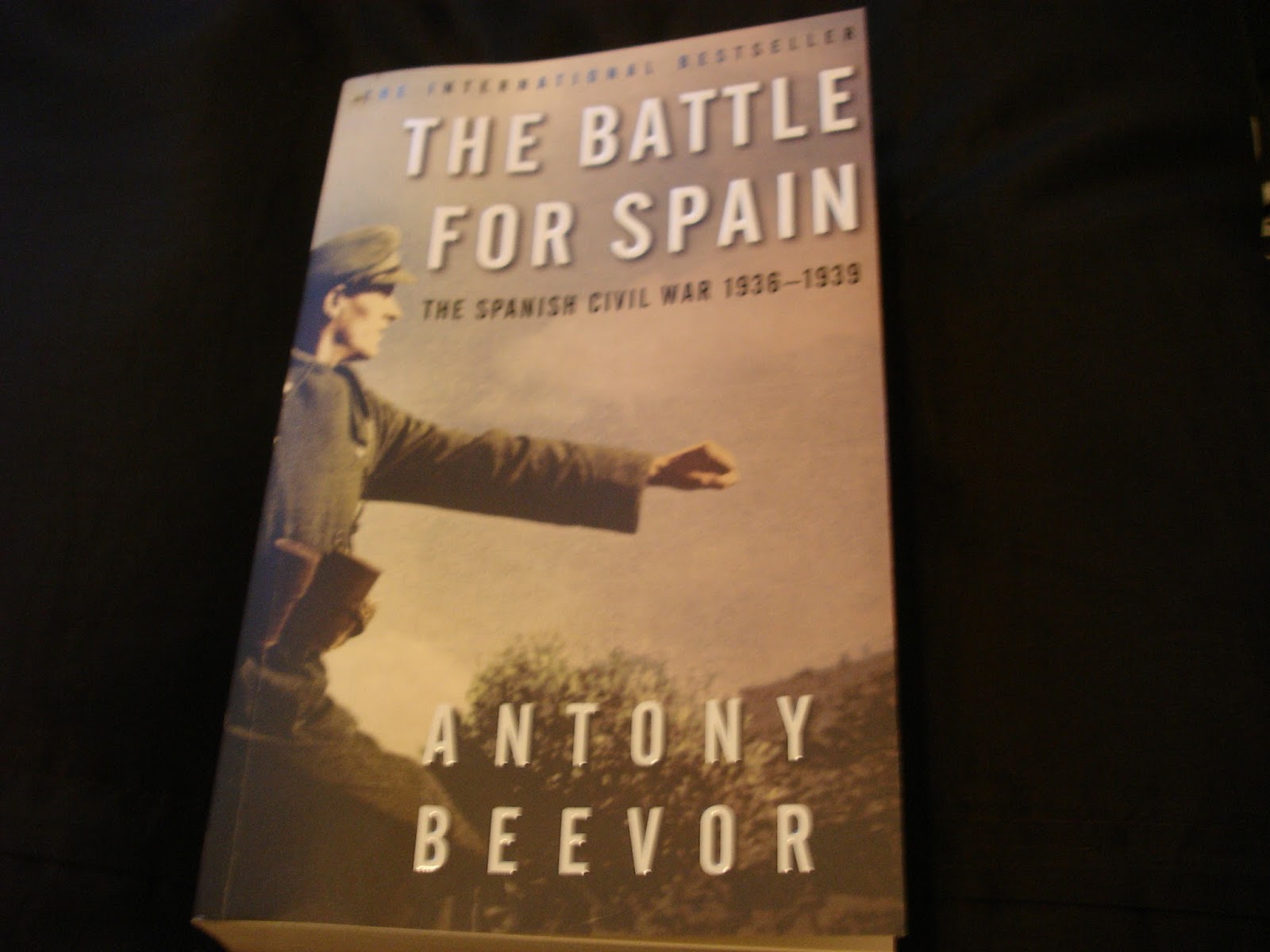
The Battle For Spain - The Spanish Civil War 1936-1939 - Antony Beevor - book review
The Spanish Civil War remains highly emotive. Antony Beevor chronicles and analyses the conflict in his book The Battle For Spain.
In the chapters which constitute a "preamble", Spain's history prior to the 1930s is stressed , with some emphasis on the influence of the Church and the landowners. The country had, it appears, not been affected as much as other parts of Europe by liberalizing impulses.
The plethora of factions on both sides of this conflict can be confusing to say the least, but Beevor does his best to clarify who was who, and why. As he observes, this was not just a struggle between left and right, but also one between libertarianism and authoritarianism and centralization and "federalism"/separatism. These dynamics served to create a very intense and volatile picture.
It is difficult not to be sympathetic to the more libertarian elements of the republican side, however much one feels that they were occasionally naive in their idealism in the face of cold realities. The anarchist scene in Spain around that time, particularly that located in Catalonia, is a fascinating and thought-provoking phenomenon. For all its flaws, a hopeful and positive experiment.
My interpretation was that Beevor felt that the left misjudged the size of its mandate, with its strident rhetoric more than its actions, driving many into the arms of the nationalists. The right exaggerated the "threat".
The infighting between the various groupings, and the fragmented nature of the alliances, is one of the factors which gives the Spanish Civil War an enduring fascination. Loose cannons, hot heads, impractical idealism, brazen opportunism, impulsiveness, impetuosity and cold calculation - all played their part in the drama.
I was impressed by the author's analysis of the early stages of the uprising, the government's hesitant and dilatory initial response, and the motivations behind some of the early atrocities. The republican excesses were more the result of an outburst of rage and chaos. The nationalists, on the other hand, planned a systematic campaign of terror, even "cleansing". The language coined by some nationalist officials is chilling, like something harking back to the Middle Ages...
Beevor goes to great lengths to outline how the unity, or otherwise, of the two sides developed and evolved, Franco maintaining a semblance of cohesion via a mixture of concessions, sops, coercion and eventually demonstrable indispensability to the success of the nationalist cause. Staying largely above the internal strife also clearly helped him. The republicans were not so fortunate, of course, having the heavy hand of Stalin and the Comintern to contend with. Was it the case that the nationalists had a simplicity of purpose, even allowing for lingering agendas, so that they were able to keep their eyes on the prize? It seems bizarre, but the situation in the anti-fascist camp was not that straightforward.
Another illuminating section of The Battle For Spain deals with the war economy in the republican zone, and the tensions which some methods sparked with the central government. It is difficult not to conclude that the anarchists sometimes clung too rigidly to lofty theories and ideals when a more pragmatic approach may have been more beneficial in the grand scheme of things. Later on, though, they felt with some justification that they were struggling for their very survival and identity.
The rather inglorious attitude of some foreign countries, as well as the manner in which big business connived with the nationalists, is a distasteful facet of the conflict. Yes, we all know now what Stalinism was like, but isn't this a case of being wise after the event? The "rationale" behind certain people's backing for Franco was rather grotesque. The republicans were drastically deprived of genuinely powerful friends, and the consequent reliance on support from the Soviet Union was to bear bitter fruit.
The "romance" surrounding the republican cause is very seductive, even if it is often tricky to pin down exactly. One of the main tasks of the historian therefore is to separate fact from myth, and to weigh what was propaganda, distortion or fabrication. I feel that Beevor remains relatively dispassionate throughout, and does not allow the emotive nature of the subject matter to impinge on lucid judgement. The cruelty and barbarism of the nationalists largely speaks for itself, although the cracks in the republican side take a little more explaining and understanding.
The International Brigades are often the things which most laymen remember about the Spanish Civil War, partly due to the literature and evocative tales which emerged, and also because of the principled stand which they made. Beevor strives to place their role into its proper perspective, and stresses how they slotted into the structure of the Republic's forces.
Diaries and private correspondence are invariably very useful in getting nearer to the truth. Intimate, often candid thoughts committed to paper in the midst of the maelstrom, not alloyed or compromised by propagandistic concerns or embellishment. Such material is made excellent use of in this book.
A probing look at the involvement of intellectuals and artists is also a feature of this work, how many became disillusioned, and how some journalists had their hands tied. It is also pointed how the "demonization" of the communists may have played into their hands, by allowing them to portray themselves as the sole meaningful and dedicated bulwark against fascism.
The portions which address the "civil war within a civil war" evoke a loss of faith among some of the leftist forces and the growth of disenchantment, It is at this point that the paranoia of the Stalin-aligned communists and their acolytes becomes a pervasive trend, seeing the hands of fifth-columnists in almost every military or political reverse. They had leverage, which meant that the other players in the republican fold had to tread carefully in dealing with them. They may admittedly have been on firmer ground in advocating firmer, more cohesive organization and leadership in the face of the nationalist threat.
The vagaries of Stalin's stance are strange. He was doing his best to conceal or downplay the "communistic" side of the republican make-up, for foreign consumption at least, whilst his men on the ground in Spain were throwing their weight around in no uncertain terms. The activities of the secret police, the harsh treatment of the International Brigades volunteers and the draconian punishments for soldiers are all documented here. It is easy to imagine how many people became exasperated and cynical.
A theme which emerges in the second half of this history is the tendency of the republican leadership, under communist sway, to embark on military adventures for reasons of propaganda, playing to both the domestic and international gallery, even when this was not consistent with military or strategic logic. At the same time, of course, the diplomatic picture was clouded and complicated by the gathering storm on the wider European scene. Decisions made regarding Spain were not made in isolation.
Rightly or wrongly, I discerned from some of the author's observations a sense that the republicans were almost naive and "green", both in some of their military decisions, and in their dealings with the outside world, in areas such as finance and arms procurement.
There is a look at what happened after the civil war concluded, including the fate of the exiles,and how Franco went about consolidating his grip on power. The role of both sides in the Second World War is given some attention, and Beevor also looks at the military lessons which the great powers learned, or disregarded, from the fighting in Spain. He also assesses the impact of the interventions made by the Soviet Union, Germany and Italy.
Overall, when reading this book I was left with a feeling of sadness at what befell Spain, at the behaviour of some people on both sides, and how those with honourable and humane motivations and intentions were let down, manipulated and misled.
The Battle For Spain is a sobering but rewarding and worthwhile read. It is well structured and paced, and it brings to life a tragic and contentious episode in modern European history.
In the chapters which constitute a "preamble", Spain's history prior to the 1930s is stressed , with some emphasis on the influence of the Church and the landowners. The country had, it appears, not been affected as much as other parts of Europe by liberalizing impulses.
The plethora of factions on both sides of this conflict can be confusing to say the least, but Beevor does his best to clarify who was who, and why. As he observes, this was not just a struggle between left and right, but also one between libertarianism and authoritarianism and centralization and "federalism"/separatism. These dynamics served to create a very intense and volatile picture.
It is difficult not to be sympathetic to the more libertarian elements of the republican side, however much one feels that they were occasionally naive in their idealism in the face of cold realities. The anarchist scene in Spain around that time, particularly that located in Catalonia, is a fascinating and thought-provoking phenomenon. For all its flaws, a hopeful and positive experiment.
My interpretation was that Beevor felt that the left misjudged the size of its mandate, with its strident rhetoric more than its actions, driving many into the arms of the nationalists. The right exaggerated the "threat".
The infighting between the various groupings, and the fragmented nature of the alliances, is one of the factors which gives the Spanish Civil War an enduring fascination. Loose cannons, hot heads, impractical idealism, brazen opportunism, impulsiveness, impetuosity and cold calculation - all played their part in the drama.
I was impressed by the author's analysis of the early stages of the uprising, the government's hesitant and dilatory initial response, and the motivations behind some of the early atrocities. The republican excesses were more the result of an outburst of rage and chaos. The nationalists, on the other hand, planned a systematic campaign of terror, even "cleansing". The language coined by some nationalist officials is chilling, like something harking back to the Middle Ages...
Beevor goes to great lengths to outline how the unity, or otherwise, of the two sides developed and evolved, Franco maintaining a semblance of cohesion via a mixture of concessions, sops, coercion and eventually demonstrable indispensability to the success of the nationalist cause. Staying largely above the internal strife also clearly helped him. The republicans were not so fortunate, of course, having the heavy hand of Stalin and the Comintern to contend with. Was it the case that the nationalists had a simplicity of purpose, even allowing for lingering agendas, so that they were able to keep their eyes on the prize? It seems bizarre, but the situation in the anti-fascist camp was not that straightforward.
Another illuminating section of The Battle For Spain deals with the war economy in the republican zone, and the tensions which some methods sparked with the central government. It is difficult not to conclude that the anarchists sometimes clung too rigidly to lofty theories and ideals when a more pragmatic approach may have been more beneficial in the grand scheme of things. Later on, though, they felt with some justification that they were struggling for their very survival and identity.
The rather inglorious attitude of some foreign countries, as well as the manner in which big business connived with the nationalists, is a distasteful facet of the conflict. Yes, we all know now what Stalinism was like, but isn't this a case of being wise after the event? The "rationale" behind certain people's backing for Franco was rather grotesque. The republicans were drastically deprived of genuinely powerful friends, and the consequent reliance on support from the Soviet Union was to bear bitter fruit.
The "romance" surrounding the republican cause is very seductive, even if it is often tricky to pin down exactly. One of the main tasks of the historian therefore is to separate fact from myth, and to weigh what was propaganda, distortion or fabrication. I feel that Beevor remains relatively dispassionate throughout, and does not allow the emotive nature of the subject matter to impinge on lucid judgement. The cruelty and barbarism of the nationalists largely speaks for itself, although the cracks in the republican side take a little more explaining and understanding.
The International Brigades are often the things which most laymen remember about the Spanish Civil War, partly due to the literature and evocative tales which emerged, and also because of the principled stand which they made. Beevor strives to place their role into its proper perspective, and stresses how they slotted into the structure of the Republic's forces.
Diaries and private correspondence are invariably very useful in getting nearer to the truth. Intimate, often candid thoughts committed to paper in the midst of the maelstrom, not alloyed or compromised by propagandistic concerns or embellishment. Such material is made excellent use of in this book.
A probing look at the involvement of intellectuals and artists is also a feature of this work, how many became disillusioned, and how some journalists had their hands tied. It is also pointed how the "demonization" of the communists may have played into their hands, by allowing them to portray themselves as the sole meaningful and dedicated bulwark against fascism.
The portions which address the "civil war within a civil war" evoke a loss of faith among some of the leftist forces and the growth of disenchantment, It is at this point that the paranoia of the Stalin-aligned communists and their acolytes becomes a pervasive trend, seeing the hands of fifth-columnists in almost every military or political reverse. They had leverage, which meant that the other players in the republican fold had to tread carefully in dealing with them. They may admittedly have been on firmer ground in advocating firmer, more cohesive organization and leadership in the face of the nationalist threat.
The vagaries of Stalin's stance are strange. He was doing his best to conceal or downplay the "communistic" side of the republican make-up, for foreign consumption at least, whilst his men on the ground in Spain were throwing their weight around in no uncertain terms. The activities of the secret police, the harsh treatment of the International Brigades volunteers and the draconian punishments for soldiers are all documented here. It is easy to imagine how many people became exasperated and cynical.
A theme which emerges in the second half of this history is the tendency of the republican leadership, under communist sway, to embark on military adventures for reasons of propaganda, playing to both the domestic and international gallery, even when this was not consistent with military or strategic logic. At the same time, of course, the diplomatic picture was clouded and complicated by the gathering storm on the wider European scene. Decisions made regarding Spain were not made in isolation.
Rightly or wrongly, I discerned from some of the author's observations a sense that the republicans were almost naive and "green", both in some of their military decisions, and in their dealings with the outside world, in areas such as finance and arms procurement.
There is a look at what happened after the civil war concluded, including the fate of the exiles,and how Franco went about consolidating his grip on power. The role of both sides in the Second World War is given some attention, and Beevor also looks at the military lessons which the great powers learned, or disregarded, from the fighting in Spain. He also assesses the impact of the interventions made by the Soviet Union, Germany and Italy.
Overall, when reading this book I was left with a feeling of sadness at what befell Spain, at the behaviour of some people on both sides, and how those with honourable and humane motivations and intentions were let down, manipulated and misled.
The Battle For Spain is a sobering but rewarding and worthwhile read. It is well structured and paced, and it brings to life a tragic and contentious episode in modern European history.
Labels:
antony beevor,
books,
europe,
germany,
history,
italy,
literature,
military history,
politics,
russia,
second world war,
soviet union,
spain,
spanish civil war,
war,
world war 2,
world war two
Wednesday, 9 September 2015
Tago Mago - Can - album review
Few, if any, artists can have created a run of albums of the consistent quality achieved by Can during the early Seventies. Perhaps the most striking and influential of those records was "Tago Mago", released in 1971 as a double album. I have seen it described by one or two critics as one of the greatest albums ever recorded, and to my ears this is no exaggeration of its merits.
Funnily enough, I did not really "get" the music of Can until comparatively recently. They seem to be one of those acts whose charms take a while to impress themselves on the listener. Once my defences were breached, however, I found it impossible not to immerse myself in their work, especially that run of records from the period 1971 to 1973. The type of material which jolts one out of any musical inertia and complacency which may have amassed.
The astonishing thing about "Tago Mago" is that in 2015 it still sounds so fresh, pristine and "contemporary". Some of the music of that era which also falls under the umbrella of "experimental" has not aged anywhere as gracefully. This album, on the other hand, has an immediacy and a punch which are enduringly compulsive and enthralling, distinct in this respect even from the other ground-breaking music which was emerging from Germany at the same time.
Despite being categorized by many as avant-garde, the outward format of the Can group was very much that of a conventional rock group. Vocalist, guitarist, bass player, keyboardist, drummer. The most immediately noticeable elements of their work, on this series of albums at least, are Jaki Liebezeit's astoundingly energetic drumming and the vocals of Damo Suzuki, who made his Can debut here. However, this should not make us overlook the contribution of the other instrumentalists, who were all integral elements in constituting the intoxicating Can sound during their best years.
Like so many great pieces of art, the draw and appeal of Can's best music is very difficult to encapsulate and convey in words. At their best, however, they were both rhythmic and blissfully melodic, often exhibiting these traits simultaneously. The terms "avant-garde" and "experimental" can serve to frighten off some people, but Can's music is ultimately as welcoming and comforting as any mainstream pop. Just cast off your blinkers and preconceptions at the door....
On such a uniformly strong record it is difficult to pick out highlights, but the track "Halleluhwah" is a particularly gripping and impressive creation, clocking in at over eighteen minutes, and for many representing the apogee of their journey. Liebezeit sounds like he has grown an extra set of limbs, the rhythm and tone are slightly more aggressive than elsewhere on the set, and the sheer length of the piece gives scope for diversions and more time for a mood and a groove to assert themselves. As elsewhere on "Tago Mago" the keyboards are not generally as prominent as one might imagine, but they are essential in engendering that peculiar ambience. This applies, if not as much, to the guitar work.
Having waxed lyrical about "Halleluhwah", it is fair to point out that the other numbers are almost all strong and interesting in their own right. Aside from "Halleluhwah", the other two more lengthy and "unconventional" pieces are "Aumgn" and "Peking O", the latter featuring some striking sound effects and vocal treatments. One gets the feeling that these two tracks more accurately embody the group's musical heritage than the more compact material. Can had the consummate knack of making such extended pieces seem accessible and benign, however.
Of the shorter items, the opener "Paperhouse" has a laid-back but insistent groove to begin with, before branching out, and it is something of a guitar showcase for Michael Karoli. It is followed by "Mushroom", which feels to me more austere and "minimalist". One can easily see how this track and its character might have rubbed off on many musicians who emerged later.
"Oh Yeah" is an absolute delight and and an adventure, from the opening "explosion" sound effect, to the propulsive beat, to what sound like backwards vocals. As so often with Can, the rhythm is soothing rather than grating, and the keyboards and guitar both accentuate this flavour and lay textures of their own.
The closing song "Bring Me Coffee or Tea", at its outset at least, displays the mellower side of Can, and is an ideal way to bring us down to earth. There is even what sounds like acoustic guitar in there. More great drumming, if more delicate and understated.
I have not compared Can or their music to other artists, quite simply because there is nothing who they can safely be compared to, certainly among their contemporaries. It is unlikely that you will be open-mouthed with astonishment when first hearing them. More likely, you will eventually, after careful attention, find yourself muttering something like "my word, these guys were good".....
Funnily enough, I did not really "get" the music of Can until comparatively recently. They seem to be one of those acts whose charms take a while to impress themselves on the listener. Once my defences were breached, however, I found it impossible not to immerse myself in their work, especially that run of records from the period 1971 to 1973. The type of material which jolts one out of any musical inertia and complacency which may have amassed.
The astonishing thing about "Tago Mago" is that in 2015 it still sounds so fresh, pristine and "contemporary". Some of the music of that era which also falls under the umbrella of "experimental" has not aged anywhere as gracefully. This album, on the other hand, has an immediacy and a punch which are enduringly compulsive and enthralling, distinct in this respect even from the other ground-breaking music which was emerging from Germany at the same time.
Despite being categorized by many as avant-garde, the outward format of the Can group was very much that of a conventional rock group. Vocalist, guitarist, bass player, keyboardist, drummer. The most immediately noticeable elements of their work, on this series of albums at least, are Jaki Liebezeit's astoundingly energetic drumming and the vocals of Damo Suzuki, who made his Can debut here. However, this should not make us overlook the contribution of the other instrumentalists, who were all integral elements in constituting the intoxicating Can sound during their best years.
Like so many great pieces of art, the draw and appeal of Can's best music is very difficult to encapsulate and convey in words. At their best, however, they were both rhythmic and blissfully melodic, often exhibiting these traits simultaneously. The terms "avant-garde" and "experimental" can serve to frighten off some people, but Can's music is ultimately as welcoming and comforting as any mainstream pop. Just cast off your blinkers and preconceptions at the door....
On such a uniformly strong record it is difficult to pick out highlights, but the track "Halleluhwah" is a particularly gripping and impressive creation, clocking in at over eighteen minutes, and for many representing the apogee of their journey. Liebezeit sounds like he has grown an extra set of limbs, the rhythm and tone are slightly more aggressive than elsewhere on the set, and the sheer length of the piece gives scope for diversions and more time for a mood and a groove to assert themselves. As elsewhere on "Tago Mago" the keyboards are not generally as prominent as one might imagine, but they are essential in engendering that peculiar ambience. This applies, if not as much, to the guitar work.
Having waxed lyrical about "Halleluhwah", it is fair to point out that the other numbers are almost all strong and interesting in their own right. Aside from "Halleluhwah", the other two more lengthy and "unconventional" pieces are "Aumgn" and "Peking O", the latter featuring some striking sound effects and vocal treatments. One gets the feeling that these two tracks more accurately embody the group's musical heritage than the more compact material. Can had the consummate knack of making such extended pieces seem accessible and benign, however.
Of the shorter items, the opener "Paperhouse" has a laid-back but insistent groove to begin with, before branching out, and it is something of a guitar showcase for Michael Karoli. It is followed by "Mushroom", which feels to me more austere and "minimalist". One can easily see how this track and its character might have rubbed off on many musicians who emerged later.
"Oh Yeah" is an absolute delight and and an adventure, from the opening "explosion" sound effect, to the propulsive beat, to what sound like backwards vocals. As so often with Can, the rhythm is soothing rather than grating, and the keyboards and guitar both accentuate this flavour and lay textures of their own.
The closing song "Bring Me Coffee or Tea", at its outset at least, displays the mellower side of Can, and is an ideal way to bring us down to earth. There is even what sounds like acoustic guitar in there. More great drumming, if more delicate and understated.
I have not compared Can or their music to other artists, quite simply because there is nothing who they can safely be compared to, certainly among their contemporaries. It is unlikely that you will be open-mouthed with astonishment when first hearing them. More likely, you will eventually, after careful attention, find yourself muttering something like "my word, these guys were good".....
Tuesday, 1 September 2015
The Habsburgs - Andrew Wheatcroft - book review
Another of the books which I have recently revisited after a gap of a few years is "The Habsburgs - Embodying Empire", by Andrew Wheatcroft, first published in 1995.
As the author is keen to stress, he adopts an approach of looking at the Habsburgs in the context of the dynastic entity, rather than simply as a series of individuals. Also, he examines the ways in which the self-image of the family evolved, and how this was conveyed via art, architecture, the printed word, ceremony and so forth. The methods by which the Habsburgs projected and perpetuated the "myth". The mystical and romantic elements of these impulses are explored, too.
It is also one of the curious aspects of the story that the Habsburgs attained their influence and reach as much by strategic marriages and accumulation of wealth than via warfare. They themselves were often relatively impecunious, and their financial strength was precarious, sometimes depending on inheritance via marriage.
One of the things which readers might find surprising is how much this study concentrates on the Spanish branch of the Habsburg dynasty. To many, the family is most commonly associated with the German-speaking parts of Europe, bur in fact the focus on Spain is quite illuminating in painting the full picture accurately and vividly.
This is not really the definitive story of the dynasty, nor does it set out to be. Some of the most notable figures, such as Maximilian, Charles V and Philip II, are accorded what might be described as mini-biographies. These portraits are quite gripping, detailing the traits of these rulers, and how they themselves interpreted and propelled the Habsburg mystique.
Wheatcroft does not exhaustively chronicle each diplomatic initiative and military campaign, but instead he tends to concentrate on some phases which he feels are particularly instructive. Some episodes which are considered pivotal in European history are therefore given less attention than one might normally expect. This does not lessen the book's appeal;in fact, in many ways, it enhances it.
The seemingly endless references to the Habsburgs' religious piety and divine guidance may give the impression of an archaic age, but they are essential to an understanding of how the dynasty perceived itself, and what drove it on.
My impression was that relatively little was mentioned about the attitudes of the Habsburgs' millions of subjects, more specifically about the impact, or lack of it, of their rule on economic and social conditions. It seemed that untold resources were expended on opulent palaces, churches, and castles. What about education, healthcare, infrastructure, economic development? The fact that they are rarely mentioned may tell its own story. Then again, the remit of the book does not demand that such subjects predominate.
There is some protracted analysis of the various difficulties which afflicted the Habsburg succession, and how the furtherance of the line was engineered and secured. The author scores highly in his examination of the tension which sometimes sprang up between the generations, and how each new ruler put his or her own stamp on the office, whilst adhering to tradition and ethos. We also acquire a sense of how the geographical and strategic orientation of the empire continued to shift over the centuries.
The last one hundred years or so of the empire are documented in a condensed, but lively and readable way. The implication I think is that, faced with revolutions and new political and social forces, the Habsburgs adapted as much by changing administrative methods and presentational styles as by changing fundamental policies and beliefs. The effects on the family of the Enlightenment, and the upheavals which came after it, appear to have been uneven.
This book did not necessarily make me more sympathetic to Habsburg values and practices. However, it did deepen my understanding of why they thought and acted in the way they did. It is a thoughtful and easily digestible exploration of the phenomenon.
As the author is keen to stress, he adopts an approach of looking at the Habsburgs in the context of the dynastic entity, rather than simply as a series of individuals. Also, he examines the ways in which the self-image of the family evolved, and how this was conveyed via art, architecture, the printed word, ceremony and so forth. The methods by which the Habsburgs projected and perpetuated the "myth". The mystical and romantic elements of these impulses are explored, too.
It is also one of the curious aspects of the story that the Habsburgs attained their influence and reach as much by strategic marriages and accumulation of wealth than via warfare. They themselves were often relatively impecunious, and their financial strength was precarious, sometimes depending on inheritance via marriage.
One of the things which readers might find surprising is how much this study concentrates on the Spanish branch of the Habsburg dynasty. To many, the family is most commonly associated with the German-speaking parts of Europe, bur in fact the focus on Spain is quite illuminating in painting the full picture accurately and vividly.
This is not really the definitive story of the dynasty, nor does it set out to be. Some of the most notable figures, such as Maximilian, Charles V and Philip II, are accorded what might be described as mini-biographies. These portraits are quite gripping, detailing the traits of these rulers, and how they themselves interpreted and propelled the Habsburg mystique.
Wheatcroft does not exhaustively chronicle each diplomatic initiative and military campaign, but instead he tends to concentrate on some phases which he feels are particularly instructive. Some episodes which are considered pivotal in European history are therefore given less attention than one might normally expect. This does not lessen the book's appeal;in fact, in many ways, it enhances it.
The seemingly endless references to the Habsburgs' religious piety and divine guidance may give the impression of an archaic age, but they are essential to an understanding of how the dynasty perceived itself, and what drove it on.
My impression was that relatively little was mentioned about the attitudes of the Habsburgs' millions of subjects, more specifically about the impact, or lack of it, of their rule on economic and social conditions. It seemed that untold resources were expended on opulent palaces, churches, and castles. What about education, healthcare, infrastructure, economic development? The fact that they are rarely mentioned may tell its own story. Then again, the remit of the book does not demand that such subjects predominate.
There is some protracted analysis of the various difficulties which afflicted the Habsburg succession, and how the furtherance of the line was engineered and secured. The author scores highly in his examination of the tension which sometimes sprang up between the generations, and how each new ruler put his or her own stamp on the office, whilst adhering to tradition and ethos. We also acquire a sense of how the geographical and strategic orientation of the empire continued to shift over the centuries.
The last one hundred years or so of the empire are documented in a condensed, but lively and readable way. The implication I think is that, faced with revolutions and new political and social forces, the Habsburgs adapted as much by changing administrative methods and presentational styles as by changing fundamental policies and beliefs. The effects on the family of the Enlightenment, and the upheavals which came after it, appear to have been uneven.
This book did not necessarily make me more sympathetic to Habsburg values and practices. However, it did deepen my understanding of why they thought and acted in the way they did. It is a thoughtful and easily digestible exploration of the phenomenon.
Saturday, 22 August 2015
The War of Wars - Robert Harvey - book review
I have recently begun to revisit some of the books which I first read about four or five years ago. I thought that I would start with "The War of Wars", by Robert Harvey, a one-volume chronicle of the French Revolutionary and Napoleonic Wars. It is subtitled "The Epic Struggle Between Britain and France 1789-1815".
The author details the main episodes which characterized the French Revolution. He documents some of the lunacy and cruelty which took place, as well as the ideals, and the undoubtedly good and progressive consequences of the upheaval. Like many people, I find myself torn between admiration of the general ideological thrust of the Revolution. and revulsion at the often hysterical, absurd and brutal methods.
Of course, much of the story revolves around the person of Napoleon Bonaparte. Yes, he cherished some lofty ideals, but he was also distinctly opportunistic and cynical. Circumstances such as those which prevailed in the late nineteenth century generally allow people such as he to flourish. Those who are adept at manipulating, but also inspiring, the masses.
The book covers the early stages of the Revolutionary Wars. It is sometimes forgotten just how intense those campaigns were. The British involvement is highlighted, as is the often less than united front presented by the "Allies".
One of the most notable aspects of "The War Of Wars" is Harvey's views of Napoleon. They contrast somewhat with those of some observers, who tend to place Bonaparte on a pedestal, and portray him as some kind of demi-god.
Harvey puts many of Napoleon's successes into perspective, not slavishly ascribing every victory to his consummate brilliance, but pointing out where the contribution of others was decisive or instrumental, and those occasions where he succeeded more by accident than design. There is an interesting account of his rise to prominence, and how it was partly triggered by luck and circumstances.
Sensibly, in view of the scope of the events being tackled, the book is divided into "bite-size" sections, each covering a short phase of the conflicts. The naval campaigns are covered in some depth, not always a feature of works about the Napoleonic epoch. There is a "mini-biography" of Horatio Nelson, and his rise to seniority. He does not necessarily come across as a particularly appealing character. The passages about the sea battles also bring to light the struggles of the day concerning meritocracy and the often flawed mechanisms of promotion and command.
Another uncomfortable truth to emerge is that Britain associated with, and endorsed, some rather unsavoury and disreputable people in those times; deeply reactionary monarchs, for example. Was it still early days in British politics, a few decades before genuine democracy and social reform became durable and entrenched? Napoleon was no angel, but London attached itself a little too assiduously to people who resented and resisted social progress.
In addition, this book serves to re-balance some common perceptions about the extent of Britain's involvement in the conflicts against France. It is often popularly assumed that Britain did little apart from writing cheques to subsidize its continental allies, and dominating the seas in order to protect its far-flung imperial possessions and its trade. However, the truth is that Britain was constantly active in some shape or form, even if many of the projects either ended in failure or were aborted.
Regarding the events of 1799, the version here seems to imply that Napoleon was in the right place at the right time, cultivated the right friendships, and possessed fewer scruples than the others who might have taken power. He was prepared to employ brute force and intimidation, as well as possessing the necessary brand of ruthlessness and ambition.
We are given some balanced and colourful assessments of the key figures, such as Pitt, Wellington and countless lesser participants in the drama. Harvey does not hesitate to illustrate and point out people's failings as well as their assets and virtues.
Some interesting tangents are dealt with, including the activities in Latin America and the Caribbean, as well as Napoleon's repeated efforts to stir up trouble for the British in India and elsewhere. Also, the Peninsular Wars in Spain and Portugal, and their impact on the broader picture, are given their rightful prominence.
The telling here also tends to jar with the notion that Napoleon was an all-conquering genius, and that his decline or stagnation only commenced with the invasion of Russia. Harvey correctly observes that the other European powers learned valuable lessons from their earlier chastening defeats at the hands of France. They reformed their military command structures and revised their tactical doctrines. As early as 1807, in the descriptions of the battles, one can sense that the "coalition" forces are proving to be sterner and more flexible opposition.
In his conclusions, the author espouses some views which people might find contentious, but he argues persuasively and cogently, for example in his assessment of Napoleon's merits as a military commander, diplomat and politician. He also makes some probing observations about how the Revolution and Napoleon affected France and the wider continent of Europe, and also how Napoleon's need to sustain his power base and position, coupled with his arrogance, ensured that further conflict, rather than peace, would be seen.
Needless to say, because of its scope, this book cannot hope to cover the various individual topics and theatres of war in the same comprehensive detail which would be seen in more specialized volumes, but it is a worthy and lively effort at explaining this momentous and turbulent period, the course and outcome of which continue to divide opinion and prompt vigorous debate to this day.
The author details the main episodes which characterized the French Revolution. He documents some of the lunacy and cruelty which took place, as well as the ideals, and the undoubtedly good and progressive consequences of the upheaval. Like many people, I find myself torn between admiration of the general ideological thrust of the Revolution. and revulsion at the often hysterical, absurd and brutal methods.
Of course, much of the story revolves around the person of Napoleon Bonaparte. Yes, he cherished some lofty ideals, but he was also distinctly opportunistic and cynical. Circumstances such as those which prevailed in the late nineteenth century generally allow people such as he to flourish. Those who are adept at manipulating, but also inspiring, the masses.
The book covers the early stages of the Revolutionary Wars. It is sometimes forgotten just how intense those campaigns were. The British involvement is highlighted, as is the often less than united front presented by the "Allies".
One of the most notable aspects of "The War Of Wars" is Harvey's views of Napoleon. They contrast somewhat with those of some observers, who tend to place Bonaparte on a pedestal, and portray him as some kind of demi-god.
Harvey puts many of Napoleon's successes into perspective, not slavishly ascribing every victory to his consummate brilliance, but pointing out where the contribution of others was decisive or instrumental, and those occasions where he succeeded more by accident than design. There is an interesting account of his rise to prominence, and how it was partly triggered by luck and circumstances.
Sensibly, in view of the scope of the events being tackled, the book is divided into "bite-size" sections, each covering a short phase of the conflicts. The naval campaigns are covered in some depth, not always a feature of works about the Napoleonic epoch. There is a "mini-biography" of Horatio Nelson, and his rise to seniority. He does not necessarily come across as a particularly appealing character. The passages about the sea battles also bring to light the struggles of the day concerning meritocracy and the often flawed mechanisms of promotion and command.
Another uncomfortable truth to emerge is that Britain associated with, and endorsed, some rather unsavoury and disreputable people in those times; deeply reactionary monarchs, for example. Was it still early days in British politics, a few decades before genuine democracy and social reform became durable and entrenched? Napoleon was no angel, but London attached itself a little too assiduously to people who resented and resisted social progress.
In addition, this book serves to re-balance some common perceptions about the extent of Britain's involvement in the conflicts against France. It is often popularly assumed that Britain did little apart from writing cheques to subsidize its continental allies, and dominating the seas in order to protect its far-flung imperial possessions and its trade. However, the truth is that Britain was constantly active in some shape or form, even if many of the projects either ended in failure or were aborted.
Regarding the events of 1799, the version here seems to imply that Napoleon was in the right place at the right time, cultivated the right friendships, and possessed fewer scruples than the others who might have taken power. He was prepared to employ brute force and intimidation, as well as possessing the necessary brand of ruthlessness and ambition.
We are given some balanced and colourful assessments of the key figures, such as Pitt, Wellington and countless lesser participants in the drama. Harvey does not hesitate to illustrate and point out people's failings as well as their assets and virtues.
Some interesting tangents are dealt with, including the activities in Latin America and the Caribbean, as well as Napoleon's repeated efforts to stir up trouble for the British in India and elsewhere. Also, the Peninsular Wars in Spain and Portugal, and their impact on the broader picture, are given their rightful prominence.
The telling here also tends to jar with the notion that Napoleon was an all-conquering genius, and that his decline or stagnation only commenced with the invasion of Russia. Harvey correctly observes that the other European powers learned valuable lessons from their earlier chastening defeats at the hands of France. They reformed their military command structures and revised their tactical doctrines. As early as 1807, in the descriptions of the battles, one can sense that the "coalition" forces are proving to be sterner and more flexible opposition.
In his conclusions, the author espouses some views which people might find contentious, but he argues persuasively and cogently, for example in his assessment of Napoleon's merits as a military commander, diplomat and politician. He also makes some probing observations about how the Revolution and Napoleon affected France and the wider continent of Europe, and also how Napoleon's need to sustain his power base and position, coupled with his arrogance, ensured that further conflict, rather than peace, would be seen.
Needless to say, because of its scope, this book cannot hope to cover the various individual topics and theatres of war in the same comprehensive detail which would be seen in more specialized volumes, but it is a worthy and lively effort at explaining this momentous and turbulent period, the course and outcome of which continue to divide opinion and prompt vigorous debate to this day.
Wednesday, 8 July 2015
Vanished Kingdoms - The History of Half-Forgotten Europe - Norman Davies
In the past three or four years, I have had the good fortune to read some wonderfully informative and entertaining books about history, predominantly covering the history of Europe. "Vanished Kingdoms - The History of Half-Forgotten Europe" by Norman Davies is a worthy addition to that list. In essence, the author selected a number of defunct realms and kingdoms, some of which, directly or indirectly, either had a sizeable influence on the future course of events, or represented a staging post, however obscure, on the path to what we have today. Others are just interesting for their own sakes. Each state is allocated its own separate chapter.
At first. some of the choices can seem a little off the beaten track, but they all are compelling and thought-provoking in their own way. Medieval (and early Modern) Europe can be a daunting tapestry, but this book helps to fill in a few gaps, and create perspective and an enhanced understanding. The "bite size" format is also an asset. "Vanished Kingdoms" doesn't just give us a portrait of a particular region or political entity, but also broadens and enriches our view of whole epochs. Times of transition, turbulence and change.
"Burgundia" was perhaps my favourite of all the articles, as it helps to clarify the post-Charlemagne carve-up, and how the beginnings of modern France, Germany and Switzerland took shape, as secessions, horse-trading and expansionism did their work . This section for me is the heart of the book, as it encompasses the early medieval period, through to the growth of the Holy Roman Empire, and touches on papal schisms and the Hundred Years War. Also Burgundia played an oft-forgotten part in the European Renaissance, and the rise of the Habsburg family, and it has a certain enigmatic richness and dynamism about it.
The "Aragon" section incorporates the struggles against the Moors (Reconquista) and the eventual "unification" of the Iberian peninsula, as well as touching on several other strands of Mediterranean and broader European history. Many of the stories told in the different chapters overlap, but the sagas are detailed in such an interesting and imaginative way that they never feel repetitive.
I was surprised at how brief the chapter on "Byzantion" was, but that is one of the delights of this book. It does not conform to any set pattern, and is full of twists and pleasant surprises. One of my tips for enjoying a book such as this is to avoid putting pressure on oneself to photographically memorise dates, names and chronologies. Just absorb the erudition and the words, and the general thread will make sense in the end. The mix is further leavened by the writer's occasionally whimsical and laconic style.
Davies is careful to illustrate how the remnants of the past are preserved and interpreted today. Also, he examines the often divisive and contentious legacies of these defuct states, and the passions and emotions which many of them continue to arouse at a local and international level.
In summary, "Vanished Kingdoms" is a charming, absorbing and entertaining look at some political entities and territories which have disappeared from the map over the centuries, and in its own way traces much of the story of Europe from around the time of the collapse of the Roman Empire through to the present day. One of those works which exudes the author's enthusiasm for his subject, and the diligence and scope of his knowledge and research.
Labels:
books,
europe,
european,
history,
literature,
norman davies,
politics,
reading,
vanished kingdoms,
writing
Saturday, 20 June 2015
Put Me Back On My Bike-In Search Of Tom Simpson - William Fotheringham
A book which has won many plaudits is "Put Me Back On My Bike", William Fotheringham's biography of the British cyclist Tom Simpson, who died during the 1967 Tour de France. I recently read the book myself.
I had enjoyed Fotheringham's biography of Eddy Merckx, and found this one even more compelling. As well as chronicling his life and achievements, it examines the tragic circumstances of his death and his legacy for British and world cycling.
In the past, I had rather shied away from fully exploring the Simpson story, mainly I suppose because of its tragic end and unsettling elements. It is a tale with many old-school elements, but also starkly pertinent for modern eyes and eyes.
What emerged most of all for me, over and above the well-documented episodes, is Simpson's complex and quirky personality. He appears to have presaged characteristics which we associate with modern sportspeople, but there were endearing traits and contradictions. I found myself warming to the man, even allowing for his flaws. Aren't we all flawed in some way? The Tom Simpson who is portayed here is much different from the one who, in my ignorance, I had sometimes imagined. His interest in money, the mild English eccentricity and the mischievous side. The one area which I expected more to be made of was the notion of the "working class boy made good", but it seems that this was only a part the story
It could even be said that he was a visionary in the context of the British scene, having his eyes on the Continental arena from an early stage, and in his renunciation of the insularity and backwardness of the domestic landscape. His approach to training and preparation is also covered in detail here, from his focus on diet to his constant striving for any minute technical or tactical advantage, his hunger for knowledge and information, and how he was prepared to stretch himself and his physical limits.
The testimony and anecdotes, together with the documentary sources, are part of what makes this book work for me, giving it real substance and authority. The recollections of those closely associated with Simpson all go towards composing a vivid picture of the man and his life. The human nitty-gritty is uncovered, not just the dry facts about races won or lost. Some of the stories are funny, others are unsettling or poignant. The author also visits some of the locations central to the tale, augmenting the tapestry. The book is compact and to-the-point, but the level of detail and insight is impressive.
In relating the Tom Simpson story, Fotheringham also evokes the atmosphere of cycling, and to a lesser degree, European society in the Sixties. Whilst the vibrancy and cosmopolitanism are celebrated, I sensed his unease about the organisation and financial structures of the professional sport in that era, which often placed the competitors in an invidious position. We also gain a taste of how Simpson was in some respects a man of his time, when sports and the world in general were going through a transitional phase. There are some touching and intriguing passages about the "expatriate" cycling community in Belgium, and how Flanders welcomed and embraced the young Brits who went there to pursue their dreams.
The last third or so of "Put Me Back On My Bike" necessarily assumes a darker tone, as the factors contributing to Tom's death are addressed, as is the issue of drug use in cycling, and how the peloton and the powers-that-be viewed it. Needless to say, these chapters contain much less in the way of levity and lightheartedness than the earlier parts of the work. It seems to me that the standard line that "everybody was doing it" is only accepted by the author up to a point, and he elaborates on the reasons for this.
All in all, I found this book to be an engrossing and informative read. It is well put together, powerful in places, and candid. Highly recommended.
It could even be said that he was a visionary in the context of the British scene, having his eyes on the Continental arena from an early stage, and in his renunciation of the insularity and backwardness of the domestic landscape. His approach to training and preparation is also covered in detail here, from his focus on diet to his constant striving for any minute technical or tactical advantage, his hunger for knowledge and information, and how he was prepared to stretch himself and his physical limits.
The testimony and anecdotes, together with the documentary sources, are part of what makes this book work for me, giving it real substance and authority. The recollections of those closely associated with Simpson all go towards composing a vivid picture of the man and his life. The human nitty-gritty is uncovered, not just the dry facts about races won or lost. Some of the stories are funny, others are unsettling or poignant. The author also visits some of the locations central to the tale, augmenting the tapestry. The book is compact and to-the-point, but the level of detail and insight is impressive.
In relating the Tom Simpson story, Fotheringham also evokes the atmosphere of cycling, and to a lesser degree, European society in the Sixties. Whilst the vibrancy and cosmopolitanism are celebrated, I sensed his unease about the organisation and financial structures of the professional sport in that era, which often placed the competitors in an invidious position. We also gain a taste of how Simpson was in some respects a man of his time, when sports and the world in general were going through a transitional phase. There are some touching and intriguing passages about the "expatriate" cycling community in Belgium, and how Flanders welcomed and embraced the young Brits who went there to pursue their dreams.
The last third or so of "Put Me Back On My Bike" necessarily assumes a darker tone, as the factors contributing to Tom's death are addressed, as is the issue of drug use in cycling, and how the peloton and the powers-that-be viewed it. Needless to say, these chapters contain much less in the way of levity and lightheartedness than the earlier parts of the work. It seems to me that the standard line that "everybody was doing it" is only accepted by the author up to a point, and he elaborates on the reasons for this.
All in all, I found this book to be an engrossing and informative read. It is well put together, powerful in places, and candid. Highly recommended.
Sunday, 14 June 2015
Merckx : Half Man, Half Bike - William Fotheringham
For some time, I have been fascinated by the great Belgian cyclist Eddy Merckx. He was one of the world's pre-eminent athletes during the early years of my childhood, and for years afterwards his name was synonymous with the sport of cycling. Fortunately, the world has been quite well served in recent times with books about the great man. I had already read Daniel Friebe's biography, and more recently came across William Fotheringham's book "Merckx;Half Man, Half Bike".
My interest in Merckx was only deepened when I learned more about his approach to his sport, and how he was perceived by his contemporaries. It is probably true to say that he remains something of an enigma.
The thing which stands above all in this relating of the Merckx story is the sheer workload which he took on year after year, There was little picking or choosing of events, by him or his peers, and no concentration on a few select races, as would become the norm in the 1990s.
Fotheringham gives due prominence to the cyclist's upbringing, and how the influence of both of his parents impacted on his temperament and his outlook on life and racing. It is also interesting to note that Merckx came from a slightly different social and cultural background to many of his rivals. This painted him as an outsider, but also has been cited as enabling him to have more universal, less parochial appeal. Of course, how "The Cannibal" sat within the linguistic and cultural make-up of Belgium, and Belgian cycling, is a theme which recurs throughout this work.
One of the things which interests me most about Merckx is how he shunned and broke down many of the cosy conventions and assumptions which prevailed in cycling when he arrived on the scene. This antagonized some, but drew acclaim from others for the way in which it shook up the status quo. It is noted here that his riding style drew ire from some purists, but he won over some sections of the press and public because of the intensity and courage of his modus operandi.
I think that Fotheringham scores highly because he continuously delves into the mind of Merckx, to see what made him tick, how insecurity and a fear of failure, as well a colossal work ethic, drove him on. He was constantly challenging himself, finding out what he was capable of, rather than just doing the minimum necessary to win. These imperatives, coupled with immense natural physical gifts, make a select few sportspeople very special. The author documents how Merckx's methods evolved and were refined throughout his career, from junior days, to the amateur ranks, through to his peak years as a professional, and to the period of decline. The author also draws on his knowledge of the finer technical, as well as tactical, points of cycling.
This book seeks to address some of the mythology which has built up around elements of Eddy's career, including the assertion that he lacked genuine opposition. These themes are explored in a nuanced and balanced way, and I was left with a much enhanced understanding of the Merckx phenomenon.
My interest in Merckx was only deepened when I learned more about his approach to his sport, and how he was perceived by his contemporaries. It is probably true to say that he remains something of an enigma.
The thing which stands above all in this relating of the Merckx story is the sheer workload which he took on year after year, There was little picking or choosing of events, by him or his peers, and no concentration on a few select races, as would become the norm in the 1990s.
Fotheringham gives due prominence to the cyclist's upbringing, and how the influence of both of his parents impacted on his temperament and his outlook on life and racing. It is also interesting to note that Merckx came from a slightly different social and cultural background to many of his rivals. This painted him as an outsider, but also has been cited as enabling him to have more universal, less parochial appeal. Of course, how "The Cannibal" sat within the linguistic and cultural make-up of Belgium, and Belgian cycling, is a theme which recurs throughout this work.
One of the things which interests me most about Merckx is how he shunned and broke down many of the cosy conventions and assumptions which prevailed in cycling when he arrived on the scene. This antagonized some, but drew acclaim from others for the way in which it shook up the status quo. It is noted here that his riding style drew ire from some purists, but he won over some sections of the press and public because of the intensity and courage of his modus operandi.
I think that Fotheringham scores highly because he continuously delves into the mind of Merckx, to see what made him tick, how insecurity and a fear of failure, as well a colossal work ethic, drove him on. He was constantly challenging himself, finding out what he was capable of, rather than just doing the minimum necessary to win. These imperatives, coupled with immense natural physical gifts, make a select few sportspeople very special. The author documents how Merckx's methods evolved and were refined throughout his career, from junior days, to the amateur ranks, through to his peak years as a professional, and to the period of decline. The author also draws on his knowledge of the finer technical, as well as tactical, points of cycling.
This book seeks to address some of the mythology which has built up around elements of Eddy's career, including the assertion that he lacked genuine opposition. These themes are explored in a nuanced and balanced way, and I was left with a much enhanced understanding of the Merckx phenomenon.
Friday, 20 March 2015
Enzo Ferrari, A Life - Richard Williams - book review
With the dawn of the new Formula 1 season, I have been prompted to revisit some of the racing books gathering dust on my shelves. One of those was Richard Williams' biography of Enzo Ferrari, first published in 2001.
This is a biography of Ferrari the man, so those searching for exhaustive lists of chassis numbers, or intricate technical analysis, should perhaps look elsewhere. There is some good scene-setting stuff, exploring Ferrari's early life and his background. Indeed, these stimulating passages left me yearning for more information concerning those formative years. The chapters dealing with Enzo's own racing exploits are equally evocative, for example the 1919 Targa Florio.
With limited space, it is understandable that this book does not go into great detail about how Ferrari reacted to, and fitted into, the febrile social and political climate which prevailed in Italy when he was launching his career in motor sport and business. The author does not ignore the issue, though, and one is left with an impression of the realities and choices faced by many prominent Italians at that time.
It is striking how convoluted, constantly shifting, and sometimes strained, Enzo Ferrari's relationship with Alfa Romeo was, much more so than is popularly imagined. I was gratified to find that this stage of his life is covered in some depth, as are the "heroic" and "golden" ages of motor racing, between the world wars. These sections are gripping, and one is left with a vivid impression of a perilous but momentous era. From the emergence of the likes of Nuvolari, Varzi and Moll, and Ferrari's relationship with these figures, to the sea-change brought about by the advent of the Auto Union and Mercedes teams. The legendary races such as the Mille Miglia and the Targa Florio are also afforded due attention.
At various junctures in this biography we are informed how some of the mythology and legend which surrounds (or surrounded?) Ferrari accumulated. It is worth stressing, however, that Williams does not go overboard on this dimension of the tale. Indeed, some myths and/or tall stories are dispelled or debunked. It is tempting to view every episode surrounding Ferrari in "conspiratorial" terms. Thankfully, a more measured and dispassionate approach is adopted here.
The parts of the book which address the tumultuous 1950s are also quite absorbing. The tragedies, the controversies, the playing off of drivers against each other, the brief Ferrari tenure of Juan Manuel Fangio and the turbulent 1958 season all feature heavily. Throughout there are also fascinating and often revealing anecdotes about Ferrari's dealings with drivers, celebrities, notables and the families of drivers. I feel that the portrayal of the man is balanced, showing his flaws but also highlighting his human qualities, which are often overlooked or obscured by the aforementioned mythology.
The outbursts of political trouble in the racing team are naturally detailed, including the problems with Italian drivers, the strains which led to the departure of John Surtees, and the Niki Lauda epoch. A recurring theme in the later chapters is the incidence of infighting, and the extent to which this was compounded by Ferrari's remoteness and consequent tendency to delegate. The complex nature of his relations with several drivers, including Surtees and Lauda, is examined realistically and sensibly. Matters were not always black and white, despite what some would like us to believe. The accounts of the negotiations with Stirling Moss and Jackie Stewart leave me with a sensation of "what might have been".
Of course, Ferrari's personal and family life are documented here, as is the growth of the road car side of the company. We also learn about the abortive negotiations with Ford in the 1960s, and the subsequent agreement with Fiat.
Overall, this is a lively and well written book.
This is a biography of Ferrari the man, so those searching for exhaustive lists of chassis numbers, or intricate technical analysis, should perhaps look elsewhere. There is some good scene-setting stuff, exploring Ferrari's early life and his background. Indeed, these stimulating passages left me yearning for more information concerning those formative years. The chapters dealing with Enzo's own racing exploits are equally evocative, for example the 1919 Targa Florio.
With limited space, it is understandable that this book does not go into great detail about how Ferrari reacted to, and fitted into, the febrile social and political climate which prevailed in Italy when he was launching his career in motor sport and business. The author does not ignore the issue, though, and one is left with an impression of the realities and choices faced by many prominent Italians at that time.
It is striking how convoluted, constantly shifting, and sometimes strained, Enzo Ferrari's relationship with Alfa Romeo was, much more so than is popularly imagined. I was gratified to find that this stage of his life is covered in some depth, as are the "heroic" and "golden" ages of motor racing, between the world wars. These sections are gripping, and one is left with a vivid impression of a perilous but momentous era. From the emergence of the likes of Nuvolari, Varzi and Moll, and Ferrari's relationship with these figures, to the sea-change brought about by the advent of the Auto Union and Mercedes teams. The legendary races such as the Mille Miglia and the Targa Florio are also afforded due attention.
At various junctures in this biography we are informed how some of the mythology and legend which surrounds (or surrounded?) Ferrari accumulated. It is worth stressing, however, that Williams does not go overboard on this dimension of the tale. Indeed, some myths and/or tall stories are dispelled or debunked. It is tempting to view every episode surrounding Ferrari in "conspiratorial" terms. Thankfully, a more measured and dispassionate approach is adopted here.
The parts of the book which address the tumultuous 1950s are also quite absorbing. The tragedies, the controversies, the playing off of drivers against each other, the brief Ferrari tenure of Juan Manuel Fangio and the turbulent 1958 season all feature heavily. Throughout there are also fascinating and often revealing anecdotes about Ferrari's dealings with drivers, celebrities, notables and the families of drivers. I feel that the portrayal of the man is balanced, showing his flaws but also highlighting his human qualities, which are often overlooked or obscured by the aforementioned mythology.
The outbursts of political trouble in the racing team are naturally detailed, including the problems with Italian drivers, the strains which led to the departure of John Surtees, and the Niki Lauda epoch. A recurring theme in the later chapters is the incidence of infighting, and the extent to which this was compounded by Ferrari's remoteness and consequent tendency to delegate. The complex nature of his relations with several drivers, including Surtees and Lauda, is examined realistically and sensibly. Matters were not always black and white, despite what some would like us to believe. The accounts of the negotiations with Stirling Moss and Jackie Stewart leave me with a sensation of "what might have been".
Of course, Ferrari's personal and family life are documented here, as is the growth of the road car side of the company. We also learn about the abortive negotiations with Ford in the 1960s, and the subsequent agreement with Fiat.
Overall, this is a lively and well written book.
Wednesday, 21 January 2015
The Oxford History of Medieval Europe
The Middle Ages are commonly seen as a misunderstood, forbidding and bewildering period in human history, often the subject of heated debate between differing schools of thought. One book which offers a modicum of clarity amid the confusion and fog is The Oxford History of Medieval Europe, edited by George Holmes.
To make it more digestible, the book is divided into chapters corresponding to three segments of time, and these periods are then further sub-divided on the basis of what occurred in Southern and Northern Europe within those years. Each chapter is written by a different historian.
The early part of this history tends to focus on the differences between the eastern and western sectors of the Mediterranean, and the two "empires" which dominated it. Of course, the incursions of the barbarians are very much to the fore, but it is pointed out that these arrivals were not always violent in nature, and that tactics of "inducement", or playing one party off against another, sometimes paid off. A fraught and precarious juggling act it must have been, though. I was impressed by the passages which explored the barbarians, and their power structures, customs and so forth.
This period, like most of the Middle Ages, can be fiendishly confusing, because of the numerous overlapping jurisdictions and the proliferation of pacts and deals, but the authors do a reasonable job of cutting through the morass of detail. One is left with an acute impression of the volatility of fortune, as the factions fought for power, influence and survival.
There are some intriguing sections dealing with the waxing and waning of cities, towns and urban and commercial life generally. Often references are made to archaeological finds to support theories and conclusions.
Of course, the Byzantine Empire is a central part of the story, and this is an aspect which fascinates me. Byzantium is something of an enigma to many, I suspect, but it also has a mystique and an allure. An area which is definitely on my agenda for additional study. Here, we get a vivid idea of how the empire constantly adapted, and managed to weather most of the changes, challenges and upheavals which came its way.
From the early medieval stages in particular, one can arrive at the conclusion that things were much more exciting in the Mediterranean than they were further north. This may be true, but I wonder how much the true picture has been distorted by the disparity in the quantity (and quality) of available documented records? There is recurring emphasis on the uneven nature of events and changes, with much cautioning against subscribing to the over-simplistic assessments which are so often served up.
It is noted once or twice that whilst all the glittering and "glamorous" political manoeuvrings and advances in commerce and culture were happening, the vast majority of the population of Europe was enduring a fairly miserable and oppressed existence. The "headline" events and pastimes were the preserve of small, privileged elites. The one-upmanship and jostling between and amongst those elites was often at the expense of the downtrodden and the disenfranchised. The latter could only look on in bemusement, unable to predict with any certainty whether they would be ruled by comparatively enlightened masters, or by despots.
In lamenting the apparent degeneration or decay of some elements of culture and civilization, do we need to bear in mind that communications were almost non-existent, that word of progress and enlightenment did not spread, and that science and knowledge were still mistrusted in some quarters? The world was not yet assuming any kind of philosophical or ethical homogeneity.
Naturally, the Vikings get a mention in this history. I would have liked more about them and their exploits, even taking into account the format of this book. What coverage there is seeks to present a balanced view of their motives and their record, and gives a genuinely Europe-wide perspective on the effects of their arrival and settlements.
There is some admirable analysis of societal structures and hierarchies. This got me thinking. Back then, real freedom and social mobility were restricted to but a few, and those in the "lower" strata possessed few of the tools to attempt a remedy. These days, with better education and modern communications, do the masses accept their lot too readily, or are they correct in recognizing that it will always be thus? Much mention of huge swathes of land (and attendant privileges) being handed out to certain "special interests". Some would opine that after that the genie was out of the bottle, and that the root of many an ill was planted.
For the most part, I found the Italian peninsula, and the areas directly adjacent to it, to constitute the most fascinating arena here. Many factions collided there, and struggled for pre-eminence,or cobbled together compromises. The developments in that part of the world also offered a glimpse into the future - merchants, "republics", original thinking, more secular culture.
There is a relatively short, but highly readable, examination of the whole city-state phenomenon, its vitality, its deficiencies and its implications. However imperfect and tenuous they were, this was another foretaste of how much of wider Europe was destined to develop. Rightly or wrongly, I perceived that the authors were seeking to imply that the city-states were not as "progressive" as some commentators might have made out. Towards the end, there is a look at cultural and intellectual trends in the later Middle Ages.
This book has prompted me to consider reading more extensively on topics as diverse as Charlemagne, Byzantium and the Italian city-states. Overall, it is an entertaining, well-pitched and illuminating overview of a vast and intricate picture.
Subscribe to:
Posts (Atom)