Showing posts with label james hunt. Show all posts

Tuesday, 13 December 2016

James Hunt - The Biography - Gerald Donaldson

Many biographies of sportspeople are entertaining, informative or provocative, but few manage to stir the emotions.  One work which evokes the latter feelings is Gerald Donaldson's biography of the former Formula 1 world champion James Hunt, first published in 1994.


This is a comprehensive, vibrant but measured account of a remarkable life, and it is amusing, evocative and in places highly poignant.

I think where Donaldson's work scores especially highly is in its efforts to analyse what made this complex man tick, and how this was conditioned by his upbringing.  The factors which influenced James' singular approach to life are frankly impossible to pin down definitively, but here there is much fascinating and insightful speculation, much of it based on the opinions of the subject's friends and associates. He was often portrayed as a caricature, but such assessments grossly over-simplified the true picture.

The biography also delves into what motivated James during his racing career, and how those who worked with him sought to extract the best performance from him. These passages, putting the racing driver's psysche under the microscope, are part of what lifts this tome out of the ordinary, and one gains some idea of how extraneous "personal" matters affected results on the track, and vice-versa.

It has been asserted by many people that this is above all an honest, "warts and all" biography, and I am fully in accord with that judgement. For example, there is a look at how his personality was perceived to have changed after he became World Champion, and also how he tackled the demons which often plagued him following his retirement.

In a broader sense, the story of James Hunt is also evocative of an era in racing, and an epoch in social and cultural history.  A central theme is also how he was one of the first British sportspeople to be covered in a "sensationalist" way by the popular press. It is a salutary glimpse at the effects, and pitfalls, of fame, fortune and media attention.

The chapters which address his post-retirement endeavours and tribulations are, if anything, even more absorbing than those detailing his racing exploits. The chronicles of his later years are intensely moving in places.  The fully rounded picture is presented, in keeping with the compact, economical but authoritative tone of the book as a whole.

A picture emerges of a remarkable character. Flawed, like all of us, but possessing intelligence, drive and charm. I think that the popular fascination with James Hunt grows with time, because whilst seeming on the face of it a throwback, there were some contradictions which rendered him thoroughly modern. As I think the author implies, it is facile to speak in terms of a "split personality". The real essence of James Hunt remains elusive and impenetrable, but attempts to capture that essence are hugely enjoyable and stimulating.

Sunday, 26 June 2016

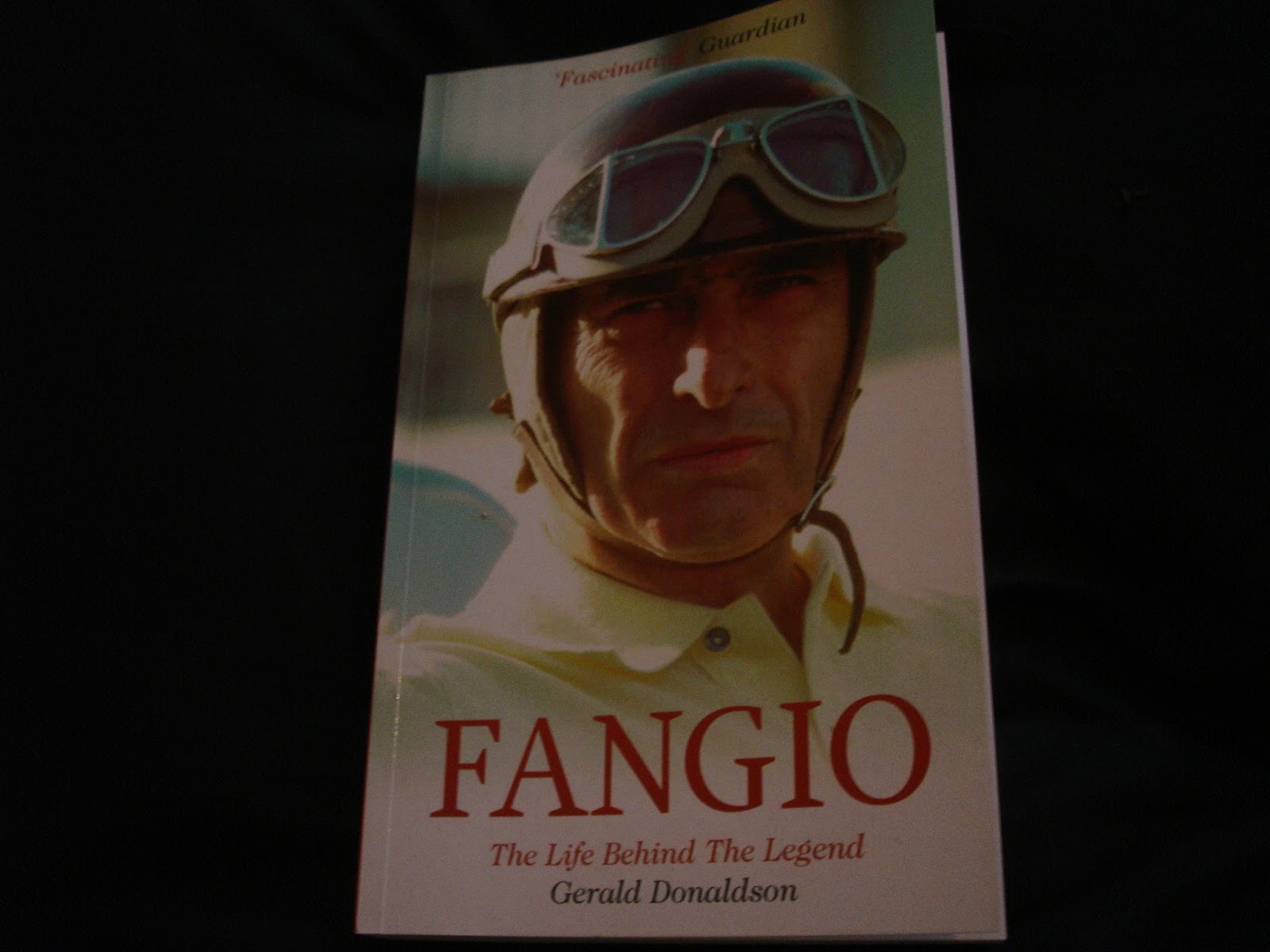
Fangio: The Life Behind The Legend - Gerald Donaldson

Furthering my campaign to revisit some of the motorsport-related titles residing on my dusty bookshelves, I recently re-read Gerald Donaldson's 2003 biography of the great Argentinian driver, Juan Manuel Fangio.

Fangio still holds a special fascination and a particular aura, matched perhaps only by those of Ayrton Senna, although they were quite different people. Fangio was revered by his peers, and still represents something of a benchmark, as much for his human qualities as his consummate skills behind the wheel of a car.

His upbringing was in stark contrast to that of today's stars, and indeed to most of his contemporaries. In addition, his racing apprenticeship was unusual, and may have helped to equip him with the qualities which separated him from his competitors when he embarked on his international career.


The early chapters are an intriguing window on the world of the early twentieth century, when motor vehicles were still a relative novelty, and in the infancy of their technical development. The picture which emerges is of an early life characterized by the inculcation of certain imperatives, such as the importance of hard work.  Even the early years suggest Fangio's hallmarks of mechanical sympathy, adaptability and resourcefulness.

A crucial part of the story is Fangio's participation in the epic South American road-race marathons. The author unfurls evocative  accounts of the sheer scale of these undertakings, the hardships which were undergone, and the perils and hazards which confronted the competitors. The range of emotions and environments which he encountered must have been character-building. Describing the dramas, the surroundings and the sensory experiences is a strength which is noticeable in some of Donaldson's other books, and those skills are well employed here.

This biography paints a picture of the tenor of an epoch, where improvised machinery and improvised racing schedules were the norm. Also, the comradeship and friendly spirit which prevailed among the drivers throughout comes across strongly.

Fangio seems to have been a self-made man, also self-taught to some extent. From humble origins, a strong work ethic had helped to instill a resilience of character which was crucial to his success. The author does not portray the man as some kind of saint, but his flaws and weaknesses were evidently less pronounced than those of most people, and a practical, pragmatic approach served him well. It also appears to me that Fangio combined old-fashioned virtues with the more entrepreneurial spirit of modern times. A more complex individual than is sometimes made out, perhaps.

The book contains some interesting material on that "lost" period between the end of the Second World War and the 1950 inception of the World Drivers' Championship. It is sobering to be reminded of the frequency of fatalities and serious injuries back then, both to competitors and spectators.  The stories of the Grand Prix races are related entertainingly but sparingly, and they capture some of the essence of what was still a "heroic" age. Indeed, some might contend that the "heroic age" came to a close when Fangio retired from racing.

There is a little insight into Fangio's character, and his philosophy of life, via quotes and anecdotes. These focus on his means of coping with danger and challenges, and with the nature of competition. An element which permeates these pages is just how much physical discomfort the drivers of that period had to withstand, whether through primitive, ill-handling machines or via the elements. Comfort was still some way in the future.

This biography is compact and balanced, although I don't think it is quite as fluent and impressive as the author's books about Gilles Villeneuve and James Hunt. It will, however, enthuse the reader about the man and the era in which he competed so ably and nobly.

Sunday, 27 December 2015

Rush (2013 movie) - more thoughts

When it was first released on DVD, I composed a blog post reviewing the 2013 movie "Rush".  This is the Ron Howard film which tells the story of the Seventies Formula 1 drivers Niki Lauda and James Hunt.  I recently watched the movie again, and wondered whether my views and impressions might have shifted in the intervening period. I propose to leave aside for the most part any historical inaccuracies which I noticed.


From my late 2015 standpoint, I might describe the feel of "Rush" as being slightly "forced", a little airless and compressed. It is visually impressive, but lacking a touch of elegance, guile and finesse, notwithstanding the inclusion of a few powerful and insightful scenes.

It has been suggested that the movie's comparatively modest budget, and associated time constraints, might have contributed to its flavour and to some of its flaws. My thoughts on this are ambivalent - in places the film has a very "professional" look, but elsewhere one can see where corners might have been cut. For my own tastes "Rush" is a touch too "digital" and post-modern, lacking the charm and fluency of some earlier racing films.

Part of my assertion that the film is "forced" is based on something which I observed when I first saw it almost two years ago. The makers appear to have had a "checklist" of anecdotes and stories (some apocryphal) which they felt they had to pack in during the early portions of the picture. My sensitivity to this phenomenon may be traceable to my status as a 70s-F1-anorak. I appreciate that this would not occur as much to more casusl viewers.

The performances of the main actors attracted much comment. Daniel Bruhl rightly received much praise for his portrayal of Niki Lauda. Quite apart from the physical resemblance, he also managed to capture many of the Austrian driver's traits and mannerisms.

Chris Hemsworth as James Hunt was less universally acclaimed, and it is true that he does not quite evoke the nuances of James' inimitable persona, or the voice. The comparison between the two actors is invidious, though. It may well be more difficult to convincingly play Hunt than it is with Lauda.

I think that "Rush" really gets on track during the scenes relating to the close season of 1975/76, when we are shown Hunt's struggles to get a drive for the forthcoming season, as well as his personal problems. Cliches aplenty, of course, but some very fine moments too. In these sequences Hemsworth is very good.  The movie improves at this point because it becomes less about "back-story", composites of events and time-compression and more about a straight account. The dramatic raw-material is also better....

The Nurburgring sequences I think were well produced, without being excessively long or sensationalist, and the hospital scenes were handled more delicately than one has come to expect in films of this sub-genre or in "biopics".

The dialogue between Niki and James at Monza is convincing and credible, and the press conference where Lauda speaks is actually better than similar scenes in most movies. However, the bit where the journalist is beaten up has rightly been deplored as over-the-top and misrepresentative. A real fly in the ointment, that one. On the plus side, the imagery used at the start of the Monza race is highly effective in conveying the tension and the apprehension.

As for the racing action scenes in "Rush", well on reflection they are a mixed bag. Some are good, and CGI is used to fine effect, but others are less dazzling. One wonders why this was.  The "arty" close ups of crash helmets, suspension parts and so forth are entertaining, and a feast for the senses, but hardly original.

The build-up to the final 1976 race at Fuji is also well done, with a "less is more" ethos concerning dialogue. Visuals, sound and music all help to create the mood and the tension before and during the event.

The final scene at the airport is noteworthy both for its quality and its plausibility. It also comes as quite a surprise to have something this reflective and pensive after what had preceded it. Philosophizing, yes, but in a believable and poignant vein.

Looking at it honestly, "Rush" is a good and entertaining, if unexceptional, piece of cinema, its main strengths being Bruhl's performance, the inherent attractiveness of the subject matter and the occasional amusing or poignant scene.


Tuesday, 28 January 2014

Rush (2013 movie) - DVD review

First of all, a confession. I did not see Ron Howard's  "Rush" when it was released in the cinemas. I fully intended to, but my September diary ended up being rather preoccupied with more pressing concerns. The movie's DVD release enabled me to catch up, and to commit these thoughts in blog form...

As a confirmed devotee of 1970s Formula 1, and something of an anorak on the subject, I resolved to put aside my reservations about the historical accuracy of the movie, and appraise it on its quality in artistic and technical terms. So within these parameters, what of "Rush"?

In short, the movie follows the fortunes of 1970s Grand Prix drivers James Hunt and Niki Lauda, concentrating on their duel for the 1976 world title. What struck me about the film straight away was the almost semi-documentary flavour to it. The opening scene, set at the Nurburgring, serves as good exposition. This is accompanied by some rather hackneyed pseudo-philosophizing, of the type which has been obligatory in all racing movies since time immemorial.


As expected, the production values are high, although the computer-assisted trickery does not obscure the story-telling. Indeed, the racing scenes, although dramatic and at times striking, were almost incidental to me. I was much more interested in the exploration of the human dimensions of the tale, which after the shaky beginning are told in quite a refreshing and unpretentious way.

Clips and previews had conditioned my expectations regarding the performances of the main actors. Daniel Bruhl is indeed excellent as Lauda, and becomes more convincing as the story unfolds, really coming into his own after the Nurburgring 1976 accident.  Lauda's allegedly prickly and abrasive nature is played up for all it is worth, as is the playboy, non-conformist image of Hunt. Chris Hemsworth's performance as the latter came as a pleasant surprise, and he also manages to capture some of James' more laconic side.

The supposed eccentricities and foibles of every character, including team personnel, are magnified and accentuated, and it seems that the producers felt the need to pack in every known and recorded anecdote and incident involving the two men. Whilst watching, I almost felt the silent presence of a researcher ticking boxes on a "checklist" of items to include in the script. So yes, the "chapters" and content are composites of various things which did occur, many in different contexts and timescales, compressed for dramatic effect. What this all shows is that regardless of how things are presented, Hunt and Lauda, and indeed the era which they lived in, are simply splendid "raw material" for film-makers.

The Hunt-Lauda relationship depicted here is at variance with the generally accepted version, but as the narrative moves on, the dialogue becomes more incisive and cerebral, and feels less forced. The scenes sometimes feel short and staccato, but this is often the case with "biopics", where lots of information has to be included in different settings within a specified time.

The film manages to capture an appealing 1970s European/transatlantic aesthetic, invoking the music, fashions and social trends of the time, but not to excess. The more informal, less regimented atmosphere is well projected, even if the recreations of haircuts and clothes are not always totally on the mark....

I found the action sequences a mixed bag.  Exciting yes, but often looking a little contrived and clinical, even if a 1970s Grand Prix is always a fine sight to behold. The greatest impact is attained via the arty "in helmet" shots and those of suspension parts, tyres and steering wheels. They help to get across the sheer primal mechanical vigour of those cars.

"Rush" moves up a notch or two with the run-up to the 1976 season. The pace quickens, and things become more intense.  This really kicks in with the demise of the Hesketh team, and Hunt's anguish and uncertainty before the McLaren drive becomes available. The 1976 race scenes make good use of the camerawork and effects, helping to capture and encapsulate the pressures and the claustrophobia, as well as the gladiatorial nature of the sport.

The centerpiece of the movie, unsurprisingly, is the '76 German Grand Prix and its aftermath. An ominous and dark atmosphere of foreboding is skilfully created.  The Lauda crash is harrowingly but effectively done, evoking its true horror. The hospital sequences are moving without being mawkish, and are cleverly interspersed with clips of the F1 season continuing to progress in the Austrian's absence.  Daniel Bruhl truly shines in this phase, ably portraying the character's bravery and single-mindedness. One somewhat jarring note is struck by the scene at Monza involving Hunt and an intrusive journalist.

Needless to day, the season finale at Fuji is given the full treatment. Although drenched with CGI, the drama, emotion and confusion are recorded with some clarity.

Overall, I think that "Rush", while being glossy and "Hollywood" up to a point, also brings out the then still grimy world  of racing, that of the nuts and bolts and the oily rags. On its own terms, good quality entertainment, if hardly a cinematic masterpiece. In the end, much of the rumination and verbal sparring between James and Niki is solid and soundly judged. The final main scene, set in Bologna, is a good way to go out - dignified and reflective.




Monday, 23 September 2013

Hunt versus Lauda - BBC documentary

Unsurprisingly, the release of Ron Howard's motion picture "Rush" has triggered much media coverage of the rivalry between the 1970s Grand Prix drivers James Hunt and Niki Lauda.  Last night BBC television rescreened its documentary entitled "Hunt vs Lauda - F1's Greatest Racing Rivals".  Some enthusiasts might dispute the accuracy of the second half of that title, but I thought it was an entertaining documentary, with some rare footage, and cutting and amusing analysis by those who were close to the action.

It was superior I think to the BBC's similar effort of years gone by, which was part of the "Clash of the Titans" series.  Some additional but revealing snippets of footage have naturally come out of the woodwork in the intervening years, and a broader list of contributors was on to hand to offer its memories and observations.

I thought that the producers did a good job of highlighting the differences in personality, without distorting the truth for dramatic effect.  The relationship between the the two men was by all accounts a good deal more complex than is often made out. It seems that they were on good terms even before they reached F1, and remained so thereafter, but the maelstrom of 1976 inevitably gave rise to tensions.

It would have been good to have more of the programme devoted to the lives of the drivers in their formative racing years, but I guess that the remit of the documentary, and time limitations, dictated that the main focus would be on the dramatic season of 1976. In all honesty, there is more than enough interest and intrigue in that year to justify three hours of running time, let alone one hour.

One of the things which continues to come through in all material about him is the web of contradictions which made up James Hunt.  A highly intelligent but unconventional character, who lived life to the full.  I still think that the definitive documentary about Hunt himself has yet to be made, one which fully examines his upbringing, his relatively short but tempestuous racing career, and his later life.  More emphasis on the Hesketh years would be particularly revealing!

I was also impressed by the way in which Niki Lauda's Nurburgring accident, and his recovery from it, were handled. Again, no resorting to sensationalism or mawkishness, but some very useful and penetrating insights. Lauda's honesty and courage shone through both in the 1976 footage, and in his later recollections.

The footage in this documentary amply illustrated the crossroads or watershed which 1976 represented for the sport.  Informality was still very much in evidence, as was diversity in aesthetics and car design. At the same time, commercialism and professionalism were increasingly making their presence felt.  The Hunt/Lauda dynamic became, if quite briefly, central to these processes. The changes being undergone by F1 definitely influenced how their relationship evolved, but by the same token they themselves acted as a catalyst for the further upheavals on the horizon.

Now, I just need to get myself to the cinema to watch the "Rush" movie myself....


Sunday, 9 December 2012

In The Name Of Glory - Tom Rubython

Continuing my post-season reading efforts, I have recently completed another book which formed part of my Kindle "backlog".  This was In The Name Of Glory by Tom Rubython, a study of the momentous 1976 Formula 1 season, and more specifically the championship contest between James Hunt and Niki Lauda.

The author does have his detractors amongst racing enthusiasts, and it has to be said that the subtitle of this book (1976 - The Greatest Ever Sporting Duel) hardly inspired confidence.  However, I was prepared to give this one a chance........

The most noticeable thing at first glance was the brevity of this publication, certainly in comparison to the two other Rubython ones which I have previously read, The Life Of Senna and Shunt, the latter of which I blogged about here:-

Shunt - The Story of James Hunt

A couple of contentious assertions early on in the book rather set the tone for me, particularly the one concerning Lauda's supposed attitude to losing the championship in such circumstances.  What is said runs totally against the grain of the majority of perceived wisdom on the subject.  Also, it is stretching things to imply that the 1976 season was uniquely dramatic, exciting or eventful.


The book contains a few factual errors.  Lauda's debut in Austria in 1971 is not mentioned, and he did not win the 1974 Belgian Grand Prix. There was no Canadian Grand Prix in 1975, and Haiti is not in South America.  These things tend to grate after a while....

The thing which most perturbed me, though, was the tendency for hyperbole and exaggeration.  Personality clashes, or personality traits, of certain individuals are laboured excessively, presumably to heighten the sense of abundant frisson.Motor racing, like life in general, tends to be a subtle and complex endeavour, and therefore best seen in a million shades of grey.  However, here the author seems at pains to interpret things in extremes. Where the 1976 season is concerned, this is unnecessary, as the reality was in itself sufficiently remarkable...

To suggest at one point that Luca di Montezemolo was solely responsible for Ferrari's mid-1970s revival is also a novel interpretation of events.  I dare say that Messrs Lauda and Forghieri would have something to say about that.  This is an example of the author's "all or nothing" approach to some topics.

There is an appraisal also of the feverish politics which supposedly gripped the Ferrari camp around that time, especially when di Montezemolo became less involved in the Formula 1 effort.  Again, there may be a little embellishment, but one can gain a good idea of the backdrop to Lauda's campaign, and these passages should be of some value to those not previously familiar with the stories.

There is much prurient, if entertaining, focus on James Hunt's lifestyle.  Where the book did score some bonus points for me was in its efforts to detail Lauda's upbringing, and his early racing activities, including the way in which he raised finance, and incurred the wrath of some family members along the way.

Unsurprisingly, much of the Hunt-orientated material will be very familiar to those who have read Rubython's Hunt biography.

For all my reservations about the book, the raw facts of the story are enough to make this an entertaining read, if one takes some of the author's flights of fancy with a pinch of salt.


Thursday, 29 March 2012

1978 Monaco Grand Prix

I recently watched a full video of the 1978 Monaco Grand Prix, and this prompted me to make some observations about the Formula 1 scene back then, and the odd comparison to our modern racing.

Viewing footage of this particular race served to remind me that this was the end of an era, and the dawn of a watershed in the sport's development, although few realised it at the time.  This was the last race before the introduction of the revolutionary and ground-breaking Lotus 79.  The complexion of F1 altered almost overnight, and the contest in the principality was the last glimpse of the "old order".  Grand Prix racing lost some of its innocence, and the modern era commenced.  Not only were "ground effects" about to become de rigueur, the commercial side of the sport was also beginning to be transformed, largely through television exposure.

These things are keenly felt by the likes of myself, who maintain that the period 1970-1977 represented some kind of golden age of F1 racing.  However, I acknowledge the merits and appeal of the ground effects and turbo eras which were being ushered in as the teams raced at Monaco in '78. 

So, to the race itself.  New talent was emerging and making its mark, in the form of Gilles Villeneuve,Patrick Tambay, Didier Pironi and Riccardo Patrese.  In the early stages of the race, the Williams of Alan Jones was quite prominent, symptomatic of the continuing rise of Frank's team.

The pole man was Carlos Reutemann in the gorgeous Ferrari 312T3, arguably one of the best looking F1 cars of its era. However, the grid was extremely competitive, with no one team or car/driver combination enjoying any discernible margin of superiority.  This was all to change at the next race in Belgium, when Colin Chapman's latest creation shook the status quo to its foundations.


The pattern of the race was influenced to some degree, as ever at Monaco, by the start.  Lauda and Reutemann clashed, and the Argentine driver had to pit with a damaged rear aerofoil. Caught up in all this was James Hunt, who brushed the barrier whilst taking evasive action.  One of the curious things about Hunt's F1 career was his relative lack of prowess and success on street circuits, although the failures were not always attributable to him.

John Watson took the lead at the start, and had the race under some kind of control, exhibiting his flair and fluency.  Alas, he was not to prevail this time, and as in so many races in 1977/78, he was denied victory. The Brabhams were pointedly competitive at this event, all this before the introduction of the notorious "fan car".

Watching the race in full, I was reminded how people's perception of Formula 1 has been affected by the role of television.  There is a tendency to lionise and wax lyrical about "the good old days", but much of this thinking is based on snippets of footage and brief highlights, in the days before widespread live TV coverage. There were lengthy "fallow", uneventful and even tedious phases in races in those days, and Monaco '78 was not a lights to flag thriller itself. Contrary to what some people might have you believe, processions are not a recent innovation....

The two Brabhams and Patrick Depailler's Tyrrell were clearly superior, and forged ahead into a race of their own, providing an absorbing three-way tussle.  Depailler constantly harried Watson, and the Frenchman drove with elan and panache, but also control and discipline.  The Brabhams may have been adversely affected by the weight and thirstiness of the Alfa engine, whereas the Tyrrell was more nimble and forgiving.

Eventually, Watson stumbled at the chicane after the tunnel, and Lauda was forced to pit for new tyres, leaving Depailler to proceed in relative comfort towards his maiden triumph. Lauda's difficulties were the springboard for a spirited recovery drive, with the Austrian's car assuming some very unorthodox angles, perhaps one of the least "Lauda-esque" displays of his entire career. His audacious manoeuvre to pass Jody Scheckter in front of the pits was especially impressive.

In the end, though, it was Depailler's day, and few would have begrudged him his moment of glory. This was a fully merited victory, although as it transpired the Tyrrell team was unable to build on it to any meaningful extent.

Watching the race was a very useful and enjoyable exercise, providing a snapshot of a time of change in Grand Prix racing.

Wednesday, 1 February 2012

The McLaren Launch

I duly cleared my hectic and overflowing social and professional diary to ensure that I would be by my laptop this morning to follow the launch of McLaren's 2012 challenger, the MP4-27.

As is often the case with these kinds of events, the anticipation was weightier than what was actually delivered. The white sheet was removed to reveal the shiny new creation, the drivers and team luminaries were interviewed by the assembled press, and sponsors name-checked at regular intervals.

I have always been somewhat ambivalent about F1 "launches" and "unveilings".  For somebody like myself, whose interest in racing revolves less around the technical side than the human and sporting aspects, they can be sterile and superficial. Many of the technological minutiae leave me cold, and the people involved are inclined to be guarded and non-committal.

Even allowing for this, I thought that today's launch was a touch one-paced.  I found the opening portion of it, when the car was unveiled and the drivers interviewed by the compere, to be awkward, and the banter stilted.  One gets the impression that all concerned see the launch as a chore to be performed, almost with gritted teeth.

The F1 circus tends to go through phases and fads when determining how to launch its machines to an expectant world. From the mid-1990s onwards, there was a trend towards employing showbiz gimmicks (pop groups mainly) and using grandiose and prestigious locations.  If we have to endure these ceremonies, my ideal would be the kind of thing we had today, carefully leavened and enlivened with a touch of razzamatazz, but not too much razzamatazz.....

I think it's fair to say that the MP4-27 is quite easy on the eye, and retains one of the most distinctive and effective liveries on the grid.  There is a temptation to equate prettiness with expected performance in F1 cars, even if experience has shown that to be a facile assumption!  However well the car goes, I would expect it to be more visually pleasing than most of its competitors.

When interviewed, Jenson Button seemed as calm, cheerful and confident as ever, these qualities perhaps reinforced by last year's events.  Lewis Hamilton was his usual enigmatic self, but of course it is impossible to gauge likely fortunes for the year ahead from a stage-managed event such as this.

As the launch progressed, and we were introduced to more members of the McLaren "family", my thoughts shifted towards how the organisation might have changed in recent years, both before and after the withdrawal of Ron Dennis from the frontline Formula 1 effort.

Though I would not describe myself as a fanatical "fan"in the modern sense, McLaren has been the team which I have most admired, after my obligatory youthful Ferrari fixation began to fade.  Even if it was to all intents and purposes a different team, I could detect a thread stretching back to the days of James Hunt, Teddy Mayer and Alastair Caldwell in the 1970s.  I was also able to delve beyond the popular perception of the Ron Dennis era, as a dour and soulless operation, and develop genuine respect for the qualities and values which he and others instilled in the team.

How does the current set-up compare?   Well, the structure and basic ethos and culture appear little changed from the previous two decades or so, but perhaps lacking the dynamism and outright passion which was there in the past.  This is not surprising, since many of the personnel are different.  Also, the more mundane aura given off by the team these days is likely more indicative of how the world itself has changed. The true nature and likely path of the "new" McLaren is yet to fully reveal itself.  It might be less overtly interesting than past incarnations, but could prove just as successful.

Martin Whitmarsh has always impressed me, from the days when I remember seeing him in documentaries in the early 1990s.  Very businesslike, and able to act as a protective buffer between the media/fans and team members, even if in a subtly different way than Dennis did in the past.  A calm, and quietly effective figure, if not quite as "hands on", visible or emotive as his predecessor.

Predictions for McLaren in 2012?   It is difficult to see them making any quantum leap forward, or plummeting backwards. Improvements will be incremental, as tends to be the case in F1 these days. We shall soon see whether the team's quiet confidence is justified.


Friday, 13 January 2012

Golden Era?

In a recent interview, Fernando Alonso suggested that the 2012 driver line-up will be the strongest in the history of Formula 1, with six world champions on the grid, and other notables such as Massa and Webber also out there.

This claim has also been advanced by some fans and members of the media, but does it stand up to scrutiny?  Whilst statistically the CVs of the class of 2012 will make impressive reading, other factors need to be examined.

Two of the six champions in the field will be Michael Schumacher and Kimi Raikkonen.  The German cannot be said to be at his peak, whilst the Finn is returning from an F1 hiatus.  There is also an argument for saying that the statistical accomplishments of drivers in this current era are distorted by the polarisation of resources, and therefore success, amongst two or three teams. Smaller grids also mean that there are fewer also-rans diluting the quality of the grid.

So which other periods in F1 history can claim to have had comparable, or superior, depth of driving talent?  Well, the mid-to-late 1970s, prior to the retirement of James Hunt and Niki Lauda, were very strong in this respect. In addition to Lauda and Hunt, we had Mario Andretti,Carlos Reutemann, Ronnie Peterson, Jody Scheckter, Clay Regazzoni, Patrick Depailler, Carlos Pace, John Watson and others. The racing at this time was fantastically competitive, and the victories were therefore spread around more, meaning that many careers left more of an indelible mark in the minds of fans, rather than in the record books.

Similar claims could be made for the 1960s and early 1970s, the "Jim Clark" and "Jackie Stewart" eras, and of course the issue of safety has also to be taken into account when making an assessment. Careers tend to be longer nowadays, cars are more reliable and there are more events on the calendar.

In truth, it is very difficut to make a direct comparison, because racing has changed out of all recognition over the decades, but I would simply counsel caution over possibly inflated claims made about the quality of the current grid. By any objective standard, it is indeed a formidable line-up, but people would also be well advised to consult the history books in order to acquire some perspective....

Wednesday, 24 August 2011

Book Review - "Shunt - The Story of James Hunt", by Tom Rubython

Having received distinctly mixed feedback, I had delayed purchasing this book, but eventually relented and decided to judge it for myself.

The first thing to make clear is that this is a very lengthy book, and it cannot be accused of skimping on detail. The style of writing will certainly not be to everyone's taste, but it can still be quite a rewarding read, for several reasons.

It would seem that the author had access to sources not available or sought out by Hunt's previous biographers. This ensures that some stories and information in Rubython's may be reaching a wide, mainstream audience for the first time. Certainly, several gaps in my knowledge were filled, particularly on matters hitherto submerged beneath the rich tapestry which was Formula 1 in the 1970s.

The life of Hunt both before and after his Formula 1 racing career are covered in more depth than in previous similar publications, although at times perhaps the level of detail is excessive.

One of the most illuminating aspects of the book was its concentration on the financial and promotional elements of motor racing at that time, when sponsorship and television coverage were still in their infancy. It was fascinating to read how informal, almost amateurish, things were as recently as 1975. The one thing I could do without was the constant quoting of figures and monetary amounts!

My main criticism of the book is its apparent tendency towards hyperbole and even exaggeration of some events. The life of James Hunt was hardly mundane, and little sensationalism is needed to turn it into a compelling story.  Some fairly insignificant and unimportant incidents are overplayed in order to embellish parts of the tale, and the "all or nothing" mode of language employed is irritating at times.

Although casual readers will probably not notice, any F1 "anorak" will be surprised by the number of historical inaccuracies and errors contained in the text.  This did slightly mar my enjoyment of the book as a whole.

The author is not afraid to pass judgement on aspects of Formula 1, particularly the transition towards ground-effect, and its impact on the quality of the racing. Not everyone will agree with his interpretation of events, but to his credit, he does not attempt to sugar-coat the Grand Prix scene of the time, or indeed Hunt's role in it.

Perhaps also I could have done without the constant references to economic and political events of the times. I accept that this is sometimes desirable for the purposes of context, but for me it went a little too far in this instance.

Later in the book, efforts are to made to analyse Hunt's complex persona, and also to document his trials and tribulations following retirement from racing. Doubtless many readers will find this the most revealing, and indeed moving, part of the book.

In summary, I would say that this is a mixed bag. Plenty of information to be extracted, if one can see past the "over the top" style of writing, and the inaccuracies. Those seeking a more condensed and temperate account of Hunt's life may wish to seek out the biography written by the Canadian journalist Gerald Donaldson.