I remember that during the 2012 Formula 1 season, relative neophytes were speculating that we were experiencing perhaps the most dramatic and unpredictable Grand Prix year ever. Those people had evidently not been around in 1982. Christopher Hilton's book, published in 2007, captures the turbulence and tragedy of that extraordinary season.
For me, the 1982 campaign was in large part coloured, and tarnished, by the death of Gilles Villeneuve, who was one of my first heroes in life. I distinctly remember crying on the day of his accident, staring into space at the end of our driveway, on a warm spring evening. However, as time has passed I have grown to recognize how that season did have some redeeming features.
The material about the drivers' strike in South Africa is fascinating, in that it suggests that the views of many of the drivers were ambivalent. They were caught between concerns of principle and solidarity and the imperatives of ambition and avarice. There are some interesting theories about Niki Lauda's motives, too. The strike is also placed within the context of the wider, momentous power struggle which was ongoing within the sport at that time. A healthy selection of quotes from drivers and other personnel helps to paint the picture.
The chapter dealing with the Belgian Grand Prix in May contains much harrowing but gripping testimony about the events of that tragic qualifying session at Zolder. Similarly, the passages documenting the Canadian Grand Prix, the scene of Ricardo Paletti's fatal accident, are moving and affecting. It is good that the author went to the trouble of researching Paletti's background and racing career.
Reading the quotes and recollections in this book, it occurs to me that in the 1980s, Grand Prix drivers were more worldly men than they are today. Maybe I think in these terms because the drivers in those days were much older than me, whereas nowadays I am many years their senior. People such as Derek Warwick and John Watson impress with their honesty and roundedness. Making allowances, one would have to say that, thirty-odd years ago, the goldfish bowl was less overpowering, and the world was a different place.
"1982" also offers a persuasive reminder that technological progress has made things too "perfect" and "infallible" to be interesting and uncertain on an "organic" level. Variables and imponderables are banished, and much of the soul and raw excitement extracted.
The heterogeneous nature of the venues, the media coverage and so forth is another part of the backdrop to this work, No identikit tracks, podium ceremonies, pit and paddock complexes, and the like.
Hilton relates some great tales, such as the Toleman "half-tanks" ploys and the Derek Daly "short cut" at Dijon. More innocent times, but in keeping with many aspects of this book, I get the impression that the people involved have been made less guarded and equivocal, and more candid, in their recollections by the passage of time.
It seems to me that, in a Formula 1 sense at least, the 1980s had not truly arrived in 1982. I tend to see this as happening in 1984, with the full flowering of the Ron Dennis/TAG/Lauda/Prost era at McLaren. Things became more clinical and orderly, and rough edges were smoothed over. The years 1982 and 1983, by contrast, still exuded elements of the Seventies. A transitional, confusing, but vibrant time.
Christopher Hilton's book, lavishly illustrated and well-researched, evokes those times vividly.
Showing posts with label gilles villeneuve. Show all posts
Wednesday, 25 January 2017
Thursday, 22 December 2016
Racers Apart - David Tremayne
Continuing my journey through some half-forgotten items in my motorsport-related library, I recently re-read Racers Apart, by David Tremayne, a little gem of a book which was first published back in 1991.
Essentially, Racers Apart is a series of portraits of, or articles about, selected motorsport figures. The author includes some figures from the world of land and water speed records, an area of special interest for him. As well as Tremayne's own thoughts, there are observations by colleagues and friends of the subjects.
The choice of people portrayed might seem almost random, but in fact it is just diverse, and the competitors examined are chosen mostly for their human qualities or their influence on the direction of the sport. Some of those featured are personal favourites of the author, such as Pedro Rodriguez, Tom Pryce,Roger Williamson and Gilles Villeneuve. This latter factor I feel induces a greater conviction, passion and authority in the writing.
It is by and large quite balanced and honest stuff, not ignoring the negatives and the frailties. The interviews with subjects are quite penetrating, managing to extract some candid recollections and analysis. These are not bland portraits.
One thing which also stood out for me during this recent reading was the author's vehemence in lamenting some aspects of modern motor sport. It is sobering to think how, even twenty five years ago, contemporary journalists perceived the sport to be so shallow and soulless at the top level. The book's general tenor is to celebrate those who, in their approach and temperament, bucked those ever-encroaching trends.
Overall, this book seems to come more from the enthusiast than the scholar, and in places seems genuinely heartfelt. Like with much of the best motor sport writing, the human dimension transcends the nuts and bolts and the technology. Those who left a scant impression in the record books are placed alongside the legends and superstars - David Purley sits very comfortably in company with Ayrton Senna and Jackie Stewart.
Essentially, Racers Apart is a series of portraits of, or articles about, selected motorsport figures. The author includes some figures from the world of land and water speed records, an area of special interest for him. As well as Tremayne's own thoughts, there are observations by colleagues and friends of the subjects.
The choice of people portrayed might seem almost random, but in fact it is just diverse, and the competitors examined are chosen mostly for their human qualities or their influence on the direction of the sport. Some of those featured are personal favourites of the author, such as Pedro Rodriguez, Tom Pryce,Roger Williamson and Gilles Villeneuve. This latter factor I feel induces a greater conviction, passion and authority in the writing.
It is by and large quite balanced and honest stuff, not ignoring the negatives and the frailties. The interviews with subjects are quite penetrating, managing to extract some candid recollections and analysis. These are not bland portraits.
One thing which also stood out for me during this recent reading was the author's vehemence in lamenting some aspects of modern motor sport. It is sobering to think how, even twenty five years ago, contemporary journalists perceived the sport to be so shallow and soulless at the top level. The book's general tenor is to celebrate those who, in their approach and temperament, bucked those ever-encroaching trends.
Overall, this book seems to come more from the enthusiast than the scholar, and in places seems genuinely heartfelt. Like with much of the best motor sport writing, the human dimension transcends the nuts and bolts and the technology. Those who left a scant impression in the record books are placed alongside the legends and superstars - David Purley sits very comfortably in company with Ayrton Senna and Jackie Stewart.
Sunday, 26 June 2016
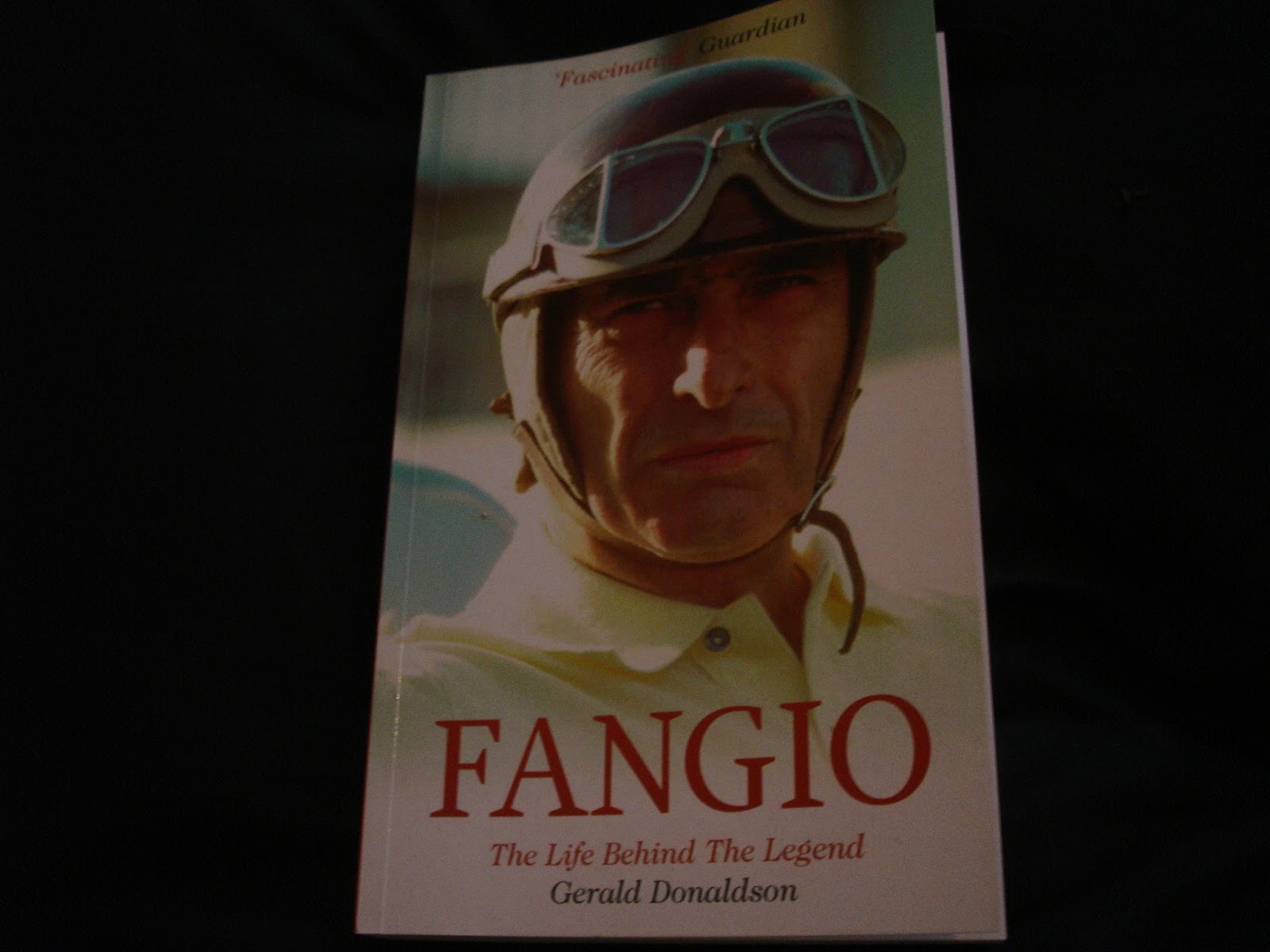
Fangio: The Life Behind The Legend - Gerald Donaldson
Furthering my campaign to revisit some of the motorsport-related titles residing on my dusty bookshelves, I recently re-read Gerald Donaldson's 2003 biography of the great Argentinian driver, Juan Manuel Fangio.
Fangio still holds a special fascination and a particular aura, matched perhaps only by those of Ayrton Senna, although they were quite different people. Fangio was revered by his peers, and still represents something of a benchmark, as much for his human qualities as his consummate skills behind the wheel of a car.
His upbringing was in stark contrast to that of today's stars, and indeed to most of his contemporaries. In addition, his racing apprenticeship was unusual, and may have helped to equip him with the qualities which separated him from his competitors when he embarked on his international career.
The early chapters are an intriguing window on the world of the early twentieth century, when motor vehicles were still a relative novelty, and in the infancy of their technical development. The picture which emerges is of an early life characterized by the inculcation of certain imperatives, such as the importance of hard work. Even the early years suggest Fangio's hallmarks of mechanical sympathy, adaptability and resourcefulness.
A crucial part of the story is Fangio's participation in the epic South American road-race marathons. The author unfurls evocative accounts of the sheer scale of these undertakings, the hardships which were undergone, and the perils and hazards which confronted the competitors. The range of emotions and environments which he encountered must have been character-building. Describing the dramas, the surroundings and the sensory experiences is a strength which is noticeable in some of Donaldson's other books, and those skills are well employed here.
This biography paints a picture of the tenor of an epoch, where improvised machinery and improvised racing schedules were the norm. Also, the comradeship and friendly spirit which prevailed among the drivers throughout comes across strongly.
Fangio seems to have been a self-made man, also self-taught to some extent. From humble origins, a strong work ethic had helped to instill a resilience of character which was crucial to his success. The author does not portray the man as some kind of saint, but his flaws and weaknesses were evidently less pronounced than those of most people, and a practical, pragmatic approach served him well. It also appears to me that Fangio combined old-fashioned virtues with the more entrepreneurial spirit of modern times. A more complex individual than is sometimes made out, perhaps.
The book contains some interesting material on that "lost" period between the end of the Second World War and the 1950 inception of the World Drivers' Championship. It is sobering to be reminded of the frequency of fatalities and serious injuries back then, both to competitors and spectators. The stories of the Grand Prix races are related entertainingly but sparingly, and they capture some of the essence of what was still a "heroic" age. Indeed, some might contend that the "heroic age" came to a close when Fangio retired from racing.
There is a little insight into Fangio's character, and his philosophy of life, via quotes and anecdotes. These focus on his means of coping with danger and challenges, and with the nature of competition. An element which permeates these pages is just how much physical discomfort the drivers of that period had to withstand, whether through primitive, ill-handling machines or via the elements. Comfort was still some way in the future.
This biography is compact and balanced, although I don't think it is quite as fluent and impressive as the author's books about Gilles Villeneuve and James Hunt. It will, however, enthuse the reader about the man and the era in which he competed so ably and nobly.
Fangio still holds a special fascination and a particular aura, matched perhaps only by those of Ayrton Senna, although they were quite different people. Fangio was revered by his peers, and still represents something of a benchmark, as much for his human qualities as his consummate skills behind the wheel of a car.
His upbringing was in stark contrast to that of today's stars, and indeed to most of his contemporaries. In addition, his racing apprenticeship was unusual, and may have helped to equip him with the qualities which separated him from his competitors when he embarked on his international career.
The early chapters are an intriguing window on the world of the early twentieth century, when motor vehicles were still a relative novelty, and in the infancy of their technical development. The picture which emerges is of an early life characterized by the inculcation of certain imperatives, such as the importance of hard work. Even the early years suggest Fangio's hallmarks of mechanical sympathy, adaptability and resourcefulness.
A crucial part of the story is Fangio's participation in the epic South American road-race marathons. The author unfurls evocative accounts of the sheer scale of these undertakings, the hardships which were undergone, and the perils and hazards which confronted the competitors. The range of emotions and environments which he encountered must have been character-building. Describing the dramas, the surroundings and the sensory experiences is a strength which is noticeable in some of Donaldson's other books, and those skills are well employed here.
This biography paints a picture of the tenor of an epoch, where improvised machinery and improvised racing schedules were the norm. Also, the comradeship and friendly spirit which prevailed among the drivers throughout comes across strongly.
Fangio seems to have been a self-made man, also self-taught to some extent. From humble origins, a strong work ethic had helped to instill a resilience of character which was crucial to his success. The author does not portray the man as some kind of saint, but his flaws and weaknesses were evidently less pronounced than those of most people, and a practical, pragmatic approach served him well. It also appears to me that Fangio combined old-fashioned virtues with the more entrepreneurial spirit of modern times. A more complex individual than is sometimes made out, perhaps.
The book contains some interesting material on that "lost" period between the end of the Second World War and the 1950 inception of the World Drivers' Championship. It is sobering to be reminded of the frequency of fatalities and serious injuries back then, both to competitors and spectators. The stories of the Grand Prix races are related entertainingly but sparingly, and they capture some of the essence of what was still a "heroic" age. Indeed, some might contend that the "heroic age" came to a close when Fangio retired from racing.
There is a little insight into Fangio's character, and his philosophy of life, via quotes and anecdotes. These focus on his means of coping with danger and challenges, and with the nature of competition. An element which permeates these pages is just how much physical discomfort the drivers of that period had to withstand, whether through primitive, ill-handling machines or via the elements. Comfort was still some way in the future.
This biography is compact and balanced, although I don't think it is quite as fluent and impressive as the author's books about Gilles Villeneuve and James Hunt. It will, however, enthuse the reader about the man and the era in which he competed so ably and nobly.
Thursday, 1 May 2014
Ayrton Senna
In the summer of 1983, I was slowly becoming obsessed with Formula 1 racing, having had my imagination well and truly captured by the exploits of Gilles Villeneuve a couple of years before. I vividly recall reading the various motor sport magazines around that time, and learning about a remarkable young Brazilian, who in those days raced under the name Ayrton Senna da Silva. Soon enough this precocious talent found his way to Grand Prix racing, and we now found ourselves commemorating the twentieth anniversary of his tragic accident at Imola.
Only yesterday I was speaking with a female friend, who told me that she had no great interest in Formula 1 as such, but had been utterly captivated by Senna's charisma, and remains so to this day. Untold millions around the globe were affected in a similar way. Senna possessed that intangible magic which transcended his own field of endeavour, an accolade which goes to the very few. It can be persuasively argued that he played a massive role in transforming F1 into the slick multinational media spectacle that we see today. He broadened the appeal of the sport.
Not unnaturally, Senna's tenure with the McLaren team tends to be highlighted, but I find his period with Lotus, from 1985 to 1987, equally compelling. The legendary outfit was in a slow decline, but Senna's mixture of raw ability, work ethic and competitive spirit kept them in the hunt. His tally of pole positions from those seasons, even when up against McLaren, Williams, Ferrari et al, speaks for itself. Senna was competitive almost everywhere, at least in '85 and '86, and his fearsome commitment and dedication were already clearly evident. Both in and out of the car, he took the "science" and "art" of Grand Prix racing to a new level, even above that practised by such modern greats as Stewart, Lauda and Prost, who had been cited as innovators and modernisers.
In common with most of the truly great drivers, Senna had what almost amounted to a "sixth sense", by way of his mechanical sensitivity. The most startling example of this which I have personally seen was captured in a British television documentary covering the 1993 season. At one race, Senna returned to the pits, unhappy with the performance of his car, and insisted that there was a minor problem with the engine, this seemingly having not been highlighted by telemetry and so forth. After much debate, the engine was dismantled, and sure enough a small but significant fault was discovered....
Only yesterday I was speaking with a female friend, who told me that she had no great interest in Formula 1 as such, but had been utterly captivated by Senna's charisma, and remains so to this day. Untold millions around the globe were affected in a similar way. Senna possessed that intangible magic which transcended his own field of endeavour, an accolade which goes to the very few. It can be persuasively argued that he played a massive role in transforming F1 into the slick multinational media spectacle that we see today. He broadened the appeal of the sport.
Not unnaturally, Senna's tenure with the McLaren team tends to be highlighted, but I find his period with Lotus, from 1985 to 1987, equally compelling. The legendary outfit was in a slow decline, but Senna's mixture of raw ability, work ethic and competitive spirit kept them in the hunt. His tally of pole positions from those seasons, even when up against McLaren, Williams, Ferrari et al, speaks for itself. Senna was competitive almost everywhere, at least in '85 and '86, and his fearsome commitment and dedication were already clearly evident. Both in and out of the car, he took the "science" and "art" of Grand Prix racing to a new level, even above that practised by such modern greats as Stewart, Lauda and Prost, who had been cited as innovators and modernisers.
In common with most of the truly great drivers, Senna had what almost amounted to a "sixth sense", by way of his mechanical sensitivity. The most startling example of this which I have personally seen was captured in a British television documentary covering the 1993 season. At one race, Senna returned to the pits, unhappy with the performance of his car, and insisted that there was a minor problem with the engine, this seemingly having not been highlighted by telemetry and so forth. After much debate, the engine was dismantled, and sure enough a small but significant fault was discovered....
Thursday, 29 March 2012
1978 Monaco Grand Prix
I recently watched a full video of the 1978 Monaco Grand Prix, and this prompted me to make some observations about the Formula 1 scene back then, and the odd comparison to our modern racing.
Viewing footage of this particular race served to remind me that this was the end of an era, and the dawn of a watershed in the sport's development, although few realised it at the time. This was the last race before the introduction of the revolutionary and ground-breaking Lotus 79. The complexion of F1 altered almost overnight, and the contest in the principality was the last glimpse of the "old order". Grand Prix racing lost some of its innocence, and the modern era commenced. Not only were "ground effects" about to become de rigueur, the commercial side of the sport was also beginning to be transformed, largely through television exposure.
These things are keenly felt by the likes of myself, who maintain that the period 1970-1977 represented some kind of golden age of F1 racing. However, I acknowledge the merits and appeal of the ground effects and turbo eras which were being ushered in as the teams raced at Monaco in '78.
So, to the race itself. New talent was emerging and making its mark, in the form of Gilles Villeneuve,Patrick Tambay, Didier Pironi and Riccardo Patrese. In the early stages of the race, the Williams of Alan Jones was quite prominent, symptomatic of the continuing rise of Frank's team.
The pole man was Carlos Reutemann in the gorgeous Ferrari 312T3, arguably one of the best looking F1 cars of its era. However, the grid was extremely competitive, with no one team or car/driver combination enjoying any discernible margin of superiority. This was all to change at the next race in Belgium, when Colin Chapman's latest creation shook the status quo to its foundations.
The pattern of the race was influenced to some degree, as ever at Monaco, by the start. Lauda and Reutemann clashed, and the Argentine driver had to pit with a damaged rear aerofoil. Caught up in all this was James Hunt, who brushed the barrier whilst taking evasive action. One of the curious things about Hunt's F1 career was his relative lack of prowess and success on street circuits, although the failures were not always attributable to him.
John Watson took the lead at the start, and had the race under some kind of control, exhibiting his flair and fluency. Alas, he was not to prevail this time, and as in so many races in 1977/78, he was denied victory. The Brabhams were pointedly competitive at this event, all this before the introduction of the notorious "fan car".
Watching the race in full, I was reminded how people's perception of Formula 1 has been affected by the role of television. There is a tendency to lionise and wax lyrical about "the good old days", but much of this thinking is based on snippets of footage and brief highlights, in the days before widespread live TV coverage. There were lengthy "fallow", uneventful and even tedious phases in races in those days, and Monaco '78 was not a lights to flag thriller itself. Contrary to what some people might have you believe, processions are not a recent innovation....
The two Brabhams and Patrick Depailler's Tyrrell were clearly superior, and forged ahead into a race of their own, providing an absorbing three-way tussle. Depailler constantly harried Watson, and the Frenchman drove with elan and panache, but also control and discipline. The Brabhams may have been adversely affected by the weight and thirstiness of the Alfa engine, whereas the Tyrrell was more nimble and forgiving.
Eventually, Watson stumbled at the chicane after the tunnel, and Lauda was forced to pit for new tyres, leaving Depailler to proceed in relative comfort towards his maiden triumph. Lauda's difficulties were the springboard for a spirited recovery drive, with the Austrian's car assuming some very unorthodox angles, perhaps one of the least "Lauda-esque" displays of his entire career. His audacious manoeuvre to pass Jody Scheckter in front of the pits was especially impressive.
In the end, though, it was Depailler's day, and few would have begrudged him his moment of glory. This was a fully merited victory, although as it transpired the Tyrrell team was unable to build on it to any meaningful extent.
Watching the race was a very useful and enjoyable exercise, providing a snapshot of a time of change in Grand Prix racing.
Viewing footage of this particular race served to remind me that this was the end of an era, and the dawn of a watershed in the sport's development, although few realised it at the time. This was the last race before the introduction of the revolutionary and ground-breaking Lotus 79. The complexion of F1 altered almost overnight, and the contest in the principality was the last glimpse of the "old order". Grand Prix racing lost some of its innocence, and the modern era commenced. Not only were "ground effects" about to become de rigueur, the commercial side of the sport was also beginning to be transformed, largely through television exposure.
These things are keenly felt by the likes of myself, who maintain that the period 1970-1977 represented some kind of golden age of F1 racing. However, I acknowledge the merits and appeal of the ground effects and turbo eras which were being ushered in as the teams raced at Monaco in '78.
So, to the race itself. New talent was emerging and making its mark, in the form of Gilles Villeneuve,Patrick Tambay, Didier Pironi and Riccardo Patrese. In the early stages of the race, the Williams of Alan Jones was quite prominent, symptomatic of the continuing rise of Frank's team.
The pole man was Carlos Reutemann in the gorgeous Ferrari 312T3, arguably one of the best looking F1 cars of its era. However, the grid was extremely competitive, with no one team or car/driver combination enjoying any discernible margin of superiority. This was all to change at the next race in Belgium, when Colin Chapman's latest creation shook the status quo to its foundations.
The pattern of the race was influenced to some degree, as ever at Monaco, by the start. Lauda and Reutemann clashed, and the Argentine driver had to pit with a damaged rear aerofoil. Caught up in all this was James Hunt, who brushed the barrier whilst taking evasive action. One of the curious things about Hunt's F1 career was his relative lack of prowess and success on street circuits, although the failures were not always attributable to him.
John Watson took the lead at the start, and had the race under some kind of control, exhibiting his flair and fluency. Alas, he was not to prevail this time, and as in so many races in 1977/78, he was denied victory. The Brabhams were pointedly competitive at this event, all this before the introduction of the notorious "fan car".
Watching the race in full, I was reminded how people's perception of Formula 1 has been affected by the role of television. There is a tendency to lionise and wax lyrical about "the good old days", but much of this thinking is based on snippets of footage and brief highlights, in the days before widespread live TV coverage. There were lengthy "fallow", uneventful and even tedious phases in races in those days, and Monaco '78 was not a lights to flag thriller itself. Contrary to what some people might have you believe, processions are not a recent innovation....
The two Brabhams and Patrick Depailler's Tyrrell were clearly superior, and forged ahead into a race of their own, providing an absorbing three-way tussle. Depailler constantly harried Watson, and the Frenchman drove with elan and panache, but also control and discipline. The Brabhams may have been adversely affected by the weight and thirstiness of the Alfa engine, whereas the Tyrrell was more nimble and forgiving.
Eventually, Watson stumbled at the chicane after the tunnel, and Lauda was forced to pit for new tyres, leaving Depailler to proceed in relative comfort towards his maiden triumph. Lauda's difficulties were the springboard for a spirited recovery drive, with the Austrian's car assuming some very unorthodox angles, perhaps one of the least "Lauda-esque" displays of his entire career. His audacious manoeuvre to pass Jody Scheckter in front of the pits was especially impressive.
In the end, though, it was Depailler's day, and few would have begrudged him his moment of glory. This was a fully merited victory, although as it transpired the Tyrrell team was unable to build on it to any meaningful extent.
Watching the race was a very useful and enjoyable exercise, providing a snapshot of a time of change in Grand Prix racing.
Wednesday, 15 February 2012
Gilles Villeneuve
Increasingly these days, I blanch at the idea of having "heroes", putting people on pedestals, or relying on one person or interest for my emotional sustenance. Hero worship, or other related obsessions, have been consigned to my past. More often than, they prove corrosive or counter-productive.
There was a time, however, when I, like other confused, insecure and impressionable kids, craved someone to look up to, to relate to, to believe in. One of the first people to fulfil this role for me was the racing driver Gilles Villeneuve.
As is often the way with these things, it happened almost randomly. I had been aware of motor racing before, but it had shimmered in and out of my consciousness. Then, one soporific Sunday afternoon in 1981, our TV became tuned to coverage of the Monaco Grand Prix. I did not recognise most of the drivers' names, and the technical ins-and-outs were beyond my ken, but the one thing which did capture my imagination was the driving of the number 27 Ferrari.
At the next race, at Jarama, Gilles won again, this time leading home a baying pack of pursuing cars. I had found my new hero. Then it struck me that this was the same guy who had performed those heroics in Holland back in '79.
Looking back, a combination of factors drew me to Gilles. His unquenchable spirit, humility and underdog status were part of the appeal. Also, at the time, I was going through a dark and bewildering time in my own young life, and Gilles represented something pure, heroic and optimistic to hold on to.
Of course, I naively expected the run of successes to continue. Ignorant of the vagaries of racing, little did I know that circumstances and the hand of fortune had contributed to the back-to-back victories. My mind was ill-equipped to cope with the reversals and mishaps which followed during the remainder of the 1981 season. I was dispirited particularly by his trip up the escape road in Austria, whilst being challenged for the lead.
Like many a callow youth, I learned through disappointment that my new hero was not infallible, but was human like the rest of us. Once I had readjusted my outlook, this made me appreciate Gilles' qualities even more.
The auguries for the 1982 season were good for Ferrari and Gilles, and strong showing in Brazil and Long Beach seemed to back up this optimism. I recall being unhappy with events at Imola, but was largely oblivious to the political background, and the alleged duplicity of Didier Pironi. There was still everything to play for....
On 8 May 1982, I had been out with friends, and returned home in the late afternoon. As soon as I had entered the house, my mother informed me that there had been a serious accident during practice at Zolder. It soon became clear that Gilles was involved. I watched the footage on the television news, hoping that this was all a bad dream.
That evening, as the sun began to go down, I vividly remember walking to the bottom of our driveway, with tears in my eyes, and just staring into space for many minutes.
Since that day, I have respected many people in many fields of endeavour, but rarely have I allowed myself to idolize them as I did with Gilles for that eleven of twelve month period.
There was a time, however, when I, like other confused, insecure and impressionable kids, craved someone to look up to, to relate to, to believe in. One of the first people to fulfil this role for me was the racing driver Gilles Villeneuve.
As is often the way with these things, it happened almost randomly. I had been aware of motor racing before, but it had shimmered in and out of my consciousness. Then, one soporific Sunday afternoon in 1981, our TV became tuned to coverage of the Monaco Grand Prix. I did not recognise most of the drivers' names, and the technical ins-and-outs were beyond my ken, but the one thing which did capture my imagination was the driving of the number 27 Ferrari.
At the next race, at Jarama, Gilles won again, this time leading home a baying pack of pursuing cars. I had found my new hero. Then it struck me that this was the same guy who had performed those heroics in Holland back in '79.
Looking back, a combination of factors drew me to Gilles. His unquenchable spirit, humility and underdog status were part of the appeal. Also, at the time, I was going through a dark and bewildering time in my own young life, and Gilles represented something pure, heroic and optimistic to hold on to.
Of course, I naively expected the run of successes to continue. Ignorant of the vagaries of racing, little did I know that circumstances and the hand of fortune had contributed to the back-to-back victories. My mind was ill-equipped to cope with the reversals and mishaps which followed during the remainder of the 1981 season. I was dispirited particularly by his trip up the escape road in Austria, whilst being challenged for the lead.
Like many a callow youth, I learned through disappointment that my new hero was not infallible, but was human like the rest of us. Once I had readjusted my outlook, this made me appreciate Gilles' qualities even more.
The auguries for the 1982 season were good for Ferrari and Gilles, and strong showing in Brazil and Long Beach seemed to back up this optimism. I recall being unhappy with events at Imola, but was largely oblivious to the political background, and the alleged duplicity of Didier Pironi. There was still everything to play for....
On 8 May 1982, I had been out with friends, and returned home in the late afternoon. As soon as I had entered the house, my mother informed me that there had been a serious accident during practice at Zolder. It soon became clear that Gilles was involved. I watched the footage on the television news, hoping that this was all a bad dream.
That evening, as the sun began to go down, I vividly remember walking to the bottom of our driveway, with tears in my eyes, and just staring into space for many minutes.
Since that day, I have respected many people in many fields of endeavour, but rarely have I allowed myself to idolize them as I did with Gilles for that eleven of twelve month period.
Labels:
didier pironi,
F1,
ferrari,
formula 1,
gilles villeneuve,
grand prix,
monaco,
zolder
Monday, 7 November 2011
How Much Would F1 Miss Ferrari?
Well, it seems that the Ferrari President has made another one of his occasional pronouncements on the direction of the sport, with many interpreting his words as a threat to withdraw should changes not be made to the regulations.
Ferrari have hastily downplayed some of his remarks, but it seems sensible to assume that Luca di Montezemolo's words are another shot across the bows of the rule-makers and other stakeholders in Formula 1, seeking to nudge them further. in the direction of change.
Even if this is, as seems likely, just another bout of sabre-rattling, what would the repercussions be if Ferrari were indeed to drop out of F1 competition?
My intial interest in racing was sparked by the exploits of Gilles Villeneuve in the early 1980s, and back then Ferrari were definitely special. The history, the absence of overt sponsorship on the cars and the scarlet colour scheme all contributed to this. However, there was also a sense that they were fallible, and human, and that the team was run at least partly on emotion. This all set them apart from the very businesslike and entrepreneurial British outfits.
At some point in the 1990s, Ferrari realised that they would have to change in order to remain competitive. It was at this point that much of the mystique began to fade, ironically as they entered probably the most successful phase in their history. Many were also alienated by efforts to play on the team's importance and heritage in order to influence some events.
It would be foolish to deny that losing Ferrari would be a severe setback, but I would see such an event in somewhat different terms than if it had occurred in, say, the early 1990s. Nowadays, I would regard it as the loss of a competitive, well-funded team, albeit one with a proud tradition. The balance has shifted in the ensuing two decades.
The attitude of younger F1 enthusiasts would also be interesting to gauge. Growing up with the Schumacher era at Maranello, do they see Ferrari as quite so indispensable, in sentimental, and even, commercial, terms? Perhaps the Italian-based team mildly over-estimates its modern-day importance? The world has changed, and Ferrari with it....
Ferrari have hastily downplayed some of his remarks, but it seems sensible to assume that Luca di Montezemolo's words are another shot across the bows of the rule-makers and other stakeholders in Formula 1, seeking to nudge them further. in the direction of change.
Even if this is, as seems likely, just another bout of sabre-rattling, what would the repercussions be if Ferrari were indeed to drop out of F1 competition?
My intial interest in racing was sparked by the exploits of Gilles Villeneuve in the early 1980s, and back then Ferrari were definitely special. The history, the absence of overt sponsorship on the cars and the scarlet colour scheme all contributed to this. However, there was also a sense that they were fallible, and human, and that the team was run at least partly on emotion. This all set them apart from the very businesslike and entrepreneurial British outfits.
At some point in the 1990s, Ferrari realised that they would have to change in order to remain competitive. It was at this point that much of the mystique began to fade, ironically as they entered probably the most successful phase in their history. Many were also alienated by efforts to play on the team's importance and heritage in order to influence some events.
It would be foolish to deny that losing Ferrari would be a severe setback, but I would see such an event in somewhat different terms than if it had occurred in, say, the early 1990s. Nowadays, I would regard it as the loss of a competitive, well-funded team, albeit one with a proud tradition. The balance has shifted in the ensuing two decades.
The attitude of younger F1 enthusiasts would also be interesting to gauge. Growing up with the Schumacher era at Maranello, do they see Ferrari as quite so indispensable, in sentimental, and even, commercial, terms? Perhaps the Italian-based team mildly over-estimates its modern-day importance? The world has changed, and Ferrari with it....
Subscribe to:
Posts (Atom)