Showing posts with label politics. Show all posts

Friday, 9 July 2021

Looking Backward - 2000-1887 - Edward Bellamy

In recent times, my interest has been increasingly focused on how society can be made more just and equitable, whilst still retaining its dynamism and promoting human flourishing and progress. 'Utopian' literature has formed part of my studies in this area. 

The novel 'Looking Backward - 2000-1887', by Edward Bellamy, was first published in 1888. A man in Boston, Massachusetts is placed into a hypnosis-induced trance or sleep, and wakes up in the year 2000, to find that the world has become a socialist utopia, with the means of production nationalised and money effectively abolished. He is given tours of this new utopia by the family which is playing host to him. There is an interesting 'twist' to the plot near the end which adds a touch of romance alongside philosophical heart of the novel. 

In some respects the work bears similarities to 'News From Nowhere' by William Morris, although their respective utopias differ quite markedly. I found 'Looking Backward' to be more substantial, and less of a 'fairytale', than Morris' effort. That said, I would question how a society can be so profoundly transformed in such a relatively short period of time, apparently without much in the way of resistance, and how the 'virtue' of its citizens can be so uniformly purified. In addition, there is the standard lingering question of how things would function with less emphasis placed on 'incentives' and 'competition'.

Of course, some areas of the story can seem dated, because of the time when the book was created, and the attitudes and theories which were fashionable then do not necessarily translate that smoothly or plausibly for twenty-first century consumption. The solutions which are detailed in 'Looking Backward....' do not always correspond to currently 'fashionable' proposals, and might even seem authoritarian or 'dystopian', and what is envisaged might appear excessively regimented.

In the novel, the apologists for the new system are a bit too certain of their own righteousness for my tastes. Having said that, for a utopian novel this is quite a decent read from a literary viewpoint, even if some might contend that the work served to a large degree as little more than a 'platform' or a vehicle for Edward Bellamy's political and philosophical ideas.


Monday, 22 January 2018

Resurrection - Leo Tolstoy

Resurrection is a philosophical novel by Leo Tolstoy. It chronicles the efforts of a Russian nobleman to atone for his previous misdeeds towards a young woman, who has found herself in prison. The protagonist, Nekhlyudov, blames himself for her fall from grace and her later incarceration.

As Nekhlyudov tries to help Maslova, he becomes acutely aware of the injustice, cruelty and corruption around him, and this ensures that his mission extends beyond mere personal redemption.

I had not read any Tolstoy since my teens (War And Peace), and the consensus seems to me that this later effort, Resurrection, is not as "literary" as some of his earlier novels, with less depth in terms of storyline and characterizations. It does act as a platform for the author to expound some of his political beliefs (by this time he was a Christian anarchist).

I was drawn to this work in part because of my own interest in the economic theories of Henry George, to which Tolstoy had become an enthusiastic adherent.  The book, though, does not go into as much detail about the workings of Georgism as I had been led to expect.

Resurrection might not be on a par in artistic terms with Tolstoy's acknowledged masterpieces, but I found the story quite absorbing, and the subject matter should tug at the conscience of most people. Some of the passages concerning the conditions endured by the prisoners are genuinely disturbing and moving.  Also, Nekhlyudov's interactions with Maslova are quite complex, and how one interprets and gauges their attitudes to each other at various stages adds to the interest.

It is possible to argue I think that there is not sufficient space in the novel to fully explore how the Nekhlyudov character arrived at his world-view - it seems that even before his liaison with Maslova he was harbouring grave misgivings about "the system", and at the disparity between the luxury enjoyed by his own class and the plight of the downtrodden. On the other hand, his indignation at what he witnesses, and his energetic moves to intervene, help to propel the story.

I found highly interesting the descriptions of some of the less appetizing representatives of the ruling classes and the bureaucracy, and the way in which their attitudes of arrogance and indifference compounded Nekhlyudov's disaffection with the milieu with which he had hitherto been closely connected.

So, Resurrection is an interesting read.  The world may have changed considerably since this was written in the late 19th century, but the broader issues which it examines can, with some imagination, be transferred to modern times.


Saturday, 9 December 2017

The Assassination of Trotsky (1972 film)

The Assassination of Trotsky is a 1972 movie, starring Richard Burton and, as the title suggests, it documents the events which surrounded the murder of the famous Russian revolutionary in Mexico in 1940. Also in the cast are Alain Delon and Romy Schneider.

I approached this film with some trepidation, as it has a reputation of being a poor piece of work. However, my recent interest in left-wing politics prompted me to give it a watch. The fact that it is done in something resembling a European art cinema style was also an attraction. It has a quintessentially early 1970s flavour about it, to my eyes anyway!

It has to be said that Richard Burton is always worth watching, and that voice of his invariably adds extra gravitas, gravitas which in this instance the work itself does not entirely deserve. I was relieved that he did not attempt a Russian accent, and he plays the role in quite a straightforward manner, eschewing exaggerations and outlandish affectations. Overall though I found this movie to be somewhat bland and muddled. The dialogue lacks guile, and too many scenes simply stumble along with no apparent purpose. 

On the positive side, the production values are reasonably good, but paradoxically it also feels rough around the edges in places. This might have something to do with the lack of focus in some scenes, and also the questionable standard of some of the supporting acting. 

I found faults in the film, but these pale into significance when compared with my reaction to the truly horrible bull-fighting sequence which is included.  What possessed them to have this in there is not clear - maybe it was an attempt at some kind of symbolism?

One of the scenes which I did enjoy was the Mexican May Day parade, although this looked a little like footage of a genuine event.

So, even the charisma of Burton, Delon and Schneider can't save this one.  It is worth a watch, though, for the sight of Burton at work, and for students of history and politics. 

Friday, 8 December 2017

United Red Army (2007 film)

United Red Army is a Japanese film, originally released in 2007, and directed by Koji Wakamatsu. It tells the story of the famous Japanese leftist militant group, from its origins in the student protest movements of the Sixties, to its eventual self-destruction.

I had been wanting to see this film for some time.  The first thing to stress is that the movie is long, clocking in at over three hours in duration. On reflection it is perhaps too long.  It is divided into three parts. The first section looks at the protest movements in the 1960s, the second at the training camps which they established in the remote mountainous regions of Japan, and the concluding "act" depicts an infamous stand-off with the police.

The first part of the picture was for me the most interesting, and the most impressively put together. The course of the protests in the Japanese universities is related using archive footage and narration, as well as some acted scenes. The mingling of these ingredients works surprisingly effectively, and I suspect that the rigour and scale of the student demonstrations will have surprised many Western observers who were unfamiliar with the Japanese scene from those times.

Some time is taken to explain the grievances which fuelled the anger of the students, such as the Vietnam War and the security treaties signed between America and Japan. This first part of United Red Army is done in almost a "docu-drama" style, and the dramatic nature of the subject matter ensures that the interest is maintained for a while, but after that the film becomes rather mired in an exploration of the internal squabbles and purges which bedeviled the group(s), and things only pick up again towards the conclusion of the picture, with the "siege" sequences in the mountains.

The middle part of the movie I found quite disturbing, and it is easy to imagine the terror and despondency felt by many of the people.  It is ironic, or perhaps not, that an enterprise which was ostensibly undertaken in the name of "liberation" was beset by so much misery and cruelty.

Although I found this film to be flawed in some respects, I am glad that movies like this are being made, as they throw some light on major events of the past which have been slightly forgotten, and they hopefully provoke some thought amongst people of all generations, not just about decades past, but about the world we live in today.

It seems that the budget for this movie was not especially lavish, but I didn't find this to be a problem as such. It means that there are no manufactured crowd scenes and over-lavish sets. This one is all about the story, the issues and the people.


Thursday, 26 October 2017

Rosa Luxemburg (1986 film)

The movie Rosa Luxemburg, released in 1986, and directed by Margarethe von Trotta, is a biopic (of sorts) of the German-Polish revolutionary and activist. Barbara Sukowa plays the title role.

I say a biopic of sorts, because the movie does not cover the whole of her life, although there are a few flashback sequences, referring back to her childhood.

For much of this picture, there is a dark atmosphere of foreboding and oppression, often with a backdrop of snow and overcast skies. I personally found this to be galvanizing rather than discouraging. Some of the most powerful and effective imagery is of Rosa trudging around prison yards in the snow, accompanied by her poetic reflections and commentary.

In addition to the above, a good deal of the running time consists of Luxemburg arguing (often at the dinner table) with her "comrades" regarding strategy, tactics and theory. If some of the settings here are an accurate reflection, then it seems that Luxemburg and her friends and associates lived in a good deal of comfort and luxury, when they were not locked up in prison, that is.

I like this film, partly because it deals with European history and politics, and partly because it is imbued with the notions of learning, ideas and books. The period sets, costumes, decor and so forth, are impressively, if soberly and unobtrusively, done. The scene which depicted a "turn of the century" ball was nicely effected and presented - this is an area where many similar pictures fall down.

The theme for much of the movie, as I interpreted it, was that the subject was principled but headstrong, and often despaired of her older, more pragmatic and conservative colleagues, and their more measured approach. There is almost as much focus on her emotional and romantic entanglements as on the political arena, partly because such areas may illustrate some of the personality traits which helped to determine her destiny and her fate.

I was intrigued by her advocacy of mass action, rather then relying totally on the drudgery of party politics and parliamentary procedure and compromise. She kept receiving promises from her party leaders, but one suspects that they were empty promises, designed to placate her temporarily, though there is merit in the argument that a hasty or ill-prepared "revolution" might be self-defeating.

She was wrong, initially at least, to claim that there would be no mass support for the war which commenced in 1914, but was ultimately proved correct in many of her observations about the effects which the war would have. I thought that the film dealt with this stage of Luxemburg's life quite honestly and deftly, illustrating her despair,resignation and disillusionment at the nationalist fervour which helped to propel Europe towards war, and eloquently summing up her views on how developments in the conflict could slowly turn the tide of opinion.

The chronology might confuse a few people in places, but the main thing is the overall effect. This is not a blandly hagiographic account, but at the same time it does have the effect of making one think beyond the smokescreens and bland over-simplifications which tend to dominate (in my experience) mainstream 21st century discourse and comment.

Barbara Sukowa's performance is admirable. Many movies of this type are marred by cartoonish or over-inflated portrayals of the main players, but here Sukowa delivers a reasonably plausible and convincing picture.

A good movie, not excessively preachy or partisan.  It is visually pleasing, soundly acted and adroitly presented.


Tuesday, 18 October 2016

Good Bye Lenin (2003 film) - review

Some of the most satisfying cinematic experiences come from those works which operate on more than one level, but which also retain a simple charm and emotional pull. One such movie is the 2003 German film, Good Bye Lenin!, directed by Wolfgang Becker.

The movie relates the story of an East German woman, a firm adherent to the ideals of the DDR, who falls into a coma shortly before the fall of the Berlin Wall in 1989, and only wakes up eight months later. Told by doctors that any kind of shock may trigger a relapse in her health, the woman's son, with the assistance of friends and relatives, constructs an elaborate ruse with the objective of convincing his bed-ridden mother that her beloved state, party and system are still very much alive and well.

Real news footage is employed to drive the narrative.  Although the visuals portraying the 1989/90 period are not always that convincing, that is besides the point. The funniest moments generally revolve around the son Alex's endeavours to recreate a "socialist" environment in the family home, even down to books by Anna Seghers and a Che Guevara poster, and to conceal from his mother the demise of much which she cherished and believed in.

Through this prism of historic political change, we are given an insight into the mother/son relationship, and human love generally, which is genuinely touching and poignant.  The acting is generally top notch, and particular praise must be given to Daniel Bruhl for his depiction of the son, not only in his concern for his mother's well-being, but also for conveying the character's growing ambivalence and unease about the course of events in Germany. Katrin Sass is also excellent and convincing in the role of the mother.

As mentioned earlier, there are some amusing scenes associated with the creation, or maintenance of the illusion of the continuance of a socialist paradise, such as Alex and his friend producing "fake" East German television broadcasts to show to his mother. The scene where a Coca-Cola banner appears outside the mother's window, and the subsequent efforts to explain this away, are both amusing and though-provoking. The encroachment of consumerism and the dog-eat-dog mentality following reunification are gently satirized throughout the film.

Towards the end the emotional gains precedence over the comedic, and the way that the story concludes is central to the film's message and its appeal. The whole concept is admirably clever, if not 100 percent plausible, and one is left with both a warm feeling, but also sadness and regret.

A film well worth watching, combining entertainment value and profundity.

Friday, 23 September 2016

Marianne and Juliane - (1981 movie)

Following on from seeing The Legend of Rita and Die Innere Sicherheit, I recently watched an earlier movie which covers similar subject matter,  Marianne and Juliane, directed by Margarethe von Trotta, and released in 1981.  Its German title was Die Bleierne Zeit. 

The film tells the story of two sisters who take different paths in trying to change the world.  It is fictionalized, but it is apparently based on the life of Gudrun Ensslin and her family.  Marianne pursues a course as a political militant, whilst Juliane works as a journalist/activist. The film focuses on the relationship between the two, and on Juliane's efforts to help and support her incarcerated sibling.

I was going to say that the movie has a bleak and gloomy aesthetic, but on reflection it is based on realism and authenticity.  So many films of this type try too hard either to faithfully recreate historical detail or to convey a "mood", and turn out as contrived. Marianne and Juliane is very different, and very natural and unforced.

The acting in the film has rightly been praised, but I must single out Jutta Lampe's superb performance as Juliane.  Very measured and very convincing, and those eyes.  Barbara Sukowa is also impressive. I don't think she is quite as good here as she would be in her later portrayal of Rosa Luxemberg, but she does manage to evoke some of the harsh, uncompromising but resolute nature of the Marianne character.

Some of the running time is occupied by "flashback" sequences from the sisters' childhood, but they don't necessarily give us straightforward or comfortable answers as to how the two people turned out as adults. The prison sequences are also beautifully and atmospherically captured.  The symbolism throughout the story is subtle, almost ambiguous (such as a statue of Bismarck), and in general the moral messages are the same.

Working out Juliane's true motives as things progress is no easy task, and it may be that they are left deliberately hazy. The story does not consciously set before us clearly defined moral choices or boundaries.  This is where much of the strength of the picture lies.  The view presented of the world is a nuanced one, where there are not two diametrically opposed points of view, but many different "poles", diverse motivations and perspectives.

Marianne and Juliane is a absorbing film, which is also a genuine story.


Wednesday, 14 September 2016

Die Innere Sicherheit - 2000 film - review

The German film, Die Innere Sicherheit (English title: "The State I Am In"), directed by Christian Petzold, and released in 2000, follows the experiences of two former terrorists and their teenage daughter, as they live in hiding, on the run from the authorities, first in Portugal and later in Germany.

The daughter Jeanne (Julia Hummer) yearns to sample the delights, adventures and discoveries of adolescence, but this has the potential to imperil her parents. A lack of money, support and accommodation forces them to take some desperate and risky measures, and at times their plight is miserable and stark.

Jeanne is the focus of much of the movie, and to be frank I found the parents, Clara and Hans, to be somewhat one-dimensional characters.  Julia Hummer's performance as Jeanne is a revelation, conveying the sullen demeanour and rebelllious streak of a young person who has clearly grown up in an surreal, unconventional and bewildering world.

The tone of this picture is dark and insidious, and these patterns are intensified by the fact that much is left unsaid, unexplained or merely implied, and left to the imagination of the viewer. The imagery and the terse dialogue are left to paint the picture and reflect the narrative. The editing is creative, sharp and even disorientating, exacerbating the oppressive and bleak mood of the piece.

To me, the "political" dimension of the story was secondary to the human dramas enveloping Jeanne, as well as her parents. A strong sense is engendered that they are ostracized from a society which would not understood them even if it sought interaction. A soulless and uncaring world is depicted, the settings being suitably austere and unwelcoming. People did not know who they were, but would have detested and shunned them if they had known.

When the fortunes of the family are at their lowest ebb, we are confronted with some harrowing and mournful scenes. Often there is little sound or dialogue, just doleful, empty or confused facial expressions and emotions, as they contemplate how to circumvent the latest obstacle or impending crisis.

The ending to the movie is suitably brutal and pitiless, but I detected a modicum of poetic justice in the outcome for Jeanne, however tragic it immediately appeared.  We do not discover, of course, how things later turned out.

Overall, this is a thoughtful and atmospheric film. Absorbing and quite unusual, and well worth people's attention.


Tuesday, 13 September 2016

The Legend of Rita - (2000 movie) - review

I recently watched the German film "The Legend of Rita", from the year 2000, (released in Germany under the name "Die Stille Nach dem Schuss), directed by Volker Schlondorff.  Somehow this movie had escaped my attention for the past decade and more, which is odd when I consider that its subject matter is the type which genuinely fascinates me.

The movie tells the story of a West German former urban guerrilla (Rita, played by Bibiana Beglau) who takes refuge in East Germany, and is provided with a new identity by the Stasi, and assumes the guise of an "ordinary" citizen in the socialist state.  She has to cope with the fear of her past being exposed, and thus causing embarrassment to the authorities of the DDR, and the fall of the Berlin Wall later complicates the situation further. Her relationship with Tatjana (Nadja Uhl) is also explored.

Once the preliminary sequences were out of the way, and the story settled into a portrayal of Rita's travails in her new life in the East, I felt that the film found its true identity. The "human interest" angles were sensitively done, and were quite touching at times, especially the friendship between Rita and Tatjana. The tension was palpable, as one kept expecting Rita's cover to be blown in some way, or for her "back story" to unravel, and this helped me identify with her anxiety and also appreciate the resilience and vigilance she had to summon up in order to cope.

There are clear allusions in this movie to real people, and to real-life events, but in the end it is a fictitious tale. This means that there was no need, or temptation. to pack in every historical anecdote and incident.  "The Legend of Rita" moves at its own pace, and on its own terms.

In my view, the early "action" scenes were a mixed bag, but I guess that they were essential to some degree for a full understanding of the background to the story. The rhetoric emanating from the mouths of the "terrorists" was occasionally corny, but it also helped to highlight and express their frustrations, their dilemmas and the disagreements which occasionally plagued their enterprises.

One of the central themes which the film articulates is how Rita's idealism and enthusiasm for the GDR "project" came up against the cynicism and apathy of the East German people who she encountered. As much of the story is set in the 1980s, the penny had clearly dropped with the populace by then. I ended up seeing both sides of the argument, acknowledging the stultification which the East Germans had endured, but also perhaps sensing that Rita had really "found" herself in her new environment, having escaped what she perceived to be the numbing effects of consumerism and the "rat race".

"The Legend of Rita" also raises the old question of theory versus reality, with the main protagonist being brought face-to-face with the pragmatism which real life, bitter and sour experience, and empirical evidence,  instill in people. Fine and lofty words and ideas are all well and good, but they don't always work in practice, or satisfy the basic aspirations of the masses. There is one very instructive scene, just after Rita has made the decision to remain in the East, when Erwin, the Stasi man, does his best, using some oblique language,to warn her what she will be up against.

It would be easy to accept that the film presents an image of uniform greyness, austerity and conformity in East Germany, but that is not quite the impression which I formed. We see many attitudes, problems and practices which have a universal resonance, including mental illness and alcoholism.  Yes, the tone and the atmosphere are primarily dark, but isn't this everyday life, for most people, wherever they happen to live?  The picture which was painted was to me rather nuanced and credible.

Two acting performances really stand out.  Bibiana Beglau is excellent as Rita, conveying her complex personality, which has perhaps partly been conditioned by her unorthodox life. A mixture of insecurity, courage, resolution, fear and even fatalism. Nadja Uhl is very engaging as Tatjana, bringing out her character's vulnerability and her humanity. The scene where the two characters part I found very moving, and also tough to watch.

I found this picture to be more plausible and well-executed than most works which cover similar territory.  The understated production values, and the believable countenance of some of the characters aided in this. It certainly got my grey matter churning, and the movie gently poses some awkward and pertinent questions.

I still wasn't quite expecting that ending, though....


Friday, 25 September 2015

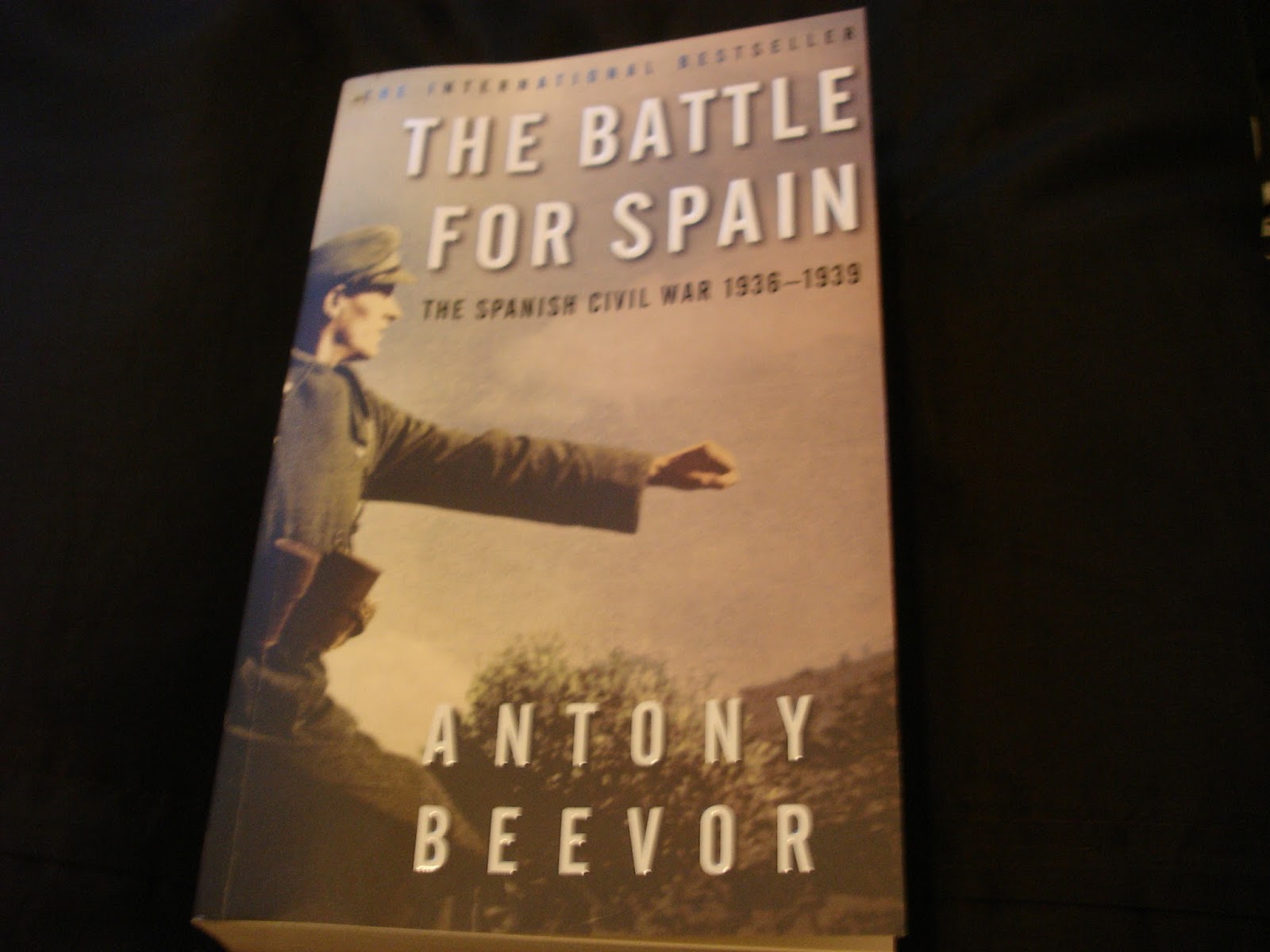
The Battle For Spain - The Spanish Civil War 1936-1939 - Antony Beevor - book review

The Spanish Civil War remains highly emotive. Antony Beevor chronicles and analyses the conflict in his book The Battle For Spain.


In the chapters which constitute a "preamble", Spain's history prior to the 1930s is stressed , with some emphasis on the influence of the Church and the landowners. The country had, it appears, not been affected as much as other parts of Europe by liberalizing impulses.

The plethora of factions on both sides of this conflict can be confusing to say the least, but Beevor does his best to clarify who was who, and why. As he observes, this was not just a struggle between left and right, but also one between libertarianism and authoritarianism and centralization and "federalism"/separatism. These dynamics served to create a very intense and volatile picture.

It is difficult not to be sympathetic to the more libertarian elements of the republican side, however much one feels that they were occasionally naive in their idealism in the face of cold realities. The anarchist scene in Spain around that time, particularly that located in Catalonia, is a fascinating and thought-provoking phenomenon. For all its flaws, a hopeful and positive experiment.

My interpretation was that Beevor felt that the left misjudged the size of its mandate, with its strident rhetoric more than its actions, driving many into the arms of the nationalists. The right exaggerated the "threat".

The infighting between the various groupings, and the fragmented nature of the alliances, is one of the factors which gives the Spanish Civil War an enduring fascination. Loose cannons, hot heads, impractical idealism, brazen opportunism, impulsiveness, impetuosity and cold calculation - all played their part in the drama.

I was impressed by the author's analysis of the early stages of the uprising, the government's hesitant and dilatory initial response, and the motivations behind some of the early atrocities. The republican excesses were more the result of an outburst of rage and chaos. The nationalists, on the other hand, planned a systematic campaign of terror, even "cleansing". The language coined by some nationalist officials is chilling, like something harking back to the Middle Ages...

Beevor goes to great lengths to outline how the unity, or otherwise, of the two sides developed and evolved, Franco maintaining a semblance of cohesion via a mixture of concessions, sops, coercion and eventually demonstrable indispensability to the success of the nationalist cause. Staying largely above the internal strife also clearly helped him. The republicans were not so fortunate, of course, having the heavy hand of Stalin and the Comintern to contend with. Was it the case that the nationalists had a simplicity of purpose, even allowing for lingering agendas, so that they were able to keep their eyes on the prize?  It seems bizarre, but the situation in the anti-fascist camp was not that straightforward.

Another illuminating section of The Battle For Spain deals with the war economy in the republican zone, and the tensions which some methods sparked with the central government. It is difficult not to conclude that the anarchists sometimes clung too rigidly to lofty theories and ideals when a more pragmatic approach may have been more beneficial in the grand scheme of things. Later on, though, they felt with some justification that they were struggling for their very survival and identity.

The rather inglorious attitude of some foreign countries, as well as the manner in which big business connived with the nationalists, is a distasteful facet of the conflict. Yes, we all know now what Stalinism was like, but isn't this a case of being wise after the event? The "rationale" behind certain people's backing for Franco was rather grotesque. The republicans were drastically deprived of genuinely powerful friends, and the consequent reliance on support from the Soviet Union was to bear bitter fruit.

The "romance" surrounding the republican cause is very seductive, even if it is often tricky to pin down exactly. One of the main tasks of the historian therefore is to separate fact from myth, and to weigh what was propaganda, distortion or fabrication. I feel that Beevor remains relatively dispassionate throughout, and does not allow the emotive nature of the subject matter to impinge on lucid judgement. The cruelty and barbarism of the nationalists largely speaks for itself, although the cracks in the republican side take a little more explaining and understanding.

The International Brigades are often the things which most laymen remember about the Spanish Civil War, partly due to the literature and evocative tales which emerged, and also because of the principled stand which they made. Beevor strives to place their role into its proper perspective, and stresses how they slotted into the structure of the Republic's forces.

Diaries and private correspondence are invariably very useful in getting nearer to the truth. Intimate, often candid thoughts committed to paper in the midst of the maelstrom, not alloyed or compromised by propagandistic concerns or embellishment. Such material is made excellent use of in this book.

A probing look at the involvement of intellectuals and artists is also a feature of this work, how many became disillusioned, and how some journalists had their hands tied. It is also pointed how the "demonization" of the communists may have played into their hands, by allowing them to portray themselves as the sole meaningful and dedicated bulwark against fascism.

The portions which address the "civil war within a civil war" evoke a loss of faith among some of the leftist forces and the growth of disenchantment, It is at this point that the paranoia of the Stalin-aligned communists and their acolytes becomes a pervasive trend, seeing the hands of fifth-columnists in almost every military or political reverse. They had leverage, which meant that the other players in the republican fold had to tread carefully in dealing with them. They may admittedly have been on firmer ground in advocating firmer, more cohesive organization and leadership in the face of the nationalist threat.

The vagaries of Stalin's stance are strange. He was doing his best to conceal or downplay the "communistic" side of the republican make-up, for foreign consumption at least, whilst his men on the ground in Spain were throwing their weight around in no uncertain terms. The activities of the secret police, the harsh treatment of the International Brigades volunteers and the draconian punishments for soldiers are all documented here. It is easy to imagine how many people became exasperated and cynical.

A theme which emerges in the second half of this history is the tendency of the republican leadership, under communist sway, to embark on military adventures for reasons of propaganda, playing to both the domestic and international gallery, even when this was not consistent with military or strategic logic. At the same time, of course, the diplomatic picture was clouded and complicated by the gathering storm on the wider European scene. Decisions made regarding Spain were not made in isolation.

Rightly or wrongly, I discerned from some of the author's observations a sense that the republicans were almost naive and "green", both in some of their military decisions, and in their dealings with the outside world, in areas such as finance and arms procurement.

There is a look at what happened after the civil war concluded, including the fate of the exiles,and how Franco went about consolidating his grip on power. The role of both sides in the Second World War is given some attention, and Beevor also looks at the military lessons which the great powers learned, or disregarded, from the fighting in Spain. He also assesses the impact of the interventions made by the Soviet Union, Germany and Italy.

Overall, when reading this book I was left with a feeling of sadness at what befell Spain, at the behaviour of some people on both sides, and how those with honourable and humane motivations and intentions were let down, manipulated and misled.

The Battle For Spain is a sobering but rewarding and worthwhile read. It is well structured and paced, and it brings to life a tragic and contentious episode in modern European history.



Tuesday, 8 September 2015

The Korean War - Max Hastings - book review

"The Korean War", written by Max Hastings, was originally published in 1987.  Having read this book about four years ago, I recently went back to it.

I won't fall into the trap of describing it as "the forgotten war".  That said, if you ask people, even those who consider themselves reasonably well informed, the finer details and the precise chronology might be somewhat hazy.


This is just the sort of history book which I relish.  It feels comprehensive and authoritative, but does not outstay its welcome and, whilst satisfying curiosity, induces a thirst for more knowledge on a range of topics.

There is a good outlining of the background to the conflict. The failings of the South Korean government, the shaky unity in the south, the ill-preparedness of the US and its allies. Throughout the work a picture is created of post-war exhaustion, and of the world adjusting to new circumstances and new alliances. It may surprise some people how stretched the military resources of the US were, early in the war at least. Everybody's inventory was depleted, and forces had to be scraped together and improvised in a short timescale.

The unflattering portrayal of the South Korean regime of that period is a reminder of how many times the West has found it necessary to prop up distasteful administrations in pursuing what it perceives to be noble ends. Hastings does assert that the nature of the North Korean regime justified Western intervention, though.

"The Korean War" is written in a lively  but forthright style. Whether the reader agrees with the author's opinions or not, his arguments are generally well reasoned and supported by evidence. A strength of Max Hastings is his knowledge in both political and military spheres. This gives the book some real depth and authority, and his views and interpretations carry some weight.

As the story unfolds, numerous "case studies" are given, detailing the experiences and recollections of servicemen and civilians. These passages serve as a window on how things were on the ground, as well as hinting at some of the prevailing social and political attitudes in the early Fifties. This "personal" dimension assists in enhancing understanding, as well as instilling some variety, when set against the analysis of grand strategy, Cold War politics and military tactics.

A recurring theme here is the lack of knowledge and reliable intelligence possessed by the West about North Korean intentions, and of attitudes in Moscow and Peking. Also, the differing interpretations between the Americans and the British about the extent of Soviet involvement or control are illuminating, and perhaps reflect the contrast in intensity between the anti-Communist crusades on the two sides of the Atlantic.

This work contains some pretty hard-hitting stuff about the unrest among commanders, and the tensions and military "culture clashes" between the UN countries. The role of Douglas MacArthur is naturally a major topic, especially in the first half of the book. The author spends considerable space explaining why and how the mercurial general made his position untenable.

Whole chapters are devoted to the role of air-power in the war, and to the question of prisoners-of-war. The section which deals with the POW camps on both sides is very powerful and illuminating, and in places disturbing.

I must admit that I found the political and "social" questions more interesting than the discussions of military intricacies. I see this as a tribute to the quality of the book, and a barometer of my own attitudes...

Hastings's summing-up at the end of the book is well-argued, based as it is on an assessment of the geo-political fall-out and the reflections of those who were involved. I was also impressed by the author's capacity to blend a humane approach with a cool appraisal of political realities. It seems that military and political lessons were not learned as fully as they should have been.


Saturday, 22 August 2015

The War of Wars - Robert Harvey - book review

I have recently begun to revisit some of the books which I first read about four or five years ago. I thought that I would start with "The War of Wars", by Robert Harvey, a one-volume chronicle of the French Revolutionary and Napoleonic Wars. It is subtitled "The Epic Struggle Between Britain and France 1789-1815".


The author details the main episodes which characterized the French Revolution. He documents some of the lunacy and cruelty which took place, as well as the ideals, and the undoubtedly good and progressive consequences of the upheaval. Like many people, I find myself  torn between admiration of the general ideological thrust of the Revolution. and revulsion at the often hysterical, absurd and brutal methods.

Of course, much of the story revolves around the person of Napoleon Bonaparte. Yes, he cherished some lofty ideals, but he was also distinctly opportunistic and cynical. Circumstances such as those which prevailed in the late nineteenth century generally allow people such as he to flourish. Those who are adept at manipulating, but also inspiring, the masses.

The book covers the early stages of the Revolutionary Wars. It is sometimes forgotten just how intense those campaigns were. The British involvement is highlighted, as is the often less than united front presented by the "Allies".

One of the most notable aspects of "The War Of Wars" is Harvey's views of Napoleon. They contrast somewhat with those of some observers, who tend to place Bonaparte on a pedestal, and portray him as some kind of demi-god.

Harvey puts many of Napoleon's successes into perspective, not slavishly ascribing every victory to his consummate brilliance, but pointing out where the contribution of others was decisive or instrumental, and those occasions where he succeeded more by accident than design. There is an interesting account of his rise to prominence, and how it was partly triggered by luck and circumstances.

Sensibly, in view of the scope of the events being tackled, the book is divided into "bite-size" sections, each covering a short phase of the conflicts. The naval campaigns are covered in some depth, not always a feature of works about the Napoleonic epoch. There is a "mini-biography" of Horatio Nelson, and his rise to seniority. He does not necessarily come across as a particularly appealing character. The passages about the sea battles also bring to light the struggles of the day concerning meritocracy and the often flawed mechanisms of promotion and command.

Another uncomfortable truth to emerge is that Britain associated with, and endorsed, some rather unsavoury and disreputable people in those times; deeply reactionary monarchs, for example. Was it still early days in British politics, a few decades before genuine democracy and social reform became durable and entrenched?  Napoleon was no angel, but London attached itself a little too assiduously to people who resented and resisted social progress.

In addition, this book serves to re-balance some common perceptions about the extent of Britain's involvement in the conflicts against France. It is often popularly assumed that Britain did little apart from writing cheques to subsidize its continental allies, and dominating the seas in order to protect its far-flung imperial possessions and its trade. However, the truth is that Britain was constantly active in some shape or form, even if many of the projects either ended in failure or were aborted.

Regarding the events of 1799, the version here seems to imply that Napoleon was in the right place at the right time, cultivated the right friendships, and possessed fewer scruples than the others who might have taken power. He was prepared to employ brute force and intimidation, as well as possessing the necessary brand of ruthlessness and ambition.

We are given some balanced and colourful assessments of the key figures, such as Pitt, Wellington and countless lesser participants in the drama. Harvey does not hesitate to illustrate and point out people's failings as well as their assets and virtues.

Some interesting tangents are dealt with, including the activities in Latin America and the Caribbean, as well as Napoleon's repeated efforts to stir up trouble for the British in India and elsewhere. Also, the Peninsular Wars in Spain and Portugal, and their impact on the broader picture, are given their rightful prominence.

The telling here also tends to jar with the notion that Napoleon was an all-conquering genius, and that his decline or stagnation only commenced with the invasion of Russia. Harvey correctly observes that the other European powers learned valuable lessons from their earlier chastening defeats at the hands of France. They reformed their military command structures and revised their tactical doctrines. As early as 1807, in the descriptions of the battles, one can sense that the "coalition" forces are proving to be sterner and more flexible opposition.

In his conclusions, the author espouses some views which people might find contentious, but he argues persuasively and cogently, for example in his assessment of Napoleon's merits as a military commander, diplomat and politician. He also makes some probing observations about how the Revolution and Napoleon affected France and the wider continent of Europe, and also how Napoleon's need to sustain his power base and position, coupled with his arrogance, ensured that further conflict, rather than peace, would be seen.

Needless to say, because of its scope, this book cannot hope to cover the various individual topics and theatres of war in the same comprehensive detail which would be seen in more specialized volumes, but it is a worthy and lively effort at explaining this momentous and turbulent period, the course and outcome of which continue to divide opinion and prompt vigorous debate to this day.


Sunday, 2 August 2015

Island - Aldous Huxley - book review

I recently read Aldous Huxley's 1962 novel Island, which is often seen as the utopian counterpart to Brave New World. 

This was the first time that I had read any of Huxley's work seriously. I chose Island because the philosophies which seemed to underpin it appealed to me;it is a "novel of ideas", and the ideas propounded here increasingly accord with my own inclinations.

In short, the plot revolves around an English journalist, Will Farnaby, who is shipwrecked on the island of Pala. He is working on behalf of an oil baron. Farnaby is exposed to the way of life on Pala, all of this against the backdrop of negotiations over oil concessions in the region, and with the spectre of invasion by an adjacent, less enlightened, island looming.

Pala is a community which seeks to achieve a fusion of the most enlightened ideas from both Europe and the Orient (the best of both worlds?), standing in contrast to the relentless advance of industrialization, consumerism, tyranny and mass communication in the outside world.

Despite my admiration for the ideals and values which the Palanese espouse, one is left with a feeling of regret and sadness early on in the piece, because of the inevitability of this utopia being trampled on by darker forces, which are intent on bringing the island in line with the misery and injustice being inflicted elsewhere.

To me, there was a real poignancy in reading this story, knowing that noble projects such as that in Pala will find themselves crushed, and dreary and oppressive conformity will be (forcibly) imposed. I say this even allowing for the customary charge that such utopian thinking is naive and "impractical". The feeling of helplessness and resignation is acute . Perhaps the world needs a new "age of enlightenment" - although that would probably be crushed, too....

I had expected Island to contain some criticism of organised Western religion, but was surprised at the vehemence of that criticism. There is much emphasis on Eastern philosophy in the Pala mix. The concepts of "oneness", awareness, mindfulness and so forth are a constant theme here.  

There is I think a case for saying that Huxley was slightly ahead of his time in tackling matters like globalization, ecology and corporatism in such a way. He also makes some prescient observations about the fate of the ex-colonies in the developing world. The Palanese attitude to science and technology is also distinctive - seeking to make it work for the benefit of human freedom and happiness, rather than allowing people to become its prisoners.

A recurring message which I absorbed from this novel was the manner in which fear and insecurity are the main tools by which malign and repressive forces are introduced and embedded in society. Exploiting weaknesses and vices as opposed to harnessing virtues. Cynical, but regrettably highly effective.

Some of the more intriguing aspects of the Palanese vision are the social policies, which differ radically from those seen in the West, especially those concerning population, birth control and the family unit. Considerable space is also allocated to the educational practices and medical procedures designed to minimize and diminish tyrannical and autocratic tendencies in the citizens.

The Will Farnaby character was a little enigmatic to me, although I found his occasionally cynical and sarcastic comments quite endearing. These remarks sometimes made it tricky to discern his true attitudes to what he was absorbing and observing as he spent time in Pala.

As a novel, Island is awkward to appraise, in the conventional sense, but the expounding of ideas is most stimulating. There was less "action" in the narrative than I had anticipated, with the majority of the text taken up by Farnaby's discussions with various Palanese people about how things worked on the island. The geo-political manoeuvrings were more of a backdrop than a centerpiece for the most part. The ending is predictably downbeat and sobering.

As a "novel of ideas", this book is well worth a read.


Wednesday, 29 July 2015

The Classical World - Robin Lane Fox - book review

For a few reasons, I find that the "classical" and ancient worlds are a more interesting and stimulating field of research and study than more modern historical topics. Because of the relative lack of sources and direct evidence, there is more scope for imagination, debate and ambiguity.


The Classical World, by Robin Lane Fox, is a vibrant, absorbing and at times passionate look at Greece and Rome. Faced with such a vast and complicated landscape, the author wisely operates within certain parameters, using 5th and 4th century Athens and the Roman Emperor Hadrian as benchmarks and reference points of a sort. The changes and upheavals through the centuries are examined through the concepts of freedom, justice and luxury, and how they were interpreted and regulated.

The most refreshing thing about this book is that the author is not afraid of making it clear where his cultural and political sympathies lie, especially where the zenith of classical Greece is concerned. In addition, he succeeds in knitting together the various strands and elements of the subject in a way which is seamless, coherent and plausible. The fragments, when assembled, become real, rather than distant, diffuse and unfathomable.

Lane Fox explores the origins of "classical" Greece, referring back to the time of Homer, and detailing how technological, military, economic and cultural factors brought about social and political changes, by altering the balance of power between the classes. The transition to Athenian democracy is also tackled, and how the democratic ethos benefited the city in its conflicts with its neighbours and antagonists. There is also a compelling look at the spread of Greek influence in both the East and the West.

Of course, no account of classical times, in their broadest sense, would be complete without a look at the Macedonians, Alexander the Great and the "successors". Again, this section of the book blends effectively into the big picture, analysing how the fallout from Alexander's exploits affected the wider world.

The secret to this book's allure to me was the blend of enthusiasm, knowledge and authority of the author. His humane, enlightened and principled approach shines through. The classical and ancient worlds are enchanting for the casual observer, but that is nothing compared to how they look and feel when studied and portrayed by a figure possessed of insight and understanding, not to mention a graceful and potent way with words.

The recurring passages about social structures I found pertinent on more than one level. They show how things were, and how flaws still remain in our time. Our generations have less "excuse".  One is also reminded about the pivotal nature and role of the ownership of land...

Often, the phases of history covered by this publication can seem abstract; unreal and threadbare. Lane Fox manages to make them appear as vivid and relevant as the Napoleonic Wars and the Reformation. It seems to me that this was achieved by a combination of admirable focus and plausible interpretation of matters which are subject to endless scholarly dispute.

There is some highly intriguing material about the periods when Macedon, Rome and Carthage overlapped. The odd myth or popular misconception is debunked or dispelled along the way, too. The author also entertainingly points out the differences between the cultural lives and political ethos which prevailed in the various city-states and regions.

The chapters on the Roman Republic, and what came in its wake, are excellent in their level of detail and their erudition. Roman times, in comparison with the earlier Greek world, arguably contained less to be idealistic or enthused about, but they are hugely instructive for students of history and human nature. Rome may have been more "exciting", in a visceral sense, but Athens commands more fondness and admiration.

Throughout The Classical World there is considerable focus on the artistic and cultural consequences and accompaniments of major events, and how the Greeks and Romans saw themselves, as reflected and depicted in art, ceremony, architecture and ritual. Of course, these forms constitute much of the tangible and retrievable evidence by which we appraise and interpret those years.

In summary, this work is hugely enjoyable, imaginative and heartfelt. A stimulating and illuminating read.


Wednesday, 8 July 2015

Vanished Kingdoms - The History of Half-Forgotten Europe - Norman Davies

In the past three or four years, I have had the good fortune to read some wonderfully informative and entertaining books about history, predominantly covering the history of Europe. "Vanished Kingdoms - The History of Half-Forgotten Europe" by Norman Davies is a worthy addition to that list. In essence, the author selected a number of defunct realms and kingdoms, some of which, directly or indirectly, either had a sizeable influence on the future course of events, or represented a staging post, however obscure, on the path to what we have today. Others are just interesting for their own sakes. Each state is allocated its own separate chapter.


At first. some of the choices can seem a little off the beaten track, but they all are compelling and thought-provoking in their own way. Medieval (and early Modern) Europe can be a daunting tapestry, but this book helps to fill in a few gaps, and create perspective and an enhanced understanding. The "bite size" format is also an asset. "Vanished Kingdoms" doesn't just give us a portrait of a particular region or political entity, but also broadens and enriches our view of whole epochs. Times of transition, turbulence and change.

"Burgundia" was perhaps my favourite of all the articles, as it helps to clarify the post-Charlemagne carve-up, and how the beginnings of modern France, Germany and Switzerland took shape, as secessions, horse-trading and expansionism did their work . This section for me is the heart of the book, as it encompasses the early medieval period, through to the growth of the Holy Roman Empire, and touches on papal schisms and the Hundred Years War.  Also Burgundia played an oft-forgotten part in the European Renaissance, and the rise of the Habsburg family, and it has a certain enigmatic richness and dynamism about it.

The "Aragon" section incorporates the struggles against the Moors (Reconquista) and the eventual "unification" of the Iberian peninsula, as well as touching on several other strands of Mediterranean and broader European history. Many of the stories told in the different chapters overlap, but the sagas are detailed in such an interesting and imaginative way that they never feel repetitive.

I was surprised at how brief the chapter on "Byzantion" was, but that is one of the delights of this book. It does not conform to any set pattern, and is full of twists and pleasant surprises. One of my tips for enjoying a book such as this is to avoid putting pressure on oneself to photographically memorise dates, names and chronologies.  Just absorb the erudition and the words, and the general thread will make sense in the end. The mix is further leavened by the writer's occasionally whimsical and laconic style.

Davies is careful to illustrate how the remnants of the past are preserved and interpreted today. Also, he examines the often divisive and contentious legacies of these defuct states, and the passions and emotions which many of them continue to arouse at a local and international level.

In summary, "Vanished Kingdoms" is a charming, absorbing and entertaining look at some political entities and territories which have disappeared from the map over the centuries, and in its own way traces much of the story of Europe from around the time of the collapse of the Roman Empire through to the present day. One of those works which exudes the author's enthusiasm for his subject, and the diligence and scope of his knowledge and research.

Sunday, 22 February 2015

Civil War - The Wars Of The Three Kingdoms 1638-1660 - Trevor Royle

A while ago, I much enjoyed reading Trevor Royle's book about the Wars Of The Roses. His work about the political upheavals which engulfed England, Scotland and Ireland in the seventeenth century is equally absorbing and rewarding. One of the strengths of Civil War is the way in which it brings together events in England, Scotland and Ireland, giving it scale and authority.
The religious intricacies leave me somewhat bewildered, but a rudimentary grasp of them is necessary to a full understanding of what occurred during those times. It is easy to make facile remarks about religion and politics; in those days, religion was inextricably inter-linked with politics, even if sometimes it was employed as a "Trojan horse" for the furtherance of other demands.
There is an illuminating, but brief exploration of the background to the conflict, and the formative years of Charles I. Did the peculiar nature of Charles' upbringing, conditioned to some degree by events in England and Scotland, have a bearing on the development of his character and the manner in which he conducted affairs later?
One aspect of the Civil War period which intrigues me greatly is the emergence, or not as the case may be, of the self-made man, of a more meritocratic order. Some of the senior figures on the Parliamentary side still relied on rarefied social connections to get into positions where they could influence events, but once there many of them made appointments on the basis of ability rather than birth. This applied to the New Model Army in particular. This new breed of man carried, in varying concentrations, idealism, fervour and commercial nous, and this proved a formidable combination both then and in later years.

Did a genuine revolution really take place, or was this just like many other "revolutions", in the sense that the population was simply exchanging one set of masters or overlords for another?  Was there any great change in the distribution of economic power and concentration of land ownership, for example?
The more radical elements, inside and outside of Parliament, were marginalised , and their ideas and demands disregarded. Also, the conservatives capitalised on the widespread desire for peace, tranquillity and order, and the attendant mistrust of grandiose and idealistic designs. People fell back on safety and certainties, which also often conveniently matched their own self-interest. Plus ca change....
Reading this book, it is noticeable how relatively infrequently "ordinary people" are mentioned, with the exception of the situation in Ireland. Power politics were being contested by competing factions of the ruling elites, and it is worth asking how much the masses benefited much in a material way, from an economic standpoint, from the upheavals and chaos. How much more "democratic" and just did England become?

Oliver Cromwell's rise to prominence is detailed, naturally, and it is worth remembering that he was not at the centre of events right from the start of the struggle. He ascended due to his own qualities, connections and tactical astuteness, and he also took advantage of favourable circumstances and the misfortunes and misdeeds of others.

As the picture unfolded, it occurred to me that Charles and the Royalists missed their opportunity, sometimes through military ineptitude, but more often because of vacillation and hesitancy, playing safe. At some stage, the initiative passed to Parliament as its key personnel began to assert themselves, and they displayed a greater sense of purpose and conviction. Parliament's times of adversity forced them to reappraise their organisation and methods. The Royalists seemed complacent by comparison.
Charles I showed intransigence, and an inability to recognise and appreciate the way in which the winds were blowing. In the early stages of the conflict it may even have been possible for some kind of compromise settlement to be effected. By the time that he made any meaningful concessions, however, he was doing so from a position of weakness, and the mood among his opponents was too militant, confident and single-minded for common ground to be reached. It still rankles to hear how often the king invoked the "divine right" and his supposed privileges and prerogative. That era was being cast away.

The author does appear to imply his unease about some of the methods employed by the Commonwealth and the Protectorate, and he also seeks to put into perspective some of the stereotypes which have built up over the centuries, notably the notion of the war as a class struggle and the portrayal of the Puritans as joyless and excessively austere. Another key point which emerges is that some key liberalizing and democratizing reforms were put on the back-burner for a century or more. The country had been more or less placed on the "right road".  The road would be a long and slow one, but at least it would be a comparatively peaceful and stable one.
The atrocities committed during the war(s) are mentioned here, of course, although the author cautions the reader to take account of the exaggerations and propagandist efforts which embellished many of the stories of excesses and abuses. He also highlights the occasions when chivalry was exhibited by the combatants.

Some of the most enlightening and revealing sections of this book deal with the constantly shifting sands of allegiance in Scotland and Ireland, the unrest within the Parliamentary army, the struggles between moderate and radical opinion, and the various revolts and mutinies which erupted across the territories.

I first read this book three or four years ago, and this time around I was much more interested in the political and social dimensions than in the niceties of military tactics. I see this as a good sign. The emergence of the Levellers and the Diggers I found especially intriguing, with their calls for more egalitarian laws on land ownership, and an emphasis on "natural rights". Were they the original left-libertarians?  My own views have been moving in a similar direction in recent times, and their idealism and courage inspire. They were way ahead of their time, and I am keen to learn more about them.
I found this book extremely enjoyable, informative and well-balanced. Stylishly written, with plenty of quotations from memoirs and literature of the time. Highly recommended.

Friday, 30 January 2015

Seeing The World Through Different Eyes

In recent times, I have had occasion to reflect on how people's world-view shifts over time, and how this is affected by altered circumstances and environment.
 
Throughout my later teenaged years, and much of the first two decades of my adult life, I very seldom questioned the economic and social systems in which I had been raised, or many of the assumptions on which they were founded. I guess that a bit of ignorance (and youthful gullibility and impressionability) was excusable in the earlier days.  Later, my outlook was I guess a form of defence mechanism.  I had a nice mundane, shallow life, and I didn't want it disturbed or spoiled by any of these new ideas, thank you very much.

So what changed?  Well, the world itself changed a bit, but the real change was in me, my circumstances and consequently my perspective. About five years ago my life underwent a major upheaval, and I stepped off the treadmill which I had boarded after leaving school at eighteen. This permitted me more time to think, to read and to analyse. I was no longer having to react impulsively or defensively to the opinions of others, but had the space to survey the landscape at my own leisure.  Also, as a result of my changed situation, I felt I had less and less of a vested interest in the status quo being maintained, and I became more attuned to the concerns of those less fortunate. The rat race encourages us to be blinkered and self-centred, despite the façade which we may habitually erect for the consumption of friends and social media.

I wonder whether my experience has been the reverse of what usually occurs with people in their adult lives?. Do people normally become more conservative as they get older, cynical and embittered by experience of the real world, and having had the idealism slowly but surely ground out of them?   I have also known plenty of people who evince "concern" for their fellow man, but ultimately the only thing which really mattered to them was whether the value of their own house and share portfolio would continue to rise. Of course, any sacrifices needed to improve the lot of humanity would have to be made by a mythical "somebody else"....


Wednesday, 21 January 2015

The Oxford History of Medieval Europe

The Middle Ages are commonly seen as a misunderstood, forbidding and bewildering period in human history, often the subject of heated debate between differing schools of thought. One book which offers a modicum of clarity amid the confusion and fog is The Oxford History of Medieval Europe, edited by George Holmes.

To make it more digestible, the book is divided into chapters corresponding to three segments of time, and these periods are then further sub-divided on the basis of what occurred in Southern and Northern Europe within those years. Each chapter is written by a different historian.

The early part of this history tends to focus on the differences between the eastern and western sectors of the Mediterranean, and the two "empires" which dominated it. Of course, the incursions of the barbarians are very much to the fore, but it is pointed out that these arrivals were not always violent in nature, and that tactics of "inducement", or playing one party off against another, sometimes paid off. A fraught and precarious juggling act it must have been, though. I was impressed by the passages which explored the barbarians, and their power structures, customs and so forth.

This period, like most of the Middle Ages, can be fiendishly confusing, because of the numerous overlapping jurisdictions and the proliferation of pacts and deals, but the authors do a reasonable job of cutting through the morass of detail. One is left with an acute impression of the volatility of fortune, as the factions fought for power, influence and survival. 

There are some intriguing sections dealing with the waxing and waning of cities, towns and urban and commercial life generally. Often references are made to archaeological finds to support theories and conclusions.

Of course, the Byzantine Empire is a central part of the story, and this is an aspect which fascinates me. Byzantium is something of an enigma to many, I suspect, but it also has a mystique and an allure. An area which is definitely on my agenda for additional study. Here, we get a vivid idea of how the empire constantly adapted, and managed to weather most of the changes, challenges and upheavals which came its way.

From the early medieval stages in particular, one can arrive at the conclusion that things were much more exciting in the Mediterranean than they were further north. This may be true, but I wonder how much the true picture has been distorted by the disparity in the quantity (and quality) of available documented records? There is recurring emphasis on the uneven nature of events and changes, with much cautioning against subscribing to the over-simplistic assessments which are so often served up.

It is noted once or twice that whilst all the glittering and "glamorous" political manoeuvrings and advances in commerce and culture were happening, the vast majority of the population of Europe was enduring a fairly miserable and oppressed existence. The "headline" events and pastimes were the preserve of small, privileged elites. The one-upmanship and jostling between and amongst those elites was often at the expense of the downtrodden and the disenfranchised. The latter could only look on in bemusement, unable to predict with any certainty whether they would be ruled by comparatively enlightened masters, or by despots.

In lamenting the apparent degeneration or decay of some elements of culture and civilization, do we need to bear in mind that communications were almost non-existent, that word of progress and enlightenment did not spread, and that science and knowledge were still mistrusted in some quarters? The world was not yet assuming any kind of philosophical or ethical homogeneity.

Naturally, the Vikings get a mention in this history. I would have liked more about them and their exploits, even taking into account the format of this book. What coverage there is seeks to present a balanced view of their motives and their record, and gives a genuinely Europe-wide perspective on the effects of their arrival and settlements.

There is some admirable analysis of societal structures and hierarchies. This got me thinking. Back then, real freedom and social mobility were restricted to but a few, and those in the "lower" strata possessed few of the tools to attempt a remedy.  These days, with better education and modern communications, do the masses accept their lot too readily, or are they correct in recognizing that it will always be thus? Much mention of huge swathes of land (and attendant privileges) being handed out to certain "special interests".  Some would opine that after that the genie was out of the bottle, and that the root of many an ill was planted.

For the most part, I found the Italian peninsula, and the areas directly adjacent to it, to constitute the most fascinating arena here. Many factions collided there, and struggled for pre-eminence,or cobbled together compromises. The developments in that part of the world also offered a glimpse into the future - merchants, "republics", original thinking, more secular culture.

There is a relatively short, but highly readable, examination of the whole city-state phenomenon, its vitality, its deficiencies and its implications. However imperfect and tenuous they were, this was another foretaste of how much of wider Europe was destined to develop. Rightly or wrongly, I perceived that the authors were seeking to imply that the city-states were not as "progressive" as some commentators might have made out. Towards the end, there is a look at cultural and intellectual trends in the later Middle Ages.

This book has prompted me to consider reading more extensively on topics as diverse as Charlemagne, Byzantium and the Italian city-states. Overall, it is an entertaining, well-pitched and illuminating overview of a vast and intricate picture.


Sunday, 16 November 2014

Peacemakers - Margaret MacMillan

After a gap of two or three years, I recently revisited this book about the Paris Peace Conference of 1919. Not only did it turn out to have fewer pages than I remembered, but it is also very wide-ranging, embracing the discussions concerning the Balkans, the Middle East and Asia as well as the "core" European concerns.
 
The tone is generally entertaining and breezy. It was a good idea to set the scene with character sketches of the main protagonists - Wilson, Clemenceau and Lloyd George. Indeed these pen portraits, extending to various politicians, diplomats and hangers-on, are one of the most likeable aspects of "Peacemakers". They are supported by passages conveying the "culture" of the conference, and the social activities which went on.


One of the things which struck me was that the "Big Three" were all nominally of a similar political creed - liberals. This, however, did not prevent numerous tensions, antagonisms and disagreements. All were acutely aware that, in addition to forging what they saw as a new international order, they were playing to their respective domestic political and public galleries. The two were not always wholly compatible. Short-term feelings of revenge or schadenfreude might be scant consolation for bitterness and complications stored up for future years.
 
It was sad to be reminded of the attitudes which still prevailed in 1919 towards people from Asia and Africa, even among self-proclaimed "liberals". This was especially visible in the dealings of the "powers" with Japan and China. At least the Americans occasionally delivered a subtle anti-colonialist dig at the British. Still, double-standards were evident throughout, in the approach of the British and the French. The writing was on the wall, but much British energy was still being expended in seeking to preserve the empire.  Should they have been looking more to the future?
 
This book also provides an intriguing window on attitudes to the Bolsheviks, in the wake of the Russian Revolution. As Wilson and Lloyd George correctly observed, it was injustice and cruelty which had given to rise to the revolution, but there was also much naivete and wishful thinking about what the Bolsheviks might turn out to represent.
 
Looking back, it also seems ridiculous for Allied governments to have been contemplating further military involvement in the internal affairs of Russia, after what the troops and civilians had just had to endure during World War One. No wonder there were mutinies and protests. Thank goodness that sanity prevailed before too much damage was done. Any further intervention might have been counter-productive, by spreading revolutionary ideas, and the muddled policies were probably a blessing in disguise. The ones who really benefited were the Soviets, who gleefully used the appearance of Western bullying for propaganda purposes.
 
How important was the Russia question in dictating how the conference proceeded?  The author rightly points out that the vexing social and economic pressures in Europe were largely independent from what was going on in the East. They would have existed regardless of the Russian Revolution.

The most troubling chapters of "Peacemakers" deal not with Germany, but with the debris of the Austro-Hungarian and Ottoman empires. The frustration of the three major powers over Italy's territorial demands and obstinacy is palpable. On the other hand, the conduct of the Allies concerning Turkey and its periphery seems like little more than shambolic. As mentioned above, the treatment of Japan and China was shabby, and the consequences for the West were arguably just as momentous as those stemming from decisions pertaining to Europe.

As this book went on, I began to lower my opinion of the pre-eminent statesmen (Wilson, Clemenceau, Lloyd George), for varying reasons. I suppose that whenever one probes deeply into the lives of prominent people, their negative traits and characteristics become more apparent, and some illusions are eroded.

One of the fascinating things about the conference was that it represented a change-over, or at least an attempt at one, from the old diplomacy to the new way of doing things.  Thus, countries felt they had to cloak unjust territorial or political demands in the clothes of the new order, citing dubious statistics and historical "facts" of questionable veracity.  Still, the disingenuous behaviour of some was hardly less admirable than the double-standards often displayed by the main powers, in seeking to perpetuate their colonial influence and strategic and economic advantages.

The Americans were quite justified in their exasperation at the "secret deals" made by their allies earlier in the war, and the way in which these complicated the post-war negotiations.  However, the thought occurs that they might have been on more solid ground if they had entered the conflict earlier. France and Britain were fighting for their lives before 1917, and in the real world, any sort of expedient or advantage must have seemed worthwhile.

The author makes some persuasive and well-balanced points in appraising the merits of the treaties and the effects of what occurred at the Conference. The Treaty of Versailles allowed Germans to perceive, rightly or wrongly, that it was unjust and humiliating, whilst at the same time its provisions and its implementation, did not do enough to avert future aggression. As MacMillan rightly says, though, the peacemakers could have done worse. They were not dealing with a simple, ideal or perfect world.  A lot of water had still to pass under the bridge during the inter-war years, and World War Two was by no means inevitable. That was how I interpreted her conclusions, anyway!
 
This is the sort of book which reminds me that much has changed in the past ninety-odd years, but also that much has remained the same.


Friday, 7 November 2014

Wer Wenn Nicht Wir (If Not Us, Who)

I recently watched the 2011 German film Wer Wenn Nicht Wir (English: If Not Us, Who), directed by Andres Veiel. The movie is largely set in the 1960s, and tells the story of Bernward Vesper and Gudrun Ensslin. The two main roles are played by August Diehl and Lena Lauzemis. The template for the movie was a book by Gerd Koenen.

Although this picture was produced by different people, it can be see in some ways almost as a "prequel" to The Baader Meinhof Complex;Ensslin went on to co-found the Red Army Faction. There is some overlap in the period 1967-70. Wer Wenn Nicht Wir follows the young duo in their literary endeavours and political activities, and their struggle to come to terms with their country's immediate past.
 
This movie is less flashy and "Hollywood" than others of its type, and the visuals have a very agreeably dusty and bookish feel to them, being understated and restrained.  The dialogue concerning literature is cleverly played so as to gently propel and complement the narrative. Real archive footage is employed in places to instil the context of the times. There are some excellent performances, most notably from Diehl and Lauzemis in the leading two roles.
 
Rightly or wrongly, I saw the efforts of Vesper and Ensslin to establish themselves as publishers as symbolic of the wider effort of the younger generation to break free from the shackles of the past, whilst at the same time endeavouring to confront, and make some sense of, what had occurred two or three decades before. There are some powerful scenes with both sets of parents, and a revealing one with a landlady when the couple are viewing an apartment, where they were given to understand that "co-habiting" without being married was seen as some kind of heinous sin.  It is hard to believe that such attitudes were still prevalent in the 1960s, but it gives some idea of the tenor of the times.
 
The hardening of Gudrun Ensslin's outlook becomes evident only quite imperceptibly, as the personal and the political continue to inter-mingle, but the move to Berlin was clearly something of a watershed. Something of which this film also reminds us is that up until about 1967/68, even the political radicals still wore sober suits or pretty dresses!
 
Of course, the scenario changes after 2 June 1967, and the arrival of Andreas Baader on the scene. Now jeans, leather jackets and cool shades begin to proliferate. A word for Alexander Fehling and his performance as Baader. He manages to capture some of the directness and impudence which we have been told about. It was intriguing to hear the Baader character say that you won't change anything with books. What did Baader and his cohorts ultimately change though? Less than words and peaceful protest did, I would contend.
 
This is a "dramatization", but it seems to stick quite closely to what we know of the true story. The scenes surrounding notable events are quite measured and plausible. Thankfully, there is a relative absence of "crowd scenes", which never quite work out in any movie....
 
One of the most significant scenes in the whole picture for me was in the prison, where a female prison official seeks to reason with Gudrun Ensslin about the methods being employed. The official may have had a point, in referring to the lack of mass grassroots support as a major flaw. She also used the phrase "small steps in the lowlands" - better than attempting giant leaps which alienate everyone and achieve little?
 
All in all, a fine movie, well worth a viewing, and not just for those interested in the precise subject matter.