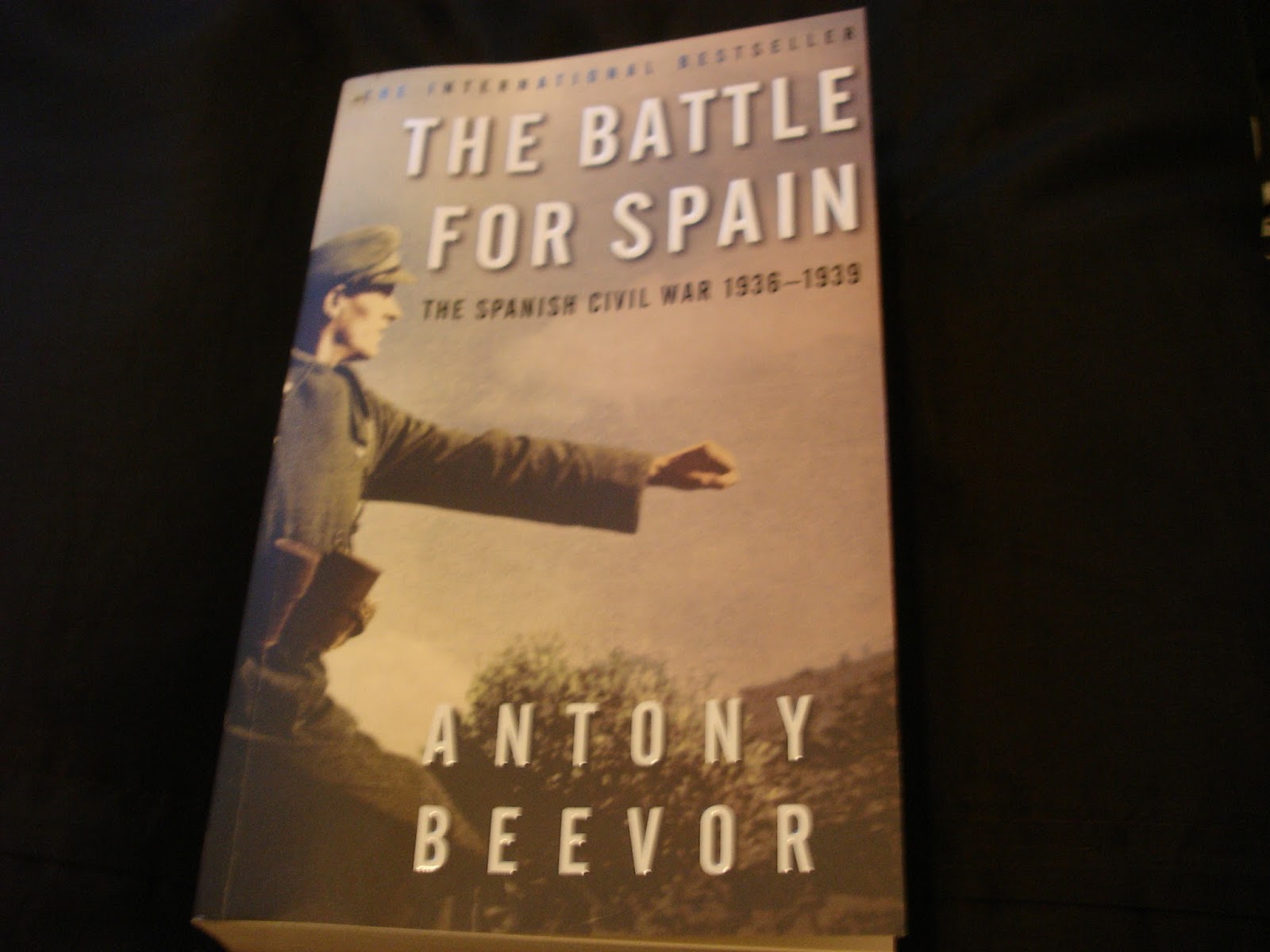
The Spanish Civil War remains highly emotive. Antony Beevor chronicles and analyses the conflict in his book The Battle For Spain.
In the chapters which constitute a "preamble", Spain's history prior to the 1930s is stressed , with some emphasis on the influence of the Church and the landowners. The country had, it appears, not been affected as much as other parts of Europe by liberalizing impulses.
The plethora of factions on both sides of this conflict can be confusing to say the least, but Beevor does his best to clarify who was who, and why. As he observes, this was not just a struggle between left and right, but also one between libertarianism and authoritarianism and centralization and "federalism"/separatism. These dynamics served to create a very intense and volatile picture.
It is difficult not to be sympathetic to the more libertarian elements of the republican side, however much one feels that they were occasionally naive in their idealism in the face of cold realities. The anarchist scene in Spain around that time, particularly that located in Catalonia, is a fascinating and thought-provoking phenomenon. For all its flaws, a hopeful and positive experiment.
My interpretation was that Beevor felt that the left misjudged the size of its mandate, with its strident rhetoric more than its actions, driving many into the arms of the nationalists. The right exaggerated the "threat".
The infighting between the various groupings, and the fragmented nature of the alliances, is one of the factors which gives the Spanish Civil War an enduring fascination. Loose cannons, hot heads, impractical idealism, brazen opportunism, impulsiveness, impetuosity and cold calculation - all played their part in the drama.
I was impressed by the author's analysis of the early stages of the uprising, the government's hesitant and dilatory initial response, and the motivations behind some of the early atrocities. The republican excesses were more the result of an outburst of rage and chaos. The nationalists, on the other hand, planned a systematic campaign of terror, even "cleansing". The language coined by some nationalist officials is chilling, like something harking back to the Middle Ages...
Beevor goes to great lengths to outline how the unity, or otherwise, of the two sides developed and evolved, Franco maintaining a semblance of cohesion via a mixture of concessions, sops, coercion and eventually demonstrable indispensability to the success of the nationalist cause. Staying largely above the internal strife also clearly helped him. The republicans were not so fortunate, of course, having the heavy hand of Stalin and the Comintern to contend with. Was it the case that the nationalists had a simplicity of purpose, even allowing for lingering agendas, so that they were able to keep their eyes on the prize? It seems bizarre, but the situation in the anti-fascist camp was not that straightforward.
Another illuminating section of The Battle For Spain deals with the war economy in the republican zone, and the tensions which some methods sparked with the central government. It is difficult not to conclude that the anarchists sometimes clung too rigidly to lofty theories and ideals when a more pragmatic approach may have been more beneficial in the grand scheme of things. Later on, though, they felt with some justification that they were struggling for their very survival and identity.
The rather inglorious attitude of some foreign countries, as well as the manner in which big business connived with the nationalists, is a distasteful facet of the conflict. Yes, we all know now what Stalinism was like, but isn't this a case of being wise after the event? The "rationale" behind certain people's backing for Franco was rather grotesque. The republicans were drastically deprived of genuinely powerful friends, and the consequent reliance on support from the Soviet Union was to bear bitter fruit.
The "romance" surrounding the republican cause is very seductive, even if it is often tricky to pin down exactly. One of the main tasks of the historian therefore is to separate fact from myth, and to weigh what was propaganda, distortion or fabrication. I feel that Beevor remains relatively dispassionate throughout, and does not allow the emotive nature of the subject matter to impinge on lucid judgement. The cruelty and barbarism of the nationalists largely speaks for itself, although the cracks in the republican side take a little more explaining and understanding.
The International Brigades are often the things which most laymen remember about the Spanish Civil War, partly due to the literature and evocative tales which emerged, and also because of the principled stand which they made. Beevor strives to place their role into its proper perspective, and stresses how they slotted into the structure of the Republic's forces.
Diaries and private correspondence are invariably very useful in getting nearer to the truth. Intimate, often candid thoughts committed to paper in the midst of the maelstrom, not alloyed or compromised by propagandistic concerns or embellishment. Such material is made excellent use of in this book.
A probing look at the involvement of intellectuals and artists is also a feature of this work, how many became disillusioned, and how some journalists had their hands tied. It is also pointed how the "demonization" of the communists may have played into their hands, by allowing them to portray themselves as the sole meaningful and dedicated bulwark against fascism.
The portions which address the "civil war within a civil war" evoke a loss of faith among some of the leftist forces and the growth of disenchantment, It is at this point that the paranoia of the Stalin-aligned communists and their acolytes becomes a pervasive trend, seeing the hands of fifth-columnists in almost every military or political reverse. They had leverage, which meant that the other players in the republican fold had to tread carefully in dealing with them. They may admittedly have been on firmer ground in advocating firmer, more cohesive organization and leadership in the face of the nationalist threat.
The vagaries of Stalin's stance are strange. He was doing his best to conceal or downplay the "communistic" side of the republican make-up, for foreign consumption at least, whilst his men on the ground in Spain were throwing their weight around in no uncertain terms. The activities of the secret police, the harsh treatment of the International Brigades volunteers and the draconian punishments for soldiers are all documented here. It is easy to imagine how many people became exasperated and cynical.
A theme which emerges in the second half of this history is the tendency of the republican leadership, under communist sway, to embark on military adventures for reasons of propaganda, playing to both the domestic and international gallery, even when this was not consistent with military or strategic logic. At the same time, of course, the diplomatic picture was clouded and complicated by the gathering storm on the wider European scene. Decisions made regarding Spain were not made in isolation.
Rightly or wrongly, I discerned from some of the author's observations a sense that the republicans were almost naive and "green", both in some of their military decisions, and in their dealings with the outside world, in areas such as finance and arms procurement.
There is a look at what happened after the civil war concluded, including the fate of the exiles,and how Franco went about consolidating his grip on power. The role of both sides in the Second World War is given some attention, and Beevor also looks at the military lessons which the great powers learned, or disregarded, from the fighting in Spain. He also assesses the impact of the interventions made by the Soviet Union, Germany and Italy.
Overall, when reading this book I was left with a feeling of sadness at what befell Spain, at the behaviour of some people on both sides, and how those with honourable and humane motivations and intentions were let down, manipulated and misled.
The Battle For Spain is a sobering but rewarding and worthwhile read. It is well structured and paced, and it brings to life a tragic and contentious episode in modern European history.
Showing posts with label world war 2. Show all posts
Friday, 25 September 2015
The Battle For Spain - The Spanish Civil War 1936-1939 - Antony Beevor - book review
Labels:
antony beevor,
books,
europe,
germany,
history,
italy,
literature,
military history,
politics,
russia,
second world war,
soviet union,
spain,
spanish civil war,
war,
world war 2,
world war two
Sunday, 15 June 2014
The Desert War - Alan Moorehead
This first-hand account of the North African campaign of World War 2, written by a British war correspondent, is deeply compelling.
It is different, and refreshing to read these accounts, from somebody who was actually there. There are some great anecdotes, evoking the atmosphere of the region, so different in some ways, yet also so similar in others, to the European war. The very fact that these writings were originally published whilst World War Two was still raging gives them a rawness and immediacy absent from so many books dealing with the period. This is not just a chronicle of military and political developments, but also a record of life as a war correspondence, a gruelling and perilous existence in itself.
The book does not just concentrate exclusively on the campaigns in Egypt, Libya and Tunisia, but covers the operations in East Africa (Abyssinia, Sudan and so forth). A large chunk of the text also deals with the fighting between the British Empire forces and the Italians, "pre-Rommel" as it were.
There is an intimate flavour to much of this work, as the effects on civilians and individual soldiers are examined, with much localised drama and colour, rather than just grand strategy. Of course, Moorehead was not always where the main action was, so this is as much the story of his war as it is an attempt to rigorously record the war in Africa as a whole.
Many eye-witness accounts of bombing raids or the aftermath of battles are here, bringing home the fears and hazards both for the individual serviceman and the journalist. Warfare in its many shades is exhibited, highlighting the diversity of terrain and tactical concerns.
As well as covering events on the fields of battle, the book includes lots of material from "behind the lines", from cities such as Cairo, where life seemed to remain relatively "normal", certainly when compared to the beleaguered cities of Europe.
There are some eye-opening passages hinting at how lavishly the Italian forces, and particularly the officers, lived at the outset of the war, certainly when compared to the spartan existence endured by many of their British counterparts. This may go against some present-day perceptions of what the state of play was. We are given detailed, and in some instances poignant, lists of the articles left behind by retreating troops.
Personality portraits of military commanders are another interesting feature, including those who have not always had a favourable press from historians, such as those who oversaw the early exchanges in North Africa. The deeper motivations behind strategy and tactics are also analysed. One is left with quite a positive impression of the effectiveness of the Allied forces in the early stages, although this was of course put into perspective by the arrival of the Germans...
Upon the advent of the Afrika Korps, I detected a darkening in the mood and tone of the book, with some lamenting of Allied inferiority in material and tactical terms. It is also interesting to see some examination of strategy in "real time", linking events in the Western Desert to Greece, Abyssinia and other areas. There are some intriguing tangents, with chapters on the home fronts in Britain and the USA, and also one concerning the political manoeuvrings in India.
The constant references to "we" and "our" may irritate some non-British readers, but we have to remember the circumstances under which these passages were composed, when Britain was under siege both at home and overseas. For this and other reasons, "The Desert War" is definitely a period piece, but a good one. I didn't think that any "bias", if it can be called that, interfered with the value of the book.
Saturday, 17 May 2014
Liddell Hart's History Of The Second World War
There are literally thousands of books available which provide an overview of the 1939-45 conflict, catering for many perspectives and tastes. Of those which major primarily on the purely military/strategic aspects, Basil Liddell Hart's "History Of The Second World War", first published in 1970, stands out, both for its level of detail and erudition and its absence of equivocation and bias.
Until recently, I had not read this book in its entirety for several years, and there is a greater quantity of discussion about grand strategy, and the "behind closed doors" elements, than I had recalled. Works of this depth travel comfortably beyond the wishy-washy generalisations seen elsewhere. Liddell Hart quotes extensively from diaries and official records, and from his own post-war interviews with some German commanders.
A lengthy pre-amble sets the scene. It is dispiriting, but worthwhile, to be reminded of the appeasement policies practised by Britain in the 1930s, and of the missed opportunities to stifle and confront Hitler's expansionist sorties, particularly those circa 1938.
In his accounts of the early campaigns of the war, the author emphasizes how comparatively fine the margins were between German success and their being repulsed by the Allies, in France in 1940 for example. He appears to adopt the line that the German victory in the West was not a foregone conclusion, dispelling a few common assumptions about that campaign, and highlighting, as he does elsewhere, how the impetus for the Wehrmacht's tactics emanated chiefly from certain of their field commanders, not from the high command itself.
As one of the early prophets, and advocates, of the new fast-moving armoured warfare, Liddell Hart is therefore ideally placed to judge how these ideas impacted on the course of events in the early stages of the conflict, and how those who failed to take heed of the new realities paid a heavy price for their blinkeredness. In expressing his exasperation at the failings of Allied strategy, he is not simply saying "I told you so", but does back up his assertions with reasoned analysis, whilst also allowing that the deficiencies sometimes resulted from political neglect and misjudgement, or economic factors.
Some of the arguments employed here about strategic and diplomatic matters are ones which appear to be unfashionable today, but I see that as a distinct strength! These viewpoints are arrived at by reasoning and knowledge, whereas I get the feeling that many 21st century commentaries on World War Two are bland, watered down or populist over-simplifications, designed not to tax people's pre-conceptions too much.
The relating of the feverish diplomatic activity both prior to and during the "Operation Torch" landings in North Africa in 1942 is a fine example of how detail and comprehensiveness can give a more representative overview than the "bullet-point" tactics used in many versions. My impression, rightly or wrongly is that the British Mediterranean strategy in the 1942-43 period is given a qualified thumbs-up, even if fault is found with its later implementation. The dreaded word "sideshow" is not to be found that frequently in these chapters!
Liddell Hart's views on the Eastern Front are fascinating, including his view that the "backwardness" of the USSR in those days helped to save it from total collapse and defeat in the first phases of the German invasion. To my mind, he does not adhere as much as some observers to the notion that the Russian front was the only "real front" in the war.
There is a balanced, humane and realistic assessment of the merits, or otherwise, of the various Allied strategic bombing initiatives. The blind alleys are highlighted, but equally the later innovations, breakthroughs and effects are acknowledged. The missed opportunities to end the war more swiftly on the Western Front are subjected to a lengthy dissection and lamentation.
The flaws and pitfalls in the "unconditional surrender" demands put forward by Allied leaders in both Europe and Asia are examined. Did this stipulation unnecessarily prolong the war, by bolstering both civilian and military morale, and defiance, amongst the surviving Axis powers?
On the subject of the atomic bomb, and the possible motivations for employing it, much emphasis is placed on the anxiety in Washington about forestalling increased Soviet influence in the Far East. The author persuasively argues that Japan was probably already finished before the bomb dropped on Hiroshima. Did the bomb merely hasten the inevitable surrender by a very short time?
It may seem to the casual observer that the closing chapters on the chronology of the war itself are a little truncated, but on reflection this is probably just symptomatic of how quickly Germany and Japan collapsed. Also, most of the fighting in the Pacific did not lend itself to the mobile and fluid warfare about which the author specialized.
Those looking for a comprehensive social and political history of the war should probably look elsewhere. The "humanitarian" aspects of the conflict are rarely touched on in detail here, although Liddell Hart refers at times to the moral dimension, and the wider struggle for civilization. If you want to read in-depth about those broader considerations, there are plenty of books which cater for those things handsomely....
Above all, what emerge to me are the author's clarity of thought, his disdain for inertia, and the power of his ideas. This is a lengthy work, but also one which can be devoured quite swiftly, such is its authoritativeness, and resultant capacity to maintain the interest.
Thursday, 21 November 2013
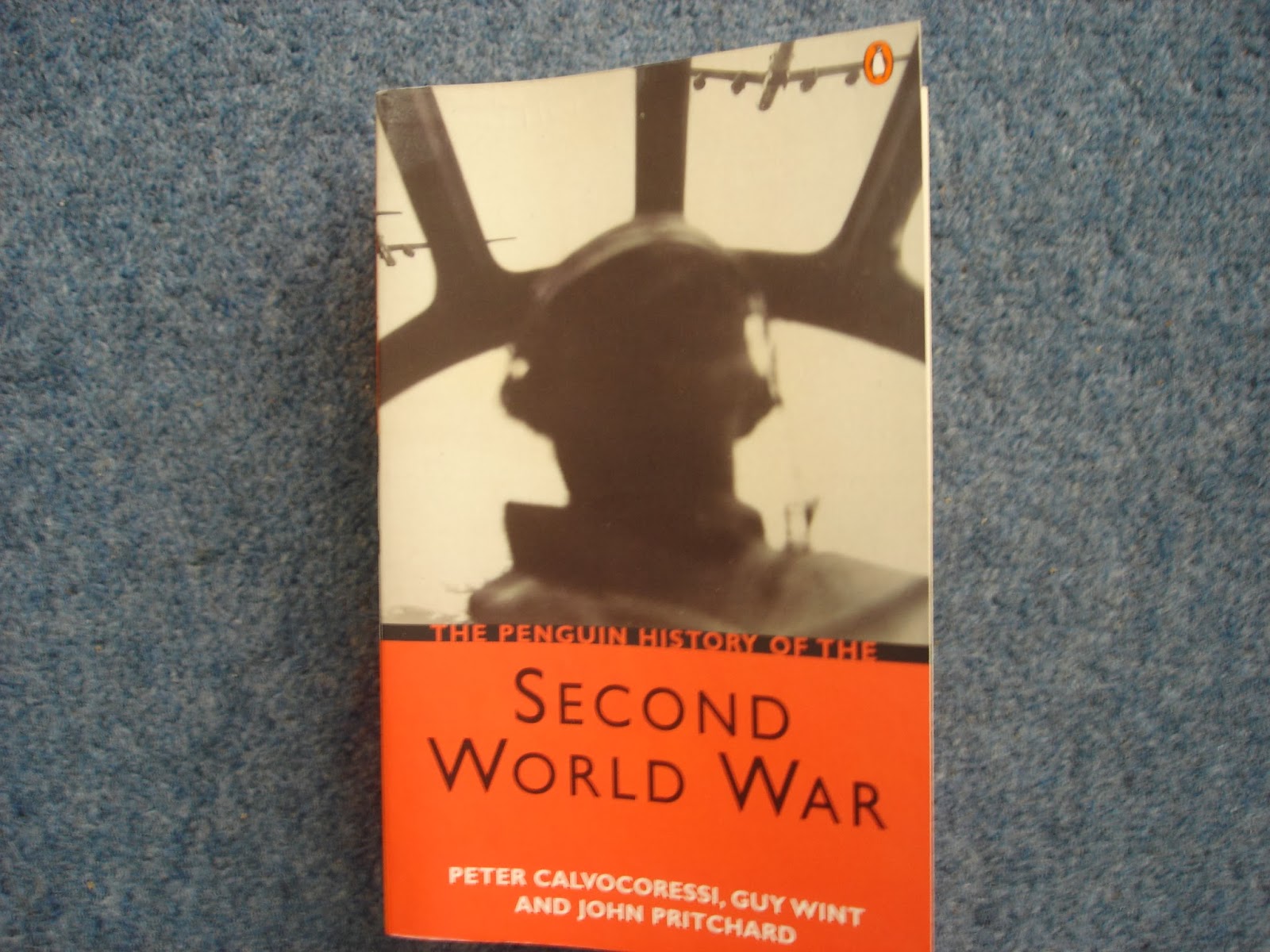
The Penguin History of the Second World War
The Second World War is such a vast and complex subject that it is very difficult to find books about it which achieve the twin aims of being comprehensive and authoritative, whilst at the same time having something different and thought-provoking to say. Those which give emphasis to matters of broad strategy and diplomacy, rather than the minutiae of military tactics, are particularly valuable. Falling into this latter category is "The Penguin History of The Second World War", by Peter Calvocoressi, Guy Wint and John Pritchard, originally published in 1972. This was a revised edition from some years later.
There is a forthright description of the events in Europe in the 1930s, including some fairly trenchant observations on what might have happened if Britain had been more obdurate and hawkish during the crisis over Czechoslovakia.
I really enjoyed the passages which commented on the major leaders, and their assorted virtues and frailties. I was (pleasantly) surprised by much of the appraisal of the respective parts played by Roosevelt and Churchill, in that it went against the grain of much of the hackneyed "wisdom" to be found in modern-day accounts. Throughout the relevant parts of the book, the interaction between the "Big Three" is assessed conscientiously. I was interested in the observations about "the race to Berlin" in 1945, and the prominence of Allied military leaders in the decision-making process.
There are superb and sobering chapters focusing on how the Nazis treated and administered occupied Europe, and how these policies affected people and the course and conduct of the overall war. Loyalties often converged and diverged due to the vicissitudes of the war. Grievances and suspicions, which were often fuelled by emotion and propaganda in the heat of conflict, are weighed in some detail.
The complex and fluid dynamics of France, from the perspective of Vichy, de Gaulle and the Resistance, is explored in a clear, compassionate and enlightening fashion. The equally elaborate and byzantine scenario in Italy is accorded similar treatment.
Where this formidable tome differs from other similar efforts is in the weight of emphasis placed on the war in Asia and the Pacific, and its origins in China and Japan. Indeed, the revised edition is effectively divided into two parts, the first dealing with European and related theatres, the second the Far East. Great care is taken to document the process by which Japan arrived at the state of affairs which triggered its conquests in the 1930s and early 1940s, with dissections of its alliances with Great Britain, and the ramifications of the war against Russia in 1904/05.
We see how Japan's embarkation on a certain course tied in with, and was affected by, developments in Europe and elsewhere, and how the imperial ambitions of the other Powers in the Far East contributed in determining Japan's approach and mentality.
The importance of China is stressed to a degree uncommon in many latter-day accounts. This is all explained with coherence and confidence, especially how the respective Japanese and Western attitudes to China helped to bring about the eventual catastrophe.
The reasons for Japan's gradual estrangement from the West in the years following the First World War are outlined, as is the manner in which the military influence became stronger and more embedded. Some insight is provided into the ethos of the armed forces, and the peculiar way in which they at times related to the population at large. Of interest to me was the sense that although Japanese society developed on the surface along Western lines, imitating institutions and policies followed by Europe and America, the outlook and practices which developed were distinctive and unusual.
The chronicles of military campaigns and other episodes are unpretentious and uncluttered, occasionally balanced out by raw statistics to illustrate points, especially dealing with the war economies and grand strategic matters. There are also some pointed and perceptive commentaries on the societal impacts of the conflict and its aftermath.
To summarise, for a slightly different perspective on this vast, complicated and emotive subject, this book comes highly recommended.
There is a forthright description of the events in Europe in the 1930s, including some fairly trenchant observations on what might have happened if Britain had been more obdurate and hawkish during the crisis over Czechoslovakia.
I really enjoyed the passages which commented on the major leaders, and their assorted virtues and frailties. I was (pleasantly) surprised by much of the appraisal of the respective parts played by Roosevelt and Churchill, in that it went against the grain of much of the hackneyed "wisdom" to be found in modern-day accounts. Throughout the relevant parts of the book, the interaction between the "Big Three" is assessed conscientiously. I was interested in the observations about "the race to Berlin" in 1945, and the prominence of Allied military leaders in the decision-making process.
There are superb and sobering chapters focusing on how the Nazis treated and administered occupied Europe, and how these policies affected people and the course and conduct of the overall war. Loyalties often converged and diverged due to the vicissitudes of the war. Grievances and suspicions, which were often fuelled by emotion and propaganda in the heat of conflict, are weighed in some detail.
The complex and fluid dynamics of France, from the perspective of Vichy, de Gaulle and the Resistance, is explored in a clear, compassionate and enlightening fashion. The equally elaborate and byzantine scenario in Italy is accorded similar treatment.
Where this formidable tome differs from other similar efforts is in the weight of emphasis placed on the war in Asia and the Pacific, and its origins in China and Japan. Indeed, the revised edition is effectively divided into two parts, the first dealing with European and related theatres, the second the Far East. Great care is taken to document the process by which Japan arrived at the state of affairs which triggered its conquests in the 1930s and early 1940s, with dissections of its alliances with Great Britain, and the ramifications of the war against Russia in 1904/05.
We see how Japan's embarkation on a certain course tied in with, and was affected by, developments in Europe and elsewhere, and how the imperial ambitions of the other Powers in the Far East contributed in determining Japan's approach and mentality.
The importance of China is stressed to a degree uncommon in many latter-day accounts. This is all explained with coherence and confidence, especially how the respective Japanese and Western attitudes to China helped to bring about the eventual catastrophe.
The reasons for Japan's gradual estrangement from the West in the years following the First World War are outlined, as is the manner in which the military influence became stronger and more embedded. Some insight is provided into the ethos of the armed forces, and the peculiar way in which they at times related to the population at large. Of interest to me was the sense that although Japanese society developed on the surface along Western lines, imitating institutions and policies followed by Europe and America, the outlook and practices which developed were distinctive and unusual.
The chronicles of military campaigns and other episodes are unpretentious and uncluttered, occasionally balanced out by raw statistics to illustrate points, especially dealing with the war economies and grand strategic matters. There are also some pointed and perceptive commentaries on the societal impacts of the conflict and its aftermath.
To summarise, for a slightly different perspective on this vast, complicated and emotive subject, this book comes highly recommended.
Friday, 15 February 2013
The Longest Day
I often find it illuminating to revisit the films, music and books which I admired during my youth, to see whether they still warrant that praise when subjected to the scrutiny of my older, more analytical and critical mind and worldview. One such example is the 1962 war movie The Longest Day, which I recently watched in its entirety for the first time in years.
As a teenager, I tended to regard The Longest Day as in some ways the definitive war movie, but looking back the reasons for this viewpoint were quite superficial. The film's big budget and impressive cast seemed to my callow mind to automatically confer greatness on it, and I did not delve beyond these factors to analyse things in greater detail. So, how did my now more discerning, forty-something eye see things?
The Longest Day tells the story of the Normandy D-Day landings of June 1944, from the point of view of Allied and German servicemen, and French civilians and resistance fighters. The whole theater of operations is covered, from paratroops and glider-borne forces, to fighter pilots and those men landing on the invasion beaches.
One of the first things to observe is the impact of the black and white stock used. This lends proceedings a certain gravitas, as well as conveying in places a sense of pathos and foreboding, and the grim and scary truth about war and combat.
Another wise touch was the decision to have the dialogue in German and French as well as English, with subtitles being employed. This imbues the film with a touch more authenticity.
The format of the movie, whereby the story is related from the point of view of various participants, in a multiplicity of roles, helps to bring across the sheer scale and magnitude of events. I suppose one could argue that this may leave the picture feeling more fragmented, and less intimate, than other ones of this genre. However, the skill and care employed in characterization and editing means that this is not a massive drawback overall.
This movie by necessity places more emphasis on the preliminary and preparatory phases than most other war films. We gain a hint of the apprehension, excitement and stakes, as well as being introduced to the various characters. These days I tend to find these aspects more interesting than the battle scenes themselves...
Despite the big-budget "Hollywood" status of The Longest Day, I did not get an impression of any major sensationalism, or excessive embellishment or over-inflation of characters. Their trepidation and insecurities seem very "human" and natural. The general atmosphere is, I would suggest, mildly understated, rather than gung-ho...
It is significant that, on the Allied side especially, the film pays most attention to those at the "sharp end", including both commanders and the rank-and-file "on the ground", as well as civilians. The scene portraying the conference involving Eisenhower, Montgomery and company is almost an afterthought, with relatively unknown actors playing the relevant parts.
One thing which I pondered on after watching the film was whether it overplayed the extent of German "complacency" and surprise concerning the landings, particularly among the higher echelons of command. On the other hand, there is some attempt to illustrate the nature of the German command structure, the degree to which localised autonomy was constrained from the top, and the recriminations which all this provoked.
The scenes in the hours of darkness, during the early stages of the operation, are perhaps the most evocative and gripping in the entire movie. The monochrome works to powerful effect here. We can begin to get some impression of just how bewildering and frightening it must have been for those people involved. The sequences featuring the parachute and glider troops, and special forces and commandos, are very dramatic and compelling.
There is vivid depiction of the improvisation which occurred in the formative stages of the operation, when the best-laid plans had gone awry. Snap decisions having to be taken by commanders on the ground, and stragglers, or those who were simply lost, joining up with other units. We also see how the Germans reacted to the confusion of those early hours, as the scale of events began to dawn on the high command.
The battle scenes in The Longest Day are not particularly graphic in comparison with more recent war movies. They are though frenetic and intense, admittedly. There is also some clever and inventive camera-work, with long and wide shots affording a panoramic view of some of the engagements.
Of the acting performances, one which stands out is that of Richard Todd, as Major John Howard. Quietly authoritative and purposeful.
One of the notable features of this film is the number of what might be described as "cameo" or relatively minor parts undertaken by major stars. The likes of Richard Burton, Henry Fonda and Rod Steiger are among those who perform these roles, and their presence and talent helps to instill real authority and weight. Another example of this phenomenon which stands out is that of Kenneth More, as an eccentric but fearless beach master.
Of the more substantial roles, a couple really linger in the consciousness. Robert Mitchum is superb and plausible as an American infantry commander embroiled in the chaos on Omaha beach, showing determination, presence of mind and humanity in his efforts to extricate his men from their predicament. John Wayne is in his element as the injured parachute commander, being wheeled around on a cart, but displaying a kind of laconic determination and persistence.
I feel that the dialogue in The Longest Day still stands up reasonably well. There is plenty of dark humour and bathos in there, alongside the standard military discourse, but it rarely descends into the realms of being corny or trite.
A few of the scenes in the picture stand out. There is a memorable sequence where a group of nuns walks through the middle of a savage battle in order to render medical assistance to Free French soldiers. Towards the end, there is an encounter between an inexperienced American soldier and Richard Burton's character, a wounded RAF pilot who has killed a German infantryman. Their conversation, in a relatively tranquil setting towards the end of that momentous day, helps to place the events in some kind of perspective.
The Longest Day has a real scope and sweep about it. It therefore does not quite have the emotional pull, or pose the distilled and condensed moral or philosophical questions which are characteristic of movies such as The Bridge On The River Kwai. However, it is a superbly polished and compelling piece of work, with many poignant and fascinating moments.
As a teenager, I tended to regard The Longest Day as in some ways the definitive war movie, but looking back the reasons for this viewpoint were quite superficial. The film's big budget and impressive cast seemed to my callow mind to automatically confer greatness on it, and I did not delve beyond these factors to analyse things in greater detail. So, how did my now more discerning, forty-something eye see things?
The Longest Day tells the story of the Normandy D-Day landings of June 1944, from the point of view of Allied and German servicemen, and French civilians and resistance fighters. The whole theater of operations is covered, from paratroops and glider-borne forces, to fighter pilots and those men landing on the invasion beaches.
One of the first things to observe is the impact of the black and white stock used. This lends proceedings a certain gravitas, as well as conveying in places a sense of pathos and foreboding, and the grim and scary truth about war and combat.
Another wise touch was the decision to have the dialogue in German and French as well as English, with subtitles being employed. This imbues the film with a touch more authenticity.
The format of the movie, whereby the story is related from the point of view of various participants, in a multiplicity of roles, helps to bring across the sheer scale and magnitude of events. I suppose one could argue that this may leave the picture feeling more fragmented, and less intimate, than other ones of this genre. However, the skill and care employed in characterization and editing means that this is not a massive drawback overall.
This movie by necessity places more emphasis on the preliminary and preparatory phases than most other war films. We gain a hint of the apprehension, excitement and stakes, as well as being introduced to the various characters. These days I tend to find these aspects more interesting than the battle scenes themselves...
Despite the big-budget "Hollywood" status of The Longest Day, I did not get an impression of any major sensationalism, or excessive embellishment or over-inflation of characters. Their trepidation and insecurities seem very "human" and natural. The general atmosphere is, I would suggest, mildly understated, rather than gung-ho...
It is significant that, on the Allied side especially, the film pays most attention to those at the "sharp end", including both commanders and the rank-and-file "on the ground", as well as civilians. The scene portraying the conference involving Eisenhower, Montgomery and company is almost an afterthought, with relatively unknown actors playing the relevant parts.
One thing which I pondered on after watching the film was whether it overplayed the extent of German "complacency" and surprise concerning the landings, particularly among the higher echelons of command. On the other hand, there is some attempt to illustrate the nature of the German command structure, the degree to which localised autonomy was constrained from the top, and the recriminations which all this provoked.
The scenes in the hours of darkness, during the early stages of the operation, are perhaps the most evocative and gripping in the entire movie. The monochrome works to powerful effect here. We can begin to get some impression of just how bewildering and frightening it must have been for those people involved. The sequences featuring the parachute and glider troops, and special forces and commandos, are very dramatic and compelling.
There is vivid depiction of the improvisation which occurred in the formative stages of the operation, when the best-laid plans had gone awry. Snap decisions having to be taken by commanders on the ground, and stragglers, or those who were simply lost, joining up with other units. We also see how the Germans reacted to the confusion of those early hours, as the scale of events began to dawn on the high command.
The battle scenes in The Longest Day are not particularly graphic in comparison with more recent war movies. They are though frenetic and intense, admittedly. There is also some clever and inventive camera-work, with long and wide shots affording a panoramic view of some of the engagements.
Of the acting performances, one which stands out is that of Richard Todd, as Major John Howard. Quietly authoritative and purposeful.
One of the notable features of this film is the number of what might be described as "cameo" or relatively minor parts undertaken by major stars. The likes of Richard Burton, Henry Fonda and Rod Steiger are among those who perform these roles, and their presence and talent helps to instill real authority and weight. Another example of this phenomenon which stands out is that of Kenneth More, as an eccentric but fearless beach master.
Of the more substantial roles, a couple really linger in the consciousness. Robert Mitchum is superb and plausible as an American infantry commander embroiled in the chaos on Omaha beach, showing determination, presence of mind and humanity in his efforts to extricate his men from their predicament. John Wayne is in his element as the injured parachute commander, being wheeled around on a cart, but displaying a kind of laconic determination and persistence.
I feel that the dialogue in The Longest Day still stands up reasonably well. There is plenty of dark humour and bathos in there, alongside the standard military discourse, but it rarely descends into the realms of being corny or trite.
A few of the scenes in the picture stand out. There is a memorable sequence where a group of nuns walks through the middle of a savage battle in order to render medical assistance to Free French soldiers. Towards the end, there is an encounter between an inexperienced American soldier and Richard Burton's character, a wounded RAF pilot who has killed a German infantryman. Their conversation, in a relatively tranquil setting towards the end of that momentous day, helps to place the events in some kind of perspective.
The Longest Day has a real scope and sweep about it. It therefore does not quite have the emotional pull, or pose the distilled and condensed moral or philosophical questions which are characteristic of movies such as The Bridge On The River Kwai. However, it is a superbly polished and compelling piece of work, with many poignant and fascinating moments.
Monday, 12 November 2012
The Guns of Navarone
There are certain films, particularly war movies, which were staple viewing for people of my generation, who grew up in the 70s and 80s. It is always intriguing to gauge how much my attitude towards these films has altered with the passage of time, and with the shifting sands of my own outlook and attitudes. One such movie is The Guns Of Navarone. I recently watched it, for the first time in quite a while.
Firstly, I had forgotten just how lengthy the film is! Much scope is allowed for the preliminaries and preparation, the tortuous build-up and the operation itself. I have not read Alistair MacLean's novel, on which the movie is based, but the running time may reflect a desire on the part of the film-makers to do full justice to the book. It also permits some concentration on the "human" aspects of the story.
I have always had a penchant for the kind of war movies which look at the more "niche" areas of conflict, and the less publicised theatres of war, and those which concentrate on special or clandestine operations, rather than the grandiose ones featuring mighty clashes of arms. A healthy dose of political intrigue, and room for plot twists and improvisation, are also very appealing. The Guns of Navarone combines elements of this, and also those of the "blockbuster", with its all-star cast and the sheer opulence of some of the visuals. This duality works well.
There are cliches aplenty throughout, although in fairness this picture probably invented quite a few of them! I found a few bits of the story a touch implausible, mainly the intricate ways in which the commando unit continue to evade capture by the Germans, but this is likely just the pedant in me making itself felt. These relatively mild reservations are counter-balanced by the cold reality which occasionally afflicts the raiding party.
Of the acting performances, Gregory Peck brings authority, gravitas and depth to his role. By contrast, I found David Niven a touch overwrought and unconvincing here. The real revelation for me is Anthony Quinn, both brooding and humane.
Even when subjected to my more exacting latter-day criteria, The Guns of Navarone still stands up reasonably well.
Firstly, I had forgotten just how lengthy the film is! Much scope is allowed for the preliminaries and preparation, the tortuous build-up and the operation itself. I have not read Alistair MacLean's novel, on which the movie is based, but the running time may reflect a desire on the part of the film-makers to do full justice to the book. It also permits some concentration on the "human" aspects of the story.
I have always had a penchant for the kind of war movies which look at the more "niche" areas of conflict, and the less publicised theatres of war, and those which concentrate on special or clandestine operations, rather than the grandiose ones featuring mighty clashes of arms. A healthy dose of political intrigue, and room for plot twists and improvisation, are also very appealing. The Guns of Navarone combines elements of this, and also those of the "blockbuster", with its all-star cast and the sheer opulence of some of the visuals. This duality works well.
There are cliches aplenty throughout, although in fairness this picture probably invented quite a few of them! I found a few bits of the story a touch implausible, mainly the intricate ways in which the commando unit continue to evade capture by the Germans, but this is likely just the pedant in me making itself felt. These relatively mild reservations are counter-balanced by the cold reality which occasionally afflicts the raiding party.
Of the acting performances, Gregory Peck brings authority, gravitas and depth to his role. By contrast, I found David Niven a touch overwrought and unconvincing here. The real revelation for me is Anthony Quinn, both brooding and humane.
Even when subjected to my more exacting latter-day criteria, The Guns of Navarone still stands up reasonably well.
Labels:
alistair maclean,
anthony quayle,
anthony quinn,
cinema,
david niven,
films,
gregory peck,
history,
movies,
politics,
second world war,
the guns of navarone,
world war 2,
world war two,
ww2
Saturday, 3 March 2012
Battle of Britain (movie)
One of the drawbacks of some war films from the 1950s and 1960s is that they promote an excessively sugar-coated or jingoistic view of the subject matter. Genuinely insightful and accurate examination of the historical issues can be obscured by the urge to pander to the prejudices of a mass audience.
Just recently I watched Battle of Britain, a 1969 movie telling the tale of the grim struggle between Germany and Britain in 1940. I had seen this film several times when I was younger, and now, equipped with greater historical knowledge and a more nuanced political appreciation, I was pleasantly surprised at what a relatively sensible and mature account of events it is.

The cast is impressive to say the least, with prominent roles for Laurence Olivier, Michael Caine, Christopher Plummer, Robert Shaw, Trevor Howard, Kenneth More and others. The sets and effects are lavish, but employed tastefully and sparingly, and scenes which in other films might have been excessively showy or grandiose are thankfully not much in evidence here.
Rather than simply deal with the air battle itself, the film seeks to apply some context, and so matters begin with the impending fall of France, and the atmosphere of despondency, retreat and chaos. This is swiftly followed by images of Britain bracing itself for possible invasion. There are some imaginative bits of sequencing which appear to contrast British stoicism with German triumphalism and perhaps over-confidence.
One of the things which I admired about this film is that it celebrated the courage and defiance of Britain in facing up to its plight without being overly sentimental or trite. The "stiff upper lip" is much in evidence, but in an agreeably understated manner. For me the script flirts with the notion that much of this was a case of "putting on a brave face". This theme is continued with the often fatalistic or sarcastic humour displayed by the RAF pilots, masking their genuine fear.
This movie was justifiably praised for its action sequences, and it is fair to say that they were impressively done. The impact of these sequences was magnified for me by the quality of the film stock. Effective camerawork and judicious use of music also contribute in this regard.
As well as the flying excerpts, the parts where British airfields are attacked are also very powerful, and occasionally graphic, as in the scene where Susannah York's character is faced with a line of the bodies of her subordinates, covered in blankets. A reminder of the human cost, in a type of war which often seemed relatively impersonal.
One of the scenes which I noticed, but which might not have garnered the credit which it deserved, was one at the height of the battle, where RAF and Home Guard personnel appear in the same location. The producers may have seen this as symbolic, and hinting what was at stake if the battle was lost, and invasion became a certainty.
There were signs that some thorough research had been undertaken, with regard to tactics, the disposition of the respective forces, and so on. I found myself cross-referencing nuggets of information in the film with my own knowledge of the events of 1940.
Laurence Olivier delivers what appears to be a fine portrayal of Air Chief Marshal Dowding. Taciturn, matter-of-fact and a realist, not given to hyperbole. Solid as a rock and level-headed when such qualities had never been more essential.
My one criticism of this movie is the decision to have a Hitler speech scene, and also some scenes featuring Hermann Goering. These bits were quite superfluous, and my opinion is that they should have confined the dialogue and characterisations to the men and women at the sharp end, as it were.
Interestingly, there is no real attempt at a stirring climax. There is some symbolism, with empty seats at a dinner for German airmen, and moves in France to suspend invasion plans. The British looked and sounded more philosophical than elated or euphoric. At the end, Olivier looks out from his headquarters at the English countryside, and this subtle and gentle, but incisive imagery is in keeping with much of this film's tone.
Overall, I thought this was a credible, well-judged and balanced telling of the tale, possibly a definitive "mainstream" cinematic take.
Just recently I watched Battle of Britain, a 1969 movie telling the tale of the grim struggle between Germany and Britain in 1940. I had seen this film several times when I was younger, and now, equipped with greater historical knowledge and a more nuanced political appreciation, I was pleasantly surprised at what a relatively sensible and mature account of events it is.

The cast is impressive to say the least, with prominent roles for Laurence Olivier, Michael Caine, Christopher Plummer, Robert Shaw, Trevor Howard, Kenneth More and others. The sets and effects are lavish, but employed tastefully and sparingly, and scenes which in other films might have been excessively showy or grandiose are thankfully not much in evidence here.
Rather than simply deal with the air battle itself, the film seeks to apply some context, and so matters begin with the impending fall of France, and the atmosphere of despondency, retreat and chaos. This is swiftly followed by images of Britain bracing itself for possible invasion. There are some imaginative bits of sequencing which appear to contrast British stoicism with German triumphalism and perhaps over-confidence.
One of the things which I admired about this film is that it celebrated the courage and defiance of Britain in facing up to its plight without being overly sentimental or trite. The "stiff upper lip" is much in evidence, but in an agreeably understated manner. For me the script flirts with the notion that much of this was a case of "putting on a brave face". This theme is continued with the often fatalistic or sarcastic humour displayed by the RAF pilots, masking their genuine fear.
This movie was justifiably praised for its action sequences, and it is fair to say that they were impressively done. The impact of these sequences was magnified for me by the quality of the film stock. Effective camerawork and judicious use of music also contribute in this regard.
As well as the flying excerpts, the parts where British airfields are attacked are also very powerful, and occasionally graphic, as in the scene where Susannah York's character is faced with a line of the bodies of her subordinates, covered in blankets. A reminder of the human cost, in a type of war which often seemed relatively impersonal.
One of the scenes which I noticed, but which might not have garnered the credit which it deserved, was one at the height of the battle, where RAF and Home Guard personnel appear in the same location. The producers may have seen this as symbolic, and hinting what was at stake if the battle was lost, and invasion became a certainty.
There were signs that some thorough research had been undertaken, with regard to tactics, the disposition of the respective forces, and so on. I found myself cross-referencing nuggets of information in the film with my own knowledge of the events of 1940.
Laurence Olivier delivers what appears to be a fine portrayal of Air Chief Marshal Dowding. Taciturn, matter-of-fact and a realist, not given to hyperbole. Solid as a rock and level-headed when such qualities had never been more essential.
My one criticism of this movie is the decision to have a Hitler speech scene, and also some scenes featuring Hermann Goering. These bits were quite superfluous, and my opinion is that they should have confined the dialogue and characterisations to the men and women at the sharp end, as it were.
Interestingly, there is no real attempt at a stirring climax. There is some symbolism, with empty seats at a dinner for German airmen, and moves in France to suspend invasion plans. The British looked and sounded more philosophical than elated or euphoric. At the end, Olivier looks out from his headquarters at the English countryside, and this subtle and gentle, but incisive imagery is in keeping with much of this film's tone.
Overall, I thought this was a credible, well-judged and balanced telling of the tale, possibly a definitive "mainstream" cinematic take.
Sunday, 19 February 2012
A Bridge Too Far
Very recently, at a loose end one afternoon, I opted to revisit the 1977 war film A Bridge Too Far, directed by Richard Attenborough. It recounts the tale of the ill-fated Operation Market Garden of World War Two.
The movie begins with an effective and evocative black and white newsreel passage, which sets the scene, and places the operation to come in its proper context.
The term "star studded" does not even begin to describe A Bridge Too Far, although none of the performances stand out in particular, generally tending to cancel one another out. None of the luminaries is given sufficient screen time to make a special impression. Among those featured are Dirk Bogarde, Ryan O'Neal, Sean Connery, Gene Hackman, Robert Redford, Edward Fox, Michael Caine, Anthony Hopkins, James Caan and Laurence Olivier.
The early scenes of the movie naturally concentrate on the preparations and planning of both sides. Cleverly, the viewpoint of Dutch civilians and resistance activists is also shown. The misgivings of some Allied commanders are also displayed, as well as to what degree the combatants read (or mis-read) the intentions of their opponents.
The rushed and improvised nature of the Allied plan is also emphasised, with subordinate commanders more often than not unwilling or unable to register the doubts about the operation, for fear of being ridiculed or demoted. One courageous reconnaissance officer spoke up, but was ignored. Whether this is absolutely historically accurate or not is hard to say, but it enhanced this reading of the story.
Some effort is made to contrast the egotism of some commanders, dazzled by prizes and glory, with the reservations and fears of the rank-and-file.
In amongst the glittering cast, I must mention one performance; that of Edward Fox as Lt. Gen. Horrocks. This seemed like a passably accurate, if exaggerated, portrayal of the man, capturing some of his character.
Credit also to the film-makers for having Dutch and German dialogue (and subtitles). This for me increased the authenticity.
One thing which I noticed about this film is the quality of the cinematography, and the camera-work, which looked to be quite advanced for its time. There is almost an intimate/documentary feel about some of the battle sequences, bringing the viewer close to the action, typified by the parachute jumps. Sharp editing and well-judged sound also help to strengthen the sense of believability.
As the campaign goes on, we are shown the sense of desperation which starts to intrude on the operation, with some gallows humour and sarcasm, and dissension in the ranks. From the bravado and optimism of the beginning, this movie takes on a bleaker, and more thoughtful, tone. The vast scale of industrialised war is inter-cut with more considered, personal sub-plots. The sense of weariness,fatigue and hopelessness gradually takes over.
The latter stages of the film dwell on the destruction,misery and futility of war, and how civilians are disproportionately affected. The finale is sombre indeed.
I do not think that A Bridge Too Far is a masterpiece, but it is a decidedly above-average war movie.
The movie begins with an effective and evocative black and white newsreel passage, which sets the scene, and places the operation to come in its proper context.
The term "star studded" does not even begin to describe A Bridge Too Far, although none of the performances stand out in particular, generally tending to cancel one another out. None of the luminaries is given sufficient screen time to make a special impression. Among those featured are Dirk Bogarde, Ryan O'Neal, Sean Connery, Gene Hackman, Robert Redford, Edward Fox, Michael Caine, Anthony Hopkins, James Caan and Laurence Olivier.
The early scenes of the movie naturally concentrate on the preparations and planning of both sides. Cleverly, the viewpoint of Dutch civilians and resistance activists is also shown. The misgivings of some Allied commanders are also displayed, as well as to what degree the combatants read (or mis-read) the intentions of their opponents.
The rushed and improvised nature of the Allied plan is also emphasised, with subordinate commanders more often than not unwilling or unable to register the doubts about the operation, for fear of being ridiculed or demoted. One courageous reconnaissance officer spoke up, but was ignored. Whether this is absolutely historically accurate or not is hard to say, but it enhanced this reading of the story.
Some effort is made to contrast the egotism of some commanders, dazzled by prizes and glory, with the reservations and fears of the rank-and-file.
In amongst the glittering cast, I must mention one performance; that of Edward Fox as Lt. Gen. Horrocks. This seemed like a passably accurate, if exaggerated, portrayal of the man, capturing some of his character.
Credit also to the film-makers for having Dutch and German dialogue (and subtitles). This for me increased the authenticity.
One thing which I noticed about this film is the quality of the cinematography, and the camera-work, which looked to be quite advanced for its time. There is almost an intimate/documentary feel about some of the battle sequences, bringing the viewer close to the action, typified by the parachute jumps. Sharp editing and well-judged sound also help to strengthen the sense of believability.
As the campaign goes on, we are shown the sense of desperation which starts to intrude on the operation, with some gallows humour and sarcasm, and dissension in the ranks. From the bravado and optimism of the beginning, this movie takes on a bleaker, and more thoughtful, tone. The vast scale of industrialised war is inter-cut with more considered, personal sub-plots. The sense of weariness,fatigue and hopelessness gradually takes over.
The latter stages of the film dwell on the destruction,misery and futility of war, and how civilians are disproportionately affected. The finale is sombre indeed.
I do not think that A Bridge Too Far is a masterpiece, but it is a decidedly above-average war movie.
Friday, 3 February 2012
Das Boot
In recent years, I have developed a real penchant for movies based on, or around, submarines. The particular atmosphere and circumstances of a sub and its crew make for great drama, and as a basis for examinations of human characteristics and foibles, there are few more fertile situations.
Many of these films were well-meaning but fairly minor in commercial terms, often made in the 1950s and 1960s on relatively meagre budgets, but with thoughtful scripts and above-average acting.
One submarine-orientated movie which made a major splash (pardon the pun) was "Das Boot", the German-produced work from 1981, which follows the fortunes of a U-Boat crew during World War 2. Just recently, I was fortunate enough to watch a full-length version.
The main thrust of the movie is a portrayal of how the psysche of the crew members is affected by isolation, fear and boredom. Some of the men prove stronger, and more resolute and robust than others. We are shown how personality and philosophical clashes can fester and thrive when people are forced by circumstance to live in close proximity to each other for any length of time.
Some of the most impactful scenes in the film were those during which the U-Boat is under attack from depth charges, with suspenseful moments while the men await their possible fate. Vulnerability, helplessness and terror are all emotions etched on the faces of the various submariners, These scenes are a vivid illustration of what it must have been like to serve in one of those vessels. When depth charges do explode near the submarine, the chaos and confusion which follows is dramatically conveyed.
The visuals in this film are a large part of its appeal, and I detected a Blade Runner type, almost dystopian aesthetic at times, with lighting deftly applied to project the darkness and eeriness inside the U-boat. The camera work also helps greatly to create the feeling of confinement.
As the mission goes on, despondency, resignation, fear, unease, tedium, unreality and fatigue all become factors. Throughout we see how the men find escape, through drunkeness, stupidity, comradeship, religion, work and duty.
Throughout, the film is cleverly held together by the narrative formed by the diary entries of a journalist travelling on the U-boat.
The commander, superbly and sensitively played by Jurgen Prochnow, comes across as a complex character, resilient but fatalistic, calm but with some insecurities.
"Das Boot" is unflinching and stark in its portrayal of the other "enemies" faced by the crew; the sea, the elements, the boat itself and the conduct of the war. There is little attempt to downplay the horrors and turmoil, and at times it is unsettling and uncomfortable viewing, but never less than absorbing.
The longer format allows full rein to be given to the development of characters and plot, and the shifts in their states of mind. The scenes in the bunk beds are especially grim and disturbing, but also occasionally comic.
A sense of loneliness also becomes sharper, with the men cut off from home, their bases and any potential help. News from the home front only aggravates these feelings.The dialogue becomes more monosyllabic and sparse as the ordeal grows more protracted and intense.
The research undertaken by the producers seemed quite meticulous and thorough, but the fruits of this, in the form of technical insight and detail, are not overplayed or over-emphasised, and are simply woven discreetly into the fabric of the movie.
During the film, we get to see all areas of the submarine, and not just the bridge and the areas frequented by the officers. This affords us a glimpse into the scale of the effort, and the differing perspectives of those discharging various roles.
In spite of the privations being endured, a kind of instinct still seemed to take over when it was time to engage in combat. Perhaps this was self-preservation, rather than glorying in the suffering of others, and as the film moves on issues of humanity and morality come to the fore more and more.
The nerves of the crew are frayed by being constantly in harm's way. Various forms of dissent, numbness, delirium and brinkmanship become more common, as thresholds of endurance are breached. Some men begin to question whether "successes" are justified by the toils which they are being put through. Weariness and skepticism grows.
In some ways the film is a study of what the human mind and body can readily withstand, and the differences between the tolerances of people in this respect. Faced with the unique circumstances of the U-boat, men have to adapt, survive and improvise. Some become almost impervious to the pain and fear, others go the opposite way.
Probably the most harrowing scene in the whole movie is that where an ailing merchant ship is sunk, and some of the U-boat crew witness the appalling plight of the sailors on board that vessel. They come face to face with the true horror of war, it having hitherto been distant and remote. The men in the water cease to be seen just as an adversary, but as fellow human beings.After this episode, the mood is more subdued and pensive. The attitude of the commander appears to harden, out of necessity, in the face of dissension from his subordinates.
The story takes a twist with the news that the mission is to be extended, taking a detour into potentially more hazardous territory. This has a demoralising effect on some of the men, but the officers remain curiously stoic.
This leads us on to another fascinating scene, where the U-boat effects a rendezvous with a German merchant ship off Spain. After their experiences, the submariners seem rather alienated from their surface-dwelling counterparts, who find it difficult to comprehend what they have been through. Also the luxury seen on the ship confuses the U-boat men, possibly more than anything because of the shock of new surroundings.
Some unity is restored by a display of insubordination by the Captain, and some sense of common purpose restored, albeit still tinged with uncertainty and tension.
Much of the rest of the film centres on the aftermath of an air attack off Gibraltar, following which the U-boat plumments to the sea-bed. The anxiety and terror displayed by the men during these sections is chilling, and the imagery and lighting used at this point almost gives some of the men the appearance of corpses. We also see the defiance and vigour of the human spirit in the desperate, and ultimately successful, efforts to rescue the stricken submarine.
The one area of this magnificent work which left me with some mixed feelings was the ending, which sees an air-raid occur just as the boat returns to port. The submarine sinks, and the commander loses his life. I am still unclear in my mind what this was intended to signify, apart from injecting a note of supreme irony. Perhaps it tells us that even as we emerge from one ordeal, the cycle begins again, and we are still vulnerable and potentially subject to forces beyond our control?
Despite my reservations concerning the ending, I still think that "Das Boot" is a momentous, courageous and thought-provoking film. And it set a benchmark for this particular sub-genre of movie which will never again be reached.
Many of these films were well-meaning but fairly minor in commercial terms, often made in the 1950s and 1960s on relatively meagre budgets, but with thoughtful scripts and above-average acting.
One submarine-orientated movie which made a major splash (pardon the pun) was "Das Boot", the German-produced work from 1981, which follows the fortunes of a U-Boat crew during World War 2. Just recently, I was fortunate enough to watch a full-length version.
The main thrust of the movie is a portrayal of how the psysche of the crew members is affected by isolation, fear and boredom. Some of the men prove stronger, and more resolute and robust than others. We are shown how personality and philosophical clashes can fester and thrive when people are forced by circumstance to live in close proximity to each other for any length of time.
Some of the most impactful scenes in the film were those during which the U-Boat is under attack from depth charges, with suspenseful moments while the men await their possible fate. Vulnerability, helplessness and terror are all emotions etched on the faces of the various submariners, These scenes are a vivid illustration of what it must have been like to serve in one of those vessels. When depth charges do explode near the submarine, the chaos and confusion which follows is dramatically conveyed.
The visuals in this film are a large part of its appeal, and I detected a Blade Runner type, almost dystopian aesthetic at times, with lighting deftly applied to project the darkness and eeriness inside the U-boat. The camera work also helps greatly to create the feeling of confinement.
As the mission goes on, despondency, resignation, fear, unease, tedium, unreality and fatigue all become factors. Throughout we see how the men find escape, through drunkeness, stupidity, comradeship, religion, work and duty.
Throughout, the film is cleverly held together by the narrative formed by the diary entries of a journalist travelling on the U-boat.
The commander, superbly and sensitively played by Jurgen Prochnow, comes across as a complex character, resilient but fatalistic, calm but with some insecurities.
"Das Boot" is unflinching and stark in its portrayal of the other "enemies" faced by the crew; the sea, the elements, the boat itself and the conduct of the war. There is little attempt to downplay the horrors and turmoil, and at times it is unsettling and uncomfortable viewing, but never less than absorbing.
The longer format allows full rein to be given to the development of characters and plot, and the shifts in their states of mind. The scenes in the bunk beds are especially grim and disturbing, but also occasionally comic.
A sense of loneliness also becomes sharper, with the men cut off from home, their bases and any potential help. News from the home front only aggravates these feelings.The dialogue becomes more monosyllabic and sparse as the ordeal grows more protracted and intense.
The research undertaken by the producers seemed quite meticulous and thorough, but the fruits of this, in the form of technical insight and detail, are not overplayed or over-emphasised, and are simply woven discreetly into the fabric of the movie.
During the film, we get to see all areas of the submarine, and not just the bridge and the areas frequented by the officers. This affords us a glimpse into the scale of the effort, and the differing perspectives of those discharging various roles.
In spite of the privations being endured, a kind of instinct still seemed to take over when it was time to engage in combat. Perhaps this was self-preservation, rather than glorying in the suffering of others, and as the film moves on issues of humanity and morality come to the fore more and more.
The nerves of the crew are frayed by being constantly in harm's way. Various forms of dissent, numbness, delirium and brinkmanship become more common, as thresholds of endurance are breached. Some men begin to question whether "successes" are justified by the toils which they are being put through. Weariness and skepticism grows.
In some ways the film is a study of what the human mind and body can readily withstand, and the differences between the tolerances of people in this respect. Faced with the unique circumstances of the U-boat, men have to adapt, survive and improvise. Some become almost impervious to the pain and fear, others go the opposite way.
Probably the most harrowing scene in the whole movie is that where an ailing merchant ship is sunk, and some of the U-boat crew witness the appalling plight of the sailors on board that vessel. They come face to face with the true horror of war, it having hitherto been distant and remote. The men in the water cease to be seen just as an adversary, but as fellow human beings.After this episode, the mood is more subdued and pensive. The attitude of the commander appears to harden, out of necessity, in the face of dissension from his subordinates.
The story takes a twist with the news that the mission is to be extended, taking a detour into potentially more hazardous territory. This has a demoralising effect on some of the men, but the officers remain curiously stoic.
This leads us on to another fascinating scene, where the U-boat effects a rendezvous with a German merchant ship off Spain. After their experiences, the submariners seem rather alienated from their surface-dwelling counterparts, who find it difficult to comprehend what they have been through. Also the luxury seen on the ship confuses the U-boat men, possibly more than anything because of the shock of new surroundings.
Some unity is restored by a display of insubordination by the Captain, and some sense of common purpose restored, albeit still tinged with uncertainty and tension.
Much of the rest of the film centres on the aftermath of an air attack off Gibraltar, following which the U-boat plumments to the sea-bed. The anxiety and terror displayed by the men during these sections is chilling, and the imagery and lighting used at this point almost gives some of the men the appearance of corpses. We also see the defiance and vigour of the human spirit in the desperate, and ultimately successful, efforts to rescue the stricken submarine.
The one area of this magnificent work which left me with some mixed feelings was the ending, which sees an air-raid occur just as the boat returns to port. The submarine sinks, and the commander loses his life. I am still unclear in my mind what this was intended to signify, apart from injecting a note of supreme irony. Perhaps it tells us that even as we emerge from one ordeal, the cycle begins again, and we are still vulnerable and potentially subject to forces beyond our control?
Despite my reservations concerning the ending, I still think that "Das Boot" is a momentous, courageous and thought-provoking film. And it set a benchmark for this particular sub-genre of movie which will never again be reached.
Subscribe to:
Posts (Atom)