Wednesday, 25 January 2017

1982 - The Inside Story of the Sensational Grand Prix season - Christopher Hilton

I remember that during the 2012 Formula 1 season, relative neophytes were speculating that we were experiencing perhaps the most dramatic and unpredictable Grand Prix year ever.  Those people had evidently not been around in 1982. Christopher Hilton's book, published in 2007, captures the turbulence and tragedy of that extraordinary season.


For me, the 1982 campaign was in large part coloured, and tarnished, by the death of Gilles Villeneuve, who was one of my first heroes in life. I distinctly remember crying on the day of his accident, staring into space at the end of our driveway, on a warm spring evening.  However, as time has passed I have grown to recognize how that season did have some redeeming features.

The material about the drivers' strike in South Africa is fascinating, in that it suggests that the views of many of the drivers were ambivalent. They were caught between concerns of principle and solidarity and the imperatives of ambition and avarice.  There are some interesting theories about Niki Lauda's motives, too. The strike is also placed within the context of the wider, momentous power struggle which was ongoing within the sport at that time.  A healthy selection of quotes from drivers and other personnel helps to paint the picture.

The chapter dealing with the Belgian Grand Prix in May contains much harrowing but gripping testimony about the events of that tragic qualifying session at Zolder.  Similarly, the passages documenting the Canadian Grand Prix, the scene of Ricardo Paletti's fatal accident, are moving and affecting. It is good that the author went to the trouble of researching Paletti's background and racing career.

Reading the quotes and recollections in this book, it occurs to me that in the 1980s, Grand Prix drivers were more worldly men than they are today. Maybe I think in these terms because the drivers in those days were much older than me, whereas nowadays I am many years their senior. People such as Derek Warwick and John Watson impress with their honesty and roundedness. Making allowances, one would have to say that, thirty-odd years ago, the goldfish bowl was less overpowering, and the world was a different place.

"1982" also offers a persuasive reminder that technological progress has made things too "perfect" and "infallible" to be interesting and uncertain on an "organic" level. Variables and imponderables are banished, and much of the soul and raw excitement extracted.

The heterogeneous nature of the venues, the media coverage and so forth is another part of the backdrop to this work, No identikit tracks, podium ceremonies, pit and paddock complexes, and the like.

Hilton relates some great tales, such as the Toleman "half-tanks" ploys and the Derek Daly "short cut" at Dijon. More innocent times, but in keeping with many aspects of this book, I get the impression that the people involved have been made less guarded and equivocal, and more candid, in their recollections by the passage of time.

It seems to me that, in a Formula 1 sense at least, the 1980s had not truly arrived in 1982.  I tend to see this as happening in 1984, with the full flowering of the Ron Dennis/TAG/Lauda/Prost era at McLaren.  Things became more clinical and orderly, and rough edges were smoothed over. The years 1982 and 1983, by contrast,  still exuded elements of the Seventies. A transitional, confusing, but vibrant time.

Christopher Hilton's book, lavishly illustrated and well-researched, evokes those times vividly.


Wednesday, 18 January 2017

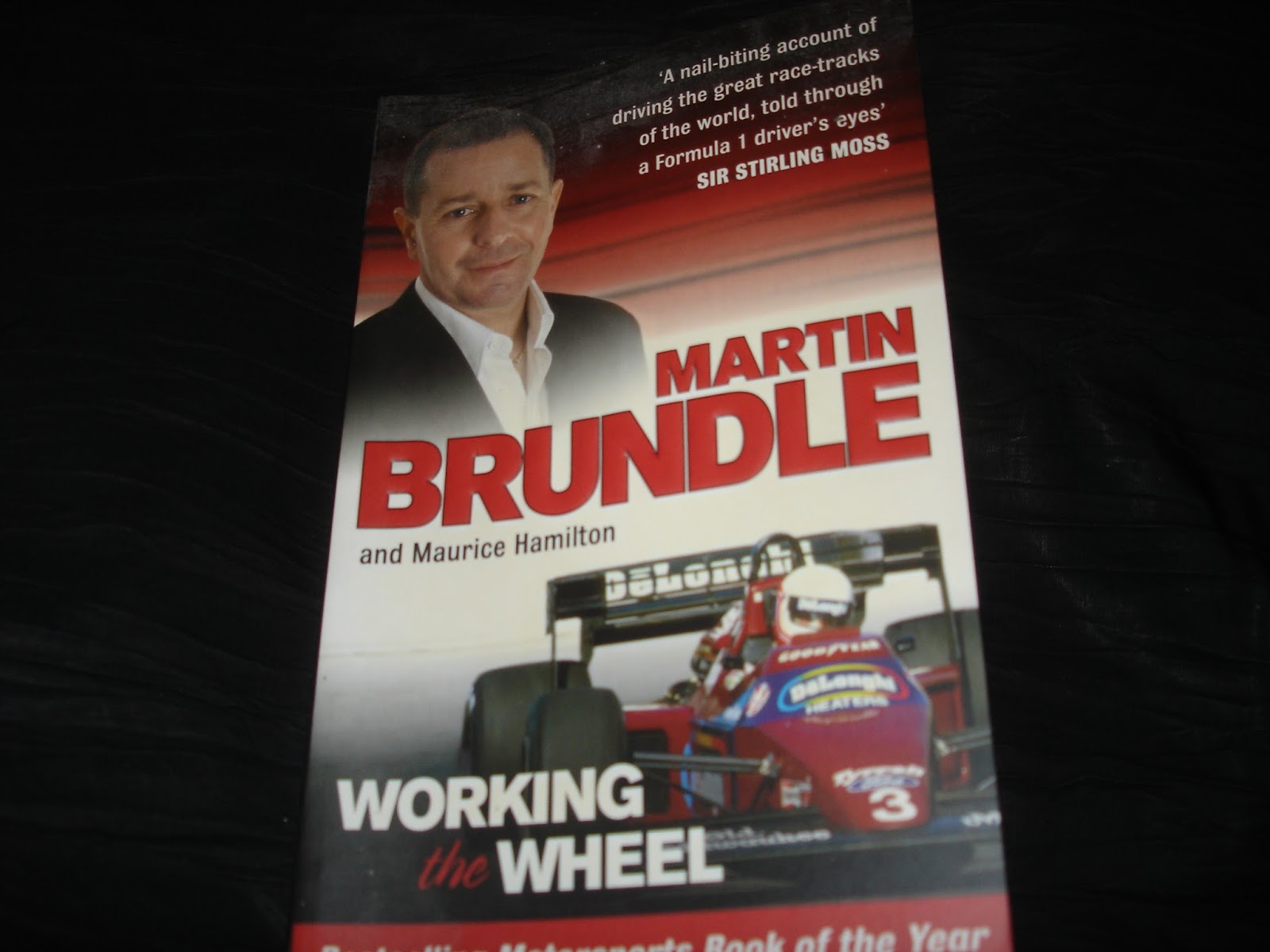
Working The Wheel - Martin Brundle and Maurice Hamilton - book review

Another item in my library of motorsport books is "Working The Wheel", by Martin Brundle and Maurice Hamilton, first published in 2004. This is a series of recollections and analyses of Formula 1 circuits and venues, based on the words of the former Grand Prix driver and Sportscar World Champion.


The text I think reflects Brundle's feisty but honest, no-nonsense racing persona. His views on some circuits are intriguing and hardly stereotypical, but his reasoning usually appears sound. He welcomes changes made to some tracks, which in other quarters have been decried.  He prefers a tricky or convoluted section of track to replace a flat-out section which represents little in the way of challenge to the driver, and with dangers ever-present.

A very practical and pragmatic philosophy emerges, although at the same time Martin underlines his respect for the traditions of motor racing and also his sense of history. He, for example, clearly relishes the atmosphere at places such as Monza.

"Working The Wheel" is liberally peppered with anecdotes from Brundle's time as a racing driver, many of these stories related to contentious or murky episodes, and doubtless made easier to recount by the passage of time.  It is fascinating to hear his own personal perspective on some epochal incidents and iconic personalities, and his own, sometimes peripheral role in how things unfolded.

There is lots of "local colour", and vivid memories of the individual flavour and atmosphere of the circuits and their environs. Some might think that a disproportionate amount of space is given over to amusing (and occasionally hair-raising) stories about Brundle's travels to and from circuits, but these add to the entertainment value, and also help to provide an insight into the pressures and the existence.

Some of Martin's observations remind us of his own narrow escapes from disaster, and his hard-luck stories, and also of incidents which have either been forgotten, or did not receive much coverage at the time when they happened. Minor triumphs and tragedies which combine to form a rich tapestry, and a window on the personal battles and "little victories" which constitute such a part of the racer's experience.  I was also delighted that he included chapters about Le Mans, as well as a few "defunct" F1 venues, such as Detroit and Adelaide.

In general, the Formula 1 circus comes across as an intoxicating place, and the enthusiasm of the author(s) shines from every page. That said, this tome does shine a light on the hardships which go along with the glory and the riches. I'm still envious of the lifestyle, though.

"Working The Wheel" is a rattling good read.  Some readers might prefer to scan over the more technical passages detailing braking points, racing lines, gear changes and so forth, but the contents are by and large candid, highly entertaining and in places enlightening.


Saturday, 14 January 2017

Jim Clark - Tribute to A Champion - Eric Dymock

Jim Clark is possibly the most gifted racing driver ever to emerge from British shores, yet his public profile was never as high as several of his contemporaries or near-contemporaries. Graham Hill was a charismatic extrovert who enjoyed the limelight and public affection, whilst Stirling Moss and Jackie Stewart survived their racing careers to achieve a high media profile in the ensuing decades.


Clark's comparatively low level of recognition with the general public may be put down to his reserve and reticence, and these and other elements of his make-up are examined in Eric Dymock's book, first published in 1997. The common perceptions about him may have clouded a more complicated and nebulous picture. The book devotes much space to assessing Clark's character traits and psyche, in addition to his feats on the racetrack.

Much emphasis is placed on his upbringing in the Scottish Borders farming community, as well as his education, and all this provides a more rounded portrait of the man than is often projected by superficial and condensed television documentaries and internet "screenbites".  This once again reinforces my conviction that if you want to acquire a nuanced understanding of a subject, don't rely purely on "audio-visual" media;read books, too.

Dymock's book has a quirky flavour and structure to it which I found quite appealing, eschewing a dry chronological story, and occasionally going off on tangents to explore sub-texts. Don't expect an exhaustive documentation of race results and chassis numbers. There is some input from people who knew Clark well, and their observations merely serve to strengthen the enigma. 

What emerged for me was a sometimes melancholy tale, not a smooth and seamless fairytale. The contradictions inherent in motor racing come through;people were entranced by aspects of the sport, but also had to reconcile themselves to its more unsavoury realities, especially the dangers and risks. Also, the true nature of the sport in the Sixties was perhaps not as idyllic and wholesome as is sometimes made out.  Some of that era's most revered exponents were not as perfect and heroic as some might like to hope, and Dymock does not flinch from highlighting some of the flaws. 

An illuminating and intriguing read...


Wednesday, 4 January 2017

McLaren Memories - A Biography of Bruce McLaren - Eoin Young

This book had been nestling on my shelves, but had been awaiting my full attention. I am glad that I gave it a read. Biographies are always more satisfying, and linger longer in the memory, if the reader comes away with a significantly greater appreciation for the subject than beforehand. This was the case for me with this book about the life of the New Zealand racing driver Bruce McLaren.


The book is based on the recollections of the author, a long-time friend and associate of Bruce, but equally importantly it draws heavily on the driver's own words and writings. There is no in-depth analysis of his character, although indications of his innermost feelings and concerns emerge in the various quotes and reminiscences.

There is some valuable material about his childhood, and struggles against adversity, and those first steps to immersion in the spheres of engineering and racing. Insight is also gained concerning the burgeoning of his ambitions, once he arrived in Europe.

To me, the middle sections of the book were the most illuminating and enthralling, evoking as they did the atmosphere and flavour of racing in the late Fifties and Sixties. McLaren's laconic and dry humour is a delight. The schedule which the drivers and teams of those days coped with is, looking back, extraordinary, and one gains a sense of the improvisation which was vital, in organisation and logistics. The haphazard, frenetic and breathless state of things seemed also part of the fun and the stimulation.

Overall, McLaren Memories greatly augmented my knowledge and understanding of the man's achievements and abilities.  It is not a massively penetrating examination or appraisal of its subject's psyche and motivations, but it is an entertaining and endearing portrait of a popular and successful figure, who had a short but eventful life.

Saturday, 31 December 2016

Le Mans (1971) - movie review

Some time ago, I wrote a blog post about Le Mans, the 1971 movie set around the famous 24-hour race in France, starring Steve McQueen.  Recently I dug out the DVD again to renew acquaintance with the film, and thought that I would share some of my observations.


It is probably fair to say that opinion on this movie has been mixed down the years. Many have pointed to the excellent racing scenes, but poured scorn on the plot and other aspects of the story. Personally I really like Le Mans, but it almost feels more like a documentary in places, and I can readily appreciate how many "laypeople" will find it pedestrian, dull even. Many things are underplayed, which is admirable from an artistic and authenticity standpoint, but people have perhaps become conditioned to expect a racing movie to be over-the-top and hysterical in tone.

The visuals are lovely, the sound impressive and Michel Legrand's music classy and atmospheric. These all help the film to capture the essence of the event and the times. The plot is hardly imaginative, but I feel that it is handled with restraint, by the standards of racing movies anyway. There is less melodrama, or pandering to the base instincts of the audience. Many of the sub-texts are implied rather than outlined explicitly, especially the emotional and "romantic" elements.

The realism of the racing sequences is difficult to dispute, as the footage was shot with real racing cars and drivers, much of it at the time of the 1970 Le Mans race. However, this does make some of the pitlane scenes seem a little "artificial" by comparison, if not excessively so. Another noticeable trait of the picture is the sparsity of the dialogue.  The narrative and the exposition are driven largely by the visuals and the words of the circuit commentators.

A thing which stands out for me in the film is ambiguity in the characters and their attitudes. The awkwardness of Michael Delaney, for example (well suited to McQueen's "underacting" here), an inscrutability which reminds me slightly of Pete Aron in John Frankenheimer's Grand Prix.  Not really cast in the comic-book image of racing drivers, who are not "meant" to be taciturn or reticent.

Of course the story and the characters are fictional, but I don't really blame the film-makers for distilling it down to "Porsche v Ferrari".  The "heartbeat" sequence before the start of the race strikes us now as hackneyed and even corny, but I guess that it may have been innovative and affecting in the early Seventies. The two main crash sequences are well done, evoking the violence and the energy involved.  The slow-motion reply of Delaney's accident has I think become quite iconic in its way.

Apart from McQueen, the cars are the stars, and few of the supporting actors make much of an impression. Ronald Leigh-Hunt is likeable though as the Gulf-Porsche team manager;authoritative but occasionally avuncular. Elga Andersen also has great screen presence as the racer's widow - those eyes!

In its tone and general aesthetic, Le Mans feels more like European art cinema than Hollywood.  We have the obligatory thrilling climax, but even here things are somewhat inconclusive, in keeping with the generally reflective and sober tenor of the movie.

I still think that, for all its faults, Le Mans is a fine document. Technically very good, and the fact that a mainstream audience would assert that as a movie it "happens" only fitfully frankly elevates it in my estimation.

Thursday, 22 December 2016

Racers Apart - David Tremayne

Continuing my journey through some half-forgotten items in my motorsport-related library, I recently re-read Racers Apart, by David Tremayne, a little gem of a book which was first published back in 1991.

Essentially, Racers Apart is a series of portraits of, or articles about, selected motorsport figures. The author includes some figures from the world of land and water speed records, an area of special interest for him. As well as Tremayne's own thoughts, there are observations by colleagues and friends of the subjects.


The choice of people portrayed might seem almost random, but in fact it is just diverse, and the competitors examined are chosen mostly for their human qualities or their influence on the direction of the sport. Some of those featured are personal favourites of the author, such as Pedro Rodriguez, Tom Pryce,Roger Williamson and Gilles Villeneuve. This latter factor I feel induces a greater conviction, passion and authority in the writing.

It is by and large quite balanced and honest stuff, not ignoring the negatives and the frailties.  The interviews with subjects are quite penetrating, managing to extract some candid recollections and analysis. These are not bland portraits.

One thing which also stood out for me during this recent reading was the author's vehemence in lamenting some aspects of modern motor sport. It is sobering to think how, even twenty five years ago, contemporary journalists perceived the sport to be so shallow and soulless at the top level. The book's general tenor is to celebrate those who, in their approach and temperament, bucked those ever-encroaching trends.

Overall, this book seems to come more from the enthusiast than the scholar, and in places seems genuinely heartfelt. Like with much of the best motor sport writing, the human dimension transcends the nuts and bolts and the technology. Those who left a scant impression in the record books are placed alongside the legends and superstars - David Purley sits very comfortably in company with Ayrton Senna and Jackie Stewart.


Tuesday, 13 December 2016

James Hunt - The Biography - Gerald Donaldson

Many biographies of sportspeople are entertaining, informative or provocative, but few manage to stir the emotions.  One work which evokes the latter feelings is Gerald Donaldson's biography of the former Formula 1 world champion James Hunt, first published in 1994.


This is a comprehensive, vibrant but measured account of a remarkable life, and it is amusing, evocative and in places highly poignant.

I think where Donaldson's work scores especially highly is in its efforts to analyse what made this complex man tick, and how this was conditioned by his upbringing.  The factors which influenced James' singular approach to life are frankly impossible to pin down definitively, but here there is much fascinating and insightful speculation, much of it based on the opinions of the subject's friends and associates. He was often portrayed as a caricature, but such assessments grossly over-simplified the true picture.

The biography also delves into what motivated James during his racing career, and how those who worked with him sought to extract the best performance from him. These passages, putting the racing driver's psysche under the microscope, are part of what lifts this tome out of the ordinary, and one gains some idea of how extraneous "personal" matters affected results on the track, and vice-versa.

It has been asserted by many people that this is above all an honest, "warts and all" biography, and I am fully in accord with that judgement. For example, there is a look at how his personality was perceived to have changed after he became World Champion, and also how he tackled the demons which often plagued him following his retirement.

In a broader sense, the story of James Hunt is also evocative of an era in racing, and an epoch in social and cultural history.  A central theme is also how he was one of the first British sportspeople to be covered in a "sensationalist" way by the popular press. It is a salutary glimpse at the effects, and pitfalls, of fame, fortune and media attention.

The chapters which address his post-retirement endeavours and tribulations are, if anything, even more absorbing than those detailing his racing exploits. The chronicles of his later years are intensely moving in places.  The fully rounded picture is presented, in keeping with the compact, economical but authoritative tone of the book as a whole.

A picture emerges of a remarkable character. Flawed, like all of us, but possessing intelligence, drive and charm. I think that the popular fascination with James Hunt grows with time, because whilst seeming on the face of it a throwback, there were some contradictions which rendered him thoroughly modern. As I think the author implies, it is facile to speak in terms of a "split personality". The real essence of James Hunt remains elusive and impenetrable, but attempts to capture that essence are hugely enjoyable and stimulating.