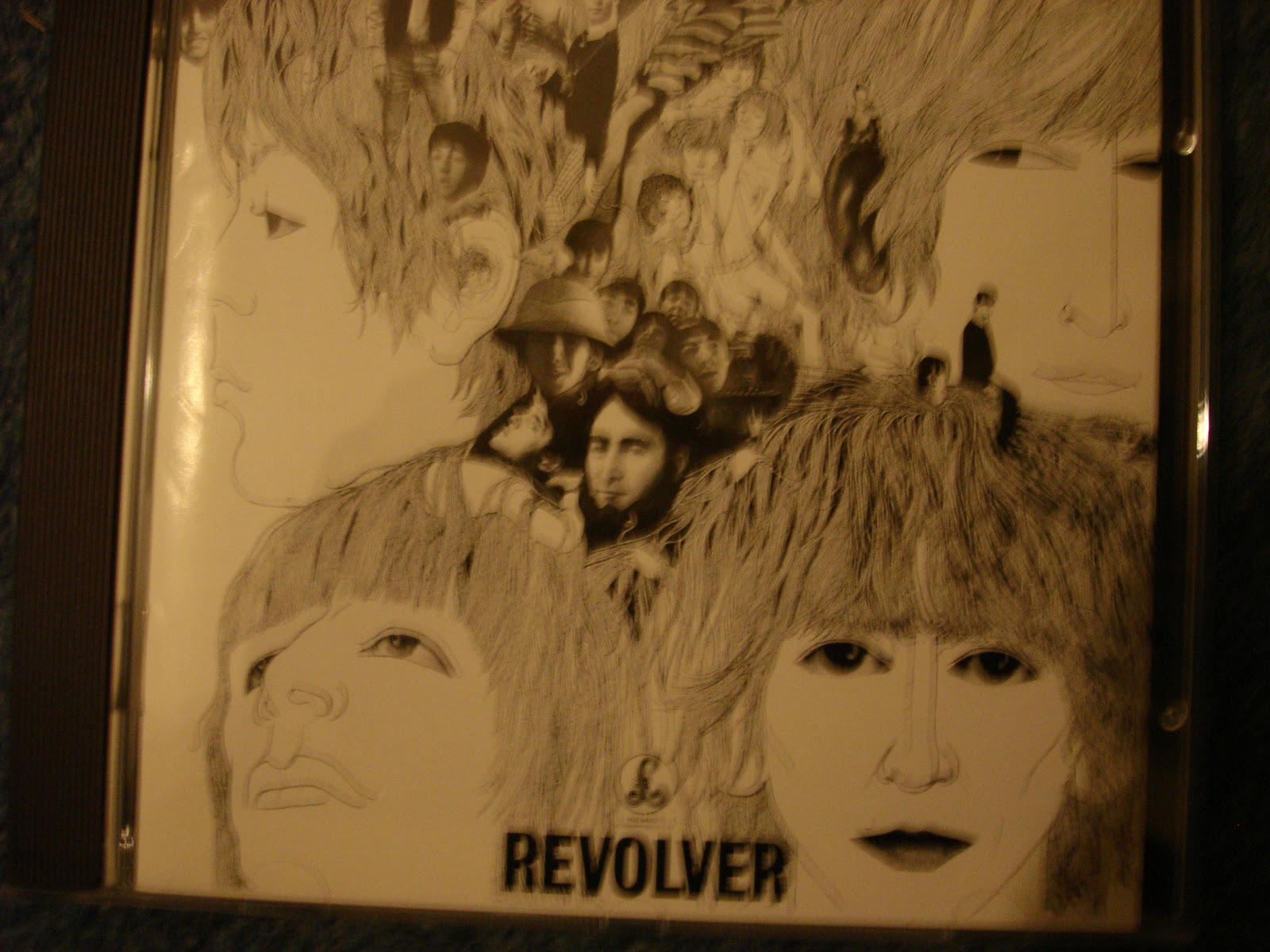
With The Beatles, the sophomore album by the Liverpudlian beat combo, was seen as a step up in polish and sophistication, if lacking some of the infectious naivete and spontaneity of the first record.
It has been observed that more time and care was taken over this one, as evidenced by the arty (and much imitated and parodied) cover design. The darker, less frivolous ambience does reflect a maturing of sorts, but in purely musical terms the progression is perhaps only slightly discernible to the untrained ear.
As on the debut, they start off proceedings with a strong album-only track, although "It Won't Be Long" emerges as a fairly mediocre song upon closer inspection. It is made memorable and impactful by the taut and urgent way in which it is put together, with fine vocal interplay and meaty guitar parts. Lots of action packed into just over two minutes, with little time to draw breath.
A trend which emerges for me is how much more measured and in control the band is on this record. Quiet confidence and a less frenetic flavour. John Lennon excels vocally throughout, and songs such as "All My Loving" exhibit a growth in musical finesse and savvy. As has been frequently pointed out, it seems remarkable that compositions of this quality could be consigned to being "mere" album tracks.
It is worth acknowledging at this juncture that the record is not uniformly strong. There is some filler, such as "Don't Bother Me" and "Little Child", but the running order is cleverly arranged and paced so as to make the album seem slightly stronger than it really is. Versatility is much on display, with the boys having excursions into something approaching Tin Pin Alley ("Till There Was You").
As on several of the Beatles' early albums, we are served up a mixture of original numbers and cover versions. The covers are of variable quality here, it should be stressed. The rendition of "Please Mr. Postman" is a wonder of control and vibrancy, both Lennon, on lead, and McCartney and Harrison, on harmonies/backing vocals, starring. Their interpretation of "Money (That's What I Want)", packs a considerable punch, if less immediately likeable than some of their other covers.
The version of "Roll Over Beethoven" feels rather perfunctory and uninspired, but one wonders how different it might have turned out had McCartney or Lennon taken the lead vocal. "You've Really Got a Hold On Me" is interpreted with great acuity and restraint, once again the voices blend and intertwine beautifully. The group seemed especially suited to covering songs in this style or sub-genre.
For all its status as a song which became a Rolling Stones single, "I Wanna Be Your Man" is rather turgid, and helps complete the complement of filler. It is not surprising that the lads felt no qualms about "giving away" this song to their nearest British competitors.
"Devil In Her Heart" is minor but enjoyable, with some pleasing harmonies and chord changes. The Beatles in their element in many ways. "Not A Second Time" is a fascinating and mildly "experimental" creation which is often forgotten, but it exudes in a quiet way some of those qualities which would soon place The Beatles well beyond the reach of most of their contemporaries.
So to sum up, With The Beatles is an advance on its predecessor, even it it less enjoyable and exuberant in an immediate sense. The musicians sound less anxious to please, having surmounted some of the pressing obstacles on the first record. The signs of their more folk-rock-orientated and acoustic phase, which was only months in the future, are not really there, but this only underscores the feverish and dynamic nature of the Sixties and the Beatles' artistic development.
Showing posts with label paul mccartney. Show all posts
Friday, 13 April 2018
Friday, 18 December 2015
Beatles Thoughts
A couple of days ago I spent an invigorating couple of hours listening to the music of The Beatles, shuffling from album to album. Immersing myself in this music is always a life-affirming and uplifting experience, but a few things occurred to me, mostly concerning the nature of the songs written by Paul McCartney and John Lennon.
The songs were credited to "Lennon-McCartney", but many of them were primarily individual efforts, written in full by one songwriter or the other. Some opinion-formers have tended to pigeon-hole the two men, asserting that John Lennon wrote the edgy and perceptive stuff while categorizing McCartney's songs as more shallow and superficial. I never subscribed to this assessment, and closer inspection of the Beatles canon supports my view.
It was around 1964 that the songs started to become more "mature" and profound, but it was not always the frequently cited "contemporary" influences which had a direct affect on the subject matter in the songs. One interesting thread is what I call Paul McCartney's "kitchen sink" songs, such as "Eleanor Rigby", "She's Leaving Home" and "Lady Madonna". In those tracks everyday concerns are explored, but these are ones which the English in particular find awkward to discuss openly. Middle-aged loneliness, rather than youthful heartache. The generation gap between parents and offspring. The struggles of single mothers.
McCartney was often accused of being excessively sentimental in his post-Beatles career. In the Fab Four, however, balancing factors were at work, and they helped imbue some of his songs with real authenticity, realism and focus. Of course, these balancing factors worked both ways, and this mechanism and its consequences were part of the magic of the group. One musician's presence or influence placed a check on the perceived "excesses" or flights of fancy of the other. And of course when there was genuine collaboration, the results were often spectacular, as witnessed on "We Can Work It Out" and "A Day In The Life", for instance.
The personal and creative dynamics operating within the Beatles contributed significantly to a highly developed and acute feel for quality control, as if they possessed some kind of sixth sense which helped them to determine what worked, and what didn't work. Considering the volume of material which they released in a relatively short period of time, and how experimental and innovative they were, there were very few lapses in taste. People have offered quasi-mystical explanations for this sensitivity and chemistry, but I prefer to believe that it was just a happy combination of circumstances, personnel and psychology. These elements help to explain why The Beatles always appeared "relevant", seeming to be in tune with their audience, and with the times, without having to try too hard.
Incidences of this "sixth sense" can be found in the sentiments expressed by McCartney in songs such as "Yesterday", which is more often acclaimed purely for its melodic and musical strengths. "For No One", from Revolver, is in the same vein. And of course "Hey Jude" exhibited that habit of harnessing and articulating universal feelings practically, simply and memorably without appearing mawkish.
Was John Lennon's approach more intuitive, instinctive and mercurial? A lot, but not all, of his stuff was introspective, existential or abstract, perhaps reflecting his innate personality and his background or upbringing, just as McCartney's temperament may go some way to explaining the character and backdrop of his own songs.
I find myself having these reflective moments whenever I go back to listening to Beatles records intensively. This is another thing which makes them so special and unique, setting them apart from those bands which, while possessing abundant technical and virtuoso proficiency, could never match The Beatles for humanistic depth and that ability to touch the soul.
The songs were credited to "Lennon-McCartney", but many of them were primarily individual efforts, written in full by one songwriter or the other. Some opinion-formers have tended to pigeon-hole the two men, asserting that John Lennon wrote the edgy and perceptive stuff while categorizing McCartney's songs as more shallow and superficial. I never subscribed to this assessment, and closer inspection of the Beatles canon supports my view.
It was around 1964 that the songs started to become more "mature" and profound, but it was not always the frequently cited "contemporary" influences which had a direct affect on the subject matter in the songs. One interesting thread is what I call Paul McCartney's "kitchen sink" songs, such as "Eleanor Rigby", "She's Leaving Home" and "Lady Madonna". In those tracks everyday concerns are explored, but these are ones which the English in particular find awkward to discuss openly. Middle-aged loneliness, rather than youthful heartache. The generation gap between parents and offspring. The struggles of single mothers.
McCartney was often accused of being excessively sentimental in his post-Beatles career. In the Fab Four, however, balancing factors were at work, and they helped imbue some of his songs with real authenticity, realism and focus. Of course, these balancing factors worked both ways, and this mechanism and its consequences were part of the magic of the group. One musician's presence or influence placed a check on the perceived "excesses" or flights of fancy of the other. And of course when there was genuine collaboration, the results were often spectacular, as witnessed on "We Can Work It Out" and "A Day In The Life", for instance.
The personal and creative dynamics operating within the Beatles contributed significantly to a highly developed and acute feel for quality control, as if they possessed some kind of sixth sense which helped them to determine what worked, and what didn't work. Considering the volume of material which they released in a relatively short period of time, and how experimental and innovative they were, there were very few lapses in taste. People have offered quasi-mystical explanations for this sensitivity and chemistry, but I prefer to believe that it was just a happy combination of circumstances, personnel and psychology. These elements help to explain why The Beatles always appeared "relevant", seeming to be in tune with their audience, and with the times, without having to try too hard.
Incidences of this "sixth sense" can be found in the sentiments expressed by McCartney in songs such as "Yesterday", which is more often acclaimed purely for its melodic and musical strengths. "For No One", from Revolver, is in the same vein. And of course "Hey Jude" exhibited that habit of harnessing and articulating universal feelings practically, simply and memorably without appearing mawkish.
Was John Lennon's approach more intuitive, instinctive and mercurial? A lot, but not all, of his stuff was introspective, existential or abstract, perhaps reflecting his innate personality and his background or upbringing, just as McCartney's temperament may go some way to explaining the character and backdrop of his own songs.
I find myself having these reflective moments whenever I go back to listening to Beatles records intensively. This is another thing which makes them so special and unique, setting them apart from those bands which, while possessing abundant technical and virtuoso proficiency, could never match The Beatles for humanistic depth and that ability to touch the soul.
Wednesday, 21 October 2015
A Hard Day's Night - The Beatles - film review
A Hard Day's Night, released in 1964, was the Beatles' first movie, and by common consent their best.
The reasons why this picture succeeds where other Beatles celluloid efforts didn't are quite simple. They didn't try too hard, the plot was kept simple, and minds were not cluttered by grandiose visions or pretensions. The film is clothed in an "arty" veneer, largely due to the fact that it was made in crisp, evocative black and white. The pace is fast and breezy, brimming with the self-confidence of its time. And of course the music is wonderful!
The movie revolves around a journey made by the Fab Four to appear on a television show, and the associated activities of Paul's "grandfather", played by Wilfrid Brambell. In amongst all this there are musical set-pieces.
The opening title sequences set the tone with their slick editing, preparing us for the impending "journey". The scenes on the train are some of the best remembered, including the encounter with the man in the bowler hat (played by Richard Vernon). Here one of the main themes of the film is seen, namely the lads coming into contact with people and situations outside their normal milieu, and their cheeky irreverence with regard to authority figures and social class. The Beatles' humour helps to smooth the edges.
Of the Fab Four, Ringo Starr arguably displayed the greatest aptitude for acting and the comedic requirements of the film. John Lennon's wit and impishness carried him through. A few people have made disparaging remarks about Paul McCartney's acting here, but I don't think he fares too badly. Describing the band as "the new Marx Brothers" and Ringo as "the new Charlie Chaplin" was hyperbole, but there is no doubt that they exhibited a naturalness on screen, in this movie at least, and this contributed to an air of informality which is most endearing.
There is some attempt to depict the Beatles' routine, including their hectic schedule and the demands of the fans and fame. Occasionally this feels artificial, but generally their charm wins the day. The "non-acting" segments are more convincing, almost having a documentary-like flavour. The implication of some scenes I think is that the Beatles were isolated and suffocated by their fame, whilst others are having enormous fun on their coat-tails.
The various small "sketches" and vignettes help to give A Hard Day's Night a distinctive quality. The "shaving" scene involving George Harrison and John Junkin, with John Lennon clowning around in the bath, springs to mind. Odd surreal touches like these lift the picture out of the ordinary, and hold the interest.
The "Ringo on the run" scenes have been justly acclaimed, both for the acting and the cinematography. Was the moral here that "normal life" is just as lonely and complex as life in the spotlight of millions? All existence has its disappointments, its downsides and its dark sides.
Some of the social commentary is quite subtle, most notably when the guys meet "media types", who represent a transitional stage between the old school of the fifties and the Swinging Sixties generation. The film gently pokes fun at some of the cliches and absurdities of the showbusiness crowd
Brambell, Junkin and others add a solidity and a substance to the acting. Victor Spinetti delivers a nice comedic stint as the morose director/producer at the television studios. Spinetti's "hairy" sweater is also the sartorial high point of the film!
Although the story drifts a fraction towards the end, this is still a charming document of a period in time, as well as fine entertainment.
The reasons why this picture succeeds where other Beatles celluloid efforts didn't are quite simple. They didn't try too hard, the plot was kept simple, and minds were not cluttered by grandiose visions or pretensions. The film is clothed in an "arty" veneer, largely due to the fact that it was made in crisp, evocative black and white. The pace is fast and breezy, brimming with the self-confidence of its time. And of course the music is wonderful!
The movie revolves around a journey made by the Fab Four to appear on a television show, and the associated activities of Paul's "grandfather", played by Wilfrid Brambell. In amongst all this there are musical set-pieces.
The opening title sequences set the tone with their slick editing, preparing us for the impending "journey". The scenes on the train are some of the best remembered, including the encounter with the man in the bowler hat (played by Richard Vernon). Here one of the main themes of the film is seen, namely the lads coming into contact with people and situations outside their normal milieu, and their cheeky irreverence with regard to authority figures and social class. The Beatles' humour helps to smooth the edges.
Of the Fab Four, Ringo Starr arguably displayed the greatest aptitude for acting and the comedic requirements of the film. John Lennon's wit and impishness carried him through. A few people have made disparaging remarks about Paul McCartney's acting here, but I don't think he fares too badly. Describing the band as "the new Marx Brothers" and Ringo as "the new Charlie Chaplin" was hyperbole, but there is no doubt that they exhibited a naturalness on screen, in this movie at least, and this contributed to an air of informality which is most endearing.
There is some attempt to depict the Beatles' routine, including their hectic schedule and the demands of the fans and fame. Occasionally this feels artificial, but generally their charm wins the day. The "non-acting" segments are more convincing, almost having a documentary-like flavour. The implication of some scenes I think is that the Beatles were isolated and suffocated by their fame, whilst others are having enormous fun on their coat-tails.
The various small "sketches" and vignettes help to give A Hard Day's Night a distinctive quality. The "shaving" scene involving George Harrison and John Junkin, with John Lennon clowning around in the bath, springs to mind. Odd surreal touches like these lift the picture out of the ordinary, and hold the interest.
The "Ringo on the run" scenes have been justly acclaimed, both for the acting and the cinematography. Was the moral here that "normal life" is just as lonely and complex as life in the spotlight of millions? All existence has its disappointments, its downsides and its dark sides.
Some of the social commentary is quite subtle, most notably when the guys meet "media types", who represent a transitional stage between the old school of the fifties and the Swinging Sixties generation. The film gently pokes fun at some of the cliches and absurdities of the showbusiness crowd
Brambell, Junkin and others add a solidity and a substance to the acting. Victor Spinetti delivers a nice comedic stint as the morose director/producer at the television studios. Spinetti's "hairy" sweater is also the sartorial high point of the film!
Although the story drifts a fraction towards the end, this is still a charming document of a period in time, as well as fine entertainment.
Friday, 11 September 2015
The Beatles' Magical Mystery Tour Movie - review
Derided by some, misunderstood by many, the Beatles' "Magical Mystery Tour" film, released in 1967, remains one of the most hotly debated episodes in their career. I recently watched the movie again to see if the picture would become any clearer in my mind.
In a few places I have seen it described as the prototype for the road movie. I'm not totally convinced by this assertion;surely there were lots of road movies before 1967? It is certainly a road movie of a kind, with a strong current of English humour running through it, and of course suffused with the psychedelic aesthetic of its time.
The core of the narrative is a charabanc trip, something of a British institution, at least back then. I don't feel that The Beatles were belittling traditions such as this. In view of their own backgrounds, they may even have been seeking to romanticize such things, with a bit of mild satire added.
For me they were poking fun more generally at contemporary straight society and its absurdities, as well as some more pernicious aspects of British life which had become archaic in the context of the Swinging Sixties and its attendant social change. Some of the symbolism is there in the film, although sometimes half-buried in the dialogue or the behaviour of the minor characters. "A Hard Day's Night", the group's first movie, explored similar territory in a more conventional, less cryptic, way. This being The Beatles, it was all done in a gentle, impish manner which the Establishment would not find unduly threatening.
Much of the critical disdain aimed at "Magical Mystery Tour" back in 1967/68 stemmed from its perceived amateurishness, and its alleged pretentiousness. As I think Paul McCartney has pointed out, they didn't set out to produce a glossy mainstream film, but instead it was intended to be quirky and off-the-wall.
The problem was that the media and the public would not "allow" The Beatles to come up with anything deemed to be even slightly self-indulgent. Surely though, by the middle of 1967 they had earned the right to be experimental? As for the charge of amateurishness, I am torn between a feeling that this was intentional, and therefore essential to an understanding of the movie and its ethos, and a nagging sense that they tried and failed to do something more polished. The former theory ultimately holds sway every time...
Allowing for the occasional raggedness, intentional or otherwise, there are some great visuals, such as those in the "Fool On The Hill" sequence, and the footage which accompanies "Flying". Several scenes stand out, such as the one in the restaurant, where John Lennon shovels food on to the woman's plate. Another favourite passage of mine is during "Blue Jay Way", where the four guys are filmed playing cellos in a large garden. For all the "arty" sections, though, I must admit that my favourite part is the drunken sing-song on the coach....
One thing which can be said for "Magical Mystery Tour" is that it is fast-moving. No scenes linger excessively, and the brevity and the diversity of settings are both assets. This of course is conditioned by the patchwork format of the film. The randomness and the chaos succeed in holding the attention.
Even if The Beatles had emphasized beforehand that this was an art-film, and an experimental venture, they would still probably have not escaped the critical barbs. However, one must also say that it is no better or worse than many similar films of that era, and it has the advantage of being less self-conscious than most, with a hint of traditional English self-mockery helping in this regard. It is a harmless period-piece, if not a masterpiece. And of course, the music is wonderful...
In a few places I have seen it described as the prototype for the road movie. I'm not totally convinced by this assertion;surely there were lots of road movies before 1967? It is certainly a road movie of a kind, with a strong current of English humour running through it, and of course suffused with the psychedelic aesthetic of its time.
The core of the narrative is a charabanc trip, something of a British institution, at least back then. I don't feel that The Beatles were belittling traditions such as this. In view of their own backgrounds, they may even have been seeking to romanticize such things, with a bit of mild satire added.
For me they were poking fun more generally at contemporary straight society and its absurdities, as well as some more pernicious aspects of British life which had become archaic in the context of the Swinging Sixties and its attendant social change. Some of the symbolism is there in the film, although sometimes half-buried in the dialogue or the behaviour of the minor characters. "A Hard Day's Night", the group's first movie, explored similar territory in a more conventional, less cryptic, way. This being The Beatles, it was all done in a gentle, impish manner which the Establishment would not find unduly threatening.
Much of the critical disdain aimed at "Magical Mystery Tour" back in 1967/68 stemmed from its perceived amateurishness, and its alleged pretentiousness. As I think Paul McCartney has pointed out, they didn't set out to produce a glossy mainstream film, but instead it was intended to be quirky and off-the-wall.
The problem was that the media and the public would not "allow" The Beatles to come up with anything deemed to be even slightly self-indulgent. Surely though, by the middle of 1967 they had earned the right to be experimental? As for the charge of amateurishness, I am torn between a feeling that this was intentional, and therefore essential to an understanding of the movie and its ethos, and a nagging sense that they tried and failed to do something more polished. The former theory ultimately holds sway every time...
Allowing for the occasional raggedness, intentional or otherwise, there are some great visuals, such as those in the "Fool On The Hill" sequence, and the footage which accompanies "Flying". Several scenes stand out, such as the one in the restaurant, where John Lennon shovels food on to the woman's plate. Another favourite passage of mine is during "Blue Jay Way", where the four guys are filmed playing cellos in a large garden. For all the "arty" sections, though, I must admit that my favourite part is the drunken sing-song on the coach....
One thing which can be said for "Magical Mystery Tour" is that it is fast-moving. No scenes linger excessively, and the brevity and the diversity of settings are both assets. This of course is conditioned by the patchwork format of the film. The randomness and the chaos succeed in holding the attention.
Even if The Beatles had emphasized beforehand that this was an art-film, and an experimental venture, they would still probably have not escaped the critical barbs. However, one must also say that it is no better or worse than many similar films of that era, and it has the advantage of being less self-conscious than most, with a hint of traditional English self-mockery helping in this regard. It is a harmless period-piece, if not a masterpiece. And of course, the music is wonderful...
Sunday, 8 February 2015
Please Please Me - The Beatles - album review
Perhaps "Please Please Me", released by The Beatles in 1963, is not the greatest debut album in rock history, but it is an endearing work which merits close inspection, even if it is difficult to be totally dispassionate when assessing it, because of the "Beatles" factor.
One of the most well-known things about the record is that most of the tracks were recorded in one day. A mixture of Lennon-McCartney originals and cover versions, it has a touching and infectious naivete. Even so, it is daunting to think that less than five years later these same musicians were writing and recording "Strawberry Fields Forever", "Penny Lane" and "A Day In The Life".
The running order is adroitly arranged to spread out the stronger performances, and it expertly conceals the weaker material. "I Saw Her Standing There" and "Twist And Shout" serve as formidable bookends, and help to make the record seem better than it actually is. I sometimes think to myself that the Beatles must have been playing better songs in the clubs than a few of those which ended up appearing on the album. Was the inclusion of some "safer" fare a sign of the band's eagerness, and that of their manager, to reach as wide and mainstream an audience as possible?
The material may be less interesting than that found, for instance, on the group's sophomore effort, but there is a real unity and cohesion here, doubtless stemming from the compressed nature of the recording session(s), and therefore having more to do with overall energy and atmosphere than musical styles as such. In some ways the strength of the individual numbers is less important than the overall effect. It is even arguable that when this LP was put together, Lennon and McCartney had not yet got fully into their stride as songwriters, separately or in terms of collaborative efforts. They only became truly prolific, in terms of quantity as well as quality, a little while later.
The opening track, "I Saw Her Standing There", still retains all of its freshness, joyousness and exuberance over fifty years after its appearance. It encapsulates that almost intangible magic which lifted The Beatles well above the nondescript, and fulfils this role much more potently than most of their later, supposedly more "mature" output. The main ingredients are the raw but likeable vocals of McCartney and Lennon, the semi-suggestive lyrics, and Ringo Starr's idiosyncratic drum fills. As a whole the song feels like a statement of intent, although probably not intended as such at the time.
In amongst the relative filler, there are some gems. The title track possesses many of the qualities of "I Saw Her Standing There", with the once again the contrasting voices of Lennon and McCartney blending to considerable effect.
Of course, "Twist and Shout" forms a rousing climax to the set, with John Lennon's searing vocal a consequence of the rigours of the legendary one-day recording session. The other members of the band perform admirably, in the knowledge that Lennon's voice might not have been able to withstand the strain of another take had any mistakes been committed.
"There's A Place" is often cited as a prototype of the more "grown up", confessional song writing which would become much in vogue in later years, but I think that its importance in this regard has been inflated, probably because this is The Beatles we are dealing with, and not some other group which disappeared into obscurity. Other artists were also beginning to dabble with the introspective around that time, anyway.
This record feels like a group effort, although George Harrison's contribution is perhaps more subdued, and less prominent, than the others. The competitive spirit, which might always have been there, did not emerge until the band had really broken big. Did the need to make that initial breakthrough breed solidarity and humility in the ranks, or at least ensure that those things were suppressed?
So in all honesty not one of the truly great debut albums, but immensely enjoyable on its own terms and as a period piece.
The opening track, "I Saw Her Standing There", still retains all of its freshness, joyousness and exuberance over fifty years after its appearance. It encapsulates that almost intangible magic which lifted The Beatles well above the nondescript, and fulfils this role much more potently than most of their later, supposedly more "mature" output. The main ingredients are the raw but likeable vocals of McCartney and Lennon, the semi-suggestive lyrics, and Ringo Starr's idiosyncratic drum fills. As a whole the song feels like a statement of intent, although probably not intended as such at the time.
In amongst the relative filler, there are some gems. The title track possesses many of the qualities of "I Saw Her Standing There", with the once again the contrasting voices of Lennon and McCartney blending to considerable effect.
Of course, "Twist and Shout" forms a rousing climax to the set, with John Lennon's searing vocal a consequence of the rigours of the legendary one-day recording session. The other members of the band perform admirably, in the knowledge that Lennon's voice might not have been able to withstand the strain of another take had any mistakes been committed.
"There's A Place" is often cited as a prototype of the more "grown up", confessional song writing which would become much in vogue in later years, but I think that its importance in this regard has been inflated, probably because this is The Beatles we are dealing with, and not some other group which disappeared into obscurity. Other artists were also beginning to dabble with the introspective around that time, anyway.
This record feels like a group effort, although George Harrison's contribution is perhaps more subdued, and less prominent, than the others. The competitive spirit, which might always have been there, did not emerge until the band had really broken big. Did the need to make that initial breakthrough breed solidarity and humility in the ranks, or at least ensure that those things were suppressed?
So in all honesty not one of the truly great debut albums, but immensely enjoyable on its own terms and as a period piece.
Tuesday, 6 January 2015
Rubber Soul - The Beatles - album review
For a long time, it was blithely stated that "Sgt. Pepper's Lonely Hearts Club Band" was the greatest Beatles album. However, reason eventually prevailed, and that particular accolade was transferred to "Revolver". It was then predicted that the consensus of critical opinion would move backwards in time again, to identify 1965's "Rubber Soul" as their finest record. That process, correctly in my opinion, has never quite materialised, but "Rubber Soul" remains an important album for several reasons.
John Lennon I think once said that this was where the contemporary influences (by which I presume he meant Bob Dylan, folk-rock and 60s soul) started profoundly affecting the Beatles' work. These influences were arguably manifesting themselves earlier, but on "Rubber Soul" they have been subsumed maturely and naturally into the framework of the group's overall sound and dynamic.
This is certainly a more "mature" record than "Help!". The latter indisputably contains some great songs (the title track, "Ticket To Ride", "Yesterday", "You've Got To Hide Your Love Away"), but much of the rest is shallow by the Beatles' standards. Of course, certain non-musical "lifestyle" factors had been at work since 1964, and it could be that on "Rubber Soul" the band had finally worked out how to best channel and harness these to generate creative energy and focus.
It almost goes without saying that the lyrical content was growing more experimental and varied. By late 1965 even the "love songs" display an enhanced worldliness and sophistication. It would take further spiritual awakenings and the introduction of other stimuli, before the full flowering of the "Revolver" period would emerge. That said, The Beatles were already exhibiting that uncanny tendency to be in tune with the way in which the socio-cultural wind was blowing, without being seen to "force the issue". Songs such as "The Word" are evidence of this.
There was also a sense that this album marked the next phase of the group's evolution, Beatlemania as such having reached its zenith on the preceding American tour. On "Rubber Soul", The Beatles exude the confidence of people who have begun to master the studio, whereas on the previous records they sound as though they are still chasing something. Psychologically, they are already entering the post-touring mentality and ethos, beginning to expand their horizons and explore new territory.
I'm not sure whether this album has historically been perceived as a "Lennon" album. The songs which have lingered longest in the popular consciousness ("Norwegian Wood", "Nowhere Man", "In My Life"), were his creations. On the other hand, Paul McCartney's presence looms large, not just in his songwriting contributions, but also in his vocal and instrumental versatility and ebullience, which always enriched and enlivened the other members' songs. To me, it genuinely feels like a collective effort, as indeed would "Revolver".
There is still some filler here, but it is superior filler, and by and large it does not tarnish the overall impression of a strong album. If anything this is despite rather than because of the running order; the record does rather tail off, with weaker material predominating towards the close.
This is probably my fourth favourite Beatles LP. "Abbey Road" is glorious pop/rock with added poignancy, "The White Album" is a sprawling and engagingly chaotic document of its times, and "Revolver" is an effervescent case of the Swinging Sixties merging into the counter-culture and psychedelia. "Rubber Soul" cannot claim that kind of cogency, but it is nevertheless a satisfying listening experience.
Thursday, 18 September 2014
Sgt. Pepper's Lonely Hearts Club Band - The Beatles - album review
When the recorded output of the Beatles is discussed, the 1967 album "Sgt. Pepper's Lonely Hearts Club Band" is a touchy subject. Some rather lazily proclaim it as "the greatest album of all time", while others seek to distract attention from its (minor) shortcomings by emphasizing the record's cultural and social impact and importance.
I first heard "Sgt. Pepper" in its entirety about 25-30 years ago, when a member of my family purchased the vinyl version. I was somewhat underwhelmed, although admittedly my musical palate was woefully under-developed at that stage, and I had yet to appreciate the greatness of the Beatles in general. To my ears, it all seemed a little lacking in drama and "punch". In those days, anything which did not feature blazing guitar riffs and power chords I treated with a touch of disdain.
I re-appraised the album again in the mid-1990s, when the whole "Anthology" project re-ignited my interest in the Fab Four, and I explored their entire back catalogue. My assessment was more nuanced, and my by then more discerning ears were more receptive, but it still did not live up to the "the hype". In fairness, by that stage "the hype" was being counter-balanced by the surfeit of Beatles scholarship available, much of which placed "Sgt. Pepper" in its proper place, and tended to champion "Revolver" and "Rubber Soul" instead. One is tempted to wonder whether that line of thinking itself has now become tired and dated. Personally, these days I prefer "The White Album" and "Abbey Road", but that's another story!
One thing I would say is that "Sgt. Pepper" cleverly "tricks" people into thinking that it is better and more substantial than it really is. This is partially due to the lavish packaging, the "aura" of a concept and the astute sequencing of the tracks.
John Lennon was later dismissive of the notion that this was a concept album, pointing out that his own contributions were "autonomous" songs, not intended to nourish or realize any greater goal. Ringo Starr I think was nearer the mark in one of the "Anthology" videos when he implied that the group started out with the loose intention of making such a record, but then decided just to record songs. He did correctly observe, however, that the finished article retained some of the flavour of embracing some vague central theme. Lennon was accurate in his suggestion that people became convinced that there was some "concept" because the Beatles said so! The mesmeric power of the Beatles having its effect on public and press alike? Was major criticism of the Beatles still something of a taboo in 1967?
The album exudes a polish and a charm which mask the deficiencies. A very "clean" sound is evident, partially resulting from the lesser role allotted to electric guitars. Paul McCartney I think has remarked that around that time he was striving for such a sound, perhaps inspired by the achievement of Brian Wilson on the Beach Boys' "Pet Sounds". The music-hall flavour of much of the music here helped to nurture the Sgt. Pepper "myth". Other artists had already been experimenting with such styles, but their adoption by the Beatles gave them mainstream acceptance and credibility.
The opening sequence of songs ("Sgt. Pepper", "With A Little Help From My Friends", "Lucy In The Sky With Diamonds") generates momentum, even if on closer inspection the material is unexceptional and relatively shallow. The momentum is not maintained, as the album then goes off on various tangents.
Of course, with "Friends" and "Lucy" we come to one of the main talking points which surrounds the work. What are these songs really about? The Beatles were thought to take delight in teasing people by making songs open to certain interpretations, and may have enjoyed poking fun at those in the media and elsewhere who had a tendency to over-intellectualize rock music. One of the strengths of the Lennon-McCartney stable was its capacity to make the compositions work on more than one level.
Some of these numbers have acquired a reputation and popularity somewhat out of proportion to their artistic merit. They might not have merited much attention if they had been performed by Fred Bloggs. In the event, because they were "Beatle songs", minute scrutiny, and a plethora of cover versions, were sure to follow.
Many of the songs on this LP lack the incisiveness of other parts of the Beatles' discography, and I would also dispute the assertion that "Sgt. Pepper" represented the apotheosis of the Swinging Sixties. That accolade belongs, in Beatles terms anyway, to "Revolver". Did the 1967 record, together with the double A-side single "Strawberry Fields Forever/Penny Lane", instead signify a watershed of sorts, before the Sixties went in another direction entirely?
The relative roles and contributions of the individual Beatles bear close examination. It is commonly regarded as a "McCartney album", and it's tempting to regard this as the point at which Paul, in tandem with George Martin, began to assume something of an ascendancy. Yes, he did come up with the "concept", and by some measurements contributes more than the others, but to say that he dominates the record is erroneous. The album's piece-de-resistance was largely the brainchild of his partner/rival. Lennon was mildly dismissive about "Sgt. Pepper" in later years, ironic indeed when one considers "A Day In The Life". Maybe he was resentful at how the project came to be perceived as a Paul vehicle, or perhaps his attitude reflected tensions which were just beginning to emerge within the group.
George Harrison is mostly a peripheral figure on this particular record, a blip in the steadily burgeoning influence which he had been enjoying within the Beatles. Even his song "Within You, Without You" is eclipsed by "Love You To" from the previous year. It has been hinted that George's blossoming interests outside the band contributed to this temporary plateau in his contribution.
"A Day In The Life" can be difficult to get one's teeth into unless the listener concentrates on what John Lennon is trying to say, and absorbs the symbolism of the arrangements. Once these things are accomplished, its glories become clear. Paul's middle section adds to the effect, and prevents the piece from becoming over-earnest, but as an example of Lennon/McCartney "syncretism" its importance has arguably been a touch exaggerated. One thing I would contend is that "A Day In The Life" is another example of how the Beatles (and their producer) possessed some intangible musical "sixth sense", which enabled them to determine what worked and what didn't.
"Sgt. Pepper" is pleasing and distinctive in its utilization of unconventional sounds, these primarily extracted from conventional instruments. Keyboards (and occasionally guitars) are made to emit sounds which do not outwardly resemble those traditionally associated with them. This quality the album shares with "Pet Sounds", and is also symptomatic of the time and care which the boys were able to lavish on their creation.
The songs forming the heart of the album ("Getting Better", "When I'm Sixty Four", "Lovely Rita" and "Good Morning Good Morning") are all beautifully crafted, and because of the band's humour and joie de vivre, immensely likeable. However, they fall short of genius in their own right as individual pieces. The album's supporters will point to the part these tracks play in making up the "Sgt. Pepper" mosaic, the big picture which makes it an "album" in the truest sense of that term.
"She's Leaving Home" appears to polarize opinion, amongst the critics at least. There is a fine line between capturing a mood perfectly and descending into over-sentimentality, and a few people have tentatively insinuated that the line was crossed by this number. I adopt a middle view, and tend to regard it as a cousin of "Eleanor Rigby". As a take on inter-generational tension and strife it is less overtly strident and subversive, but more affecting and poignant, than most of what was being written on the subject by others at the time.
So how do we judge "Sgt. Pepper", leaving aside personal tastes? It signalled a further intensification of rock's elevation to that of an art-form worthy of cerebral discussion, and cemented the Beatles' place in the vanguard of that process. The musical merits of the record will continue to be debated so long as there is air to breathe, but in pop-cultural terms it might be the single achievement for which they will be best remembered.
Wednesday, 7 November 2012
Revolver - The Beatles - album review
Of all the albums recorded by The Beatles, perhaps none more epitomised the Swinging Sixties than Revolver, released in 1966. Embodying some of the sunny optimism of the time, but also exuding a sophistication and a keener affinity with counter-cultural concerns.
This record was made when The Beatles were still a touring band, before their retreat into a more reclusive and studio-bound existence. Although some of the tracks on Revolver are very much studio creations, others very much inhabit guitar-band territory, with added "attitude" and occasionally tinged with a nascent psychedelia. One can discern the influence of 1966-era Beatles guitar-orientated material in the New Wave groups of the late 1970s and early 1980s, and even in later indie bands.
Having said that Revolver exudes the vibrancy of its era, it is also worth noting that the scope of its lyrical concerns was very broad, encompassing more social commentary than before, and containing many references to emergent underground culture. The Beatles were by no means unique in exploring virgin subject matter, but the sheer variety of the topics on Revolver is remarkable. Death, taxes, loneliness, consciousness, war and mind-altering substances - they are all there.
It is often said that the complementary strengths and approaches of Lennon and McCartney were some of the ingredients which made the Beatles special. However on Revolver such simplistic pigeon-holing is not really applicable, as both men are in creative and restless form. It cannot be smugly declared that one songwriter's contributions are edgy and subversive, whilst the other's are more conservative. The fact that both rise to the occasion, and push themselves, helps give the album additional depth and sweep.
The record's closing track, "Tomorrow Never Knows" doesn't so much close the book on one era, as open a door and peer into an exciting but unpredictable future. I would argue that the song has been excessively acclaimed in purely musical terms, but symbolically, and as a statement of intent, its effect was startling, probably more so on their peers and the "in crowd" than on Joe Public.
The continued blossoming of George Harrison added another dimension. His often contradictory concerns were being projected with greater clarity, as exemplified by "Taxman" and "Love You To", and this greatly augmented the group's eclecticism and mystique. This was the stage at which George truly advanced from being a mere guitar player to something much more integral.
Many of the songs on Revolver are pervaded by a peculiar, almost sleepy and indolent, ambience, which sets it apart from the warm crispness of Rubber Soul and the flawless perfectionism of "Sgt Pepper". Production techniques may have played a part, but there could have been other contributory factors.
There were sign-posts for the future, with unconventional instrumentation and studio experimentation, but The Beatles never lost sight of the fundamental importance of good songwriting and craftsmanship, and these sensibilities are on full display on tracks such as "Got To Get You Into My Life", "For No One" and "Here, There and Everywhere".
Listening to the record, I am also reminded of the apparent effortlessness with which this album was turned out. On other Beatles albums, for all their undoubted quality and charm, one can sense how hard they were trying. On Revolver, very little feels "forced" or calculating. It was as if creativity and ideas were flowing naturally from the musicians, with no need for gimmicks or pretension.
Revolver represents a peak of sorts. Other artists would have sensed that they had nothing further to say, but time would amply demonstrate that The Beatles were in many respects only just beginning....
The record's closing track, "Tomorrow Never Knows" doesn't so much close the book on one era, as open a door and peer into an exciting but unpredictable future. I would argue that the song has been excessively acclaimed in purely musical terms, but symbolically, and as a statement of intent, its effect was startling, probably more so on their peers and the "in crowd" than on Joe Public.
The continued blossoming of George Harrison added another dimension. His often contradictory concerns were being projected with greater clarity, as exemplified by "Taxman" and "Love You To", and this greatly augmented the group's eclecticism and mystique. This was the stage at which George truly advanced from being a mere guitar player to something much more integral.
Many of the songs on Revolver are pervaded by a peculiar, almost sleepy and indolent, ambience, which sets it apart from the warm crispness of Rubber Soul and the flawless perfectionism of "Sgt Pepper". Production techniques may have played a part, but there could have been other contributory factors.
There were sign-posts for the future, with unconventional instrumentation and studio experimentation, but The Beatles never lost sight of the fundamental importance of good songwriting and craftsmanship, and these sensibilities are on full display on tracks such as "Got To Get You Into My Life", "For No One" and "Here, There and Everywhere".
Listening to the record, I am also reminded of the apparent effortlessness with which this album was turned out. On other Beatles albums, for all their undoubted quality and charm, one can sense how hard they were trying. On Revolver, very little feels "forced" or calculating. It was as if creativity and ideas were flowing naturally from the musicians, with no need for gimmicks or pretension.
Revolver represents a peak of sorts. Other artists would have sensed that they had nothing further to say, but time would amply demonstrate that The Beatles were in many respects only just beginning....
Wednesday, 3 October 2012
Abbey Road - The Beatles - album review
By the time that recording sessions commenced for the Abbey Road album in 1969, the writing was on the wall as far as any future for the Beatles as a continuing entity was concerned. It is therefore common for the work released later that year to be lauded as a fitting and poignant parting shot (Let It Be was released later, but most of it was recorded in the early months of 1969). So, from the perspective of over four decades later, were the plaudits truly warranted, or just a case of respectful wishful thinking?
A "bittersweet" but defiant quality runs through Abbey Road, although whether this has been accrued with the passing of time is open to debate. I am in no real position to adjudicate, as the album was released shortly before I was born!
Certain aspects make this LP stand out from other albums released by the Fab Four. The production and sound quality are markedly more lavish and "polished" than their other works. They were now gaining access to more advanced recording technology. Whether this makes the album sound "better" is a matter of taste, and the sheen possessed by these recordings could give rise to an accusation that the sound is a touch clinical. In fairness to the Beatles, they did not hide behind their newly acquired gizmos and equipment, and instead relied primarily on their trademark melodic inventiveness and imagination and songwriting prowess.
The album also witnessed the true flowering of George Harrison as a songwriter, and his two songs, "Something" and "Here Comes The Sun", have been the most enduring of the tracks on the listing. The clarity and sincerity of Harrison's writing here contrasts with the contributions of both Lennon and McCartney which, whilst substantial and important to the album's overall appeal, are beginning to diverge and possibly presage their respective solo careers to come.
Notwithstanding the reverence expressed for Abbey Road, there is some undoubted filler, although this being the Beatles it is interesting and entertaining filler! It is a moot point whether the group members were holding some stronger material back for impending solo projects. We know from the Anthology 3 album that some impressive songs were floating around circa 1969.
Even much of the fabled "medley" on side 2 of the vinyl album could justly described as "filler", but the group, and in particular McCartney and George Martin, expertly pull together this mixture of minor gems, vignettes and fragments, and fuse it into something vibrant, moving and enthralling. A case of the whole being greater than the sum of the individual parts...
Partly because of the efficacy of the "medley", and also because of the diversity and quality of the other material, Abbey Road works better as an "album" in the truest sense than most of the Beatles' other work. Not quite as enigmatic and disparate as "The White Album", but much warmer and compact. The musical ingenuity conquers all, together with the group's uncanny knack of knowing what to do, when and how, rarely if ever sounding self-indulgent or pretentious.
Abbey Road represents a brave, unapologetic and proud farewell, if it can be accurately described as a "farewell". Bittersweet in tone, but captivating and, and one of those albums which demands to be listened to from start to finish, in order for the full effect to be absorbed. For this listener at least, there is never the temptation to skip tracks...
Throughout the record, there are hints and indications of what direction the Beatles would have travelled in musically, had they remained together during the 1970s. Multi-tracked vocals and guitars, increasing use of synthesizers, more elaborate and ambitious arrangements, and of course the blossoming input of George Harrison.
On a sonic level, Ringo Starr's drumming is a revelation, sounding confident, idiosyncratic and "three dimensional". Another hallmark of the album is the "trebly" and chiming guitar sound. Both of these elements were doubtless accentuated by the better recording technology at the band's disposal, but as common threads they help to hold the record together.
I try not to categorise or rank Beatles albums in particular, because of the leap in musical sophistication and philosophical outlook which they made in such a short time during the 1960s, but Abbey Road is without doubt one of their most enjoyable and cohesive creations.
A "bittersweet" but defiant quality runs through Abbey Road, although whether this has been accrued with the passing of time is open to debate. I am in no real position to adjudicate, as the album was released shortly before I was born!
Certain aspects make this LP stand out from other albums released by the Fab Four. The production and sound quality are markedly more lavish and "polished" than their other works. They were now gaining access to more advanced recording technology. Whether this makes the album sound "better" is a matter of taste, and the sheen possessed by these recordings could give rise to an accusation that the sound is a touch clinical. In fairness to the Beatles, they did not hide behind their newly acquired gizmos and equipment, and instead relied primarily on their trademark melodic inventiveness and imagination and songwriting prowess.
The album also witnessed the true flowering of George Harrison as a songwriter, and his two songs, "Something" and "Here Comes The Sun", have been the most enduring of the tracks on the listing. The clarity and sincerity of Harrison's writing here contrasts with the contributions of both Lennon and McCartney which, whilst substantial and important to the album's overall appeal, are beginning to diverge and possibly presage their respective solo careers to come.
Notwithstanding the reverence expressed for Abbey Road, there is some undoubted filler, although this being the Beatles it is interesting and entertaining filler! It is a moot point whether the group members were holding some stronger material back for impending solo projects. We know from the Anthology 3 album that some impressive songs were floating around circa 1969.
Even much of the fabled "medley" on side 2 of the vinyl album could justly described as "filler", but the group, and in particular McCartney and George Martin, expertly pull together this mixture of minor gems, vignettes and fragments, and fuse it into something vibrant, moving and enthralling. A case of the whole being greater than the sum of the individual parts...
Partly because of the efficacy of the "medley", and also because of the diversity and quality of the other material, Abbey Road works better as an "album" in the truest sense than most of the Beatles' other work. Not quite as enigmatic and disparate as "The White Album", but much warmer and compact. The musical ingenuity conquers all, together with the group's uncanny knack of knowing what to do, when and how, rarely if ever sounding self-indulgent or pretentious.
Abbey Road represents a brave, unapologetic and proud farewell, if it can be accurately described as a "farewell". Bittersweet in tone, but captivating and, and one of those albums which demands to be listened to from start to finish, in order for the full effect to be absorbed. For this listener at least, there is never the temptation to skip tracks...
Throughout the record, there are hints and indications of what direction the Beatles would have travelled in musically, had they remained together during the 1970s. Multi-tracked vocals and guitars, increasing use of synthesizers, more elaborate and ambitious arrangements, and of course the blossoming input of George Harrison.
On a sonic level, Ringo Starr's drumming is a revelation, sounding confident, idiosyncratic and "three dimensional". Another hallmark of the album is the "trebly" and chiming guitar sound. Both of these elements were doubtless accentuated by the better recording technology at the band's disposal, but as common threads they help to hold the record together.
I try not to categorise or rank Beatles albums in particular, because of the leap in musical sophistication and philosophical outlook which they made in such a short time during the 1960s, but Abbey Road is without doubt one of their most enjoyable and cohesive creations.
Wednesday, 7 March 2012
Paul McCartney and Wings
Amongst my own contemporaries, I like to think that I am something of a contrarian, cynical of "memes" and willing to go out on a limb, rather than run with the herd in order to conform or belong.I am definitely inclined towards this approach when it comes to music and popular culture in general.
This approach means that, for example, music which others smugly dismiss as "guilty pleasures", I accord the same respect as any other works. Falling within this definition for me are the likes of Abba, the Carpenters and Paul McCartney and Wings.
Since the break-up of the Beatles it has been fashionable to decry McCartney's solo material as hollow and over-sentimental, a trend which many had detected whilst he was in the Beatles, but which some had disregarded because criticism of the Beatles was considered taboo. But once he was out of the cocoon of the Fab Four, he was fair game, and it was open season.
What had gone immediately before was an albatross around Paul's neck, but at least some observers are able to retain some objectivity, and appraise his post-Beatles efforts on their own merits.
It is hard to dispute that some of Paul's solo work is uneven, with occasional weak moments and even what could be termed lapses in taste. However, the cream of this body of work has stood the test of time.
Some of the criticisms levelled are valid, but at the same time much of the disdain stemmed from snobbery and false premises. In the eyes of some detractors, Paul's 1970s music committed the crime of not being as "good" as the Beatles, or as socially or politically relevant as what John Lennon was doing around the same time. In reality, what he was doing differed little from his role in the Beatles, but he was now more exposed and vulnerable.
Looking back at the "Wings" era, there were very few periods of sustained weakness, Paul always being capable of coming up with strong melodies and commercially appealing songs. So the output was reasonably consistent. As has been said, the strongest material at any given time was always around the same standard.
One thing which some of the tracks suffer from in the period 1971-75 is that curious 1970s "sheen", which is by no means unique to Paul's work of the time, which can be disconcerting, and even detracts from the quality of the songs on occasion.
Ironically, one of the McCartney tracks from the early 1970s which receives inordinate amounts of praise from pundits is "Maybe I'm Amazed". For me, it is over-rated, with a mediocre tune which is partially concealed by a grandiose production and arrangement. It comes across as "profound", but a closer look reveals otherwise.
Most of the genuine high points were reached in the first half of the decade. "Another Day" is a prime example of Paul's common touch, although I accept not everyone's cup of tea. Definite parallels with, and echoes of "Eleanor Rigby" here. Relying on subtlety and finesse for its impact, and melodically reminding me of some of Paul's acoustic numbers of the "White Album" period.
The status of "Live and Let Die" as a Bond theme I think has distorted people's appreciation of it as a song. A dynamic production, benefiting from application of "light and shade", whilst also allowing Paul's prowess as a tunesmith to shine through.
Although "My Love" probably divides opinion, it is difficult to dispute its gorgeous simplicity.
The McCartney and Wings music of this era was quite eclectic, with some genre exercises, reflecting his sheer joyous love of music in all its forms. The attempts at returning to rock 'n' roll roots met with mixed results artistically, but were invariably infectious and likeable, dripping with the customary enthusiasm.
There was always something engagingly low-key, humble and unpretentious about Wings. No outlandish projection of an "image" or gimmicks, just musicians making music and enjoying themselves. This went against the grain of the period.
By common consent, 1973's Band On The Run was the apogee of the Wings era, and two of the songs on that album, the title track and "Jet" represent everything that was admirable and pure about Paul, and the group, at their best. Effortlessly tuneful, clever, crafted and hook-intensive, with a warm, vibrant and inviting production. This was what Wings were always meant to sound and feel like, but the formula sometimes proved elusive before and since...
Would Paul and Wings have "benefited" from a harder edge, to be provided by more assertive collaborators? Possibly at times, but this is missing the point. This was one of the things which made the Beatles so powerful, and was Macca really striving for that anymore? Wings were not designed to be "the Beatles Mark II".
One of the things which did not promote balanced assessment of Paul's work, in Britain at least, was the overwhelming commercial success of "Mull of Kintyre". This, in hindsight something of a novelty record, for some time overshadowed their worthy and interesting music of previous years. Thankfully, this perception receded gradually, and my feeling is that the McCartney/Wings catalogue has been mildly rehabilitated in the eyes of many.
Listen, and enjoy!
This approach means that, for example, music which others smugly dismiss as "guilty pleasures", I accord the same respect as any other works. Falling within this definition for me are the likes of Abba, the Carpenters and Paul McCartney and Wings.
Since the break-up of the Beatles it has been fashionable to decry McCartney's solo material as hollow and over-sentimental, a trend which many had detected whilst he was in the Beatles, but which some had disregarded because criticism of the Beatles was considered taboo. But once he was out of the cocoon of the Fab Four, he was fair game, and it was open season.
What had gone immediately before was an albatross around Paul's neck, but at least some observers are able to retain some objectivity, and appraise his post-Beatles efforts on their own merits.
It is hard to dispute that some of Paul's solo work is uneven, with occasional weak moments and even what could be termed lapses in taste. However, the cream of this body of work has stood the test of time.
Some of the criticisms levelled are valid, but at the same time much of the disdain stemmed from snobbery and false premises. In the eyes of some detractors, Paul's 1970s music committed the crime of not being as "good" as the Beatles, or as socially or politically relevant as what John Lennon was doing around the same time. In reality, what he was doing differed little from his role in the Beatles, but he was now more exposed and vulnerable.
Looking back at the "Wings" era, there were very few periods of sustained weakness, Paul always being capable of coming up with strong melodies and commercially appealing songs. So the output was reasonably consistent. As has been said, the strongest material at any given time was always around the same standard.
One thing which some of the tracks suffer from in the period 1971-75 is that curious 1970s "sheen", which is by no means unique to Paul's work of the time, which can be disconcerting, and even detracts from the quality of the songs on occasion.
Ironically, one of the McCartney tracks from the early 1970s which receives inordinate amounts of praise from pundits is "Maybe I'm Amazed". For me, it is over-rated, with a mediocre tune which is partially concealed by a grandiose production and arrangement. It comes across as "profound", but a closer look reveals otherwise.
Most of the genuine high points were reached in the first half of the decade. "Another Day" is a prime example of Paul's common touch, although I accept not everyone's cup of tea. Definite parallels with, and echoes of "Eleanor Rigby" here. Relying on subtlety and finesse for its impact, and melodically reminding me of some of Paul's acoustic numbers of the "White Album" period.
The status of "Live and Let Die" as a Bond theme I think has distorted people's appreciation of it as a song. A dynamic production, benefiting from application of "light and shade", whilst also allowing Paul's prowess as a tunesmith to shine through.
Although "My Love" probably divides opinion, it is difficult to dispute its gorgeous simplicity.
The McCartney and Wings music of this era was quite eclectic, with some genre exercises, reflecting his sheer joyous love of music in all its forms. The attempts at returning to rock 'n' roll roots met with mixed results artistically, but were invariably infectious and likeable, dripping with the customary enthusiasm.
There was always something engagingly low-key, humble and unpretentious about Wings. No outlandish projection of an "image" or gimmicks, just musicians making music and enjoying themselves. This went against the grain of the period.
By common consent, 1973's Band On The Run was the apogee of the Wings era, and two of the songs on that album, the title track and "Jet" represent everything that was admirable and pure about Paul, and the group, at their best. Effortlessly tuneful, clever, crafted and hook-intensive, with a warm, vibrant and inviting production. This was what Wings were always meant to sound and feel like, but the formula sometimes proved elusive before and since...
Would Paul and Wings have "benefited" from a harder edge, to be provided by more assertive collaborators? Possibly at times, but this is missing the point. This was one of the things which made the Beatles so powerful, and was Macca really striving for that anymore? Wings were not designed to be "the Beatles Mark II".
One of the things which did not promote balanced assessment of Paul's work, in Britain at least, was the overwhelming commercial success of "Mull of Kintyre". This, in hindsight something of a novelty record, for some time overshadowed their worthy and interesting music of previous years. Thankfully, this perception receded gradually, and my feeling is that the McCartney/Wings catalogue has been mildly rehabilitated in the eyes of many.
Listen, and enjoy!
Tuesday, 3 January 2012
The White Album - The Beatles - album review
Between the end of 1967 and the early months of 1968, the Beatles underwent some changes, and it can be argued that this period represented a watershed in their career.
They began 1968 by recording the single "Lady Madonna", and then decamped to a spiritual retreat in India. Meanwhile, plans were being laid for the the formation of the Apple company.
Both during the sojourn in India, and in the immediate aftermath, the band members composed lots of new songs, and many of these found their way onto the eponymous double album more commonly referred to as The White Album.
The recording sessions for this work revealed the first hairline cracks in the Beatles facade, cracks which gradually developed into fissures. However, for me The Beatles is one of the most fascinating, if enigmatic, areas of the group's catalogue.
Many rock historians have interpreted the content and atmosphere of The White Album as a retreat from the psychedelic excesses of the previous two years, a trend also reflected by the Rolling Stones' Beggars Banquet, and the output of the likes of Bob Dylan, The Byrds and The Band around the same time. Many of the songs have an acoustic, rustic feel to them, and this is also a product of the circumstances under which they were written in India.
In addition to the stripped down nature of some of the numbers, there are also signs of a return to the band's rock n roll roots on "Back in the USSR", "Birthday" and "Everybody's Got Something to Hide Except Me and My Monkey". Notwithstanding this general return to a simpler and rootsier sound, the experimental was not totally abandoned, as evidenced by some of the contributions of John Lennon, notably "Revolution 9".
I see The White Album as one of the crucial stepping stones in the transition from "pop" to "serious" rock music. That said, the lyrical content of the tracks on this album varies from the esoteric ("Happiness Is A Warm Gun") to the downright banal ("Rocky Raccoon"). The eclecticism is a large part of the LP's charm, and I think that those who said that a condensed single album would have been a better option are missing the point. The vignettes and fragments are the glue which hold things together.
Underlying many of the songs is a certain darkness,menace, ennui even; symptomatic perhaps of the tensions within the Beatles, and also of the social and political climate which was prevalent in 1968. Largely absent is the ebullience and levity of Sgt. Pepper and Magical Mystery Tour. Rarely has an album been as apposite and illustrative of its times as The White Album. Its tenor seemed to be in tune with the then nascent counter-culture.
The internal group dynamics are also worth discussing. After Paul McCartney's pre-eminence through most of the 1967 recordings, John Lennon's re-asserts himself as a songwriter on this double album, and his contributions are arguably the most substantial. The continuing emergence of George Harrison's writing and performing prowess is a also a central feature.
Whilst The Beatles is an "album" in the truest sense of the word, this does not mean that there are not highlights. "Dear Prudence", with its pastoral and joyous air, is one of the hidden gems in the Beatles' oeuvre, and features Paul McCartney on drums, after Ringo Starr temporarily left the group.
"Martha My Dear", although lyrically less than profound, is wonderfully tuneful, and appears to have influenced the Electric Light Orchestra melodically.
"While My Guitar Gently Weeps" was one of Harrison's most substantial efforts to date, although the spine-tingling acoustic "demo" version is superior.
The White Album is not as instantly likeable as the Beatles' previous releases, or even what was to follow, but it is essential to an understanding of the group's artistic progression, and the musical, social and cultural landscape of 1968.
They began 1968 by recording the single "Lady Madonna", and then decamped to a spiritual retreat in India. Meanwhile, plans were being laid for the the formation of the Apple company.
Both during the sojourn in India, and in the immediate aftermath, the band members composed lots of new songs, and many of these found their way onto the eponymous double album more commonly referred to as The White Album.
The recording sessions for this work revealed the first hairline cracks in the Beatles facade, cracks which gradually developed into fissures. However, for me The Beatles is one of the most fascinating, if enigmatic, areas of the group's catalogue.
Many rock historians have interpreted the content and atmosphere of The White Album as a retreat from the psychedelic excesses of the previous two years, a trend also reflected by the Rolling Stones' Beggars Banquet, and the output of the likes of Bob Dylan, The Byrds and The Band around the same time. Many of the songs have an acoustic, rustic feel to them, and this is also a product of the circumstances under which they were written in India.
In addition to the stripped down nature of some of the numbers, there are also signs of a return to the band's rock n roll roots on "Back in the USSR", "Birthday" and "Everybody's Got Something to Hide Except Me and My Monkey". Notwithstanding this general return to a simpler and rootsier sound, the experimental was not totally abandoned, as evidenced by some of the contributions of John Lennon, notably "Revolution 9".
I see The White Album as one of the crucial stepping stones in the transition from "pop" to "serious" rock music. That said, the lyrical content of the tracks on this album varies from the esoteric ("Happiness Is A Warm Gun") to the downright banal ("Rocky Raccoon"). The eclecticism is a large part of the LP's charm, and I think that those who said that a condensed single album would have been a better option are missing the point. The vignettes and fragments are the glue which hold things together.
Underlying many of the songs is a certain darkness,menace, ennui even; symptomatic perhaps of the tensions within the Beatles, and also of the social and political climate which was prevalent in 1968. Largely absent is the ebullience and levity of Sgt. Pepper and Magical Mystery Tour. Rarely has an album been as apposite and illustrative of its times as The White Album. Its tenor seemed to be in tune with the then nascent counter-culture.
The internal group dynamics are also worth discussing. After Paul McCartney's pre-eminence through most of the 1967 recordings, John Lennon's re-asserts himself as a songwriter on this double album, and his contributions are arguably the most substantial. The continuing emergence of George Harrison's writing and performing prowess is a also a central feature.
Whilst The Beatles is an "album" in the truest sense of the word, this does not mean that there are not highlights. "Dear Prudence", with its pastoral and joyous air, is one of the hidden gems in the Beatles' oeuvre, and features Paul McCartney on drums, after Ringo Starr temporarily left the group.
"Martha My Dear", although lyrically less than profound, is wonderfully tuneful, and appears to have influenced the Electric Light Orchestra melodically.
"While My Guitar Gently Weeps" was one of Harrison's most substantial efforts to date, although the spine-tingling acoustic "demo" version is superior.
The White Album is not as instantly likeable as the Beatles' previous releases, or even what was to follow, but it is essential to an understanding of the group's artistic progression, and the musical, social and cultural landscape of 1968.
Labels:
back in the ussr,
bob dylan,
dear prudence,
george harrison,
john lennon,
lady madonna,
martha my dear,
music,
paul mccartney,
ringo starr,
the band,
the beatles,
the byrds,
the rolling stones,
the white album
Tuesday, 18 October 2011
The Beatles
When I first began listening to the music of The Beatles seriously, in the mid-1990s, I vaguely subscribed to the notion that "everyone loves The Beatles". However, I soon realised that the Fab Four have their share of detractors and nay-sayers, and equally those who maintain that they are beyond criticism.
So, what are the charges most often levelled against The Beatles, and to what degree do they have some foundation?
Perhaps the most common complaint is that they were "in the right place at the right time", and that they were no more deserving than numerous other British (and American) bands of the day. Well, they were certainly helped by circumstance, and by factors largely outside of their control. Equally, we will never know how other artists would have reacted and developed in a similar situation.
It is also difficult to deny that The Beatles had the talent, ambition and nous to capitalise on their breakthrough. Subsequent events indicate persuasively that the hype was warranted, and they could not be accused of squandering their opportunities, or lapsing into complacency.
In addition, there was ample room for other acts to flourish, so The Beatles were not really guilty of crowding out or hampering the careers of others. On the contrary, their own success helped to pave the way for their contemporaries.
Critics also point out the lack of technical musical virtuosity within The Beatles. Although a case can be made for Paul McCartney as a multi-instrumentalist,this is largely fair comment. However, such analyses miss the point. The appeal of The Beatles had little to do with conventional musical proficiency,and related more to expression,imagination, ideas and inspiration.
Working within their own limitations, and that of the recording technology of the time, often proved advantageous. One of the striking things about the Beatles' career is how seldom they descended into pretentiousness or self-indulgence. Their sense of quality control was impeccable, and they had very keen "antennae", being able to assess what worked and what didn't.
So were The Beatles necessarily doing anything musically that their fellow groups were not? In truth, probably not. It was their unique non-musical attributes, including their social significance, which set them apart. To be fair to them,they rarely to my knowledge claimed to be particularly great musical innovators, and respected the work of other artists. In the spirit of the Sixties, the accent was on friendly competition and the exchange of ideas. This was evident in the transatlantic "communication" between the Fab Four and the likes of Bob Dylan,the Byrds and Brian Wilson.
And what of the role of producer George Martin? Some have opined that he was the real "genius" behind The Beatles. In the early days, he was undoubtedly very important, but before long the band members, especially McCartney and John Lennon were beginning to dictate the agenda. They needed Martin to help them realise their artistic visions, and he also proved to be a valuable sounding-board for ideas. In interviews over the years, the producer himself has sought to slightly downplay his own importance.
Notwithstanding the above, it would be a mistake to under-estimate George Martin's contribution to the Beatles' success. Would the group have thrived similarly with a different producer, and achieved the same chemistry? We will never know...
Much debate has also centred on the merits, or otherwise, of The Beatles as a live band. In the Hamburg and Cavern days they are reputed to have been a tight and dynamic outfit, although relatively little recorded evidence exists. From what I have seen and heard, they were still good concert performers during the early stages of "Beatlemania".
From 1964 onwards,audience hysteria (and screams), the primitive nature of 1960s amplification and a punishing schedule began to take their toll. The concerts became less about quality of performance, and more about a sense of "event" and spectacle. Bad habits set in, and in any event the band were already devoting their energies more and more to songwriting and recording.
In the right circumstances, The Beatles as a live band could still cut the mustard, as glimpsed in the famous rooftop performance in the film Let It Be. It would have been fascinating, if they had remained together, to see the Beatles in concert during the 1970s, with more controlled environments and better sound equipment. Alas, it was not to be....
Taste is largely subjective, but objectively one can have respect for the craftsmanship and influence of a group. Since I went through my original "Beatles phase", I have been able to put their music into perspective. Certainly, some of their work can seem tame when set against the elaborate and ambitious rock music of the 1970s, with its better sound quality.
I have listened to lots of music in the rock/pop genres, much of it technically complex and emotionally affecting, but much of it struggles to match the optimism and life-affirming qualities of the Beatles' body of work.
The debate will no doubt go on as long as music is written and played....
So, what are the charges most often levelled against The Beatles, and to what degree do they have some foundation?
Perhaps the most common complaint is that they were "in the right place at the right time", and that they were no more deserving than numerous other British (and American) bands of the day. Well, they were certainly helped by circumstance, and by factors largely outside of their control. Equally, we will never know how other artists would have reacted and developed in a similar situation.
It is also difficult to deny that The Beatles had the talent, ambition and nous to capitalise on their breakthrough. Subsequent events indicate persuasively that the hype was warranted, and they could not be accused of squandering their opportunities, or lapsing into complacency.
In addition, there was ample room for other acts to flourish, so The Beatles were not really guilty of crowding out or hampering the careers of others. On the contrary, their own success helped to pave the way for their contemporaries.
Critics also point out the lack of technical musical virtuosity within The Beatles. Although a case can be made for Paul McCartney as a multi-instrumentalist,this is largely fair comment. However, such analyses miss the point. The appeal of The Beatles had little to do with conventional musical proficiency,and related more to expression,imagination, ideas and inspiration.
Working within their own limitations, and that of the recording technology of the time, often proved advantageous. One of the striking things about the Beatles' career is how seldom they descended into pretentiousness or self-indulgence. Their sense of quality control was impeccable, and they had very keen "antennae", being able to assess what worked and what didn't.
So were The Beatles necessarily doing anything musically that their fellow groups were not? In truth, probably not. It was their unique non-musical attributes, including their social significance, which set them apart. To be fair to them,they rarely to my knowledge claimed to be particularly great musical innovators, and respected the work of other artists. In the spirit of the Sixties, the accent was on friendly competition and the exchange of ideas. This was evident in the transatlantic "communication" between the Fab Four and the likes of Bob Dylan,the Byrds and Brian Wilson.
And what of the role of producer George Martin? Some have opined that he was the real "genius" behind The Beatles. In the early days, he was undoubtedly very important, but before long the band members, especially McCartney and John Lennon were beginning to dictate the agenda. They needed Martin to help them realise their artistic visions, and he also proved to be a valuable sounding-board for ideas. In interviews over the years, the producer himself has sought to slightly downplay his own importance.
Notwithstanding the above, it would be a mistake to under-estimate George Martin's contribution to the Beatles' success. Would the group have thrived similarly with a different producer, and achieved the same chemistry? We will never know...
Much debate has also centred on the merits, or otherwise, of The Beatles as a live band. In the Hamburg and Cavern days they are reputed to have been a tight and dynamic outfit, although relatively little recorded evidence exists. From what I have seen and heard, they were still good concert performers during the early stages of "Beatlemania".
From 1964 onwards,audience hysteria (and screams), the primitive nature of 1960s amplification and a punishing schedule began to take their toll. The concerts became less about quality of performance, and more about a sense of "event" and spectacle. Bad habits set in, and in any event the band were already devoting their energies more and more to songwriting and recording.
In the right circumstances, The Beatles as a live band could still cut the mustard, as glimpsed in the famous rooftop performance in the film Let It Be. It would have been fascinating, if they had remained together, to see the Beatles in concert during the 1970s, with more controlled environments and better sound equipment. Alas, it was not to be....
Taste is largely subjective, but objectively one can have respect for the craftsmanship and influence of a group. Since I went through my original "Beatles phase", I have been able to put their music into perspective. Certainly, some of their work can seem tame when set against the elaborate and ambitious rock music of the 1970s, with its better sound quality.
I have listened to lots of music in the rock/pop genres, much of it technically complex and emotionally affecting, but much of it struggles to match the optimism and life-affirming qualities of the Beatles' body of work.
The debate will no doubt go on as long as music is written and played....
Subscribe to:
Posts (Atom)