Showing posts with label george harrison. Show all posts

Wednesday, 21 October 2015

A Hard Day's Night - The Beatles - film review

A Hard Day's Night, released in 1964, was the Beatles' first movie, and by common consent their best.

The reasons why this picture succeeds where other Beatles celluloid efforts didn't are quite simple. They didn't try too hard, the plot was kept simple, and minds were not cluttered by grandiose visions or pretensions. The film is clothed in an "arty" veneer, largely due to the fact that it was made in crisp, evocative black and white. The pace is fast and breezy, brimming with the self-confidence of its time. And of course the music is wonderful!


The movie revolves around a journey made by the Fab Four to appear on a television show, and the associated activities of Paul's "grandfather", played by Wilfrid Brambell. In amongst all this there are musical set-pieces.

The opening title sequences set the tone with their slick editing, preparing us for the impending "journey". The scenes on the train are some of the best remembered, including the encounter with the man in the bowler hat (played by Richard Vernon). Here one of the main themes of the film is seen, namely the lads coming into contact with people and situations outside their normal milieu, and their cheeky irreverence with regard to authority figures and social class. The Beatles' humour helps to smooth the edges.

Of the Fab Four, Ringo Starr arguably displayed the greatest aptitude for acting and the comedic requirements of the film. John Lennon's wit and impishness carried him through. A few people have made disparaging remarks about Paul McCartney's acting here, but I don't think he fares too badly. Describing the band as "the new Marx Brothers" and Ringo as "the new Charlie Chaplin" was hyperbole, but there is no doubt that they exhibited a naturalness on screen, in this movie at least, and this contributed to an air of informality which is most endearing.

There is some attempt to depict the Beatles' routine, including their hectic schedule and the demands of the fans and fame. Occasionally this feels artificial, but generally their charm wins the day. The "non-acting" segments are more convincing, almost having a documentary-like flavour. The implication of some scenes I think is that the Beatles were isolated and suffocated by their fame, whilst others are having enormous fun on their coat-tails.

The various small "sketches" and vignettes help to give A Hard Day's Night a distinctive quality. The "shaving" scene involving George Harrison and John Junkin, with John Lennon clowning around in the bath, springs to mind. Odd surreal touches like these lift the picture out of the ordinary, and hold the interest.

The "Ringo on the run" scenes have been justly acclaimed, both for the acting and the cinematography. Was the moral here that "normal life" is just as lonely and complex as life in the spotlight of millions?  All existence has its disappointments, its downsides and its dark sides.

Some of the social commentary is quite subtle, most notably when the guys meet "media types", who represent a transitional stage between the old school of the fifties and the Swinging Sixties generation. The film gently pokes fun at some of the cliches and absurdities of the showbusiness crowd

Brambell, Junkin and others add a solidity and a substance to the acting. Victor Spinetti delivers a nice comedic stint as the morose director/producer at the television studios. Spinetti's "hairy" sweater is also the sartorial high point of the film!

Although the story drifts a fraction towards the end, this is still a charming document of a period in time, as well as fine entertainment.




Thursday, 18 September 2014

Sgt. Pepper's Lonely Hearts Club Band - The Beatles - album review

When the recorded output of the Beatles is discussed, the 1967 album "Sgt. Pepper's Lonely Hearts Club Band" is a touchy subject. Some rather lazily proclaim it as "the greatest album of all time", while others seek to distract attention from its (minor) shortcomings by emphasizing the record's cultural and social impact and importance.

I first heard "Sgt. Pepper" in its entirety about 25-30 years ago, when a member of my family purchased the vinyl version. I was somewhat underwhelmed, although admittedly my musical palate was woefully under-developed at that stage, and I had yet to appreciate the greatness of the Beatles in general. To my ears, it all seemed a little lacking in drama and "punch". In those days, anything which did not feature blazing guitar riffs and power chords I treated with a touch of disdain.

I re-appraised the album again in the mid-1990s, when the whole "Anthology" project re-ignited my interest in the Fab Four, and I explored their entire back catalogue. My assessment was more nuanced, and my by then more discerning ears were more receptive, but it still did not live up to the "the hype". In fairness, by that stage "the hype" was being counter-balanced by the surfeit of Beatles scholarship available, much of which placed "Sgt. Pepper" in its proper place, and tended to champion "Revolver" and "Rubber Soul" instead. One is tempted to wonder whether that line of thinking itself has now become tired and dated.  Personally, these days I prefer "The White Album" and "Abbey Road", but that's another story!

One thing I would say is that "Sgt. Pepper" cleverly "tricks" people into thinking that it is better and more substantial than it really is. This is partially due to the lavish packaging, the "aura" of a concept and the astute sequencing of the tracks.

John Lennon was later dismissive of the notion that this was a concept album, pointing out that his own contributions were "autonomous" songs, not intended to nourish or realize any greater goal. Ringo Starr I think was nearer the mark in one of the "Anthology" videos when he implied that the group started out with the loose intention of making such a record, but then decided just to record songs. He did correctly observe, however, that the finished article retained some of the flavour of embracing some vague central theme. Lennon was accurate in his suggestion that people became convinced that there was some "concept" because the Beatles said so! The mesmeric power of the Beatles having its effect on public and press alike?  Was major criticism of the Beatles still something of a taboo in 1967?
The album exudes a polish and a charm which mask the deficiencies. A very "clean" sound is evident, partially resulting from the lesser role allotted to electric guitars. Paul McCartney I think has remarked that around that time he was striving for such a sound, perhaps inspired by the achievement of Brian Wilson on the Beach Boys' "Pet Sounds". The music-hall flavour of much of the music here helped to nurture the Sgt. Pepper "myth". Other artists had already been experimenting with such styles, but their adoption by the Beatles gave them mainstream acceptance and credibility.
The opening sequence of songs ("Sgt. Pepper", "With A Little Help From My Friends", "Lucy In The Sky With Diamonds") generates momentum, even if on closer inspection the material is unexceptional and relatively shallow. The momentum is not maintained, as the album then goes off on various tangents.
Of course, with "Friends" and "Lucy" we come to one of the main talking points which surrounds the work. What are these songs really about?  The Beatles were thought to take delight in teasing people by making songs open to certain interpretations, and may have enjoyed poking fun at those in the media and elsewhere who had a tendency to over-intellectualize rock music. One of the strengths of the Lennon-McCartney stable was its capacity to make the compositions work on more than one level.
Some of these numbers have acquired a reputation and popularity somewhat out of proportion to their artistic merit. They might not have merited much attention if they had been performed by Fred Bloggs. In the event, because they were "Beatle songs", minute scrutiny, and a plethora of cover versions, were sure to follow.
Many of the songs on this LP lack the incisiveness of other parts of the Beatles' discography, and I would also dispute the assertion that "Sgt. Pepper" represented the apotheosis of the Swinging Sixties. That accolade belongs, in Beatles terms anyway, to "Revolver".  Did the 1967 record, together with the double A-side single "Strawberry Fields Forever/Penny Lane", instead signify a watershed of sorts, before the Sixties went in another direction entirely?
The relative roles and contributions of the individual Beatles bear close examination. It is commonly regarded as a "McCartney album", and it's tempting to regard this as the point at which Paul, in tandem with George Martin, began to assume something of an ascendancy. Yes, he did come up with the "concept", and by some measurements contributes more than the others, but to say that he dominates the record is erroneous. The album's piece-de-resistance was largely the brainchild of his partner/rival. Lennon was mildly dismissive about "Sgt. Pepper" in later years, ironic indeed when one considers "A Day In The Life". Maybe he was resentful at how the project came to be perceived as a Paul vehicle, or perhaps his attitude reflected tensions which were just beginning to emerge within the group.
George Harrison is mostly a peripheral figure on this particular record, a blip in the steadily burgeoning influence which he had been enjoying within the Beatles. Even his song "Within You, Without You" is eclipsed by "Love You To" from the previous year. It has been hinted that George's blossoming interests outside the band contributed to this temporary plateau in his contribution.
"A Day In The Life" can be difficult to get one's teeth into unless the listener concentrates on what John Lennon is trying to say, and absorbs the symbolism of the arrangements. Once these things are accomplished, its glories become clear. Paul's middle section adds to the effect, and prevents the piece from becoming over-earnest, but as an example of Lennon/McCartney "syncretism" its importance has arguably been a touch exaggerated. One thing I would contend is that "A Day In The Life" is another example of how the Beatles (and their producer) possessed some intangible musical "sixth sense", which enabled them to determine what worked and what didn't.
"Sgt. Pepper" is pleasing and distinctive in its utilization of unconventional sounds, these primarily extracted from conventional instruments. Keyboards (and occasionally guitars) are made to emit sounds which do not outwardly resemble those traditionally associated with them. This quality the album shares with "Pet Sounds", and is also symptomatic of the time and care which the boys were able to lavish on their creation.
The songs forming the heart of the album ("Getting Better", "When I'm Sixty Four", "Lovely Rita" and "Good Morning Good Morning") are all beautifully crafted, and because of the band's humour and joie de vivre, immensely likeable. However, they fall short of genius in their own right as individual pieces. The album's supporters will point to the part these tracks play in making up the "Sgt. Pepper" mosaic, the big picture which makes it an "album" in the truest sense of that term.
"She's Leaving Home" appears to polarize opinion, amongst the critics at least. There is a fine line between capturing a mood perfectly and descending into over-sentimentality, and a few people have tentatively insinuated that the line was crossed by this number. I adopt a middle view, and tend to regard it as a cousin of "Eleanor Rigby". As a take on inter-generational tension and strife it is less overtly strident and subversive, but more affecting and poignant, than most of what was being written on the subject by others at the time.
So how do we judge "Sgt. Pepper", leaving aside personal tastes?  It signalled a further intensification of rock's elevation to that of an art-form worthy of cerebral discussion, and cemented the Beatles' place in the vanguard of that process. The musical merits of the record will continue to be debated so long as there is air to breathe, but in pop-cultural terms it might be the single achievement for which they will be best remembered.


Wednesday, 7 November 2012

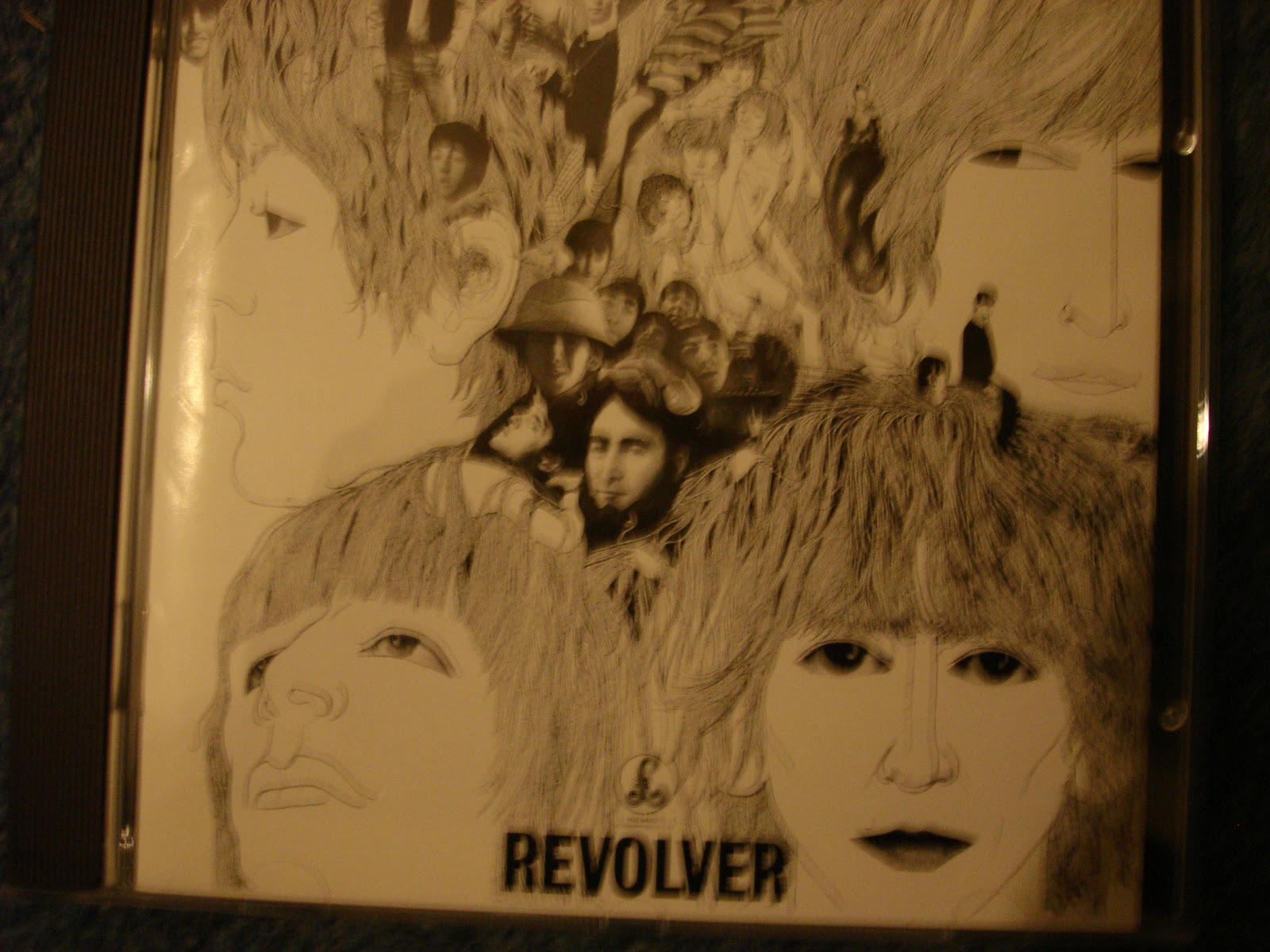
Revolver - The Beatles - album review

Of all the albums recorded by The Beatles, perhaps none more epitomised the Swinging Sixties than Revolver, released in 1966.  Embodying some of the sunny optimism of the time, but also exuding a sophistication and a keener affinity with counter-cultural concerns.

This record was made when The Beatles were still a touring band, before their retreat into a more reclusive and studio-bound existence. Although some of the tracks on Revolver are very much studio creations, others very much inhabit guitar-band territory, with added "attitude" and occasionally tinged with a nascent psychedelia.  One can discern the influence of 1966-era Beatles guitar-orientated material in the New Wave groups of the late 1970s and early 1980s, and even in later indie bands.

Having said that Revolver exudes the vibrancy of its era, it is also worth noting that the scope of its lyrical concerns was very broad, encompassing more social commentary than before, and containing many references to emergent underground culture. The Beatles were by no means unique in exploring virgin subject matter, but the sheer variety of the topics on Revolver is remarkable. Death, taxes, loneliness, consciousness, war and mind-altering substances - they are all there.


It is often said that the complementary strengths and approaches of Lennon and McCartney were some of the ingredients which made the Beatles special.  However on Revolver such simplistic pigeon-holing is not really applicable, as both men are in creative and restless form.  It cannot be smugly declared that one songwriter's contributions are edgy and subversive, whilst the other's are more conservative.  The fact that both rise to the occasion, and push themselves, helps give the album additional depth and sweep.

The record's closing track, "Tomorrow Never Knows" doesn't so much close the book on one era, as open a door and peer into an exciting but unpredictable future.  I would argue that the song has been excessively acclaimed in purely musical terms, but symbolically, and as a statement of intent, its effect was startling, probably more so on their peers and the "in crowd" than on Joe Public.

The continued blossoming of George Harrison added another dimension.  His often contradictory concerns were being projected with greater clarity, as exemplified by "Taxman" and "Love You To", and this greatly augmented the group's eclecticism and mystique.  This was the stage at which George truly advanced from being a mere guitar player to something much more integral.


Many of the songs on Revolver are pervaded by a peculiar, almost sleepy and indolent, ambience, which sets it apart from the warm crispness of Rubber Soul and the flawless perfectionism of "Sgt Pepper". Production techniques may have played a part, but there could have been other contributory factors.

There were sign-posts for the future, with unconventional instrumentation and studio experimentation, but The Beatles never lost sight of the fundamental importance of good songwriting and craftsmanship, and these sensibilities are on full display on tracks such as "Got To Get You Into My Life", "For No One" and "Here, There and Everywhere".

Listening to the record, I am also reminded of the apparent effortlessness with which this album was turned out. On other Beatles albums, for all their undoubted quality and charm, one can sense how hard they were trying.  On Revolver, very little feels "forced" or calculating.  It was as if creativity and ideas were flowing naturally from the musicians, with no need for gimmicks or pretension.

Revolver represents a peak of sorts.  Other artists would have sensed that they had nothing further to say, but time would amply demonstrate that The Beatles were in many respects only just beginning....


Wednesday, 3 October 2012

Abbey Road - The Beatles - album review

By the time that recording sessions commenced for the Abbey Road album in 1969, the writing was on the wall as far as any future for the Beatles as a continuing entity was concerned.  It is therefore common for the work released later that year to be lauded as a fitting and poignant parting shot (Let It Be was released later, but most of it was recorded in the early months of 1969).  So, from the perspective of over four decades later, were the plaudits truly warranted, or just a case of respectful wishful thinking?

A "bittersweet" but defiant quality runs through Abbey Road, although whether this has been accrued with the passing of time is open to debate.  I am in no real position to adjudicate, as the album was released shortly before I was born!

Certain aspects make this LP stand out from other albums released by the Fab Four.  The production and sound quality are markedly more lavish and "polished" than their other works.  They were now gaining access to more advanced recording technology.  Whether this makes the album sound "better" is a matter of taste, and the sheen possessed by these recordings could give rise to an accusation that the sound is a touch clinical. In fairness to the Beatles, they did not hide behind their newly acquired gizmos and equipment, and instead relied primarily on their trademark melodic inventiveness and imagination and songwriting prowess.


The album also witnessed the true flowering of George Harrison as a songwriter, and his two songs, "Something" and "Here Comes The Sun", have been the most enduring of the tracks on the listing. The clarity and sincerity of Harrison's writing here contrasts with the contributions of both Lennon and McCartney which, whilst substantial and important to the album's overall appeal, are beginning to diverge and possibly presage their respective solo careers to come.

Notwithstanding the reverence expressed for Abbey Road, there is some undoubted filler, although this being the Beatles it is interesting and entertaining filler!  It is a moot point whether the group members were holding some stronger material back for impending solo projects.  We know from the Anthology 3 album that some impressive songs were floating around circa 1969.

Even much of the fabled "medley" on side 2 of the vinyl album could justly described as "filler", but the group, and in particular McCartney and George Martin, expertly pull together this mixture of minor gems, vignettes and fragments, and fuse it into something vibrant, moving and enthralling.  A case of the whole being greater than the sum of the individual parts...

Partly because of the efficacy of the "medley", and also because of the diversity and quality of the other material, Abbey Road works better as an "album" in the truest sense than most of the Beatles' other work. Not quite as enigmatic and disparate as "The White Album", but much warmer and compact.  The musical ingenuity conquers all, together with the group's uncanny knack of knowing what to do, when and how, rarely if ever sounding self-indulgent or pretentious.

Abbey Road represents a brave, unapologetic and proud farewell, if it can be accurately described as a "farewell".  Bittersweet in tone, but captivating and, and one of those albums which demands to be listened to      from start to finish, in order for the full effect to be absorbed.  For this listener at least, there is never the temptation to skip tracks...

Throughout the record, there are hints and indications of what direction the Beatles would have travelled in musically, had they remained together during the 1970s.  Multi-tracked vocals and guitars, increasing use of synthesizers, more elaborate and ambitious arrangements, and of course the blossoming input of George Harrison.

On a sonic level, Ringo Starr's drumming is a revelation, sounding confident, idiosyncratic and "three dimensional".  Another hallmark of the album is the "trebly" and chiming guitar sound.  Both of these elements were doubtless accentuated by the better recording technology at the band's disposal, but as common threads they help to hold the record together.

I try not to categorise or rank Beatles albums in particular, because of the leap in musical sophistication and philosophical outlook which they made in such a short time during the 1960s, but Abbey Road is without doubt one of their most enjoyable and cohesive creations.

Tuesday, 3 January 2012

The White Album - The Beatles - album review

Between the end of 1967 and the early months of 1968, the Beatles underwent some changes, and it can be argued that this period represented a watershed in their career.

They began 1968 by recording the single "Lady Madonna", and then decamped to a spiritual retreat in India.  Meanwhile, plans were being laid for the the formation of the Apple company.

Both during the sojourn in India, and in the immediate aftermath, the band members composed lots of new songs, and many of these found their way onto the eponymous double album more commonly referred to as The White Album.


The recording sessions for this work revealed the first hairline cracks in the Beatles facade, cracks which gradually developed into fissures. However, for me The Beatles is one of the most fascinating, if enigmatic, areas of the group's catalogue.

Many rock historians have interpreted the content and atmosphere of The White Album as a retreat from the psychedelic excesses of the previous two years, a trend also reflected by the Rolling Stones' Beggars Banquet, and the output of the likes of Bob Dylan, The Byrds and The Band around the same time. Many of the songs have an acoustic, rustic feel to them, and this is also a product of the circumstances under which they were written in India.

In addition to the stripped down nature of some of the numbers, there are also signs of a return to the band's rock n roll roots on "Back in the USSR", "Birthday" and "Everybody's Got Something to Hide Except Me and My Monkey".  Notwithstanding this general return to a simpler and rootsier sound, the experimental was not totally abandoned, as evidenced by some of the contributions of John Lennon, notably "Revolution 9".

I see The White Album as one of the crucial stepping stones in the transition from "pop" to "serious" rock music. That said, the lyrical content of the tracks on this album varies from the esoteric ("Happiness Is A Warm Gun") to the downright banal ("Rocky Raccoon").  The eclecticism is a large part of the LP's charm, and I think that those who said that a condensed single album would have been a better option are missing the point.  The vignettes and fragments are the glue which hold things together.

Underlying many of the songs is a certain darkness,menace, ennui even; symptomatic perhaps of the tensions within the Beatles, and also of the social and political climate which was prevalent in 1968. Largely absent is the ebullience and levity of Sgt. Pepper and Magical Mystery Tour. Rarely has an album been as apposite and illustrative of its times as The White Album.  Its tenor seemed to be in tune with the then nascent counter-culture.

The internal group dynamics are also worth discussing.  After Paul McCartney's pre-eminence through most of the 1967 recordings, John Lennon's re-asserts himself as a songwriter on this double album, and his contributions are arguably the most substantial.  The continuing emergence of George Harrison's writing and performing prowess is a also a central feature.

Whilst The Beatles is an "album" in the truest sense of the word, this does not mean that there are not highlights.  "Dear Prudence", with its pastoral and joyous air, is one of the hidden gems in the Beatles' oeuvre, and features Paul McCartney on drums, after Ringo Starr temporarily left the group.

"Martha My Dear", although lyrically less than profound, is wonderfully tuneful, and appears to have influenced the Electric Light Orchestra melodically. 

"While My Guitar Gently Weeps" was one of Harrison's most substantial efforts to date, although the spine-tingling acoustic "demo" version is superior.

The White Album is not as instantly likeable as the Beatles' previous releases, or even what was to follow, but it is essential to an understanding of the group's artistic progression, and  the musical, social and cultural landscape of 1968.


Tuesday, 15 November 2011

The Band

It is rare for a group to make definitive musical statements with its first two albums, let alone produce two works which have such a profound effect on the musical landscape. However, this was achieved by The Band, the Canadian-American combo which until then had been best known as Bob Dylan's some-time backing band.


Music From Big Pink and The Band, released in 1968 and 1969 respectively, were instrumental (if you'll pardon the pun) in rock music's shift in a more rootsy direction, and away from the extravagance of the psychedelic and heavy music which had begun to dominate. Much of the rock aristrocracy, including Eric Clapton and George Harrison, was inspired by The Band, not only because of their sound, but because of the sense of community which their music seemed to encapsulate.

I was initially resistant to The Band, probably because they were praised by rock critics whose taste and judgement I did not always trust. However, interest in other exponents of "roots" rock eventually led me to purchase those first two albums, and I became a fan for life.

One of the first things which is immediately noticeable when listening to Music from Big Pink is an exuberance and impishness, which suggests that the musicians were having great fun recording these songs! 

In an era when individual virtuosity and showmanship were becoming ever more important, The Band were at pains to ensure where possible that efforts were subsumed into concise and organic song structures, while still allowing space for the individual contributions to breathe. This was possible because of the even distribution of talent within the group. The soulful vocals of Richard Manuel and Levon Helm, and the keyboard wizardry of Garth Hudson were central to the group's appeal, but were never permitted to dominate or marginalise other elements.

Another remarkable thing about The Band is how they combined and mixed various musical influences into their own unique style. Many of their songs contained elements of blues,R&B,country, and folk, but few of the tracks in their catalogue can be pigeon-holed as typifying any particular genre.

Of the two, I probably marginally prefer Music From Big Pink because of its greater spontaneity, but I know that many fans treat the two LPs as in effect one double-album. The "brown album" exudes more polish. Robbie Robertson, in particular, appears to have gone through a remarkably fertile period of songwriting productivity.

When examining two albums of such sustained and consistent quality, it is difficult, and even churlish, to pick out highlights.  However, Manuel's vocal on "Tears of Rage" never fails to send a shiver down the spine, and the tuneful opening bars of "Across The Great Divide" exemplify everything that was great about The Band. The versions of the "Basement Tapes" songs on the first album are pretty much definitive.

And the lyrical content of these songs also differed from those of the majority of The Band's contemporaries, delving as they did into historical themes, and featuring some offbeat humour. It was as if they were instinctively rebelling against some of the more outlandish pretensions then prevalent on the rock scene.

The rustic and rootsy flavour of the material was also enhanced by the distinctive, and sometimes intentionally ragged, vocal interplay between Helm, Manuel and Rick Danko.  When other artists were aiming for more and more pristine multi-tracked harmonies, The Band allowed the diverse talents of their singers to shine through. In addition, they were not scared of employing unusual instruments for a rock setting, and the members themselves sometimes switched between instruments.  The Band were a "band" in the truest sense of the word....

Perhaps inevitably, The Band were not quite able to maintain the stunning standard of their first two albums on subsequent works. Although their craftsmanship and talent remained intact, reproducing the magic of 1968/69 proved elusive.

The Band's place in rock history was assured by their work at the close of the 1960s.  This was not just because of the quality and charm of the music, but because they caused a generation of musicians to take stock, and consider whether things could be done differently.

Music From Big Pink and The Band have stood the test of time, and sound as fresh and as ebullient as they must have done over four decades ago.

Listen to the keyboard-drenched introduction to "We Can Talk", and you'll see what I mean....